
Keyword Tool API review
Best multi-platform keyword discovery
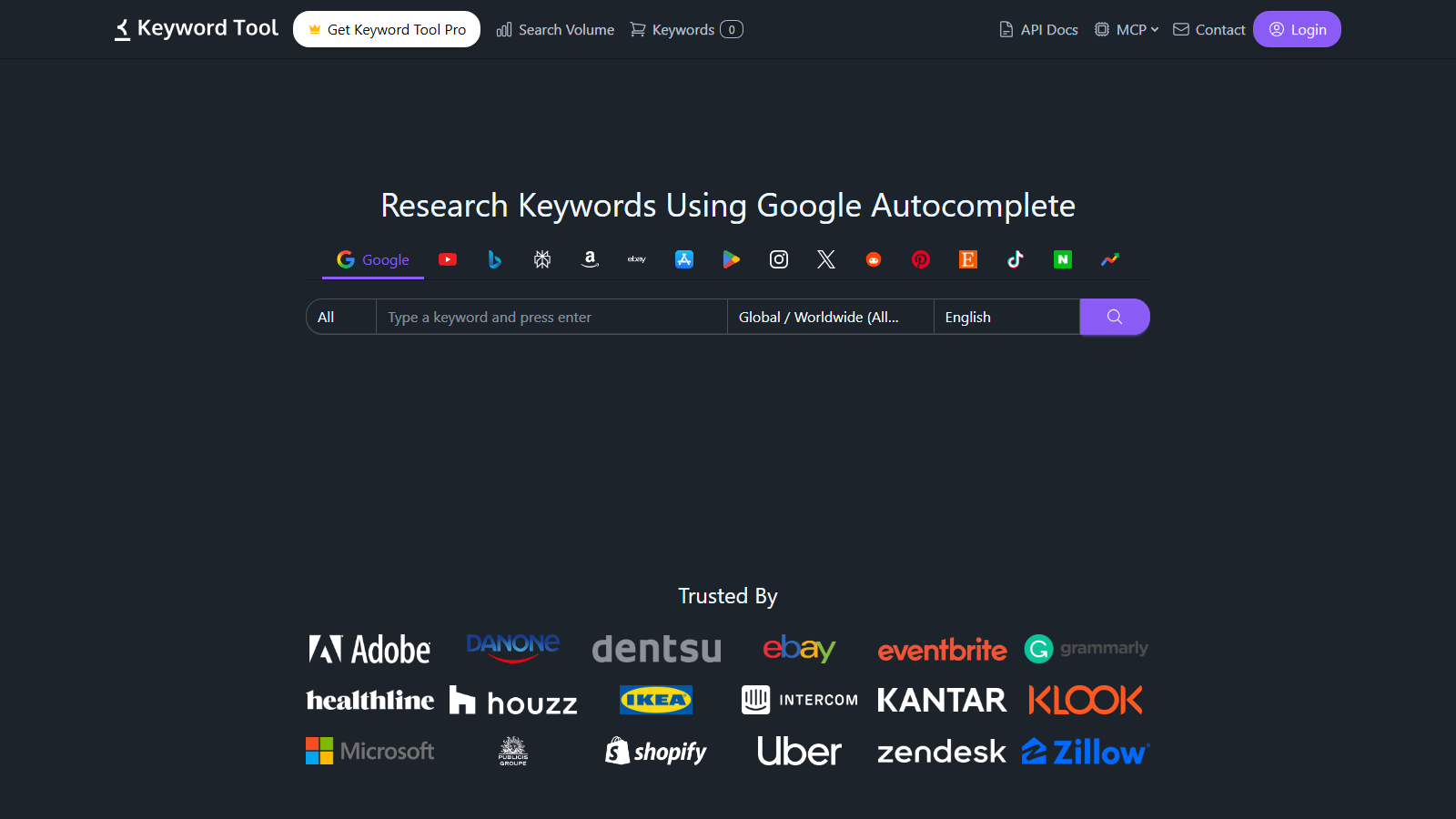
Keyword Tool is keywordtool.io, an independent keyword research product whose API returns what its web app shows. Suggestions come from the autocomplete of 16 platforms, from Google and YouTube to TikTok, Etsy, Naver and both app stores. Google and Bing volume is, by the vendor's account, sourced directly from the two ad platforms' keyword planners, and 13 further platforms get modelled estimates.
Before comparing it with any other keyword research API, learn its unit. Plans are sold as requests per rolling 24 hours, 50 on Starter and 400 on Agency, and every call spends one whatever it holds. A volume call can hold 1,000 keywords; a suggestion call takes one seed. So Starter enriches 50,000 keywords a day or explores 50 seeds, and the web app and MCP share that pool.
How you pay changed as well. The Pro Basic, Pro Plus and Pro Business ladder has gone, and the API is no longer a separate purchase. Starter at $88 a month, Growth at $188, Scale at $388 and Agency at $788 each include the web interface, the API and an official MCP server. The older API-only tiers survive only as legacy entries in the API specification.
Our scorecard
Our editorial read across six dimensions, scored 1 to 5. This is our own assessment, not an aggregate of user reviews, and it is deliberately kept out of the page's structured data.
- Data coverage4/5
Sixteen platforms for suggestions and fifteen for volume. No SERP, ranking or backlink data of any kind.
- Pricing3/5
Competitive for bulk enrichment at 1,000 keywords a call. Expensive for discovery at one seed a call.
- Documentation4/5
Public OpenAPI 3.1 file, a Markdown copy and a full error table. The transport throttle is documented only in the spec.
- Ease of integration4/5
One POST per call, the provider as a path slug, JSON or XML back, and a sandbox base for testing.
- Reliability3/5
On-demand retrieval can return partial results. They are flagged and not charged, but your code must retry.
- Support3/5
A contact route and a demo request for custom limits. No SLA published for the self-serve plans.
An editorial read, not an aggregate of user reviews, and deliberately kept out of this page's structured data.
Keyword Tool API in their own words
From Keyword Tool API's own YouTube channel. Vendor marketing rather than an independent review, included because it is the quickest way to see the product before you sign up.
What you can pull
Search volume: Google and Bing
1 request per call, whatever the keyword count
Planner-sourced monthly volume for 1 to 1,000 keywords, with monthly history (Google 12 to 48 months by plan, Bing up to 24), CPC, top-of-page bid range, competition and a device breakdown
Search volume: 13 other platforms
1 request per call
Clickstream-modelled volume and 12 months of history for YouTube, Perplexity, Amazon, eBay, App Store, Play Store, Instagram, X, Reddit, Pinterest, Etsy, TikTok and Naver
Keyword suggestions
1 request per seed
Autocomplete ideas for one seed across 16 platforms, as suggestions, related, questions or prepositions where supported, plus Reddit communities and profiles, with metrics attached on request
Analyze Competitors
1 request per URL
The keywords Google associates with one URL, with volume, CPC, top-of-page bids and competition. Google only
Quota
GET with the API key
Remaining per-minute and daily request buckets on the current plans, so a batch can check before it starts
Sandbox base
No production quota
The same contract under /v2-sandbox for suggestions, volume and competitors. Successful sandbox calls do not consume production quota
MCP server
Spends the same daily pool
Four tools (suggestions, search volume, Analyze Competitors, quota) for Claude, ChatGPT, Cursor and other MCP clients, authorised by OAuth. Google and Bing only for now
Who Keyword Tool API is for
Teams that already hold a keyword list and need volume, CPC and trend against it in bulk, and teams whose customers search somewhere other than Google. A content team sizing thousands of candidate phrases suits the 1,000-per-call volume endpoint well, and an ecommerce or app team gets Amazon, Etsy, App Store and Play Store ideas from the same integration it uses for Google.
Look elsewhere if the job is discovery at volume through code. Fifty seeds a day on Starter is a research session rather than a pipeline, and anyone logged into the web app spends from the same allowance. It also returns no rankings, SERPs or links, so it sits beside a broader SEO keyword API rather than replacing one.
Strengths and limits
What it does well
- One volume request carries up to 1,000 keywords, so a single Starter day covers 50,000 keywords of volume, CPC and competition.
- Suggestions from 16 platforms, including TikTok, Etsy, Reddit, Naver, Perplexity and both app stores, through one URL pattern where only the provider slug changes.
- Google and Bing volume that the vendor sources from the two ad platforms' own keyword planners, with up to 48 months of monthly history on Scale and Agency.
- The API and an official MCP server come with every plan, so there is no second subscription to price.
- A public OpenAPI 3.1 file and a Markdown copy of the docs, which makes generated clients and AI-assisted integration straightforward.
- Partial results are flagged with code 10 and are not counted against quota, so retrying the failed keywords costs nothing.
- A sandbox base with an identical contract whose successful calls leave production quota untouched.
Where it falls short
- The daily pool is counted in requests and shared across the web app, API and MCP, so a colleague's research session spends the pipeline's budget.
- A suggestion request takes one seed, which makes programmatic discovery expensive: Starter allows 50 seeds in any 24 hours.
- Every self-serve plan, including the $788 Agency plan, caps the API at 15 requests a minute.
- Plan quota exhaustion returns HTTP 404 with an error code rather than 429, so generic retry middleware will misread it as a bad URL.
- Volume for the 13 non-planner platforms is modelled from clickstream data and stops at 12 months of history.
- Responses can group close variants, with close_variants_source naming the keyword the metrics came from, so near-identical phrases may share a single figure.
- No free trial. The refund window is 30 days, but you pay before you can test against production.
Keyword Tool API pricing
Four self-serve plans, each with the web interface, the API and MCP. Starter is $88 a month or $68 a month billed annually, Growth $188 or $148, Scale $388 or $308, and Agency $788 or $628. Euro prices use the same numbers. Above Agency there is a custom quote for higher daily and per-minute limits.
Price it per keyword only for the endpoint you will actually call. If every Starter request were a full 1,000-keyword volume call, a 30-day month would be 1.5 million keywords for $88, about $0.06 per thousand, which matches DataForSEO's Standard-queue rate of $0.06 per task of up to 1,000. If every request were a suggestion call, the same month would be 1,500 seeds.
The Pro Basic, Pro Plus and Pro Business plans are no longer on the pricing page, and the old keywordtool.io/pricing address returns a 404. The API specification still names legacy API-only tiers (API Lite, Basic and Plus v2) and a grandfathered Pro Business v2 at 50 requests a day, but publishes no price for any of them and the site does not sell them.
Buying is the only way to test against production. The terms allow a refund within 30 days of purchase, and subscriptions renew automatically at the end of each billing cycle, so cancel before renewal if the request model does not suit your workload.
Starter
$88 / mo
$68 a month billed annually
- 50 requests per rolling 24 hours
- Up to 50,000 keywords a day through volume calls
- 12 months of volume history
- Web, API and MCP share the one pool
Growth / Scale
$188 / $388 per mo
$148 and $308 billed annually
- 100 and 200 requests a day
- Up to 100,000 and 200,000 keywords a day
- 24 months of history on Growth, 48 on Scale
- Still 15 API requests a minute
Agency / Custom
$788 / mo or quote
$628 a month billed annually
- 400 requests a day, up to 400,000 keywords
- 48 months of volume history
- Custom daily and per-minute limits by quote
- Bank transfer and procurement paperwork on custom
Request example
A minimal call against the live endpoint, with credentials read from the environment rather than pasted inline.
curl -s -X POST "https://api.keywordtool.io/v2/search/volume/google?apikey=$KEYWORDTOOL_API_KEY" \
  -H "Content-Type: application/json" \
  -d '{
        "keyword": ["crm software", "crm for small business", "free crm"],
        "metrics_location": [2840],
        "metrics_language": ["en"],
        "metrics_network": "googlesearch",
        "metrics_currency": "USD",
        "output": "json"
      }'

# This call costs ONE request from the daily pool whether the array
# holds 3 keywords or 1,000, so fill it. A suggestions call takes a
# single seed and costs the same one request.
#
# Check what is left before a batch:
curl -s "https://api.keywordtool.io/v2/quota?apikey=$KEYWORDTOOL_API_KEY"

# Running out of plan quota returns HTTP 404 with error code 9 (daily)
# or 7 (per minute), not 429. Branch on the code, not the status.
Rate limits and quotas
- Requests per rolling 24 hours: Starter 50, Growth 100, Scale 200, Agency 400, shared across web, API and MCP.
- API burst limit: 15 requests per rolling minute on all four plans.
- Transport throttle: 120 requests a minute per endpoint group per account, applied regardless of plan or response code.
- Search volume: 1 to 1,000 keywords per request, one location and one language per request.
- Keyword suggestions: one seed per request, with up to 2,000 negative keywords.
- A keyword may not exceed 80 characters or 10 words.
- Volume history: Google 12 to 48 months by plan, Bing up to 24, all other platforms 12.
- Plan quota exhaustion returns HTTP 404 (code 9 daily, code 7 per minute). HTTP 429 is reserved for the transport throttle.
- Incomplete results return code 10 with HTTP 200 and are not counted against quota.
- MCP covers Google and Bing; the web interface and REST API cover all 16 platforms.
Third-party reviews
Scores read from each source on 2026-09-13. We report them as-is and publish no rating of our own.
Capterra rates Keyword Tool as a product, which in practice means the web interface rather than the API. The newest review we could see dates from January 2025, before the current plans.
What practitioners say on Reddit
Recent discussion of the API is thin, and the most useful thread shows the request model confusing buyers. In a 2023 r/TechSEO question, a developer ruled Keyword Tool out over a 50-requests-a-day limit, and a practitioner replied that the API ran to hundreds of thousands a day. Both had real numbers: the reply's figures fit the spec's legacy tiers of 100, 400 and 800 requests at 1,000 keywords each.
A second pattern is that accuracy varies by platform. A 2021 subscriber buying for Amazon data accepted the Google figures as planner-sourced but found the Amazon estimates far off. A 2023 buyer wanting one keyword's volume across 40 markets in a single call gave up because the API is structured by locale, and the documentation still allows one location per request.
Everything we found predates the current Starter to Agency plans and the MCP server, so read it as a record of where the model trips people up rather than as a verdict on today's product.
“50 API Requests Per Day for their most expensive plan is a deal breaker, it needs to be in the thousands at least.”
r/TechSEO on Reddit“You can run thousands of requests for search volume data against the keywordtool.io API. Why do you think you can only do 50 per day?”
r/TechSEO on Reddit“Thanks, I understand their Google data comes through Keyword Planner and it's reliable. However, it sounds like their data for other platforms such as Amazon isn't accurate.”
r/marketing on Reddit“thanks checked them out; but api is structured exclusively by locale.”
r/TechSEO on Reddit
Verdict
Buy Keyword Tool for the breadth nothing else in this directory matches: autocomplete ideas from TikTok, Etsy, Reddit, Naver and both app stores through one API, with Google and Bing volume attached. For research that has to cover where people search beyond Google, assembling that any other way means several vendors and several integrations.
Model the workload in requests before committing. As an enrichment engine it is fairly priced, because each call carries 1,000 keywords and a fully used Starter month lands near DataForSEO's per-thousand volume rate. As a discovery engine it is tight, because each call carries one seed, and a teammate in the web app spends the same allowance.
Choose the plan on daily requests and months of history, since every plan has every platform, the API and MCP. The per-minute ceiling of 15 does not move between Starter and Agency, so a job that needs more speed than that needs a custom quote rather than an upgrade.
Keyword Tool API FAQ
How much does the Keyword Tool API cost?
It comes with every plan rather than as a separate product. Starter is $88 a month ($68 billed annually), Growth $188 ($148), Scale $388 ($308) and Agency $788 ($628). All four include the web interface, the API and MCP, and limits above Agency are quoted individually.What counts as one request?
Any suggestion, volume or competitor call, whatever its size. A volume request can hold 1,000 keywords while a suggestion request holds one seed, yet each spends one from the daily pool, and that pool is shared with the web app and MCP. Calls that return partial results with code 10 are not counted.Is it a keyword suggestion API or a search volume API?
Both, plus a third job. Suggestions come from autocomplete on 16 platforms. Volume covers Google and Bing from their keyword planners and 13 more platforms by estimate. Analyze Competitors returns the keywords Google associates with a URL you supply.Is this Google's keyword tool API?
No. Keyword Tool is keywordtool.io, an independent business registered in Hong Kong and the UAE, with no connection to Google. Google's own planner data is reached through the Keyword Planning services of the Google Ads API, which Google rate limits more tightly than its other services. Keyword Tool returns planner-sourced volume, by its own account, without you building that integration.What are the Keyword Tool API rate limits?
Two layers apply. Plans cap requests at 50, 100, 200 or 400 per rolling 24 hours and API calls at 15 a minute. A separate transport throttle allows 120 requests a minute per endpoint group per account. Exhausting a plan quota returns a 404 with code 9 or 7, while 429 is reserved for the throttle.Which platforms does it cover?
Sixteen for suggestions: Google, YouTube, Bing, Perplexity, Amazon, eBay, App Store, Play Store, Instagram, X, Reddit, Pinterest, Etsy, TikTok, Naver and Google Trends. Volume covers the same list without Google Trends. The MCP server currently exposes Google and Bing only.How accurate is the search volume?
Accuracy varies by platform. Google and Bing figures are, per the vendor, taken from the two keyword planners, so planner behaviour comes with them: responses can group close variants under one number. The other 13 platforms are clickstream estimates with 12 months of history, better for ranking ideas against each other than for forecasting traffic.Does Keyword Tool have a free trial?
Not for the paid product. Each plan carries a 30-day money-back guarantee instead, and a sandbox base lets you test integration code without spending production quota. A free Guest MCP needs no signup but is limited to Google and Bing suggestions, with volume and trend on the first five keywords.
Other providers worth a look
This is an independent review. We have no affiliate relationship with Keyword Tool API, earn nothing if you sign up, and no provider pays for placement in the directory. Prices were read from the vendor's own pages in September 2026 and change without notice.