Patients search trademarked treatment names, not clinical ones
Written by Eugene Suslov·Last reviewed 29 August 2026·No affiliate links
Sector
Health and medical
Model
Local service, Multi-location
Competition
Brutal
Time to results
4 to 8 months
Typical monthly
$2,500 to $9,000
Key takeaways
1The queries worth having are registered trademarks belonging to somebody else. Build a page per treatment brand you genuinely offer and stop optimising for the clinical noun nobody types.
2The manufacturers run the provider locators that sit above you, and placement is bought with purchase volume and loyalty tier rather than earned with content. Treat that as a channel with a cost, not as a perk.
3A cash-pay med spa is frequently not a HIPAA covered entity, which means the health privacy rule most people quote does not reach it. The FTC's Health Breach Notification Rule does.
4Before-and-after photographs are regulated advertising in several states, down to the pose and the lighting. The gallery is the highest-converting asset on the site and the one most likely to be non-compliant.
5Groupon and the national chains own the discount query and you cannot win it on price. Win it on who is holding the needle, because that is the actual question behind the search.
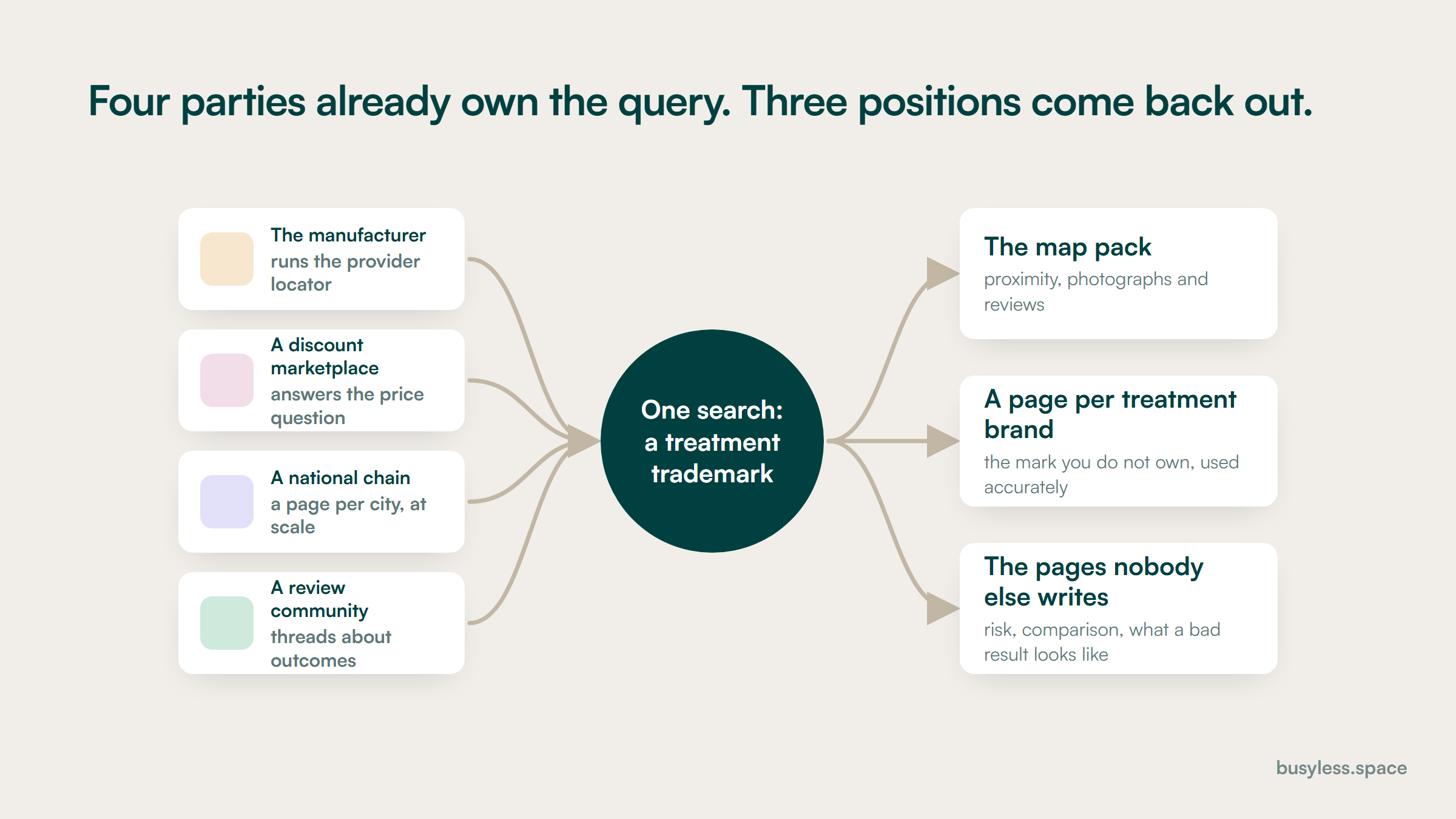
SEO for medical spas begins from an awkward fact. Almost every query worth having in this market is a registered trademark belonging to a pharmaceutical or device company, and you are competing for it against the company that owns it.
Nobody searches for onabotulinumtoxinA, and very few people search for cryolipolysis or for radiofrequency microneedling. They search Botox, CoolSculpting and Morpheus8. The clinical vocabulary carries almost no demand, and the vocabulary that does carry demand belongs to somebody else.
That single fact reorganises everything. A medical spa SEO strategy is built around a treatment-brand page set rather than a service page set, and the competitive analysis has to include the trademark holder, because the trademark holder is on the results page.
Allergan runs a provider locator that routes patients to participating injectors, and it sits inside the same loyalty programme those patients use to earn points on their treatments. Entry is a function of what you buy and which tier you reach, not of what you publish.
So one of your most valuable acquisition channels is priced in vials. Say that plainly to anybody planning a budget, because it is a real cost with a real return and it appears on no marketing line item anywhere in the business.
Underneath all of it sits the thing patients are actually deciding. They are choosing a person to inject a prescription drug into their face, and the whole of the trust problem lives there rather than in the treatment description.
Who already ranks in medical spa
Run your three highest-value treatment queries with a city attached and look at what comes back before you plan anything. Nearly every medical spa SEO audit turns up the same five layers, and only one of them is a clinic like yours: the map pack, a discount marketplace, a national chain with a page per city, a review platform, and the manufacturer's own locator.
What is on the results page
Local pack on every treatment plus city query, which is where most of the clicks go
Groupon and discount marketplaces ranking on the treatment term itself
National chains with a page per treatment per city, built at scale
Manufacturer locators and brand sites, which own the trademark you are targeting
Review and community platforms carrying question threads about outcomes
Image results on before-and-after and result queries
People Also Ask, dense on pain, downtime, cost per unit and safety
Manufacturer provider locators
alle.comClaim it
The one gatekeeper with no equivalent in any other industry here. Allergan's locator routes patients to participating injectors and sits inside the loyalty programme those patients already use. Presence and prominence follow purchasing and tier status, so this is a channel bought with product rather than with content. Find out exactly which locators your suppliers run and what places you on them.
Groupon
groupon.comClaim it
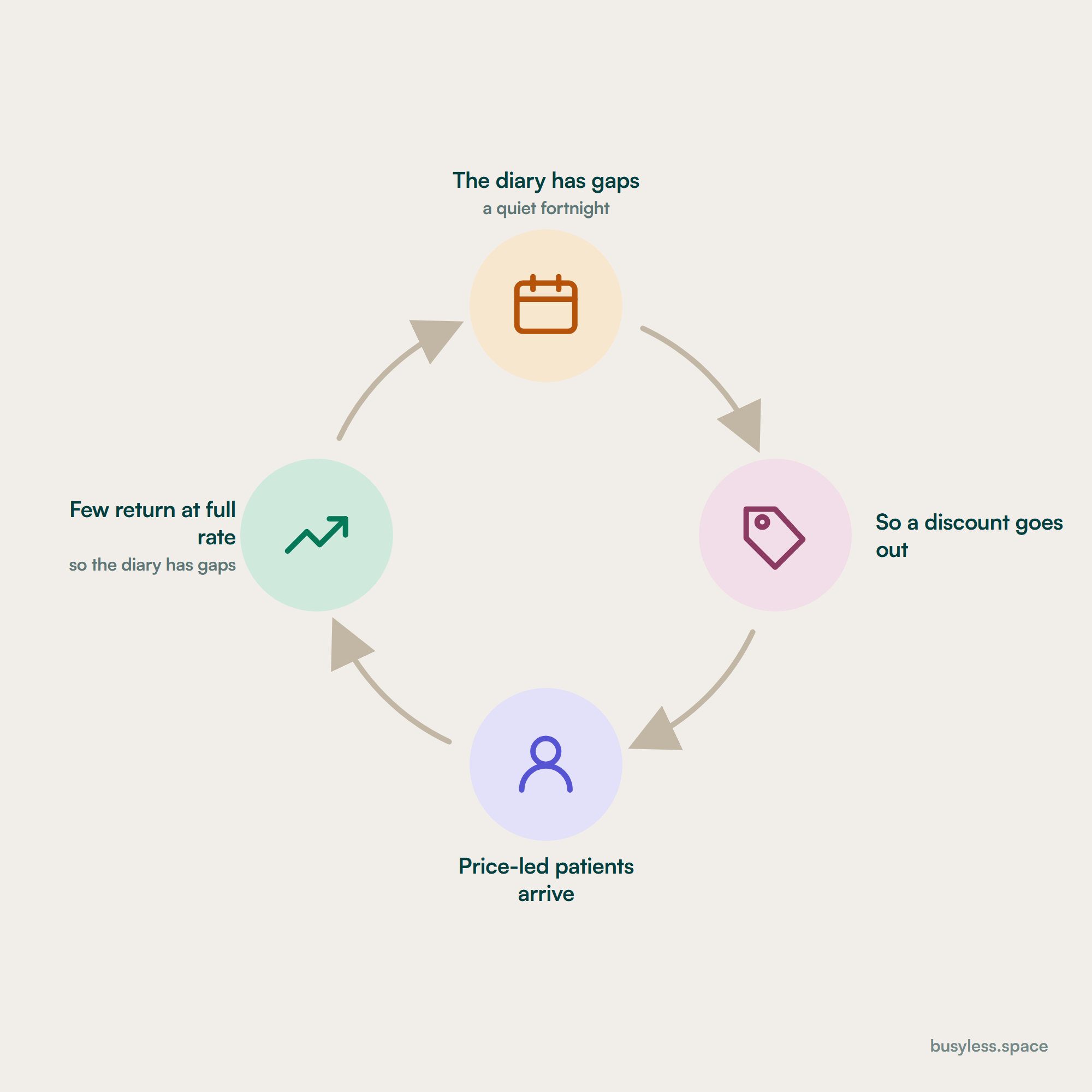
Ranks directly on treatment plus city queries and trains a price-led audience. It fills quiet chairs and it also fills them with people comparing unit prices, who rarely return at full rate. If you use it, use it for a treatment you want people to try once, never for the treatment your business depends on.
National aesthetic chains
laseraway.com
They publish a page per treatment per location and can afford to. You will not out-publish them, and you do not need to. Their pages are generic by construction, so the winnable ground is the specific injector, the specific room, the specific result and the honest answer about who a treatment does not suit.
Review and outcome communities
realself.comClaim it
Question and answer threads about outcomes rank persistently, because they are the only content on the results page that admits a treatment can go wrong. A complete profile with real answers is worth having. Answering the awkward questions honestly is what actually gets read.
Google Business Profile
google.comClaim it
The single biggest lever, and in this category the photographs do most of the work. Set services rather than leaving the category to describe you, keep the booking link pointed somewhere you control, and treat review responses as public writing, because they are read by people who have not called yet.
Yelp and the general local directories
yelp.comClaim it
Still ranks in many metros for aesthetics and feeds Apple Maps. Worth claiming and keeping accurate. Not worth paying for placement in a category where the deciding factor is the injector rather than the listing.
Device manufacturer find-a-provider pages
inmode.comClaim it
Every device you have bought probably comes with a locator, and most clinics never complete the listing. It is a free citation from an authoritative domain, it reaches somebody who has already decided on the technology, and it takes twenty minutes per device.
The only one of the four you can influence with a purchase order is the first.
What people actually search
Aesthetic search splits into a trademark cluster carrying almost all the volume, a concern cluster where people describe the problem in their own words, and a fear cluster nobody in the industry wants to write for. The third one converts.
Treatment brand plus location
Local commercial
> botox [city]
The page that wins it:A page per treatment brand you genuinely offer
The bulk of the volume, and it is somebody else's mark. Use the trademark accurately to describe a treatment you provide, keep the manufacturer's own claims out of it, and let the page be about your delivery of it.
Concern in the patient's words
Informational
> how to get rid of a double chin
The page that wins it:A concern page mapping the problem to the options, including doing nothing
The upstream cluster and the one worth owning. People describe the problem long before they know the product name, and the page that names all the routes is the page they trust when they pick one.
Price and units
Commercial investigation
> how much is botox per unit
The page that wins it:A pricing page with real ranges and an explanation of how units work
Enormous volume, contested by discount marketplaces, and usually answered with a consultation form. Publishing a range with the reasoning attached takes you out of the price comparison rather than into it.
Comparison between products
Commercial investigation
> botox vs dysport
The page that wins it:An honest comparison written by the person who injects both
Two trademarks in one query, so the manufacturers cannot write it without a conflict. A clinic that carries both can, and that is a structural advantage almost nobody uses.
Aftercare and downtime
Informational
> what not to do after botox
The page that wins it:Aftercare pages written for your own patients
High volume, mostly people already treated somewhere. It builds the entity, it reduces your own phone calls, and it reaches the people quietly looking for a better injector.
Fear and regret
Informational
> botox gone wrong
The page that wins it:An honest page on risks, reversal, and what a bad result looks like
Every clinic avoids this and every prospective patient reads it. Writing it well is the strongest trust signal available in this category, because it is the only page on your site that could cost you a booking.
Weight management
Local commercial
> semaglutide [city]
The page that wins it:A page that is very careful about what it claims
The fastest growing cluster and the most closely watched. The FDA has written to med spas about exactly this copy, so treat the page as a regulatory document that happens to rank.
Membership and packages
Transactional
> botox membership [city]
The page that wins it:A membership page with the terms written out
The retention mechanism in this industry, and the one query where you are not competing with a trademark holder. It is also a recurring contract, so publish the cancellation terms rather than burying them.
What the rules change
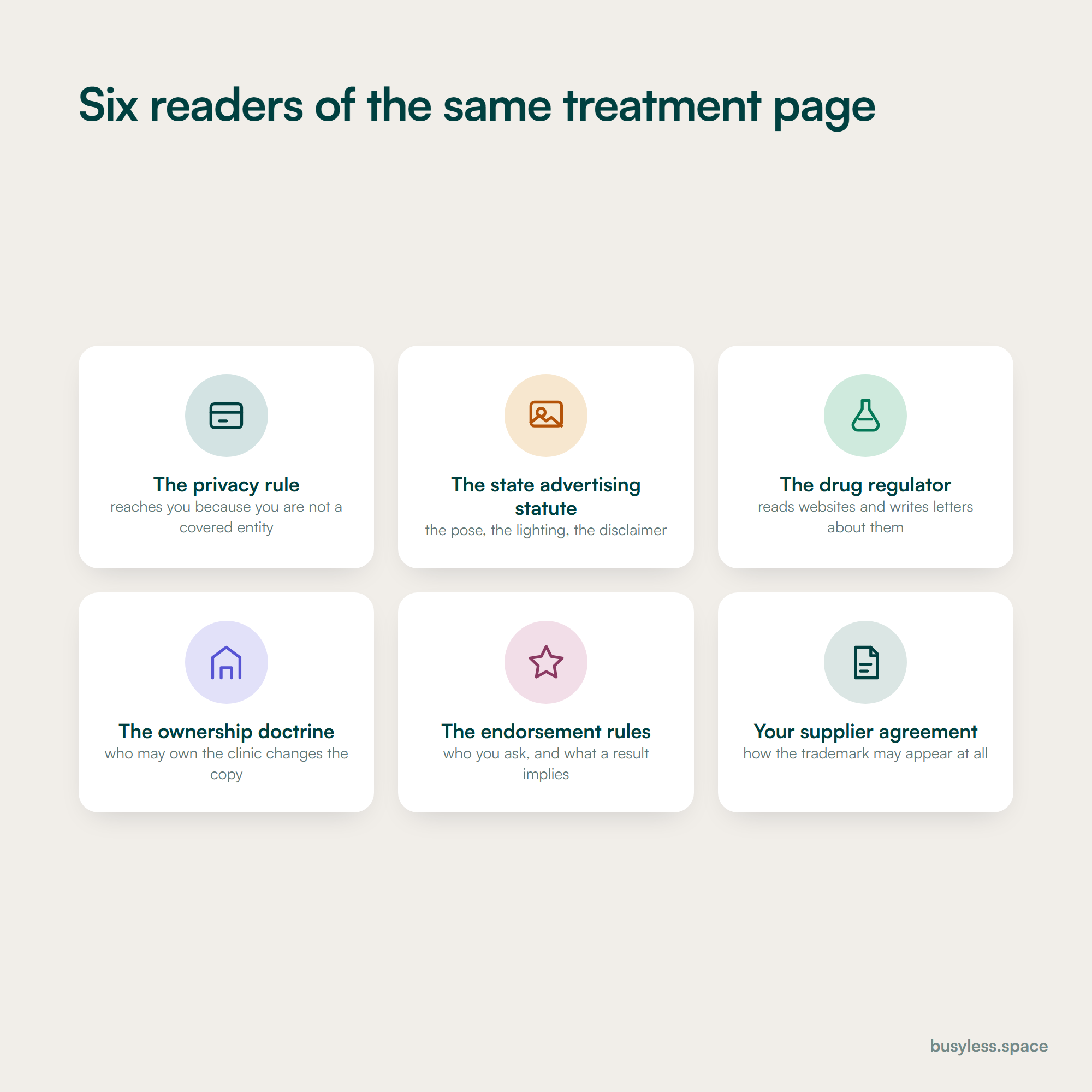
Regulated from four directions at once, and the combination is specific to this industry. An advertising statute in some states, a federal privacy rule that reaches you precisely because you are not a hospital, a drug regulator reading your website, and the ordinary law on testimonials. Check your own state and your own counsel; none of this is legal advice.
1
The privacy rule that catches you is the one for businesses that are not covered entities
Federal Trade Commission Health Breach Notification Rule, 16 CFR Part 318, as amended; the amendments took effect on 29 July 2024
What it means
A cash-pay med spa is frequently not a HIPAA covered entity, because it does not bill insurance electronically. The FTC rule reaches health businesses outside HIPAA, and the amended version makes clear that a breach includes an unauthorised disclosure, not only an intrusion. A voluntary disclosure counts, which is what a marketing pixel on a booking page is.
So do this
Inventory every tag on any page where a visitor names a treatment or books one, and remove the ones sending that information to an advertising platform. Move conversion tracking to a server-side event carrying no treatment detail. Then write down which of the two regimes you are actually in, because most operators have never checked.
2
Before-and-after photographs are regulated advertising, down to the lighting
California Business and Professions Code section 651, which governs advertising by healing arts licensees; other states have comparable provisions
What it means
Under the California statute an image that does not accurately depict the result, or that has been altered from the actual subject, is a violation. Before and after views have to be comparable, so results are not distorted by favourable poses or lighting. The procedures performed must be stated prominently and a model must be identified as a model. The set must carry a statement that the same results may not occur for all patients.
So do this
Standardise the capture: same camera, same distance, same light, same expression, no filter. Caption every pair with the procedures performed, the number of sessions and the interval. Put the not-typical statement on the gallery itself rather than in the footer, and check your own state's wording.
3
A drug regulator reads med spa websites
FDA warning letters to Cosmo Med Spa (715873) and Invigorate Med Spa (715872), both issued 9 September 2025, each written from a review of the practice's own website
What it means
Both letters followed a website review and cited false or misleading claims about compounded products, including copy presenting a compounded drug as though it were the FDA-approved one. Promoting a prescription drug for uses it has not been approved for is separately prohibited, however indirectly it is phrased.
So do this
Have somebody clinical read every treatment page against the approved indication and against what you actually stock. Never present a compounded preparation under a brand name it does not carry. Weight management pages are the highest-risk copy on the site and should be reviewed on a schedule rather than once.
4
Who may own the clinic changes what the advertising may say
The corporate practice of medicine doctrine, which is state law and varies substantially in strictness
What it means
In stricter states the entity providing medical services has to be physician-owned, and a non-physician owner cannot employ a physician to supervise. Advertising rules follow from that: some states treat the omission of the supervising physician from marketing material as misleading, and the words medical spa carry expectations about who is on site.
So do this
Name the medical director and the supervising physician on the site, with their licence details, and keep the page current when the arrangement changes. Confirm your ownership structure is lawful in your own state before you spend on scaling the marketing, because the fix is structural rather than editorial.
5
Testimonials and reviews carry federal rules of their own
FTC Guides Concerning the Use of Endorsements and Testimonials in Advertising, revised effective 26 July 2023, and the Rule on the Use of Consumer Reviews and Testimonials, 16 CFR Part 465, effective 21 October 2024
What it means
A testimonial describing a result is a performance claim and needs substantiation, and a result that is not typical has to be presented as such. The 2024 rule separately bans creating, buying or disseminating fake reviews, including ones written by staff or generated by a model, and reaches the suppression of negative reviews too.
So do this
Stop asking staff for reviews, stop incentivising them, and stop filtering which patients get the review request. Where a testimonial names an outcome, publish what a typical outcome looks like beside it. This is also the cheapest place to be honest, because patients in this category read reviews with unusual scepticism.
None of the six outranks the others, and only one of them will ever write to tell you it has read the page.
Proving expertise
The decision here is about a person, not a clinic. Somebody is choosing who will inject a prescription drug into their face, and almost everything that would answer that question is missing from a typical med spa website.
Every injector named, with licence type, licence number and the state that issued it
The medical director and supervising physician named, with their credentials
Training named specifically, including the product and the awarding body
How many years each injector has done the specific treatment, not aesthetics in general
Before-and-after sets attributed to the injector who performed them
The devices and products you actually stock, by name and manufacturer
An honest page on risks, contraindications and what happens if a result is poor
What you decline to treat, and why, which is the most persuasive thing on a med spa site
How to build a medical spa SEO strategy
Six months, in the order that produces revenue soonest. The first three weeks of this medical spa SEO strategy are almost entirely compliance and profile work, which is unglamorous and is also the part that stops the rest of it becoming a liability.
1
Weeks 1 to 3
Clear the liabilities and claim the locators
Audit every tag on treatment and booking pages, and remove the ones leaking treatment detail
Establish in writing whether you are a HIPAA covered entity or an FTC one
Complete the Google Business Profile with services set explicitly
Complete every manufacturer and device locator listing you are eligible for
Name the medical director, supervising physician and every injector with licence details
Audit the gallery against your state's advertising statute
You end up with A site that will survive a regulator reading it, and every free locator listing claimed
2
Weeks 3 to 8
Build the treatment brand page set
One page per treatment brand you genuinely offer, replacing the single injectables page
Publish real price ranges and explain how units and sessions work
Rebuild the before-and-after gallery as real pages with compliant captions
Attribute results to the injector who performed them
Add the business, injector and image structured data
Have somebody clinical read every page against the approved indications
You end up with A page for every query patients actually type, and a gallery that can be indexed
3
Weeks 6 to 16
Take the upstream and the awkward queries
Write the concern pages that map a problem to all its options
Write the honest comparisons between products you carry
Write the risks, reversal and poor-result page
Write aftercare for each treatment, for your own patients first
Build the membership page with the contract terms written out
Review the weight management copy against the current FDA position
You end up with Coverage of the questions asked before a brand name is known, and after a bad experience
4
Weeks 12 to 26
Measure retained patients and the cost of the locator
Track consultations booked by source, with one question asked the same way
Track the conversion from consultation to first treatment, by source
Track repeat treatment rate at six and twelve months by source
Price the manufacturer locator channel against its purchase commitment
Report revenue per patient rather than per booking
Compare marketplace visitors on return rate at full price
You end up with A report that names which channels bring people back, and what the locator really costs
Technical fixes with the best payoff
Two structural defects account for most of the lost ground in this industry, and both come from the same instinct: putting the visual proof and the treatment range into an interface rather than into pages. Technical SEO for spas is mostly getting the proof back out of that interface.
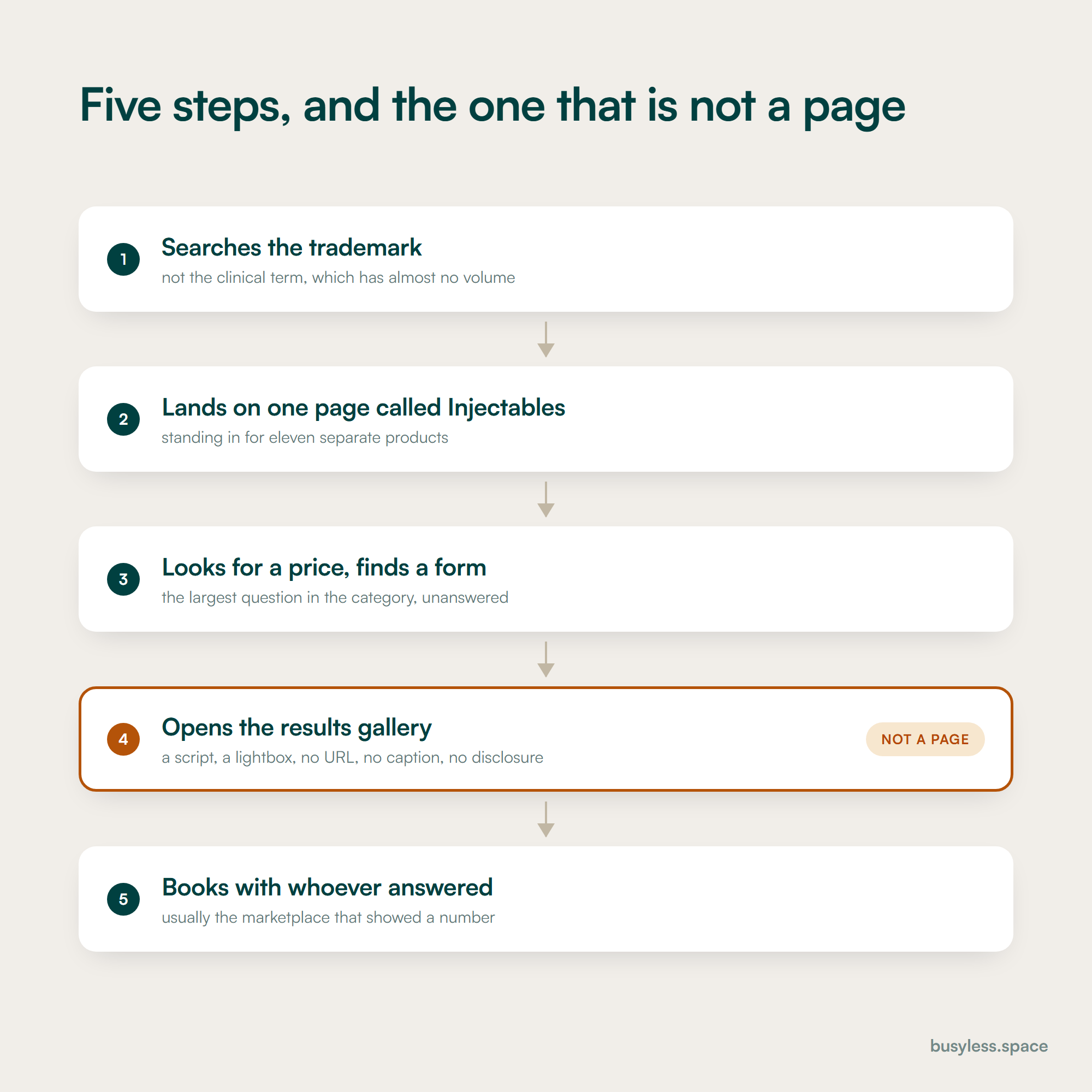
One page called Injectables covers eleven trademarks
A day per treatment
Clinic websites are usually built around services as the practice thinks of them, and patients search products as the manufacturer named them. A single injectables page cannot rank for Botox, Dysport, Xeomin, Juvederm, Restylane, Sculptra, Kybella and the rest, and each of those is a separate search with separate questions.
One page per treatment brand you genuinely offer. What it is, what it treats, what it costs, how long it lasts, who should not have it, who performs it, and the results from your own clinic. Keep the manufacturer's marketing claims off it and write from your own experience.
The before-and-after gallery is a JavaScript lightbox
A sprint
The highest-converting asset on a med spa site is usually loaded into one gallery page by a script, so there is no page per result, no caption in the markup, no alt text and nothing for image search to index. It is also the asset most likely to be non-compliant, and a lightbox is the hardest place to put a required disclosure.
Build results as real pages grouped by treatment, each with the procedures performed, the number of sessions, the interval, the injector and the not-typical statement in the visible copy. Add image structured data. The compliance fix and the indexing fix are the same piece of work.
Tracking pixels sit on booking and treatment pages
A day
The booking flow is where somebody names a treatment, and the standard marketing stack forwards that to advertising platforms by default. Because a cash-pay clinic is often outside HIPAA, operators assume no rule applies, which is precisely the gap the FTC rule was amended to close.
Remove advertising tags from any page where a treatment is named or booked. Move conversions to a server-side event carrying no treatment detail. Keep analytics, lose the identifiers, and write down what you decided so the next agency does not put them back.
The booking system lives on somebody else's domain
An afternoon, then a call
Most clinics run scheduling on a platform that hosts the flow at its own address. The visitor leaves your site at the moment of highest intent, the platform's own listing page may rank for your name, and none of the behaviour after the click belongs to you.
Put the booking flow on your own subdomain where the platform allows it, and make the profile link point at your page rather than the platform's. If neither is possible, at least own the page the visitor lands on first and pass consistent tracking through it.
Prices sit behind a consultation form
An afternoon
How much does it cost is one of the largest clusters in the category, and the standard answer is a form. Discount marketplaces answer it with a number, which is how they end up ranking for treatments you perform better than they do.
Publish ranges with the reasoning: what a unit is, how many are typical for an area, how long it lasts, why the range is wide. That reframes the comparison away from price per unit, which is the only comparison you lose.
Multi-location clinics share one team page
A sprint
Injectors are the product and they do not work at every site. A shared team page means the location page cannot answer the question the visitor is actually asking, and the profile, the site and the booking system frequently disagree about who works where.
A page per location with its own injectors, own devices, own hours, own results and its own profile link. Devices in particular differ between sites and are almost always listed as though they do not.
Nothing on the site names a licence
An afternoon
The category has a trust problem it earned, and the single thing a nervous patient wants is verification. Licence type and number are checkable against a public register, which is exactly why publishing them is persuasive and why so few clinics do.
Name every injector with licence type, number and issuing state, and name the supervising physician. Link to the register where the state publishes one. It costs nothing and it is the most convincing thing you can put on the page.
Steps two and three are an afternoon each. Step four is the one that also carries a disclosure requirement.
Structured data that applies here
The types below fit this industry specifically. Most of them earn no rich result on their own, which is worth knowing before anyone sells the work on that basis. What they do is describe the entity precisely, which matters for how search engines and answer engines resolve who you are.
HealthAndBeautyBusiness
Home page and every location page
The honest type for a med spa. MedicalClinic asserts a clinical setting many cash-pay spas are not, and the vocabulary should match the ownership structure you actually have. Keep the medical director in the markup as an employee rather than implying the business itself is a physician.
Team pages, referenced from every treatment page they perform
The most important node on the site, because the decision is about a person. Licence number and issuing state are checkable against a public register, which is what makes them worth publishing. Only claim credentials that are current.
This node exists on this page and almost nowhere else in the directory, because here a photograph is a regulated advertisement. Everything the statute wants stated prominently should also be in the visible caption. The markup is not the disclosure; the visible text is.
ImageObject for a compliant before-and-after pair.jsonld
{
  "@context": "https://schema.org",
  "@type": "ImageObject",
  "@id": "https://[YOUR-DOMAIN]/results/[SLUG]#image",
  "contentUrl": "https://[YOUR-DOMAIN]/results/[SLUG].jpg",
  "name": "[TREATMENT] before and after, [AREA TREATED]",
  "caption": "[TREATMENT BRAND], [N] units / [N] sessions, photographed [N] weeks apart. Same camera, distance and lighting. No filter or retouching applied. Individual results vary and the same before and after results may not occur for all patients.",
  "description": "[Which procedures were performed, on which areas, over what period.]",
  "creditText": "[CLINIC NAME]",
  "copyrightNotice": "[CLINIC NAME]",
  "creator": { "@id": "https://[YOUR-DOMAIN]/team/[INJECTOR-SLUG]#person" },
  "representativeOfPage": true,
  "acquireLicensePage": "https://[YOUR-DOMAIN]/results/[SLUG]"
}
OfferCatalog for the treatment menu
The treatments index, referenced from the business node
The place to put real price ranges. It also forces the question of which treatments are genuinely separate offers, which is the same question that decides whether you have one injectables page or eleven treatment pages.
The pair worth covering is cost and safety, because those are the two questions asked before every booking and the two most often answered with a form. Match the visible text exactly and keep the claims inside the approved indication.
FAQPage.jsonld
{
  "@context": "https://schema.org",
  "@type": "FAQPage",
  "mainEntity": [
    {
      "@type": "Question",
      "name": "[Question exactly as it appears on the page]",
      "acceptedAnswer": {
        "@type": "Answer",
        "text": "[Answer exactly as it appears. Give the real range, the real downtime and the real contraindications.]"
      }
    }
  ]
}
BreadcrumbList
Treatment, result and location pages
Worth adding once the site is a real hierarchy of treatments and results rather than a services page with a gallery attached. Building the breadcrumb usually exposes how few pages the site actually has.
Editorial estimates rather than quotes, and higher than most local businesses in this directory because the ground is genuinely contested and the photography is a real production cost. One line is missing from every band below on purpose: the manufacturer locator is bought with product, so it belongs in clinical purchasing rather than here.
Do it yourself
$0 to $500
Business profile completed with services set explicitly
Every manufacturer and device locator listing claimed
Injectors named with licence details
A page per treatment brand, written by whoever performs it
Price ranges published with the reasoning
Who it suits
A single-location clinic with an owner-injector who will write
Where it stops
It will not produce a compliant gallery at volume, and it will not fix the tracking on the booking flow, which is the item with real exposure attached.
Lean
$2,500 to $5,000
The full treatment brand page set built properly
The gallery rebuilt as indexable, compliant result pages
Tracking cleaned off treatment and booking pages
Concern pages covering the upstream questions
A standardised before-and-after photography workflow
Who it suits
An established single site competing with chains in the same metro
Where it stops
It covers the queries but not the awkward ones. Risks, comparisons and the poor-result page take clinical time that a lean budget rarely buys.
Funded
$5,000 to $9,000
A page per location with its own injectors, devices and results
Comparison and risk content written with clinical review
Membership programme content and retention sequences
Reporting split by source through to repeat treatment
Regular regulatory review of the weight management copy
Who it suits
Multi-site groups, or single sites with a large device investment to fill
Where it stops
Above this the constraint is injector capacity rather than demand. If the diary is full four weeks out, more acquisition raises the no-show rate rather than the revenue.
How to do it with no budget
Most of the value here costs nothing but attention, and the first two items are compliance rather than marketing. Do them in this order, because the later ones are what a regulator would read.
1
Find out which privacy regime you are actually in
2 hours
Your billing records and your own reading of the FTC rule
If you do not transmit claims electronically you are probably not a HIPAA covered entity, which means the rule that reaches you is the FTC one. Almost nobody in this industry has checked, and the answer decides what your marketing stack may do.
2
Strip advertising tags off treatment and booking pages
2 hours
Your tag manager and your browser's network tab
Load a booking page, watch what leaves the browser, and remove anything sending treatment detail to an ad platform. The highest-value free hour on this page, and not a marketing task at all.
3
Claim every manufacturer and device locator
20 minutes each
Your supplier portals
Every product and device you have bought probably comes with a find-a-provider listing, and most clinics have completed none of them. Free citations from authoritative domains, reaching somebody who has already chosen the technology.
4
Name every injector with licence type and number
1 hour
Your website editor and your state register
Checkable credentials are the most persuasive thing on a med spa website and among the rarest. Link to the public register where your state publishes one.
5
Split the injectables page into one page per brand
Half a day each
Your website editor
Patients search the trademark. A single page cannot rank for eleven of them, and each has different questions about cost, longevity and who it does not suit.
6
Publish price ranges with the reasoning
2 hours
Your website editor
Explain what a unit is and how many an area typically needs. It moves the conversation off price per unit, which is the comparison the discount marketplaces win.
7
Fix the gallery captions
An afternoon
Your website editor and your state's advertising statute
Procedures performed, sessions, interval, no retouching, and the statement that the same results may not occur for everyone. Visible on the page, not in the footer, and not only in the markup.
The tool stack
Jobs first, tools second. Two entries here are not marketing software at all, and they are the two that decide whether the rest of the spend was worth anything.
Track position on treatment brand plus city queries
Track by treatment brand rather than by service category, and track from residential areas rather than from the clinic. Trademark queries move differently from generic ones, because the manufacturer's own pages move with them.
Free routeManual checks from a few points in your catchment
The useful output is not a keyword list, it is the count of national chains and marketplaces on each term. That tells you which treatments deserve a page and which are worth conceding.
Free routeSearch the query and read the results page carefully
Watch what leaves the browser on a booking page
Your browser's network tab
Load the booking flow, filter to third-party requests, and read what is being sent. Every med spa I have looked at has found something it did not know was there.
Free routeFree, and the most important tool on this list
Work out what a patient is actually worth
Customer Churn Analysis Calculator
Use repeat treatment rate rather than first booking value. A Groupon visitor and a referral who returns three times a year are not the same acquisition, and blending them hides the entire argument.
Free routeFree
Set a budget against retained patients
SEO Budget Calculator
Set the target as patients who return for a second treatment at full price. It usually lowers the number and improves the outcome, which is the right shape of answer here.
Free routeFree
Generate the business, injector and image markup
Schema Markup Generator
The image node is the one worth getting right, because it is the same piece of work as the compliance fix on the gallery.
Free routeFree
Publish treatments, injectors and results as related content
Treatments, injectors, devices, locations and results are related entities, and a result needs to reference the injector who produced it. Modelling that properly is what turns a lightbox gallery into a page set.
Free routeFree tier for a small site
Price the locator channel honestly
Your supplier purchasing records
Not a marketing tool and the one most likely to change a decision. Put the purchase commitment that keeps you on the locator beside the bookings it produced, and you have the cost per acquisition of a channel nobody reports on.
Free routeAlready paid for, and never analysed this way
Take it from here
Everything below is yours to take. Fill the [BRACKETS] and it is ready to use. Start with the tracking audit: it is an afternoon of work, it is the only item here with regulatory exposure attached, and almost nobody has done it.
Checklist
The item with real exposure attached. A cash-pay med spa is often outside HIPAA, which is exactly why the FTC rule reaches it, and an unauthorised disclosure counts even when it was voluntary.
TRACKING AUDIT - [CLINIC] - [DATE]
Run by: [NAME]      Re-run every: [6 months]

WHY THIS IS FIRST
If you do not bill insurance electronically you are probably not
a HIPAA covered entity. That does not mean no rule applies. The
FTC Health Breach Notification Rule reaches health businesses
outside HIPAA, and its amendments took effect on 29 July 2024.
A breach under it includes an unauthorised DISCLOSURE, not only
an intrusion, and a voluntary disclosure still counts. A pixel
sending "booked: [TREATMENT]" to an ad platform is that case.

1. ESTABLISH WHICH REGIME YOU ARE IN
   Do you transmit claims electronically?        [ Y / N ]
   Do you accept insurance for any service?      [ Y / N ]
   Have you ever taken written advice on this?   [ Y / N ]
   Our position, in one sentence: [_______________________]
   Decided by: [NAME]  Date: [____]

2. LIST EVERY PAGE WHERE A TREATMENT IS NAMED
   [ ] Treatment pages          [__] of them
   [ ] Booking / scheduling flow
   [ ] Consultation request form
   [ ] Pre-treatment questionnaires
   [ ] Membership sign-up
   [ ] Gallery / results pages
   [ ] Anything with a treatment name in the URL

3. WATCH WHAT ACTUALLY LEAVES THE BROWSER
   Open each page above. Developer tools, Network tab,
   filter to third-party domains. Load, then submit.
   | Destination domain | Page | What it received | Keep? |
   |--------------------|------|------------------|-------|
   | [________________] | [__] | [______________] | [Y/N] |
   | [________________] | [__] | [______________] | [Y/N] |
   | [________________] | [__] | [______________] | [Y/N] |

   Look specifically for:
   [ ] Treatment name in a URL being sent as a page view
   [ ] Form field values in a conversion event
   [ ] Email or phone hashed and forwarded
   [ ] Session replay recording a questionnaire
   [ ] Chat widget storing what was asked about
   [ ] Any pixel you did not know was installed

4. THE FIX
   [ ] Remove advertising tags from every page in section 2
   [ ] Move conversions to a server-side event
   [ ] Send only "booking completed", never the treatment
   [ ] Strip treatment names out of URLs used for tracking
   [ ] Turn off session replay on any clinical form
   [ ] Re-check after ANY agency or platform change

5. WRITE DOWN WHAT YOU DECIDED
   The next person to touch the site will put them back
   unless there is a document saying why they were removed.
   Stored at: [_______________________________]
What to publish
Write what a person deciding this week needs to read. General aesthetic advice competes with the manufacturers, who have larger budgets and better lawyers, and it reaches nobody who is choosing an injector.
A page per treatment brand
One per treatment you genuinely offer, reviewed when you change supplier
The queries are trademarks and each carries different questions. This is the page set the whole strategy rests on.
Result pages with compliant captions
Continuously, as consent allows
The highest-converting asset in the category, and rebuilding it as pages fixes the indexing and the compliance problem in one pass.
Concern pages in the patient's own words
One per concern you treat, then leave them
Reaches people before they know the product name, which is the only point in the journey where you are not competing with the trademark holder.
Honest product comparisons
One per pair you carry, reviewed yearly
Two trademarks in one query means the manufacturers cannot write it fairly. A clinic carrying both can, and hardly any do.
The risks and poor-result page
Once, properly, with clinical review
Every clinic avoids it and every prospective patient looks for it. It is the only page on the site that could cost you a booking, which is exactly why it is believed.
Aftercare for your own patients
One per treatment, updated with protocol changes
Reduces call volume, builds the entity, and quietly reaches people treated elsewhere who are looking for somebody better.
And what not to
Copying the manufacturer's marketing claims onto your treatment page
Any claim about a use the drug is not approved for, however indirectly phrased
Presenting a compounded preparation under a brand name it does not carry
Retouched, filtered or differently lit before-and-after pairs
Testimonials describing an outcome with no statement of what is typical
Review requests routed only to patients you expect to be happy
A single injectables page trying to serve eleven separate searches
Discount-led pages for the treatments your business actually depends on
The expensive mistakes
Optimising for the clinical term
Costs you A page targeting a word with almost no search volume, while the trademark carrying the demand goes uncontested
One page per treatment brand you offer, using the mark accurately to describe what you provide
Assuming no privacy rule applies because you do not bill insurance
Costs you Treatment-level data forwarded to advertising platforms by a stack nobody audited, under the rule written for exactly this situation
Establish which regime you are in, then strip advertising tags off treatment and booking pages
Treating the gallery as a design element
Costs you The best-converting asset on the site invisible to search, and images that may not satisfy your state's advertising statute
Result pages with procedures, sessions, interval, attribution and the not-typical statement in visible copy
Competing with Groupon on price
Costs you A discount audience that does not return at full rate, and a price anchor you cannot undo
Publish ranges with the reasoning and compete on who is holding the needle
Leaving the manufacturer locators unclaimed
Costs you Free listings on authoritative domains, reaching patients who have already chosen the product, left blank
Complete every supplier and device listing, then price what the purchase commitment behind them really costs
Publishing weight management copy without review
Costs you The most closely watched category on your site, written by a marketer, in a year when regulators wrote to med spas about exactly that copy
Clinical review before publication and a scheduled re-read, not a one-off sign-off
The loop only keeps turning while the return rate is the number nobody reports.
What to measure
Two things make measurement awkward here. The channel that may matter most is bought with product rather than with marketing spend, so it never appears in the report; and a first booking is a weak signal, because the money in aesthetics is in the second, third and tenth visit.
Leading indicators
Move first. They predict, they do not prove.
Position on treatment brand plus city queries
Geo-specific rank tracking, by treatment brand
Tracked per brand rather than per category, because a clinic can be first for one trademark and absent for the next one it performs just as well.
Profile actions and photo views
Google Business Profile insights
Photo engagement matters more in this category than in almost any other, because the visual proof is the decision. Watch it move when the gallery changes.
Impressions on concern and comparison clusters
Search Console, filtered by cluster
The upstream ground. It grows slowly and it is the leading indicator that the site is reaching people before the trademark holder does.
Locator listings live and complete
Your supplier portals
A count, checked quarterly. It looks trivial and it is usually the fastest unclaimed traffic available on this page.
Business indicators
The ones a manager acts on.
Consultations booked by source
Practice management system, one question asked the same way
The input rather than the outcome. Worth reporting only beside the two metrics below it.
Consultation to first treatment rate, by source
Practice management system
Where discount channels reveal themselves. A source can produce plenty of consultations and almost no treatments, and the booking count alone will never show it.
Repeat treatment rate at six and twelve months
Practice management system
The number this industry runs on. Injectables are a recurring purchase, so a channel producing one-off visitors is a cost rather than an acquisition.
Cost of the locator channel
Purchasing records set against attributed bookings
The purchase commitment that keeps you on a manufacturer's locator is a marketing cost recorded as clinical supply. Reporting it correctly sometimes changes which products a clinic carries.
The verdict
Aesthetics is the only market in this directory where the queries you need belong to your suppliers and one of your best channels is bought in vials. Once you accept both, the work becomes clear: a page per trademark, a gallery that can be indexed, and credentials somebody can verify.
Compliance is not a tax on the marketing here, it is most of the marketing. Standardised photographs with honest captions, licence numbers on the team page and a booking flow that does not leak treatment detail are all things a nervous patient is looking for anyway.
Three questions will tell you almost everything about a proposal for medical spa SEO services. Will they audit what your booking pages transmit? Will they rebuild the gallery as compliant pages rather than a slider? Will they report repeat treatment rate rather than consultations?
Expect the third to be dodged, because consultation counts flatter a report and repeat rates rarely do. That gap is the whole difference between a channel that fills a diary once and one that builds a practice, and it is the first thing I would put to anybody selling SEO services for medical spas.
FAQ
Medical spa SEO questions
Can we use trademarked treatment names on our website?+
You can use a mark accurately to describe a treatment you genuinely provide, which is how every legitimate clinic in the category writes. What you cannot do is imply endorsement, restyle the mark as your own branding, or repeat the manufacturer's efficacy claims as though they were yours. Write about your delivery of the treatment, keep the supplier's marketing copy off the page, and check your supplier agreement for logo rules.
Does HIPAA apply to a cash-pay med spa?+
Often it does not, because a clinic that never transmits claims electronically may not be a covered entity. That is not the relief it sounds like. The FTC Health Breach Notification Rule reaches health businesses outside HIPAA, its amendments took effect on 29 July 2024, and it treats an unauthorised disclosure as a breach even when it was voluntary. A pixel on your booking page is exactly that case.
How should we handle before-and-after photographs?+
Same camera, same distance, same lighting, same expression, no filter and no retouching. Caption every pair with the procedures performed, the sessions and the interval, and carry a statement that the same results may not occur for all patients. California Business and Professions Code section 651 sets that standard for licensees there and other states have comparable rules, so check your own before publishing a gallery.
Is Groupon worth using?+
For a treatment you want people to try once, sometimes. For the treatment your revenue depends on, no. It ranks on the term itself and it trains a price-led audience that rarely returns at full rate, so it fills chairs while setting an anchor you cannot undo. If you use it, measure the return rate at full price rather than the redemption count.
How do the manufacturer locators actually work?+
The drug and device companies run find-a-provider tools that route patients to participating injectors, and several sit inside loyalty programmes patients already use. Presence and prominence generally follow purchase volume and tier status rather than content. Claim every one you are eligible for, then price what the purchase commitment behind your tier really costs against the bookings it produces.
Should treatment prices be visible before an enquiry?+
Publish ranges with the reasoning behind them. What it costs is one of the largest clusters in the category, and answering it with a consultation form sends people back to the results page where a discount marketplace is showing a number. Explaining what a unit is, how many an area typically takes and how long the result lasts moves the comparison away from price per unit, which is the only comparison you lose.
What does medical spa SEO cost?+
The tiers above are editorial estimates rather than quotes. A clinic running a real programme sits at roughly $2,500 to $9,000 a month, higher than most local businesses in this directory because the ground is contested and the photography is a genuine production cost. One channel is missing from those numbers on purpose, because the manufacturer locator is paid for in product.
How careful do we need to be with weight management pages?+
Very. In September 2025 the FDA issued warning letters to med spas after reviewing their websites, citing false or misleading claims about compounded products, including copy presenting a compounded drug as though it were the approved one. Treat that page as a regulatory document that happens to rank, have somebody clinical sign it off, and re-read it on a schedule rather than once.
Can a clinic do this without help?+
The listing and the treatment pages, yes. SEO for spas is mostly writing the trademarked treatment names into text and getting the gallery indexable. Seo for plastic surgeons is harder, because the consideration is longer and the outcome claims are the part carrying the risk.
How do we choose between med spa SEO providers?+
By what they will not write. A seo consultant for plastic surgeons who agrees to every outcome claim you suggest is a liability. The best seo agency for plastic surgeons will decline some of them and tell you which state rule applies.
Does the provider need to be local to us?+
Not for the work, only for the market knowledge. Local seo for plastic surgeons is decided by the profile, the reviews and the gallery, and a local seo agency for plastic surgeons has no structural advantage over a remote one. A local seo consultant for plastic surgeons is worth it only if they know your metro's competitors.
What should a med spa proposal contain?+
A compliance step and a photography plan. Anyone quoting seo services for plastic surgeons without mentioning the before-and-after rules has not read them. An seo company for plastic surgeons should also say who writes the clinical copy and who reviews it.
Cosmetic margins fund the budget, routine queries carry the volume
The most saturated local health vertical in most metros, where high-margin cosmetic work funds the marketing and routine hygiene queries carry the volume. Two funnels, one website, and an insurance directory sitting in front of both.
Privacy law decides your analytics stack before SEO decides anything
Patients search for symptoms months before they search for a provider, and a handful of national directories own the results in between. The work is earning the local pack, the condition pages and the insurance queries without breaking privacy rules that most marketing stacks break by default.
Efficacy claims are constrained twice, by boards and by YMYL
Dense single-location competition in a category where claims about what treatment achieves are constrained by both state boards and the quality bar on health content.
Everything above is written to be run without us, and the free path is genuinely most of the value for a single-location business. Where these plans stall is almost never the plan. It is that nobody owns it after the first month. That is the job we do, with search as one distribution layer inside a wider system rather than the whole engagement.