
Skip to content

Dental SEO strategy

YMYL and regulated

Cosmetic margins fund the budget, routine queries carry the volume

Written by Eugene SuslovLast reviewed 28 August 2026No affiliate links
Sector
Health and medical
Model
Local service, Multi-location
Competition
Brutal
Time to results
4 to 9 months
Typical monthly
$2,000 to $8,000

Key takeaways

  1. 1Your insurance page is the highest commercial-intent page on the site, and on most dental websites it is a grid of carrier logos with no crawlable text at all.
  2. 2Your procedure pages were probably written by your website vendor and shipped to a thousand other practices. Take one sentence, search it in quotes, and count the copies.
  3. 3Cosmetic work pays for the marketing and hygiene recall fills the chairs. A programme aimed at only one of those either starves or does not pay back.
  4. 4Answering a review in a way that confirms somebody is a patient is a disclosure of protected health information. OCR has already settled a case about exactly that.
  5. 5Every location needs its own page, its own phone number and its own profile. A shared locations page concedes every satellite office to whoever did build one.

SEO for dentists is really two jobs sharing one website, and most practices only budget for one of them.

One job is routine. Exams, hygiene, a filling, a child's first visit. It is high volume, low margin, mostly decided on proximity and whether you take the patient's insurance, and it is what keeps chairs full and hygienists employed.

The other job is elective. Implants, veneers, clear aligners, whitening. Low volume, long consideration, and margins several times higher. So a dental SEO strategy has to serve two funnels that barely overlap, because the routine side pays the salaries and the elective side pays for the marketing.

The routine funnel is won off your website rather than on it. The local pack, the profile, the reviews and the insurance directories decide it, and a patient rarely reads a page before booking a cleaning.

The elective funnel is the opposite. Somebody researching implants reads for weeks, compares prices, looks at before-and-after photographs and wants to know who is doing the work. That is a content and trust problem, and it is where a website actually earns something.

Almost every practice site is built by one of a handful of dental-specific vendors, and the procedure library ships with it. That is why so many practices publish word-for-word identical pages about dental implants, and why rewriting them is usually the highest-value content work available.

Who already ranks in dental

Open a private window and run a routine query, then a cosmetic one. The first thing dental SEO has to reckon with is that the practice website is rarely the first result on either, and the things above it are different in each case: a map pack and an insurance directory on one, a national publisher and a manufacturer's locator on the other.

What is on the results page

  • Local pack on almost every routine query, frequently with an open-now filter applied
  • Booking links on profiles connected to a scheduling partner, which shortcut the website entirely
  • Insurance carrier directories ranking for the accepts-my-plan queries
  • People Also Ask, dense on cost, recovery time and procedure comparison
  • Image results on cosmetic queries, which is where before-and-after work would appear if it were indexable
  • Review stars from Yelp and Healthgrades rather than from the practice's own site
  • AI Overviews on procedure and cost questions, drawn from whoever explained them most clearly
  • Insurance carrier directories

    deltadental.comClaim it

    The gatekeeper nobody treats as one. Delta Dental, Cigna, Aetna, MetLife and Guardian all run find-a-dentist tools, they rank for plan-name queries, and a large share of patients start there rather than in Google. You get in by being credentialed and in network, not by marketing, so the work is making sure every listing is accurate once you are. Check what each carrier shows about you, because they are frequently years out of date.

  • Google Business Profile

    google.comClaim it

    The single highest-return asset for the routine funnel. Categories, services, hours, photos, reviews and the booking link do more for new patient volume than any page on the website. One profile per physical location, never one for the group.

  • Zocdoc

    zocdoc.comClaim it

    Ranks well on dentist-plus-city and insurance queries in most metros, and it is a paid marketplace rather than a directory. Judge it on cost per booked new patient against your own channels, and remember it also competes with you for your own brand query.

  • Yelp

    yelp.comClaim it

    Still strong in dental in many markets and it feeds Apple Maps. Claim it, keep the hours and services accurate, and read the HIPAA note below before anybody replies to anything on it.

  • Healthgrades

    healthgrades.comClaim it

    Carries a profile for most licensed dentists whether or not they have claimed it, and it often outranks the practice for the dentist's own name. Claiming it is free and it is the cheapest way to control what a patient sees when they search you personally.

  • Manufacturer and system locators

    invisalign.comClaim it

    Clear aligner, implant system and whitening manufacturers all run find-a-provider tools that rank for their own trademarks. If you are certified, your listing is free, high authority and usually incomplete. This is the closest thing dental has to a free high-value directory and most practices have never opened theirs.

  • Group practice and DSO brands

    aspendental.com

    Not claimable and not beatable on head terms. A national group with hundreds of locations has authority no single practice will match, so concede the generic queries and win on the ones a national brand cannot answer: this dentist, this neighbourhood, this insurance plan, this specific case.

What people actually search

Dental search splits along the same line the business does. One set of queries is a scheduling problem and is decided before anybody reads a word. The other is a considered purchase of several thousand dollars, researched over weeks, and it is the only place your writing changes the outcome.

Routine local

Local transactional

dentist near me accepting new patients

The page that wins it: A complete profile and a location page that loads and books

Decided on proximity, reviews and availability. No amount of writing wins this; profile completeness and review velocity do.

Insurance acceptance

Local commercial

dentist that takes [carrier] near me

The page that wins it: A real insurance page with carrier names in text

The highest commercial intent in the routine funnel and the one most practices render as a logo grid. Nobody searching this is browsing.

Emergency

Local transactional, urgent

emergency dentist open saturday

The page that wins it: An emergency page with real availability and a tappable number

Converts within the hour and is usually answered by whoever is genuinely open. Do not claim Saturday cover you do not have.

Cosmetic and elective, by brand

Commercial investigation

clear aligners near me

The page that wins it: A treatment page plus a claimed manufacturer locator listing

These queries are often other companies' trademarks. You are competing with the manufacturer's own locator, so the listing matters as much as the page.

Cost and financing

Commercial investigation

how much do dental implants cost

The page that wins it: Honest ranges with what moves them, and how payment works

The most searched elective cluster and the one practices most often refuse to answer. Read the Regulation Z note before advertising a monthly figure.

Procedure comparison

Commercial investigation

dental implant vs bridge

The page that wins it: A comparison written by a named clinician, including when to choose the cheaper option

High trust, high margin, and the page that fairly recommends the bridge is the one that gets the implant consultation.

Anxiety and access

Informational to local

dentist for nervous patients

The page that wins it: A page about how you actually handle anxious patients

A genuinely underserved cluster. The people searching it have usually not been to a dentist in years, which makes them high value and easy to keep.

Symptom and urgency triage

Informational

how long can you leave an abscess

The page that wins it: A short clinical explainer that ends in a call-us threshold

Searched before the emergency, at night, on a phone. Almost uncontested by practices because it feels like giving advice away.

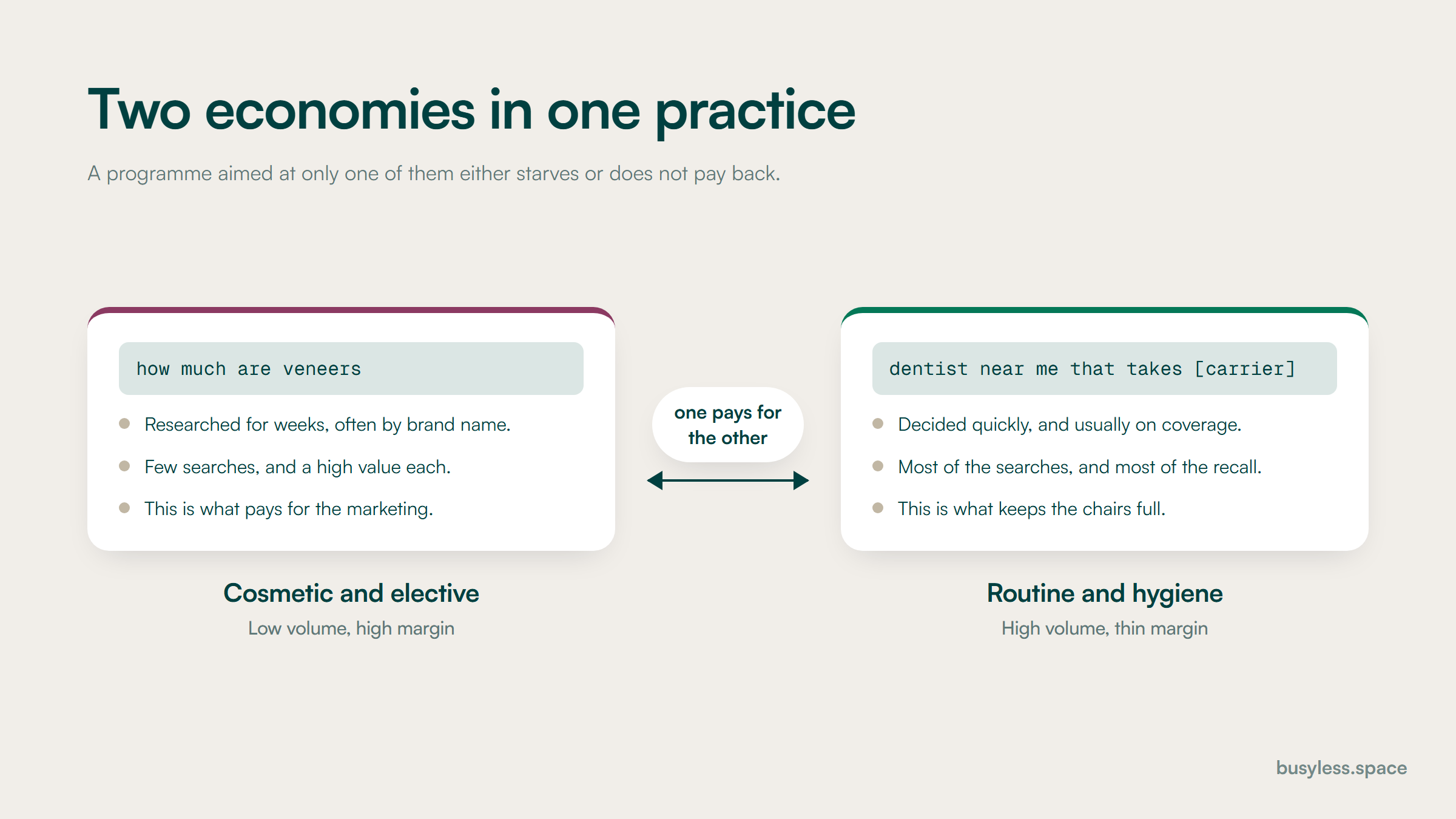
Two cards joined by a double-headed arrow labelled one pays for the other. On the left, cosmetic and elective work: researched for weeks, few searches, high value each. On the right, routine and hygiene: decided on coverage, most of the searches, most of the recall.
Not two audiences to choose between. A programme aimed at only one of them either starves or does not pay back.

What the rules change

Dental practices are covered entities under HIPAA, which surprises people who think of it as a hospital rule. The items below are the ones that actually reach the marketing, and the first is the one most likely to be being broken right now. None of this is legal advice; check with your own counsel and your state dental board.

1

Replying to a review can itself be a disclosure of health information

HHS Office for Civil Rights, settlement with Elite Dental Associates of Dallas, announced October 2019

What it means

OCR settled with a dental practice for $10,000 after it responded to reviews on Yelp in a way that disclosed patient information, including a patient's last name and details of her treatment and costs. Confirming that somebody is a patient at all is a disclosure, so even a friendly reply saying the practice has looked at their file is a problem.

So do this

Write one approved reply that never confirms a relationship: thank the reviewer, state your policy of not discussing patient information publicly, and give a phone number and a named person to call. Put it in a document, train whoever handles reviews, and never let the front desk improvise.

2

A before-and-after photograph is protected health information

HIPAA Privacy Rule, 45 CFR 164.508 on authorizations for uses and disclosures

What it means

Clinical images used in marketing require a valid authorization, and a general treatment consent form is not one. The authorization has to be specific about the use, and de-identification is harder than it looks with dental photographs, since a full smile with distinctive anatomy is not obviously anonymous.

So do this

Use a separate marketing authorization, filed with the chart, naming the surfaces you will publish on and how the patient revokes it. Track which images have one. If you cannot produce the authorization for an image on your website today, take the image down until you can.

3

You may not advertise a specialty you do not hold

State dental practice acts and board advertising rules; specialties recognised through the National Commission on Recognition of Dental Specialties and Certifying Boards

What it means

A general dentist who places implants is not an oral surgeon, and one who straightens teeth is not an orthodontist. States regulate the words themselves, so a page title, a meta title and a business profile category are all advertising for this purpose. Litigation has narrowed how far some states can go on credentials outside the recognised list, which is exactly why the rules differ by state.

So do this

Say what you do rather than what you are: "implant dentistry" and "clear aligner treatment" instead of "implant specialist". Check your own board's advertising rule before writing a title tag, and audit your profile categories at the same time.

4

Advertising a monthly payment triggers credit disclosure rules

Truth in Lending Act, Regulation Z advertising provisions at 12 CFR 1026.24

What it means

"Implants from $99 a month" is an advertisement for consumer credit, not a price. Stating a payment amount or a payment period in an advert generally requires other terms to be stated too. Practices publish figures like this constantly because the financing vendor supplied the creative.

So do this

Either publish a total price range with no payment terms, or run the payment creative past whoever provides the financing and get their compliance sign-off in writing. The safest page says what the treatment costs and that financing is available, with the terms on the financing partner's own page.

5

The review funnel your vendor installed may be review gating

FTC Rule on the Use of Consumer Reviews and Testimonials, final rule 2024

What it means

Several dental reputation tools ask a patient how the visit went, then send happy patients to Google and unhappy ones to a private feedback form. That is selection by sentiment, and the FTC's 2024 rule addresses suppressing negative reviews directly. It is sold as standard practice, which is why so many practices are running it without ever deciding to.

So do this

Open your own review tool and follow the flow as a patient would. If the path splits on sentiment, turn the split off and send everyone the same request. A slightly lower average from a real distribution is worth more than a curated one anyway.

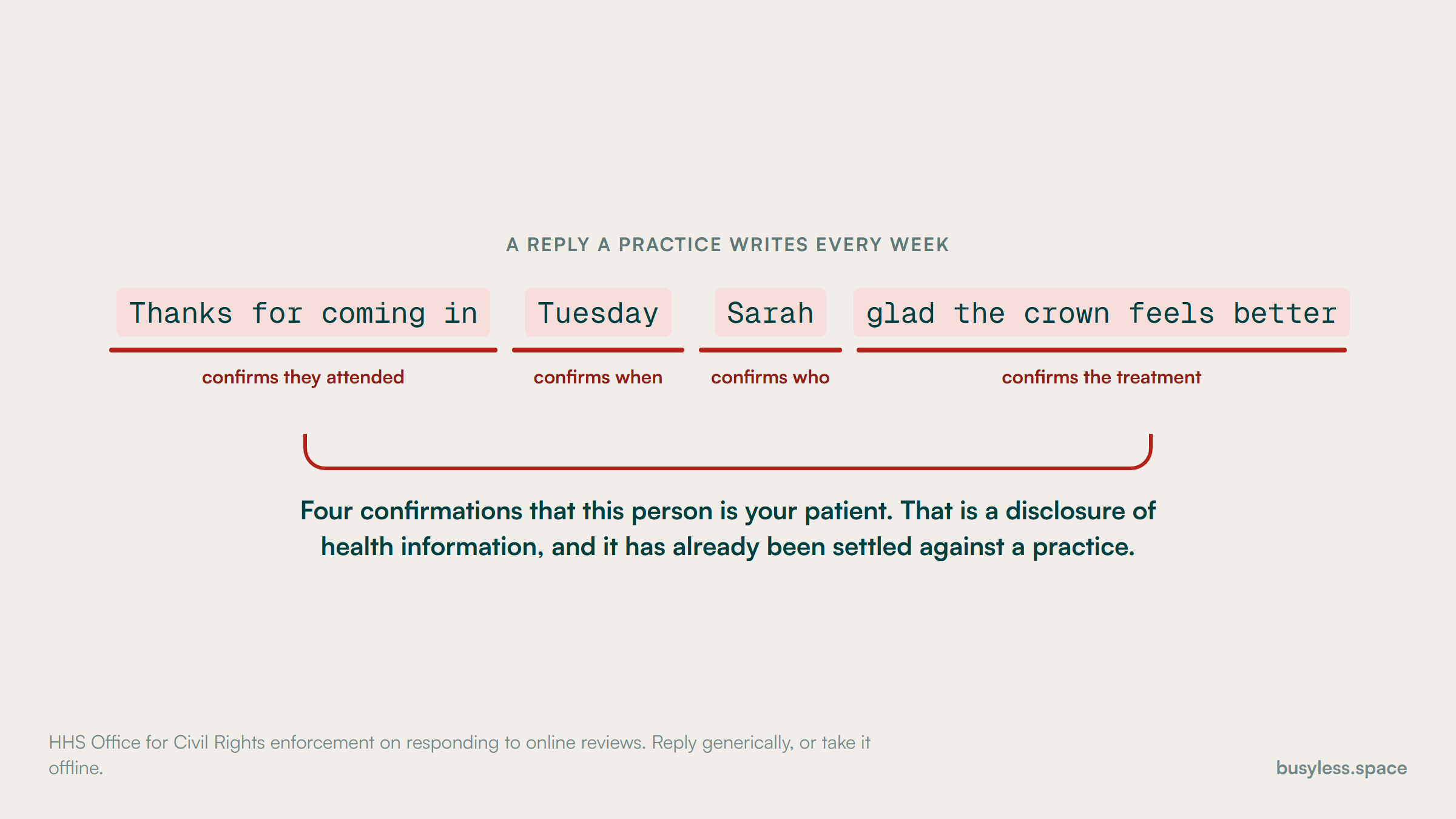
A friendly review reply broken into four highlighted clauses. Thanks for coming in confirms they attended, Tuesday confirms when, Sarah confirms who, and glad the crown feels better confirms the treatment.
Nothing in that reply reads as a mistake until you mark up what each clause confirms.

Proving expertise

Dental sits squarely inside Google's your-money-or-your-life territory, and it is a category where the person doing the work matters more than the brand. Most practice sites get this backwards: the procedure pages are anonymous vendor copy and the only human page is a stock biography.

  • Every clinical page bylined by a named dentist with their degree, licence number and the state that issued it
  • A link to the state board licence lookup, which turns a claim into something a patient can check in one click
  • Continuing education, fellowships and certifications named precisely, including the awarding body
  • Which specific systems and materials you use, named, since a patient researching implants is comparing systems
  • Real photographs of the practice, the team and the equipment rather than stock dentistry imagery
  • Before-and-after cases with the treatment described and an authorization on file for each one
  • A clinical review line on every treatment page giving the reviewer and the date
  • Membership of associations stated as membership, never implied as a credential

How to build a dental SEO strategy

A realistic first six months for a single practice. The order matters more here than in most industries, because a dental SEO strategy that opens with a blog spends four months producing nothing while the insurance page and the profile, which take days, sit broken.

  1. 1

    Weeks 1 to 3

    Fix the pages and listings that already have intent

    • Rewrite the insurance page so every carrier and plan name is real text, not a logo
    • Complete the Google Business Profile: categories, every service, real photos, accurate hours
    • Claim and correct every insurance carrier directory listing you are credentialed on
    • Claim Healthgrades, Yelp and every manufacturer locator you qualify for
    • Audit the review reply process against the HIPAA note above, and write the approved reply
    • Check whether the reputation tool is routing patients by sentiment, and turn it off if it is

    You end up with
    Correct listings everywhere a patient is already looking, and a review process that cannot cause a disclosure

  2. 2

    Weeks 3 to 8

    Take the vendor content off the shelf and make it yours

    • Run the duplication check on every procedure page and rank them by search demand
    • Rewrite the top five in your own words, bylined by the dentist who does that work
    • Publish real price ranges for the elective treatments, with what moves them
    • Build a proper page for each location with its own phone number and its own profile link
    • Add Dentist and MedicalProcedure structured data
    • Get the before-and-after gallery indexable: real images, real alt text, real page copy

    You end up with
    Procedure pages that exist nowhere else, and an elective funnel that answers the cost question

  3. 3

    Weeks 6 to 16

    Build the elective funnel properly

    • Write the comparison pages: implant against bridge, aligners against fixed braces, and so on
    • Publish case write-ups with photographs, treatment detail and authorizations on file
    • Write the anxiety and access pages, which nobody local is competing for
    • Add symptom and urgency explainers that end at a clear call-us threshold
    • Build the financing page carefully, with the Regulation Z note in mind
    • Start a review request that goes to every patient at the same point in the visit

    You end up with
    Coverage of the researched, high-margin cluster, with named clinicians attached to all of it

  4. 4

    Weeks 12 to 26

    Measure new patients and case value, not sessions

    • Attribute calls and online bookings, and reconcile against the practice management system
    • Report new patients and case acceptance value separately from traffic
    • Track the routine and elective funnels apart, because a blended number hides both
    • Review which procedure pages produce consultations rather than which produce sessions
    • Set a quarterly cadence for insurance directory accuracy, which drifts constantly
    • Re-check clinical review dates on treatment pages

    You end up with
    A report the practice owner can act on, showing new patients and production value by source

Technical fixes with the best payoff

Almost every problem below comes from the same source: a small number of dental-specific website vendors build a very large share of practice websites, so the same defects appear in market after market. That is good news. It means the fixes are known, and it means your competitors have them too.

  • The insurance page is a grid of carrier logos

    An afternoon

    It is the highest commercial-intent page on the site and the one query where the patient has already decided to book. Rendered as images, it contains no text for the carrier names, so it cannot rank for a single plan-name query.

    List every carrier and plan in text. Say plainly whether you are in network or out of network for each, since those are different searches and different patients. Keep the logos if you like them, but they are decoration and the words are the page.

  • The procedure library shipped with the website

    A sprint

    Dental site vendors supply a standard set of treatment pages, so thousands of practices publish the same description of a root canal. There is nothing to rank: the page has no reason to be preferred over any of its identical siblings.

    Take one sentence from the middle of each page, search it in quotes, and count the results. Rewrite the pages that have demand, in the voice of the dentist who does the work, with your own cases, your own materials and your own prices.

  • The before-and-after gallery is invisible to search

    A sprint

    Cosmetic queries return image results, and a gallery built as a JavaScript lightbox with no alt text and no surrounding copy is not eligible for any of them. It is usually the most persuasive asset on the site and the least discoverable.

    Give every case a real page or a real block: what the patient wanted, what was done, how long it took, who did it. Compress properly and write alt text describing the treatment. Confirm the authorization exists before publishing any of it.

  • The booking widget is an iframe on the vendor's domain

    An afternoon per page

    Scheduling platforms embed their flow from their own host, so the highest-intent step on the site contributes nothing to search and often does not work well on a phone.

    Keep the widget and put real content around it: which appointment types can be booked, what a first visit involves, what to bring, what it costs. Strip the widget out mentally: if nothing useful is left, the page is not doing its job.

  • Several locations share one page and one phone number

    A sprint

    Local ranking is location by location. A single locations page with a list of addresses gives each office nothing to rank with, and a shared phone number breaks the profile-to-website consistency the pack relies on.

    One page per location, with that office's own address, own phone number, own hours, own team and own embedded map, linked from and linking to that office's profile.

  • Call tracking numbers have broken the listings

    A day

    Dental marketing vendors push dynamic number insertion hard, and it is genuinely useful. Done badly it puts a different number on the website from the one on the profile and the directories, which is the exact inconsistency local ranking punishes.

    Use dynamic insertion for paid and referral traffic only, keep the real number visible for organic and direct, and make sure the profile, the directories and the site footer all agree.

  • There is no structured data, or a generic LocalBusiness node

    A day

    Schema.org has a Dentist type, and MedicalProcedure genuinely fits the treatment pages here in a way it does not in most verticals. A generic node describes the practice less precisely than the vocabulary allows.

    Mark the practice up as Dentist with services, hours and area served, the dentists as people with credentials, and the treatment pages as MedicalProcedure. See the structured data section below.

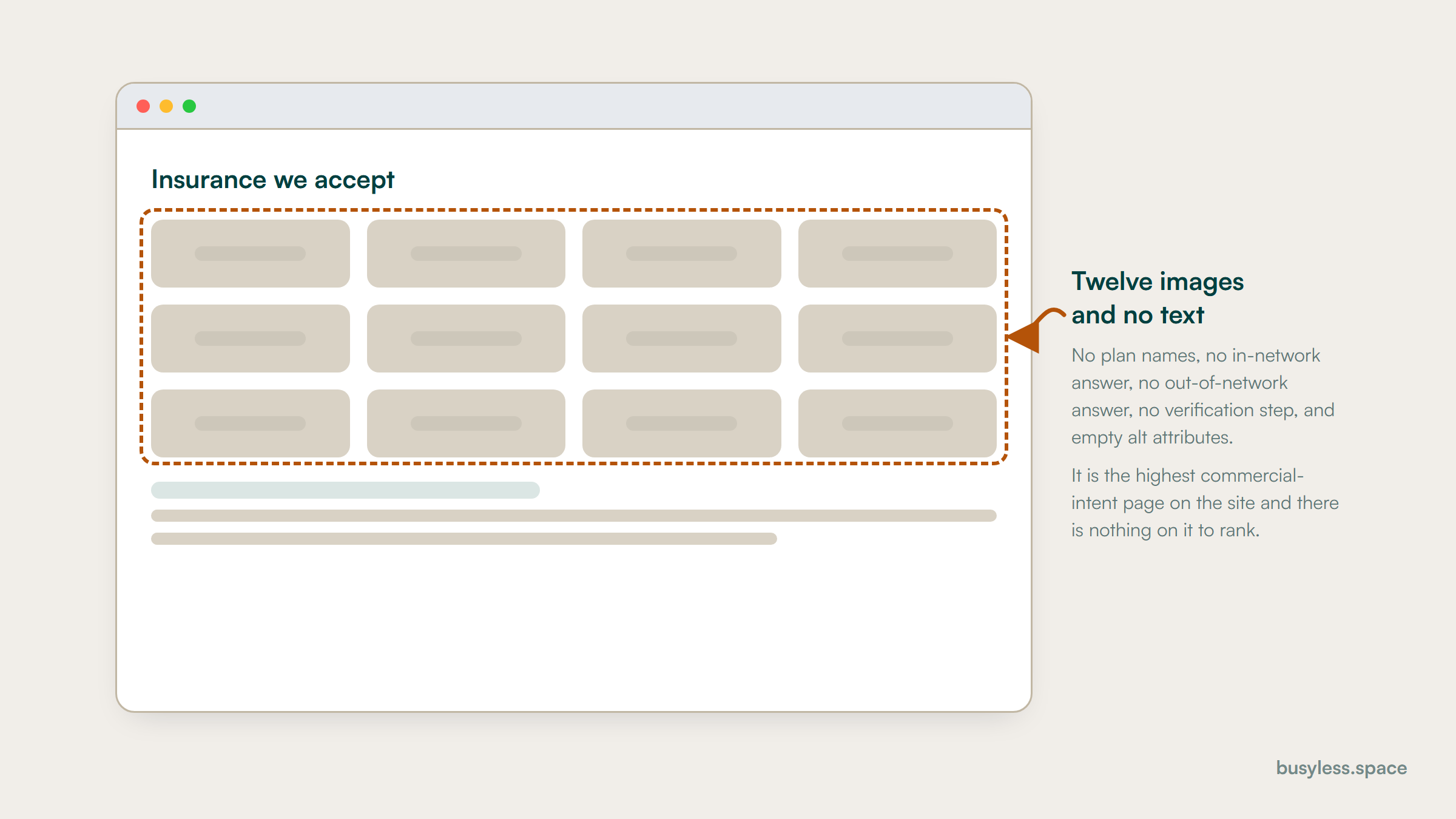
A mock insurance page showing twelve blank carrier logo tiles and almost no text, with the logo grid outlined and annotated: no plan names, no in-network answer, no out-of-network answer, no verification step and empty alt attributes.
The highest commercial-intent page on most dental sites, with nothing on it a search engine can read.

Structured data that applies here

The types below fit this industry specifically. Most of them earn no rich result on their own, which is worth knowing before anyone sells the work on that basis. What they do is describe the entity precisely, which matters for how search engines and answer engines resolve who you are.

  • Dentist

    Home page and every location page

    A real schema.org type, a subtype of MedicalBusiness and LocalBusiness. One node per physical location with that location's own details, never one node for the group.

    Dentist.jsonld
    {
      "@context": "https://schema.org",
      "@type": "Dentist",
      "@id": "https://[YOUR-DOMAIN]/locations/[SLUG]#practice",
      "name": "[PRACTICE NAME, this location]",
      "url": "https://[YOUR-DOMAIN]/locations/[SLUG]",
      "telephone": "[+1-555-000-0000]",
      "priceRange": "[$$]",
      "image": "https://[YOUR-DOMAIN]/img/[LOCATION].jpg",
      "address": {
        "@type": "PostalAddress",
        "streetAddress": "[123 Example St, Suite 200]",
        "addressLocality": "[CITY]",
        "addressRegion": "[ST]",
        "postalCode": "[00000]",
        "addressCountry": "US"
      },
      "geo": {
        "@type": "GeoCoordinates",
        "latitude": "[00.000000]",
        "longitude": "[-00.000000]"
      },
      "openingHoursSpecification": [{
        "@type": "OpeningHoursSpecification",
        "dayOfWeek": ["Monday","Tuesday","Wednesday","Thursday"],
        "opens": "[08:00]",
        "closes": "[17:00]"
      }],
      "availableService": [
        { "@type": "MedicalProcedure", "name": "[General dentistry]" },
        { "@type": "MedicalProcedure", "name": "[Dental implants]" }
      ],
      "areaServed": { "@type": "City", "name": "[CITY]" }
    }
  • MedicalProcedure

    Each treatment page

    The type that makes a treatment page something other than an untyped article. Keep the name to the words a patient uses, and only describe what you actually perform at this practice.

    MedicalProcedure.jsonld
    {
      "@context": "https://schema.org",
      "@type": "MedicalProcedure",
      "name": "[TREATMENT, in the patient's words]",
      "procedureType": "https://schema.org/SurgicalProcedure",
      "bodyLocation": "[Mouth]",
      "howPerformed": "[Two or three plain sentences describing the appointment.]",
      "preparation": "[What the patient should do beforehand.]",
      "followup": "[Recovery and review appointments.]",
      "provider": { "@id": "https://[YOUR-DOMAIN]/locations/[SLUG]#practice" },
      "url": "https://[YOUR-DOMAIN]/treatments/[SLUG]"
    }
  • Dentist as a person, with credentials

    Each dentist's biography page, referenced from the pages they wrote

    The E-E-A-T node. It only helps if the page it describes is genuinely bylined by that person, and if the licence number is real and checkable.

    Dentist as a person, with credentials.jsonld
    {
      "@context": "https://schema.org",
      "@type": "Dentist",
      "@id": "https://[YOUR-DOMAIN]/team/[SLUG]#person",
      "name": "[Dr FIRST LAST], [DDS or DMD]",
      "jobTitle": "[Practice owner]",
      "url": "https://[YOUR-DOMAIN]/team/[SLUG]",
      "image": "https://[YOUR-DOMAIN]/team/[SLUG].jpg",
      "worksFor": { "@id": "https://[YOUR-DOMAIN]/locations/[SLUG]#practice" },
      "alumniOf": {
        "@type": "CollegeOrUniversity",
        "name": "[DENTAL SCHOOL]"
      },
      "hasCredential": [{
        "@type": "EducationalOccupationalCredential",
        "credentialCategory": "State dental licence",
        "identifier": "[LICENCE NUMBER]",
        "recognizedBy": {
          "@type": "GovernmentOrganization",
          "name": "[STATE] Board of Dental Examiners"
        }
      }],
      "knowsAbout": ["[Implant dentistry]", "[Clear aligner treatment]"]
    }
  • Offer with a price range

    Treatment pages where you publish a real range

    Only mark up a range you will actually honour, and only where the same range is visible on the page. A marked-up price a patient cannot find in the copy is worse than no markup.

    Offer with a price range.jsonld
    {
      "@context": "https://schema.org",
      "@type": "Service",
      "name": "[TREATMENT]",
      "provider": { "@id": "https://[YOUR-DOMAIN]/locations/[SLUG]#practice" },
      "areaServed": { "@type": "City", "name": "[CITY]" },
      "offers": {
        "@type": "Offer",
        "priceSpecification": {
          "@type": "PriceSpecification",
          "minPrice": "[0000]",
          "maxPrice": "[0000]",
          "priceCurrency": "USD",
          "valueAddedTaxIncluded": false
        },
        "description": "[What the range includes and what changes it. No payment terms here, see the Regulation Z note.]"
      }
    }
  • FAQPage

    Treatment and cost pages with genuinely visible questions

    Mark up only questions a visitor can see and answers that match the visible text word for word. Reserve it for the cost questions, which are the ones actually being asked.

    FAQPage.jsonld
    {
      "@context": "https://schema.org",
      "@type": "FAQPage",
      "mainEntity": [
        {
          "@type": "Question",
          "name": "[Question exactly as it appears on the page]",
          "acceptedAnswer": {
            "@type": "Answer",
            "text": "[Answer exactly as it appears on the page. Give a real range where you have one.]"
          }
        }
      ]
    }
  • BreadcrumbList

    Treatment and location pages

    Modest on its own. Do it once treatments and locations are real hierarchies rather than a flat list of vendor pages, and expect the exercise to expose how disorganised the treatment section is.

    BreadcrumbList.jsonld
    {
      "@context": "https://schema.org",
      "@type": "BreadcrumbList",
      "itemListElement": [
        { "@type": "ListItem", "position": 1, "name": "Home",
          "item": "https://[YOUR-DOMAIN]/" },
        { "@type": "ListItem", "position": 2, "name": "[Treatments]",
          "item": "https://[YOUR-DOMAIN]/treatments" },
        { "@type": "ListItem", "position": 3, "name": "[TREATMENT]",
          "item": "https://[YOUR-DOMAIN]/treatments/[SLUG]" }
      ]
    }

What it costs

Editorial estimates rather than quotes. Dental costs more than most local service verticals for one structural reason: you are competing against practices funded by elective margins, and in many metros against groups with a central marketing team. The tiers below assume a practice that already has patients and wants more of the profitable kind.

Lean

$1,500 to $3,000
  • Profile, insurance directories and manufacturer locators kept accurate
  • The insurance page and the top five treatment pages rewritten properly
  • Location pages built correctly, one per office
  • Two or three new pages a month, aimed at the elective cluster
  • Structured data, and reporting split into leading and business indicators

Who it suits

A single practice in a normal market that has decided search is a channel rather than an experiment

Where it stops

It will not out-produce a group practice with a content team, and it does not fund a proper case-study programme. It also cannot fix a two-star review profile.

Funded

$3,500 to $8,000
  • The full elective funnel: comparisons, case write-ups, financing and anxiety pages
  • A photography workflow that produces publishable cases with authorizations on file
  • Call and booking attribution reconciled against the practice management system
  • Content at a cadence that compounds rather than in occasional batches
  • Competitive work in a market where several practices are already doing this properly

Who it suits

A practice with real elective capacity to fill, or one in a metro where the obvious work is already done by everyone

Where it stops

This is the tier that competes with the dental marketing specialists. It does not buy its way past a schedule that is already full or a front desk that does not convert calls.

Group and multi-location

$8,000 and up
  • Location pages and profiles managed as a system rather than one at a time
  • Shared treatment content that stays distinct per location instead of duplicating
  • Consistency management across dozens of directory and carrier listings
  • Per-location reporting, so a weak office is visible rather than averaged away
  • The content infrastructure to add a location without a developer

Who it suits

Anything above about four locations, where the failure mode changes from writing to consistency

Where it stops

Scale creates its own problem: duplication across location pages. Solving that is a content modelling job, not a budget one.

How to do it with no budget

For a single practice with no budget, the list below is genuinely most of the available value, and none of it requires a website change beyond text edits.

  1. 1

    Rewrite the insurance page in plain text

    2 hours

    Your website editor

    Every carrier and plan name spelled out, with in network or out of network stated per carrier. This is the highest return per hour anywhere on this page.

  2. 2

    Complete the Google Business Profile

    3 hours, then 20 minutes a week

    Google Business Profile

    Primary category, each treatment as its own service entry, photographs of the actual practice, and hours that include any Saturday cover. Most competitors filled in about a third of this and stopped.

  3. 3

    Check every insurance carrier directory listing

    3 hours once, then quarterly

    Each carrier's provider portal

    The listings drift badly. Wrong address, wrong phone, wrong accepting-new-patients flag. Patients who cannot reach you from the carrier's own tool do not try again.

  4. 4

    Claim the manufacturer and system locators

    2 hours

    Each manufacturer's provider portal

    Free, high authority and almost always incomplete. If you are certified on an aligner or implant system, that listing ranks for the brand query you cannot win outright.

  5. 5

    Fix the review reply process

    1 hour

    A document and twenty minutes of training

    Write one approved reply that never confirms anyone is a patient, and make sure whoever answers reviews uses it. This is a liability fix before it is a marketing one.

  6. 6

    Run the duplication check on your treatment pages

    1 hour

    A search engine and quotation marks

    One sentence from the middle of each page, searched in quotes. The result is a prioritised rewriting list, produced in an afternoon, that most practices have never seen.

  7. 7

    Write the anxiety page

    2 hours

    Your website editor

    How you actually handle a nervous patient, in specifics. Barely contested locally, and the patients it brings have usually avoided dentistry for years, which makes them worth a great deal over time.

The tool stack

Jobs first, tools second. A single practice needs almost none of the paid tooling below; a group above four locations needs most of it, because the problem changes from writing pages to keeping dozens of listings consistent.

  • Track local pack position from each location's own catchment

    DataForSEOSEO APIRead the review

    Rank tracking has to be geo-specific or it means nothing. A practice can own the pack at its own address and be invisible three miles away where the new housing is.

    Free routeManual checks from a few postcodes, workable for one office and not for four

  • Find the cost and comparison queries worth writing for

    Google Search Console plus the front desk

    Write down what patients actually ask when they ring about implants. Those exact words are your keyword list, and they beat anything a tool will hand you here.

    Free routeBoth free, and the front desk is the better source

  • Model what a new patient from search is worth

    SEO Revenue Growth CalculatorFree toolOpen the tool

    Run it twice, once for routine and once for elective. A blended new-patient value hides the entire argument for funding the elective funnel.

    Free routeFree

  • Set a defensible budget for the practice owner

    SEO Budget CalculatorFree toolOpen the tool

    A sanity check against the tiers above, in a form an associate or a partner can read without a marketing background.

    Free routeFree

  • Generate the Dentist and MedicalProcedure markup

    Schema Markup GeneratorFree toolOpen the tool

    Produce it once, validate it, and put it in the template so no page is hand-edited. The Dentist type is the piece almost nobody bothers with.

    Free routeFree

  • Run many location pages without a developer per location

    PayloadHeadless CMSRead the review

    Locations, treatments and clinicians are related entities. Modelling them properly is what stops twelve location pages becoming one template with the suburb swapped.

    Free routeFree and self-hosted

  • Attribute phone calls without breaking listing consistency

    A call tracking vendor with dynamic number insertion

    The phone is still the conversion here. Insert numbers for paid and referral traffic only, and leave the real number in place for organic, or the fix costs more ranking than the data is worth.

  • See what AI assistants say when somebody describes a symptom

    LLM visibility trackerOur toolSee the tool

    Patients increasingly describe the pain to an assistant before searching. The answers lean on clear clinical explainers, which is an argument for writing the triage cluster rather than skipping it.

Take it from here

Everything below is yours to take. Fill the [BRACKETS] and it is ready to use. Start with the insurance page audit: it is the fastest fix on this page and it sits on the highest-intent query in the routine funnel.

Checklist

The fastest win available to most practices. The page a patient reaches when they search a plan name is usually a grid of logos, which means it cannot rank for a single one of them.

INSURANCE PAGE AUDIT - [PRACTICE] - [DATE]

WHY THIS IS FIRST
"Dentist that takes [carrier]" is a booking query, not a browsing
query. If your carrier names exist only inside image files, the page
cannot appear for any of them.

1. WHAT IS ON THE PAGE NOW
   [ ] Carrier names appear as real text          Y / N
   [ ] Plan names appear as real text             Y / N
   [ ] In network vs out of network stated        Y / N
   [ ] A phone number and a booking route         Y / N
   [ ] Page still readable with JavaScript off    Y / N

   Quick test: load the page, select all, copy, paste into a text
   editor. Every carrier name you cannot see in the paste is
   invisible to a search engine too.

2. LIST EVERY CARRIER, HONESTLY
   | Carrier         | Plans accepted | In network? | On page as text? |
   |-----------------|----------------|-------------|------------------|
   | [_____________] | [____________] | [ Y / N ]   | [ Y / N ]        |
   | [_____________] | [____________] | [ Y / N ]   | [ Y / N ]        |
   | [_____________] | [____________] | [ Y / N ]   | [ Y / N ]        |
   | [_____________] | [____________] | [ Y / N ]   | [ Y / N ]        |
   | [_____________] | [____________] | [ Y / N ]   | [ Y / N ]        |

3. THE OUT-OF-NETWORK ANSWER
   Patients search this too, and most practices say nothing.
   Write two or three sentences explaining what happens if you are
   out of network with their plan: whether you file for them, what
   reimbursement usually looks like, what they pay on the day.

   [_____________________________________________________________]
   [_____________________________________________________________]

4. THE OTHER DIRECTION
   For each carrier you are credentialed with, open THEIR provider
   directory and check what it says about you.
   | Carrier         | Address right? | Phone right? | Accepting new? |
   |-----------------|----------------|--------------|----------------|
   | [_____________] | [ Y / N ]      | [ Y / N ]    | [ Y / N ]      |
   | [_____________] | [ Y / N ]      | [ Y / N ]    | [ Y / N ]      |

5. FIX LIST
   [ ] Rewrite carrier and plan names as text
   [ ] Add in network / out of network status per carrier
   [ ] Add the out-of-network explanation
   [ ] Add a booking route on the same page
   [ ] Correct [__] carrier directory listings
   [ ] Set a quarterly reminder to re-check all of it

What to publish

Ordered by how quickly it turns into booked treatment. Dental sites write about the practice; what pays is a decision the patient is trying to make and cannot get a straight answer on.

  • A real insurance page

    Once, then reviewed whenever your credentialing changes

    The highest commercial intent on the site, and it is a text problem rather than a writing problem. Nobody searching a plan name is browsing.

  • Rewritten treatment pages, bylined

    Five to start, then one a month

    Replaces vendor copy that exists on a thousand other sites with something only you can publish, attached to the person who does the work.

  • Honest price ranges with what moves them

    Once, reviewed when fees change

    The most searched elective question and the one competitors refuse to answer. It also shortens consultations, because the patient arrives already knowing the shape of the number.

  • Case write-ups with photographs

    One or two a month, once the authorization workflow exists

    The most persuasive asset in cosmetic dentistry, and usually the least discoverable. Each one is a page no competitor can copy.

  • Comparison pages

    One per real treatment decision

    Implant against bridge, aligners against fixed braces, whitening options against each other. High margin, high trust, and the fair version outperforms the sales version.

  • Anxiety, access and first-visit pages

    Once, properly

    An underserved cluster that reaches people who have avoided dentistry for years. They are expensive to acquire anywhere else and they stay for a decade.

And what not to

  • The vendor procedure library, republished with a new logo on it
  • A page for every suburb within twenty miles, which is the same doorway pattern the trades fall into
  • Practice news, staff birthdays and charity days, which nobody searches and which crowd the blog
  • Before-and-after images published without a marketing authorization on file for each one
  • Any review reply that confirms the reviewer is a patient, however friendly
  • "Specialist" and "specialising in" where your state board reserves those words
  • A monthly payment figure in an advert, unless somebody has signed off the credit disclosures
The expensive mistakes

Treating the insurance page as a trust badge rather than a landing page

Costs you The highest-intent query in the routine funnel, lost, on a page that would take an afternoon to fix

Carrier and plan names in text, in network status stated per carrier, and a booking route on the same page

Republishing the vendor treatment library

Costs you A treatment section that cannot rank because it is identical to a thousand other practices, and a year of blog effort compensating for it

Rewrite the five with real demand, bylined, with your own cases and your own prices

Marketing only the elective work

Costs you An empty hygiene schedule, which is where recall and lifetime value actually come from, and a practice that lives on one-off cases

Fund both funnels deliberately, and report them separately so neither hides the other

Letting the front desk reply to reviews freely

Costs you A regulatory exposure OCR has already fined a practice for, sitting in public with a timestamp on it

One approved reply that never confirms a relationship, plus a phone number and a named person

One page for four locations

Costs you Three offices with nothing to rank on, in a channel that is decided location by location

A page per location with its own number, hours, team and profile, and its own reporting line

Reporting sessions to the practice owner

Costs you The budget goes in the first quiet month, because nothing in the report connects to a chair being filled

New patients and accepted case value by source, with the attribution gap stated plainly

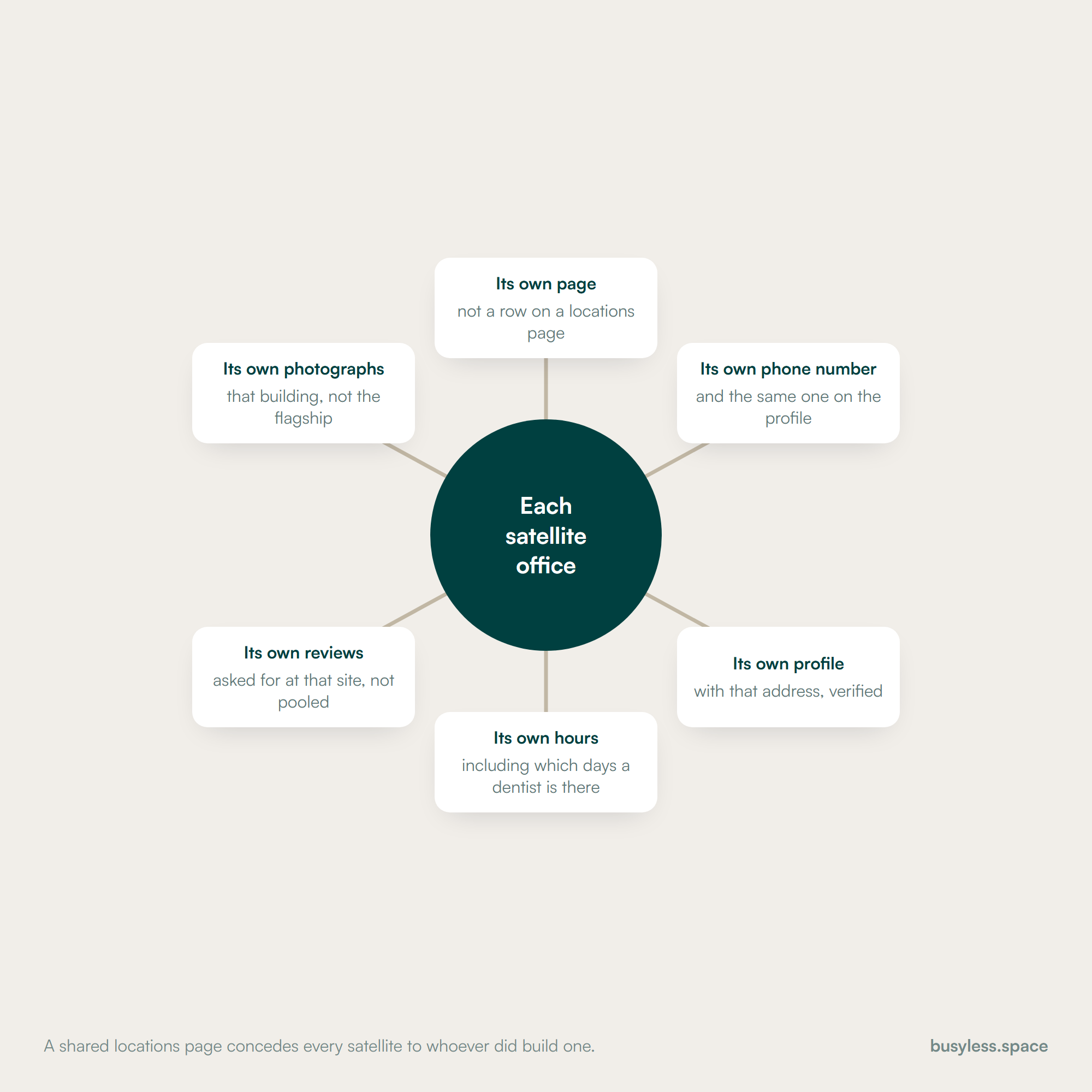
A hub and spoke diagram with each satellite office at the centre, connected to six things it needs of its own: its own page, its own phone number, its own profile, its own hours, its own reviews and its own photographs.
Six things, per site, none of them optional. A shared locations page concedes every satellite to whoever did build one.

What to measure

Dental attribution is more tractable than most health verticals, because the practice management system knows exactly what happened and what it was worth. The gap is at the front: a patient who found you through search may book by phone, and the value of that patient is not known until treatment is accepted.

Leading indicators

Move first. They predict, they do not prove.

  • Local pack position by location

    Geo-specific rank tracking

    Measured from the catchment rather than the practice address, and reported per office. An average across four locations tells you nothing about any of them.

  • Profile actions: calls, direction requests, booking clicks

    Google Business Profile insights

    The fastest-moving indicator here and the best free proxy for routine demand. It responds to profile work within weeks.

  • Impressions on the elective cluster

    Search Console, filtered to treatment and cost queries

    The slow one, and the one that compounds. It is the only early evidence that the content programme is doing anything at all.

  • Review volume and average, by location

    Google Business Profile and the review platforms

    Report volume alongside average. A rising average with no new reviews usually means somebody is filtering, which is the thing the compliance section warns about.

Business indicators

The ones a manager acts on.

  • New patients from search

    Practice management system, reconciled with call and booking attribution

    Needs whoever answers the phone to record a source consistently. That is a training problem, and it is worth more than any tool you could buy to work around it.

  • Accepted case value by source

    Practice management system

    The number that decides the budget. It is also the one that shows whether the elective content is reaching people who accept treatment or people who read and leave.

  • Routine and elective mix

    Practice management system

    The elective programme should move this over quarters. If it does not, the content is attracting readers rather than patients and the pages need a decision point.

  • Cost per new patient by channel

    Production data plus channel spend

    Compare organic honestly against the paid marketplaces. This is the number that decides whether a marketplace subscription is worth renewing.

The verdict

Dental is one of the most competitive local verticals anywhere, and it is also one where the obvious work is still undone almost everywhere. The insurance page, the vendor content and the location pages are three fixes with real intent behind them, and they take weeks rather than quarters.

The genuinely defensible asset is your own clinical voice. Cases you treated, prices you will honour, comparisons that sometimes recommend the cheaper option, all bylined by a named dentist with a checkable licence. None of that can be syndicated to a competitor, which is exactly why it works.

Dental SEO services are easy to buy badly. Three questions make it harder. Will they rewrite the vendor procedure pages or add to them? Will they check your review replies against HIPAA before touching anything else? Will they report new patients and accepted case value rather than traffic?

Expect a weak answer on the first two. Rewriting is slower than publishing and compliance is not a growth story, so SEO services for dentists are rarely sold on either. I would not sign without the third, since it is the only one that tells you whether any of it worked.

FAQ

Dental SEO questions

  • How long does it take a dental practice to see results?
    The listing and insurance page work can move new patient calls within four to twelve weeks, because it fixes queries that already have intent behind them rather than creating new demand. The elective content cluster takes five to nine months to build momentum. If you are in a metro where several practices are already doing this properly, add a few months to both.
  • Why does our website say the same thing as every other dentist in town?
    Because it probably does. A small number of dental-specific website vendors build a large share of practice sites, and the treatment library ships with the template. Take one sentence from the middle of your dental implants page, search it in quotation marks, and count the results. Rewriting the pages that have real search demand is usually the highest-value content work available to a practice.
  • Should we publish our prices?
    Ranges, yes, with what moves them. The objection is always that every case is different, which is true and is exactly why a range with the variables listed is the honest answer rather than a fixed number. Be careful with monthly payment amounts specifically: stating one in an advertisement engages the Truth in Lending Act's advertising rules, so publish the total range and leave the payment terms to your financing partner.
  • Can we reply to a bad review?
    Yes, but not in the way most practices do. Confirming that somebody is a patient is itself a disclosure of health information, and the HHS Office for Civil Rights settled with a Dallas dental practice in October 2019 over exactly that. Use one approved reply that thanks the reviewer, says you do not discuss anyone's information publicly, and gives a phone number and a named person. Never reference the treatment, the visit or your records.
  • Is Zocdoc worth it?
    It is a lead-buying decision rather than an SEO one, so price it that way: cost per booked new patient, compared honestly against your own channels. Two things to weigh. It ranks well for insurance and dentist-plus-city queries in most metros, which is real distribution. It also competes with you for your own brand name, and the patients it sends are shopping on availability rather than choosing you.
  • What about the insurance directories?
    They are the most underrated channel in this vertical. A large share of patients start at their carrier's find-a-dentist tool rather than a search engine, you are already in it if you are credentialed, and the listing is almost always wrong or incomplete. Checking every carrier's entry for your practice takes an afternoon and it costs nothing. Put it on a quarterly reminder, because they drift.
  • What does dental SEO cost?
    The tiers above are editorial estimates rather than quotes. A single practice running a real programme is realistically looking at $1,500 to $8,000 a month, driven mainly by how contested the metro is and how much elective capacity there is to fill. Below that you are buying maintenance, which is worth having if it is done properly and is not sold as growth.
  • Can we use AI to write treatment pages?
    Use it to get a draft written, which is the step most practices never get past. For publishing without a dentist reading and correcting it, no. These pages carry clinical claims, prices you will be held to, and in some states words your board regulates. Draft with AI, have the clinician who does the work rewrite the parts that are actually about your practice, and put their name, degree and licence number on the page.

Run it yourself, or have someone own it

Everything above is written to be run without us, and the free path is genuinely most of the value for a single-location business. Where these plans stall is almost never the plan. It is that nobody owns it after the first month. That is the job we do, with search as one distribution layer inside a wider system rather than the whole engagement.