
Semrush API review
Best for competitor research
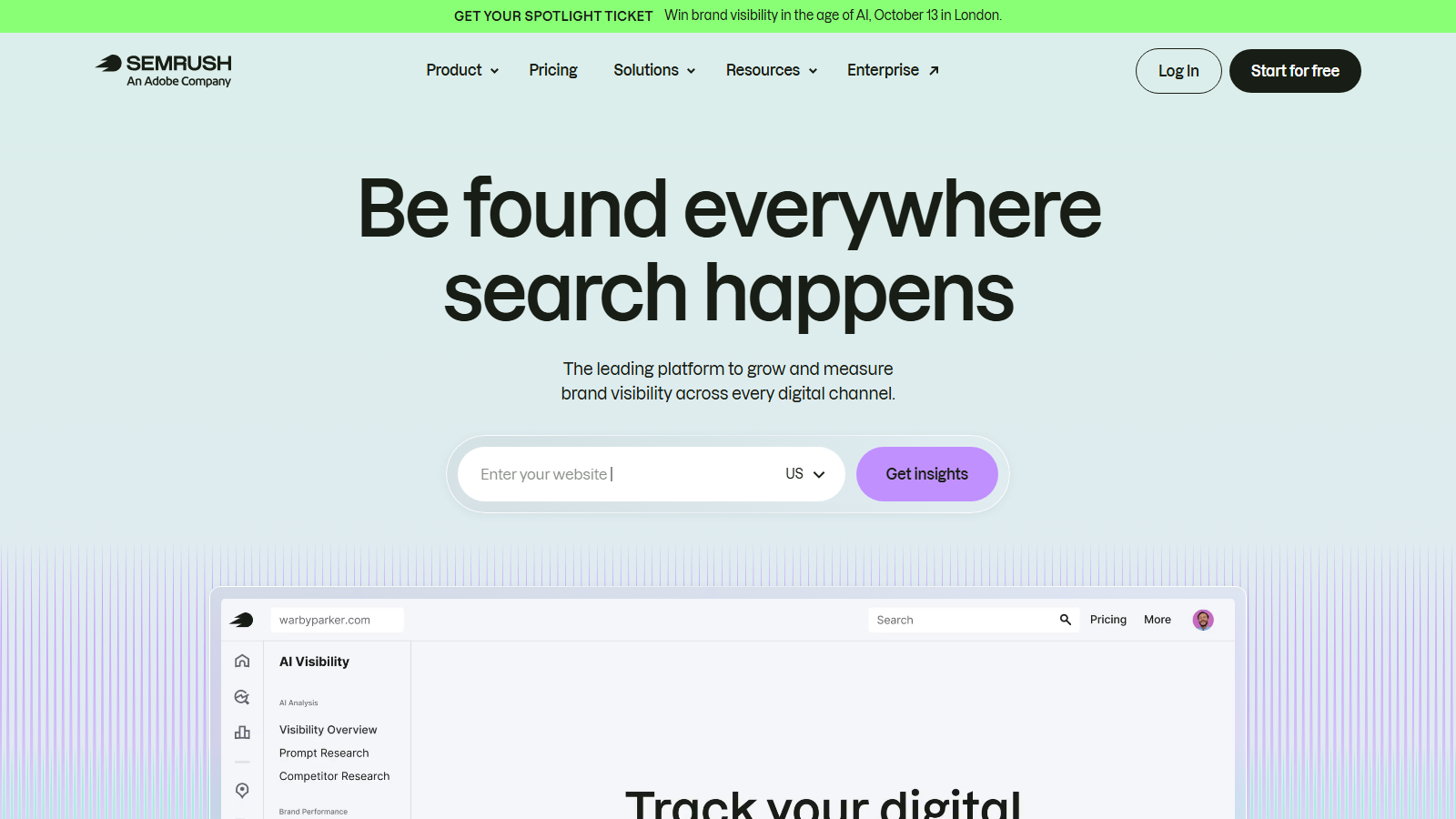
Semrush sells one of the two best-known SEO datasets in the category, and the API is how you get it into your own reporting. It arrives in three parts that most buyers conflate: the Standard API for domain and keyword analytics, the Trends API for traffic and clickstream estimates, and the Projects API for the audit and position-tracking data belonging to your own projects. They are bought separately and they meter separately.
Adobe completed its acquisition of Semrush on 28 April 2026, an all-cash deal worth $1.9bn at $12.00 a share, and the homepage wordmark now reads "An Adobe Company".
The customer FAQ commits to "no immediate changes to your current services, agreements, or points of contact" and adds that there are no changes to existing contracts "at this time". Both hedges are Semrush's own words, and no timeline sits behind either of them. That is not a reason to avoid the API, but it is a reason to keep the integration behind an interface you could repoint.
The pricing is where this gets genuinely awkward, and not because it is expensive. The plan the developer documentation tells you to buy no longer exists. Semrush retired the Business tier and now sells Free, SEO, Starter, Pro+ and Advanced, of which only Advanced lists API data integration.
The developer portal and the knowledge base both still name a "SEO Business" plan. Budget against the pricing page and confirm with sales, because the docs will send you looking for a product that is not on it.
Our scorecard
Our editorial read across six dimensions, scored 1 to 5. This is our own assessment, not an aggregate of user reviews, and it is deliberately kept out of the page's structured data.
- Data coverage5/5
Keyword lists run deep in its largest markets, and the Trends clickstream data has few real equivalents.
- Pricing2/5
A top-tier plan and a unit package stacked on each other, and the packages carry no public price at all.
- Documentation3/5
Endpoints are documented well with real example requests. The plan names in them are wrong, which is a bad first impression.
- Ease of integration4/5
Plain GET requests with an API key, CSV or JSON. Getting access approved takes longer than writing the code.
- Reliability4/5
A long track record and a large body of community integration code. No published per-second rate limit to design against.
- Support4/5
Responsive, and unit questions get real answers. The Adobe transition is the open question rather than support quality.
An editorial read, not an aggregate of user reviews, and deliberately kept out of this page's structured data.
What you can pull
SEO API (v3 and v4)
Per line on domain reports, fixed per request on others
Domain analytics, keyword research, organic and paid positions, backlinks and authority data, returned as CSV or JSON
Projects API (v3 and v4)
Consumes standard API units
Site Audit and Position Tracking data for projects in your own account, rather than third-party estimates
Trends API (v3)
Bought separately. 10,000 requests a month by default
Website traffic estimates, clickstream behaviour, market dynamics and AI search traffic data
Listing Management API (v4)
Needs a Local Pro or Local Business plan, no units
Business location data and directory listing distribution
Review Management API (v4)
No API units required
Customer reviews, ratings, rating distribution and reply statistics
Google Business Profile API (v4)
No API units required
GBP categories, attributes, posts, extended hours and performance metrics
Map Rank Tracker API (v4)
Open to all users, no units
Local pack rankings by location, campaign and competitor data
Who Semrush API is for
Teams already standardised on Semrush that want its numbers inside their own dashboards, and competitor-intelligence work where keyword depth in the large markets decides the answer. The Trends API is the real draw, because competitor traffic and clickstream estimates are data most of this directory cannot return at any price.
As a first SEO API it is hard to recommend. Two stacked costs, one of them unpublished, and an access path the documentation describes incorrectly is a lot of friction to absorb before the first row of data arrives.
Strengths and limits
What it does well
- Keyword lists run deep per market: by each vendor's own published counts, longer than Serpstat's in 113 of the 121 countries both cover, which is what makes it hold up on international work.
- The Trends API returns competitor traffic and clickstream estimates that few providers in this directory expose at all, now including AI search traffic.
- The Projects API returns your own audit and position-tracking data, so internal reporting does not need a second subscription underneath it.
- Four of the seven APIs consume no units at all, including review management, Google Business Profile and map rank tracking, which makes local work far cheaper than the headline suggests.
- Plain GET requests returning CSV or JSON, with a free balance endpoint you can poll before a large job.
- A long track record and a deep well of community integration code, so almost nothing you build is a first attempt.
Where it falls short
- Two costs stacked on each other, and the second one has no public price. You cannot model this from the website.
- Your unit balance is zero the moment you upgrade. The plan buys permission, not data.
- Unused units expire on renewal rather than rolling over, so over-buying is a real loss and under-buying stops the pipeline mid-month.
- The developer portal and the knowledge base both name a Business plan that is no longer sold, so the documented access path is wrong.
- Historical data costs five times what current data costs on a per-line report, which makes backfills far more expensive than they look.
- Traffic and volume figures are modelled rather than measured, and practitioners are consistent that the deltas against Search Console are large.
- Adobe completed the acquisition on 28 April 2026, a few months before this review, and the commitments in the customer FAQ are all hedged with "at this time".
Semrush API pricing
There are two line items and only one of them has a price. API access sits on the Advanced plan at $549 a month billed monthly, or $455.67 a month billed annually. That is the entry ticket and it includes no data: Semrush's own documentation states that your unit balance is still zero after upgrading.
Units are then bought as packages of 2, 5, 10 or 20 million. Semrush publishes the package sizes and no package prices, so the second half of your bill is a sales conversation. We are not going to guess at it, and neither should a comparison article.
Model the burn by report type rather than by request count. Domain reports bill per line returned at 10 units for current data and 50 for historical, while others bill a fixed cost per request.
Semrush's worked example is the one to internalise: 500 keywords across 50 domains costs 250,000 units live and 1,250,000 historical, from the same query. Unused units expire on renewal, so the sizing decision is annual and slightly punishing in both directions.
The Trends API is a separate purchase again, with 10,000 requests a month by default, and the local APIs for reviews, Google Business Profile and map rank tracking consume no units at all.
Advanced plan
$549 / mo
$455.67 / mo billed annually
- The only self-serve plan listing API data integration
- Replaces the retired Business tier the docs still name
- Buys the right to use the API, not any units
- Free, SEO, Starter and Pro+ sit below it with no API access
Standard API units
Quote only
Packages of 2m, 5m, 10m or 20m units
- Your balance is zero after upgrading until you buy a package
- No package price is published anywhere on the site
- Renews with your plan, and unused units expire rather than roll over
- Balance is readable free at /users/countapiunits.html
Trends API
Quote only
Basic self-serve, Premium via sales
- Not included in any standard plan, bought as its own thing
- 10,000 requests a month included by default
- Metered in requests, not in standard API units
- The route to competitor traffic and AI search traffic data
Request example
A minimal call against the live endpoint, with credentials read from the environment rather than pasted inline.
curl -s -G "https://api.semrush.com/" \
  --data-urlencode "type=domain_organic" \
  --data-urlencode "key=$SEMRUSH_API_KEY" \
  --data-urlencode "domain=seobook.com" \
  --data-urlencode "database=us" \
  --data-urlencode "display_limit=10" \
  --data-urlencode "display_sort=tr_desc" \
  --data-urlencode "export_columns=Ph,Po,Nq,Cp,Ur,Tr"

# Billed per LINE returned, not per request: 10 units a line for
# current data, 50 a line for historical. Trim display_limit and
# export_columns before you trim anything else.
Rate limits and quotas
- Standard API units start at zero on a new Advanced plan and must be bought as a package.
- Packages come in 2,000,000, 5,000,000, 10,000,000 and 20,000,000 units. No price is published for any of them.
- Units renew with the plan and unused units expire rather than accumulating.
- Domain reports bill per line: 10 units a line for current data, 50 a line for historical.
- Some reports bill a fixed cost per request instead, the backlinks overview among them.
- Semrush's own worked example: 500 keywords across 50 domains is 250,000 units live, or 1,250,000 historical.
- The Trends API includes 10,000 requests a month by default and is metered separately from standard units.
- No per-second or per-minute rate limit is published, so build your own backoff rather than assuming one.
Third-party reviews
Scores read from each source on 3 September 2026. We report them as-is and publish no rating of our own.
These scores rate the Semrush platform as a whole, not the API specifically. No review site scores the API on its own.
What practitioners say on Reddit
Practitioners separate the two halves of the product cleanly and have done for years: the keyword tooling, clustering and SERP context are rated highly, and the link and audit data are widely distrusted. The recurring advice is to use Semrush for keyword and content work, Ahrefs for link validation, and Search Console as the tie-breaker when they disagree.
The estimates are the sharpest criticism, and one r/bigseo thread put numbers on it: against 487,646 real Search Console clicks for a month, Semrush reported 563,520, Ahrefs 376,776 and Similarweb 619,600. Nobody in that comparison was close, which is the fairer reading than singling one tool out.
The Adobe acquisition has added a second, more speculative thread of concern about roadmap and investment. It is prediction rather than evidence, and worth reading as sentiment about what buyers now think they are signing up to.
“I love SEMrush for their other tools and their keyword data--but I never use their audit or their link data, as it's just not worth looking at.”
r/SEO on Reddit“What ought to be concerning is the massive deltas between estimated traffic and keyword volumes. No one is leading here. All off by -200% to +4000%”
r/bigseo on Reddit“The 'Ahrefs for links / SEMrush for keywords' cliche exists for a reason. SEMrush's keyword tooling, clustering, and SERP context are genuinely strong, especially for planning and content work. Most agencies I know tolerate the backlink gap because the keyword side saves time.”
r/bigseo on Reddit“Semrush is a bit more sophisticated in applying a higher API credit for the call instead of putting the work on the integration development.”
r/bigseo on Reddit“Semrush desperately needs innovation to stay relevant and there is just no way Adobe invests enough to make that happen. More rent seeking. Good for the semrush investors I guess”
r/SEO on Reddit
Verdict
Buy this if you are already on Semrush and the keyword breadth or the Trends clickstream data is the thing your work turns on. Nothing else in this directory returns competitor traffic estimates as readily, and the local APIs are genuinely good value because most of them consume no units.
Do not buy it to save money, and do not buy it as a first SEO API. The real cost is a top-tier plan plus an unpublished unit package, and you cannot finish that sum without talking to sales. For raw SERP and keyword volume, DataForSEO or SE Ranking will cover the same ground for a fraction of it.
The Adobe question is worth holding lightly. A few months in, the public commitments are real but hedged, and no roadmap has been published. That is an argument for keeping your integration behind an interface you could repoint, not an argument against building it.
Semrush API FAQ
How much does the Semrush API cost?
Two line items. API access sits on the Advanced plan at $549 a month, or $455.67 a month billed annually. Units are then bought as packages of 2, 5, 10 or 20 million, and Semrush publishes no price for any of them. Budget for a sales conversation before you can finish the sum.Which Semrush plan do I need for API access?
Advanced, as of September 2026. It is the only self-serve plan listing API data integration. Note that the developer portal and the knowledge base both still tell you to buy a "SEO Business" plan, which Semrush no longer sells. Go by the pricing page and confirm with sales.Does the plan include any API units?
No. Semrush's own documentation says the balance is still zero after upgrading. The plan buys permission to call the API and nothing else, so a unit package is a mandatory second purchase rather than an optional top-up.Do unused Semrush API units roll over?
No. Units renew on the same day as your plan and anything unused expires instead of being added to the new balance. That makes the package sizing decision harder than it looks: over-buy and you lose it, under-buy and the pipeline stops mid-month.How are Semrush API units consumed?
It depends on the report. Domain reports bill per line returned, at 10 units a line for current data and 50 a line for historical. Others bill a fixed cost per request. Semrush's worked example is 500 keywords across 50 domains costing 250,000 units live and 1,250,000 historical, so trimming your row limit matters more than trimming your call count.What changed when Adobe bought Semrush?
Commercially, nothing yet. The acquisition completed on 28 April 2026 for $1.9bn, and the customer FAQ promises no immediate changes to services, agreements, contacts, billing or product access, with no changes to existing contracts "at this time". No integration timeline has been published, so treat the hedge as real and keep your integration repointable.Is the Trends API included?
No, it is bought separately and metered in requests rather than in standard API units, with 10,000 requests a month included by default. Trends Basic is self-serve from the Traffic and Market page and Trends Premium is a sales conversation. It is the only route to the competitor traffic and clickstream data.Semrush API or Ahrefs API?
Semrush for keyword breadth and competitor traffic, Ahrefs for backlink depth and freshness. The practitioner consensus has been stable for years and is worth taking at face value. On cost the comparison is awkward rather than close: Ahrefs now starts API access at $129 a month with 100,000 units, while Semrush publishes a plan price and keeps the data price behind a quote.
Other providers worth a look
This is an independent review. We have no affiliate relationship with Semrush API, earn nothing if you sign up, and no provider pays for placement in the directory. Prices were read from the vendor's own pages in September 2026 and change without notice.