
Skip to content

Accounting SEO strategy

Regulated marketing

Demand spikes to a fixed deadline and software answers the easy queries

Written by Eugene SuslovLast reviewed 28 August 2026No affiliate links
Sector
Legal and financial
Model
Local service, National service
Competition
High
Time to results
6 to 12 months
Typical monthly
$2,000 to $8,000

Key takeaways

  1. 1Your competitor is not another firm. It is irs.gov on the tax questions and Intuit on the software ones, and neither can be outranked on the general version.
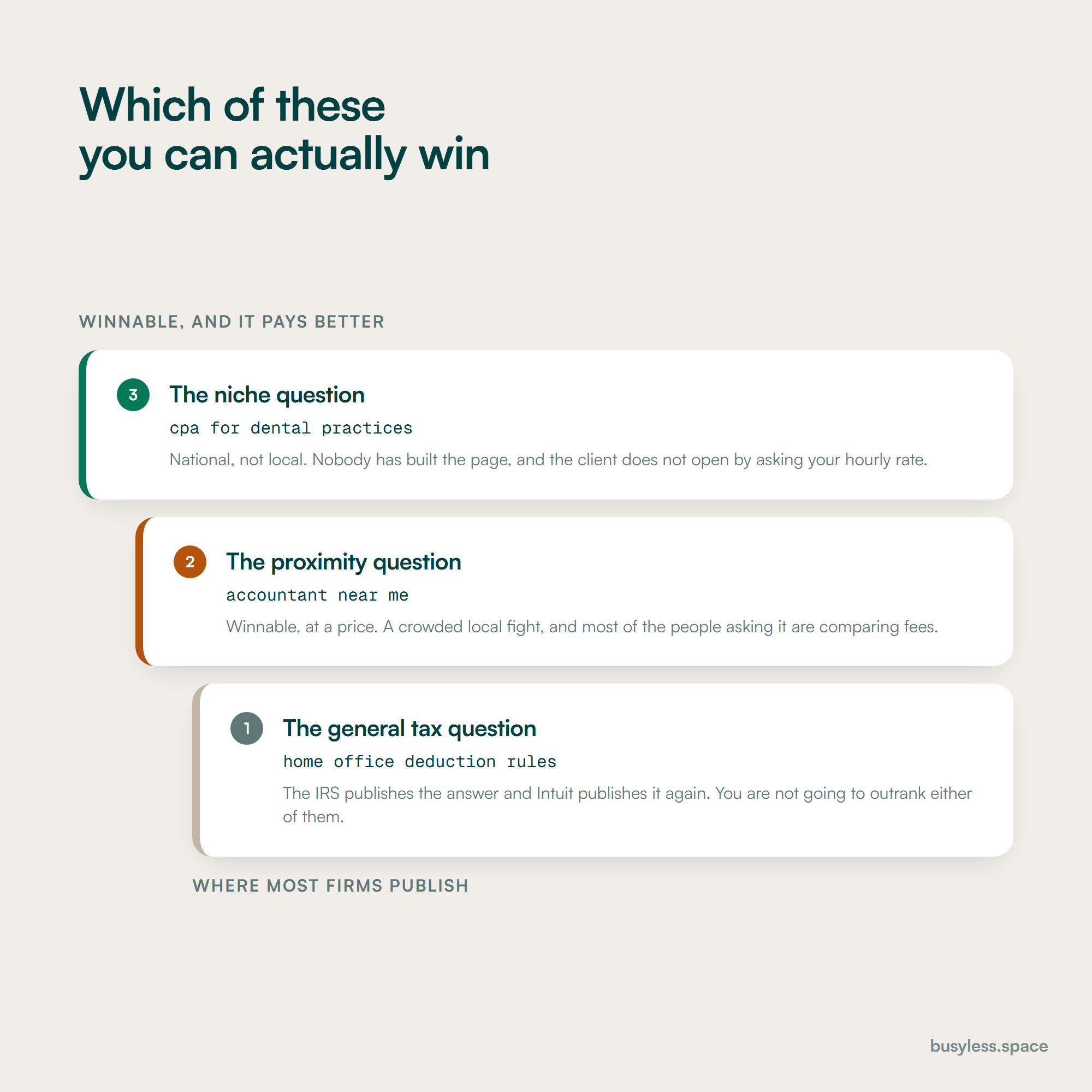
  2. 2Niche beats local. "CPA for [specific industry]" is winnable, nationally, at a higher fee, while "accountant near me" is a crowded local fight for price-shoppers.
  3. 3Your content has a shelf life measured in tax years. A library that is not diarised for annual review becomes actively wrong every January.
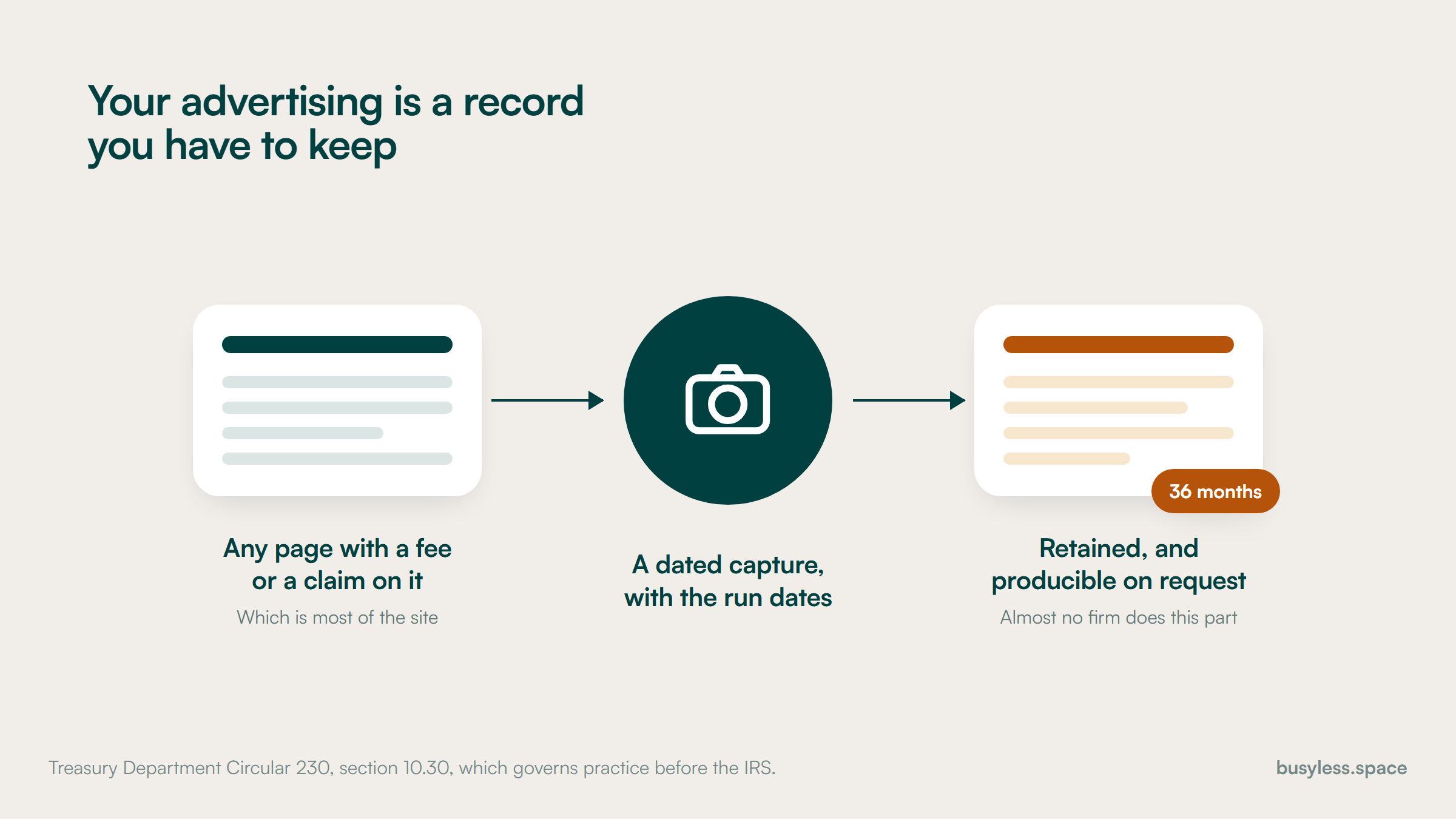
  4. 4Circular 230 restricts advertising for anyone practising before the IRS, and requires copies of your advertising to be kept for 36 months. Almost no firm does the second part.
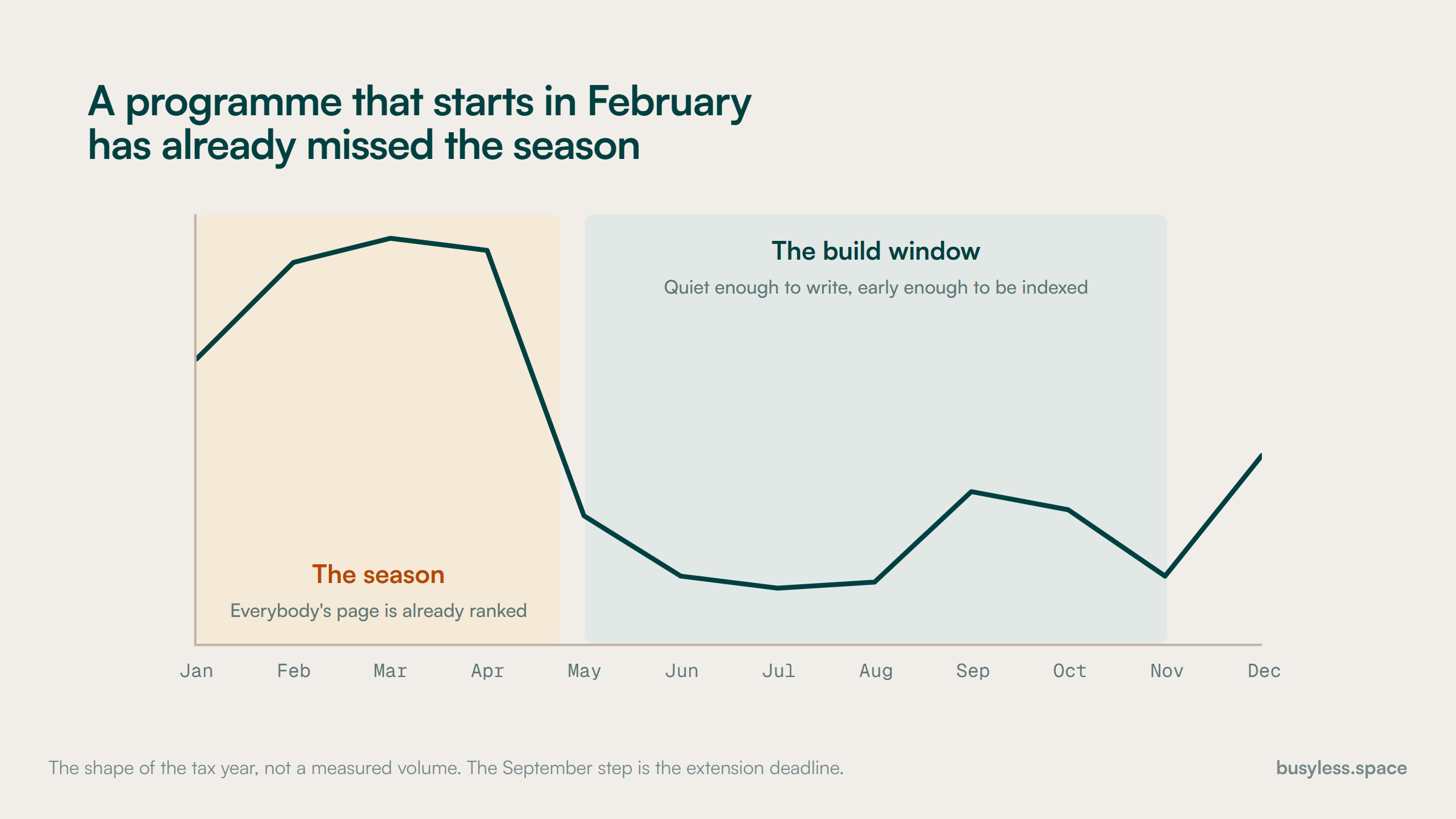
  5. 5Build in the summer. A programme that starts in February has already missed the season it was meant to serve, and the quiet months are when the work is possible anyway.

SEO for accountants is shaped by two forces that do not apply to most professional services. Demand is not flat, it spikes to a fixed calendar date and then vanishes. And the strongest competitors are not other firms.

On tax questions the IRS itself ranks, and it is both authoritative and free. On software questions Intuit ranks, and it has an enormous content operation attached to the product most of your clients already use. Neither can be outranked on the general version of the question.

So an accounting SEO strategy that goes after general tax queries is a plan to lose slowly.

The ground that is actually winnable is narrower and more valuable. A firm that serves one industry properly can rank nationally for that industry's specific problems, charge more, and never compete on proximity at all. "CPA for dental practices" is a different market from "accountant near me", and only one of them is full of price-shoppers.

The seasonality changes the calendar rather than the strategy. Everything gets built between May and November, because January to April there is no capacity to write anything and no time for a new page to rank before the deadline it was written for.

There is also a maintenance burden here that no other industry in this directory carries. Thresholds, rates, brackets and deadlines change annually, which means a content library is a standing commitment rather than a one-off build.

Who already ranks in accounting

Look at who ranks before writing a word. The uncomfortable lesson of accounting SEO is that your competition on the highest-volume queries is a government agency and a software company, not the firm across town. That should change what you write rather than how hard you try.

What is on the results page

  • irs.gov ranking first on most general tax questions, with a knowledge panel alongside
  • Local pack on service-plus-city queries and anything with near me
  • People Also Ask, extremely dense on threshold and deadline questions
  • AI Overviews on tax questions, drawing heavily on the IRS and the large publishers
  • Featured snippets on deadline queries, which is the one place a well-structured page can take ground
  • Software comparison content dominated by the vendors themselves and affiliate publishers
  • The IRS

    irs.gov

    Owns the general tax questions outright and will not be outranked on them. Do not write the generic version of what a 1099 is. Write the version that names your client's industry, your state, and the decision they are actually facing.

  • Intuit

    intuit.com

    TurboTax and QuickBooks between them own the software and self-service queries, backed by a content operation larger than most publishers. The same rule applies: compete on the specific, never on the general.

  • IRS Directory of Federal Tax Return Preparers

    irs.govClaim it

    A free federal listing of credentialed preparers, searchable by location and credential. It is claimable by anyone with a PTIN and the right credentials, it carries government authority, and a surprising number of firms are not correctly listed in it.

  • QuickBooks ProAdvisor directory

    quickbooks.intuit.comClaim it

    A free listing that comes with a certification many firms already hold. High authority, genuine referral traffic, and most firms complete about a third of the profile. Same for the Xero advisor directory if you work in that ecosystem.

  • State CPA society directories

    aicpa-cima.comClaim it

    Most state societies run a find-a-CPA directory included in membership you already pay for. Low traffic individually, high trust, and useful for consistency across your listing set.

  • NerdWallet, Investopedia and Bankrate

    nerdwallet.com

    Own the explainer layer between the IRS and the practitioner. Worth knowing they exist so you do not write against them, and worth reading to see which questions they answer badly for a specific industry.

What people actually search

Accounting search splits by who is asking and when. Most of the volume is people looking for a free answer, and most of the money is a much smaller group looking for someone to take a problem away. The clusters below are ordered by that second thing rather than by volume.

Niche specialisation

Commercial investigation

cpa for dental practices

The page that wins it: A genuine industry practice page with that industry's real problems

The most valuable cluster and the least contested. It ranks nationally, escapes the proximity fight entirely, and attracts clients who are not comparing on price. Almost no firm commits to it properly.

Situation and trigger

Commercial investigation, urgent

received an irs notice cp2000 what do i do

The page that wins it: Notice or situation explainer ending in a clear next step

Somebody with a letter in their hand is not shopping. These queries are low volume, high intent, and largely unwritten by firms because they look like support content rather than marketing.

Threshold and obligation

Informational

do i need to file a 1099 for a contractor

The page that wins it: Answer for a specific business type, not the general rule

The IRS owns the general answer. You win the version scoped to an industry, an entity type or a state, which is also the version that identifies the reader as a potential client.

Deadline

Informational, urgent

when are business taxes due [year]

The page that wins it: A dated deadline page, maintained annually

Spikes hard and predictably. It is also the cluster that goes stale fastest, and a deadline page showing last year's dates is worse than no page at all.

Cost and fee

Commercial investigation

how much does a cpa cost for a small business

The page that wins it: Fee structure page with real ranges and what drives them

Firms resist this more than almost any other industry here. Publishing ranges filters out the price-shoppers, which is precisely the traffic a general accounting site attracts most of.

Software and stack

Commercial investigation

quickbooks vs xero for [industry]

The page that wins it: Comparison scoped to a niche you actually serve

The vendors own the general comparison. The industry-specific version is winnable and it demonstrates exactly the expertise a niche client is looking for.

Entity and structure

Commercial investigation

s corp vs llc for [profession]

The page that wins it: Decision guide with the numbers worked through

High intent, evergreen apart from the rates, and it converts because the answer genuinely depends on facts only an accountant can weigh.

Local service

Local transactional

accountant near me

The page that wins it: A proper local service page plus the profile

The crowded fight. Worth winning if you serve a local market, but it is the cluster most full of price comparison and the one where the niche play does not help.

What the rules change

Lighter than law or health, but with one rule almost nobody complies with. Requirements differ by credential: CPAs answer to a state board and the AICPA, enrolled agents and anyone practising before the IRS answer to Circular 230, and many firms are subject to both. Nothing here is legal or professional advice.

1

Circular 230 restricts advertising, and requires you to keep copies of it

Treasury Department Circular 230, section 10.30

What it means

Circular 230 governs practice before the IRS. Section 10.30 prohibits false, fraudulent, deceptive or misleading advertising, constrains how fee information may be presented, and requires a practitioner to retain a copy or recording of any advertising, along with a record of when and where it was used, for at least 36 months.

So do this

Archive the website. Take dated snapshots of every page carrying a fee or a claim, keep the ad creative, and record the run dates. Almost no firm does the retention part, and it is the half of the rule with a specific number attached to it.

2

Fee statements are constrained, and published fees bind you

Treasury Department Circular 230, section 10.27 and 10.30

What it means

Circular 230 addresses both fee arrangements and how fees may be advertised. Where a fee is published, a practitioner is generally expected to honour it for a period after publication rather than treating it as indicative.

So do this

This is not a reason to publish nothing. It is a reason to publish ranges with the factors that move them, and to date the page. Check the current text of the rule before setting the wording, because the fee provisions have been litigated.

3

Your state board and the AICPA both reach the marketing

AICPA Code of Professional Conduct; state boards of accountancy

What it means

The AICPA Code prohibits false, misleading or deceptive promotional efforts, and state boards adopt their own versions with variation. Rules on firm naming, on describing services, and on what may be claimed about specialisation differ by state.

So do this

Check your own state board on firm naming and on any specialisation language before publishing a niche practice page. The niche play is the strongest strategy here, and the wording of it is the part that is regulated.

4

Client confidentiality constrains testimonials and case studies

AICPA Code of Professional Conduct; Internal Revenue Code section 7216 on return information

What it means

Tax return information carries specific statutory protection, and using it, including in marketing, generally requires client consent. A case study describing a client's tax position is a disclosure question before it is a marketing one.

So do this

Get written consent before publishing anything client-specific, and prefer anonymised, aggregated or scenario-based examples. Never use figures from a return without explicit permission.

Proving expertise

The credentials in accounting are unusually verifiable, which is an advantage: a reader can check a CPA licence or a PTIN in a public register in seconds. Most firm sites publish almost none of it, and lean on stock photography and the word trusted instead.

  • Credentials named precisely, with the state and licence number: CPA, EA, CMA, and which ones apply to which staff
  • PTIN holders correctly listed in the IRS Directory of Federal Tax Return Preparers
  • Software certifications named and matched to a completed listing in that vendor's directory
  • Named authors on technical content, with their credential rather than a firm byline
  • A review date on anything containing a rate, threshold or deadline, maintained rather than set once
  • Citations to primary sources: the Internal Revenue Code, IRS publications, state revenue departments
  • Industry specialisation demonstrated with the specifics of that industry rather than claimed as a list
  • Clear statement of who you serve and, just as usefully, who you do not

How to build a accounting SEO strategy

A realistic sequence, and the start date matters more here than the pace. Begin in the quiet months: an accounting SEO strategy that kicks off in February has no capacity behind it and no time for anything to rank before the deadline it was written for.

  1. 1

    Months 1 to 2, ideally May or June

    Pick the niche and claim what is free

    • Decide the one or two industries the firm genuinely serves best, using your own client list rather than ambition
    • Verify the listing in the IRS Directory of Federal Tax Return Preparers for every credentialed person
    • Claim and complete the QuickBooks ProAdvisor and Xero advisor listings
    • Claim the state CPA society directory and the Google Business Profile
    • Start the Circular 230 advertising archive: dated snapshots of every page carrying a fee or a claim
    • Audit the existing content for anything showing a superseded tax year, rate or threshold

    You end up with
    A chosen niche, a claimed and consistent listing set, and an advertising archive that satisfies the rule nobody complies with

  2. 2

    Months 2 to 5, the quiet season

    Build the niche practice

    • Write the industry practice page properly: their problems, their entity structures, their software, their seasonality
    • Write the threshold and obligation pages scoped to that industry rather than in general
    • Write the software comparison for that industry's stack
    • Write the entity structure guide with the numbers worked through for that profession
    • Publish a fee page with real ranges, dated, and add it to the advertising archive
    • Write the situation and notice pages, which are low volume and high intent

    You end up with
    A body of content that ranks nationally for a niche and escapes the proximity fight entirely

  3. 3

    Months 4 to 8

    Prepare for the season before it arrives

    • Build the deadline pages for the coming year and diarise their update dates
    • Set up the annual review process: every page carrying a rate, threshold or deadline gets an owner and a date
    • Write the local service pages properly, for the part of the business that is genuinely local
    • Add AccountingService and Service structured data
    • Install a review request routine that runs outside the busy season
    • Build the onboarding content that reduces the friction of switching firms

    You end up with
    A site that is current on the day the season starts, and a maintenance process that keeps it that way

  4. 4

    Months 6 to 12

    Measure retained clients, not enquiries

    • Attribute enquiries through to engagement letters signed, and then to clients retained past the first year
    • Report leading and business indicators separately, and never present one as the other
    • Track average fee by source and by niche, because a niche client and a local price-shopper are different businesses
    • Compare like for like against the same month last year, never against last month
    • Review the niche content on engagements won rather than on sessions
    • Run the annual content refresh before January, not during it

    You end up with
    A report a partner can act on, showing retained clients and average fee alongside the indicators that predict them

Technical fixes with the best payoff

One of these is specific to accounting and it is the one that matters most. Everything else on an accounting site is ordinary, but almost no other industry publishes a library that becomes factually wrong on a schedule.

  • The content library expires every tax year

    A sprint to inventory, then an annual commitment

    Brackets, thresholds, mileage rates, contribution limits and deadlines change annually. A page confidently stating last year's figure is not merely stale, it is wrong, and in a field where the whole product is accuracy that is a credibility problem rather than a ranking one.

    Inventory every page containing a number that changes. Give each an owner and an annual review date. Put a visible last-reviewed date on the page, and prefer a single maintained page per topic over a new one per year unless the year is genuinely the query.

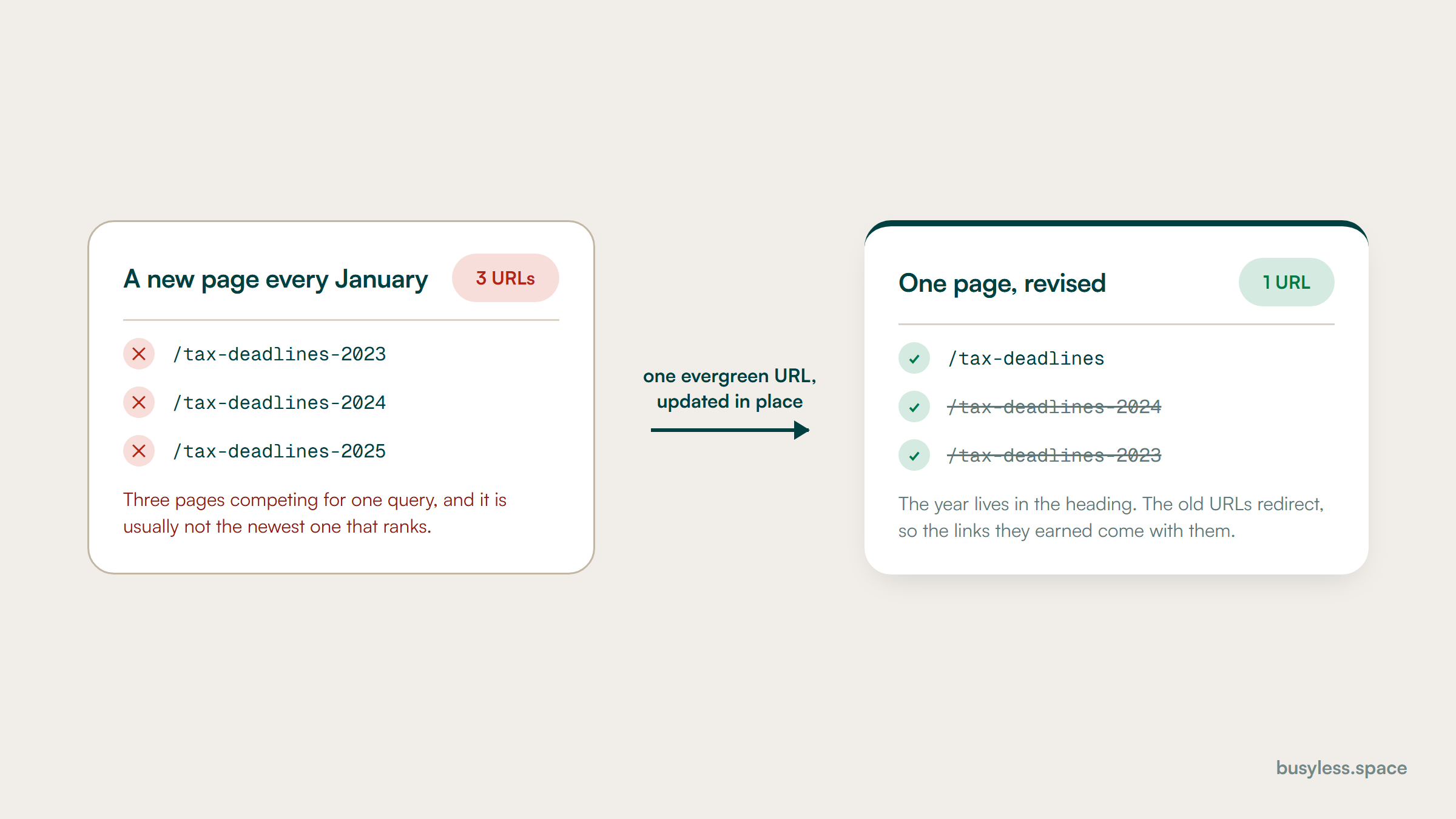
  • Year-in-the-URL pages accumulating

    A day

    Firms publish a new deadlines page every year and leave the previous ones live, so three versions compete with each other and the oldest often outranks the newest because it has had longer to accumulate links.

    One evergreen page per topic, updated in place, with the year in the heading rather than the URL. Redirect the old year-stamped versions into it rather than leaving them to compete.

  • The client portal is an iframe or a subdomain with no content

    An afternoon

    Practice management platforms embed the portal, and firms often put it on a subdomain that carries no content at all. It is not a crawl disaster, but the highest-value page for existing clients contributes nothing.

    Keep the portal where it is and put real indexable content around the entry point: what to upload, when, in what format, what happens next. That content also cuts the number of emails during the season.

  • Calculators built as unindexable widgets

    A day per calculator

    Firms build tax and entity-comparison calculators as JavaScript with no server-rendered content, so a genuinely useful asset ranks for nothing and earns no links.

    Give the calculator a real page with a written explanation, a worked example and the assumptions stated. The prose is what ranks and earns links; the widget is what converts once somebody arrives.

  • The whole site goes quiet from January to April

    A planning decision

    Nobody publishes during the season, which is understandable. The problem is that nobody publishes in the summer either, so the site has no momentum when the season arrives.

    Shift the publishing calendar deliberately: build May to November, maintain December, publish nothing January to April except deadline updates. Plan the capacity that way rather than intending to write in March and failing.

  • No structured data, or a generic LocalBusiness node

    A day

    Schema.org has AccountingService and it is barely used. A generic node also misses the chance to state the services and the area, which for a niche firm is national rather than local.

    Mark up as AccountingService with services and area served, and be honest in areaServed about whether the practice is local or national. A niche firm serving one industry nationwide should not be describing itself as a local business.

Structured data that applies here

The types below fit this industry specifically. Most of them earn no rich result on their own, which is worth knowing before anyone sells the work on that basis. What they do is describe the entity precisely, which matters for how search engines and answer engines resolve who you are.

  • AccountingService

    Home page and firm pages

    A real schema.org type, a subtype of FinancialService and LocalBusiness, and barely used. The important field for a niche firm is areaServed: if you serve one industry nationally, say so rather than describing yourself as a neighbourhood business.

    AccountingService.jsonld
    {
      "@context": "https://schema.org",
      "@type": "AccountingService",
      "@id": "https://[YOUR-DOMAIN]/#firm",
      "name": "[FIRM NAME]",
      "url": "https://[YOUR-DOMAIN]",
      "telephone": "[+1-555-000-0000]",
      "priceRange": "[$$]",
      "address": {
        "@type": "PostalAddress",
        "streetAddress": "[123 Example St]",
        "addressLocality": "[CITY]",
        "addressRegion": "[ST]",
        "postalCode": "[00000]",
        "addressCountry": "US"
      },
      "areaServed": {
        "@type": "Country",
        "name": "United States"
      },
      "knowsAbout": [
        "[NICHE INDUSTRY] accounting",
        "[SERVICE]",
        "[SERVICE]"
      ],
      "openingHoursSpecification": [{
        "@type": "OpeningHoursSpecification",
        "dayOfWeek": ["Monday","Tuesday","Wednesday","Thursday","Friday"],
        "opens": "[09:00]",
        "closes": "[17:00]"
      }]
    }
  • Person

    Staff and partner pages

    The credential fields are the point. A CPA licence and a PTIN are publicly verifiable, so stating them precisely is a trust signal a reader can check in seconds.

    Person.jsonld
    {
      "@context": "https://schema.org",
      "@type": "Person",
      "@id": "https://[YOUR-DOMAIN]/team/[SLUG]#person",
      "name": "[FIRST LAST]",
      "honorificSuffix": "[CPA]",
      "jobTitle": "[Partner]",
      "url": "https://[YOUR-DOMAIN]/team/[SLUG]",
      "worksFor": { "@id": "https://[YOUR-DOMAIN]/#firm" },
      "hasCredential": [
        {
          "@type": "EducationalOccupationalCredential",
          "credentialCategory": "CPA licence",
          "recognizedBy": {
            "@type": "Organization",
            "name": "[STATE] Board of Accountancy"
          },
          "identifier": "[LICENCE NUMBER]"
        },
        {
          "@type": "EducationalOccupationalCredential",
          "credentialCategory": "PTIN",
          "recognizedBy": { "@type": "Organization", "name": "Internal Revenue Service" }
        }
      ],
      "knowsAbout": ["[NICHE INDUSTRY]", "[SPECIALISM]"]
    }
  • Service

    Each service and niche practice page

    For a niche firm this is where the specialisation gets stated in machine-readable form. Keep audience precise: the whole strategy is that you serve one kind of client unusually well.

    Service.jsonld
    {
      "@context": "https://schema.org",
      "@type": "Service",
      "name": "[SERVICE] for [NICHE INDUSTRY]",
      "serviceType": "[SERVICE]",
      "provider": { "@id": "https://[YOUR-DOMAIN]/#firm" },
      "areaServed": { "@type": "Country", "name": "United States" },
      "audience": {
        "@type": "BusinessAudience",
        "audienceType": "[NICHE INDUSTRY]"
      },
      "offers": {
        "@type": "Offer",
        "priceSpecification": {
          "@type": "PriceSpecification",
          "minPrice": "[000]",
          "maxPrice": "[0000]",
          "priceCurrency": "USD"
        }
      },
      "description": "[One plain sentence. Any published fee is dated and archived per Circular 230.]"
    }
  • WebPage

    Anything containing a rate, threshold or deadline

    The type that earns its keep in this industry specifically. A visible and machine-readable review date on a page full of annual figures is both a trust signal and your own maintenance tripwire.

    WebPage.jsonld
    {
      "@context": "https://schema.org",
      "@type": "WebPage",
      "@id": "https://[YOUR-DOMAIN]/[SLUG]#webpage",
      "url": "https://[YOUR-DOMAIN]/[SLUG]",
      "name": "[PAGE TITLE]",
      "datePublished": "[YYYY-MM-DD]",
      "dateModified": "[YYYY-MM-DD]",
      "reviewedBy": {
        "@type": "Person",
        "name": "[FIRST LAST, CPA]",
        "@id": "https://[YOUR-DOMAIN]/team/[SLUG]#person"
      },
      "about": {
        "@type": "Thing",
        "name": "[Tax year YYYY thresholds]"
      }
    }
  • FAQPage

    Pages with genuinely visible questions

    Strong here because threshold and deadline questions are exactly what people type. Mark up only visible questions, and remember the answers are advertising for Circular 230 purposes and belong in the archive.

    FAQPage.jsonld
    {
      "@context": "https://schema.org",
      "@type": "FAQPage",
      "mainEntity": [
        {
          "@type": "Question",
          "name": "[Question exactly as it appears on the page]",
          "acceptedAnswer": {
            "@type": "Answer",
            "text": "[Answer exactly as on the page. Name the tax year for anything that changes annually.]"
          }
        }
      ]
    }
  • BreadcrumbList

    Niche practice and service pages

    Worth it once the niche structure exists, because it makes the hierarchy legible: firm, then industry practice, then the service within it. It also exposes structural muddle when the practice page is buried under a generic services folder.

    BreadcrumbList.jsonld
    {
      "@context": "https://schema.org",
      "@type": "BreadcrumbList",
      "itemListElement": [
        { "@type": "ListItem", "position": 1, "name": "Home",
          "item": "https://[YOUR-DOMAIN]/" },
        { "@type": "ListItem", "position": 2, "name": "[NICHE INDUSTRY]",
          "item": "https://[YOUR-DOMAIN]/[niche]" },
        { "@type": "ListItem", "position": 3, "name": "[SERVICE]",
          "item": "https://[YOUR-DOMAIN]/[niche]/[service]" }
      ]
    }

What it costs

Editorial estimates, not quotes, and they should be spent unevenly. A flat monthly budget in a business with a four-month season is being spent at the wrong time. Weight it toward May through November, when there is capacity to produce anything at all.

Lean

$2,000 to $3,500
  • Every free directory claimed: IRS preparer directory, ProAdvisor, state society, Google Business Profile
  • The Circular 230 advertising archive established
  • One niche practice page built properly, with its supporting content
  • The annual content review process set up with owners and dates
  • A fee page with real ranges, dated

Who it suits

A small firm ready to commit to one niche rather than serving everyone locally

Where it stops

One niche, built slowly. It will not compete on local service queries at the same time, and trying to do both at this budget produces neither.

Funded

$4,000 to $8,000
  • Two niches built out properly, with their own threshold, software and structure content
  • The situation and notice cluster, which is low volume and high intent
  • Calculators built as real pages rather than widgets
  • Local service pages for the part of the business that is genuinely local
  • Attribution through to engagement letters and first-year retention

Who it suits

A multi-partner firm with the capacity to serve a niche nationally rather than a town locally

Where it stops

It does not solve a capacity problem. Winning a niche nationally produces enquiries in January that a firm without the staff to serve them cannot convert.

How to do it with no budget

Everything below costs nothing but time, and the first two are the ones nobody does. Do them in the summer.

  1. 1

    Start the Circular 230 advertising archive

    3 hours to set up, 20 minutes a month

    A dated folder and a screenshot tool

    Section 10.30 requires retaining copies of advertising and a record of when and where it ran, for 36 months. Almost no firm does this. Snapshot every page carrying a fee or a claim, dated, and keep it.

  2. 2

    Verify your IRS preparer directory listing

    20 minutes per credentialed person

    IRS Directory of Federal Tax Return Preparers

    A free federal listing with government authority, and a surprising number of firms are listed incorrectly or not at all. Check the credential shown matches what your site claims.

  3. 3

    Complete the software partner directories

    1 hour each

    QuickBooks ProAdvisor, Xero advisor directory

    Free listings attached to certifications you already hold, with real referral traffic. Most firms fill in about a third of the profile and never revisit it.

  4. 4

    Inventory every page with an expiring number

    Half a day

    A spreadsheet and your own site

    Every rate, threshold, bracket, limit and deadline. Give each page an owner and an annual review date. This is the single highest-value maintenance action in the industry and almost nobody has the list.

  5. 5

    Pick the niche from your own client list

    2 hours

    Your practice management system

    Sort clients by fee, by profitability and by how little they argue. The niche is usually already in the data, and it is rarely the one the partners would have guessed.

  6. 6

    Write the fee page

    A day

    Your website

    Ranges with the factors that move them, dated. It filters out the price-shoppers a general accounting site attracts most of, and it goes into the advertising archive.

  7. 7

    Complete the Google Business Profile

    2 hours, then 20 minutes a month

    Google Business Profile

    Correct primary category, services listed individually, real photos of the actual office. Set the seasonal hours honestly, because the season is when people are checking.

The tool stack

Jobs first, tools second. The one job here that has no equivalent in other industries is tracking which of your pages has gone factually stale, and that is more of a process than a product.

  • Track niche rankings nationally, not locally

    DataForSEOSEO APIRead the review

    The niche play is a national ranking game, so geo-specific tracking matters less here than in the trades. Track the industry-plus-service queries and ignore proximity entirely for that half of the business.

    Free routeSearch Console, which shows the niche queries you already earn impressions for

  • Find which threshold questions your niche actually asks

    Your own client emails plus Search Console

    The questions clients ask you in March are the content calendar for the following summer. Keep a running list during the season, because you will not remember them in July.

    Free routeFree, and the client emails are the better source

  • Model what a retained niche client is worth

    SEO Revenue Growth CalculatorFree toolOpen the tool

    Use lifetime value rather than first-year fee. Accounting clients stay for years, so first-year revenue understates a niche client by a wide margin and makes the whole programme look weaker than it is.

    Free routeFree

  • Set a seasonal rather than flat budget

    SEO Budget CalculatorFree toolOpen the tool

    Use it as a sanity check, then deliberately weight spend to May through November. A flat budget in a seasonal business funds work during the months nobody can do it.

    Free routeFree

  • Generate AccountingService and credential markup

    Schema Markup GeneratorFree toolOpen the tool

    The credential nesting on Person is the fiddly part. Get it right once in the template rather than per page.

    Free routeFree

  • Run content with an annual review workflow built in

    SanityHeadless CMSRead the review

    This is the industry where a review date and a named reviewer are not nice to have. A workflow that surfaces every page due for its annual check is worth more here than anywhere else in this directory.

  • Model niche practices and services as related content

    PayloadHeadless CMSRead the review

    Industries, services and the content that connects them are related entities. Modelling them properly is what makes a second niche a week of work rather than a rebuild.

    Free routeFree and self-hosted

  • See what assistants tell your niche about their tax questions

    LLM visibility trackerOur toolSee the tool

    Business owners increasingly ask an assistant before they ask an accountant. Those answers lean on the IRS and the large publishers, which is exactly why the industry-specific version of a question is the winnable one.

Take it from here

Everything below is yours to take. Fill the [BRACKETS] and it is ready to use. Start with the expiry inventory: it is the one that stops a content library quietly becoming wrong, and almost no firm has the list.

Checklist

Every page containing a number that changes with the tax year, with an owner and a date. This is the highest-value maintenance asset in the industry and almost no firm has one.

CONTENT EXPIRY INVENTORY - [FIRM] - [YEAR]

WHY THIS EXISTS
Brackets, thresholds, mileage rates, contribution limits and deadlines
change every year. A page confidently stating last year's figure is
not stale, it is WRONG, in a profession whose product is accuracy.

STEP 1 - FIND THEM
Search the site for anything that dates a page:
[ ] "2025" / "2026" / "tax year"
[ ] "$" followed by a threshold
[ ] "deadline" / "due date" / "April 15"
[ ] "mileage rate" / "standard deduction" / "contribution limit"
[ ] "bracket" / "phase-out" / "threshold"

STEP 2 - THE REGISTER
| URL | What expires | Source of truth | Owner | Review by | Done |
|-----|--------------|-----------------|-------|-----------|------|
| [__] | [threshold]  | [IRS Pub ___]   | [__]  | [Jan 15]  | [ ]  |
| [__] | [deadline]   | [IRS]           | [__]  | [Jan 15]  | [ ]  |
| [__] | [rate]       | [____]          | [__]  | [Dec 01]  | [ ]  |
| [__] | [limit]      | [____]          | [__]  | [Nov 15]  | [ ]  |

STEP 3 - THE RULES
[ ] One evergreen page per topic. Update in place.
[ ] Year in the HEADING, not the URL.
[ ] Visible "Last reviewed [DATE] by [NAME, CPA]" on every one.
[ ] Old year-stamped URLs redirected into the evergreen page, never
    left live to compete with it.
[ ] Source of truth named on the page (IRS publication, state DOR).

STEP 4 - THE ANNUAL RUN
Schedule it for [NOVEMBER], before the season, never during it.
[ ] Pull the new figures from the primary source
[ ] Update every page in the register
[ ] Update the review date and the reviewer
[ ] Re-snapshot for the Circular 230 archive
[ ] Re-submit the sitemap

STEP 5 - THE TRIPWIRE
[ ] Any page in this register whose impressions drop sharply in
    January is probably stale. Check it first.

Pages in register: [___]   Reviewed this year: [___]   Overdue: [___]

What to publish

What to publish, ranked by how directly it produces a retained client. The instinct in this industry is to publish tax updates. Those are the lowest-value thing on this list, because the IRS published them first and better.

  • The niche practice page and its supporting content

    Built once over a summer, then extended

    Ranks nationally, escapes the proximity fight, attracts clients who are not comparing on price, and is the only genuinely defensible position in this industry.

  • Situation and notice pages

    One or two a month in the quiet season

    Somebody holding an IRS letter is not shopping. Low volume, very high intent, and almost unwritten by firms because it looks like support rather than marketing.

  • Threshold questions scoped to your niche

    Two to four a month, May to November

    The IRS owns the general answer. The version scoped to an industry or entity type is winnable and it self-identifies the reader as a potential client.

  • A dated fee page with real ranges

    Once, reviewed annually and archived per Circular 230

    Filters out the price-shoppers that a general accounting site attracts most of, and shortens every enquiry that does arrive.

  • Entity and structure decision guides

    One per profession you serve

    High intent and evergreen apart from the rates, and it converts because the honest answer genuinely depends on facts only an accountant can weigh.

  • Calculators as real pages

    One or two, done properly

    Earn links and rank on the prose, then convert on the tool. Most firms build the tool and forget the page it needs to live on.

And what not to

  • General tax explainers, which the IRS already owns and publishes more authoritatively than you can
  • Generic software comparisons, which the vendors own and which say nothing about your expertise
  • A new deadlines page every year, left alongside the old ones to compete with each other
  • Any page containing a rate or threshold with no visible review date and no owner
  • Tax season announcements and firm news, which nobody outside the firm searches for
  • Client case studies containing return information without written consent, which is a section 7216 question before it is a marketing one

The expensive mistakes

Competing with the IRS on general tax questions

Costs you A content programme that produces traffic from people looking for a free answer and never an enquiry

Write the version scoped to your niche, your state or a specific entity type, which is winnable and self-qualifying

Serving everyone, locally

Costs you A crowded fight on proximity against firms competing on price, with nothing that distinguishes you in the results

Pick one industry from your own client data and go national with it. Higher fees, less competition, no proximity constraint

Letting the library expire

Costs you A site confidently stating last year's thresholds, in a profession whose entire product is accuracy

Inventory every page with an expiring number, give each an owner and an annual date, and put the review date on the page

Starting the programme in January

Costs you No capacity to write, no time to rank, and a season spent watching a plan that could not have worked

Start in May. Build through November. Maintain in December. Publish nothing but deadline updates during the season

Publishing no fees at all

Costs you Every price-shopper in the market booking a consultation to find out, all season

Ranges with the factors that move them, dated, and archived per Circular 230

Never archiving the advertising

Costs you A straightforward Circular 230 failure, with a specific 36-month requirement attached, that almost no firm has addressed

Dated snapshots of every page carrying a fee or a claim, kept with a record of when they ran

What to measure

Two things make measurement here different. The sales cycle can be a year, because a business that finds you in September often does not switch until the following filing season. And the value of a client is a multi-year number, not a first-invoice number. Report both, and never compare a month to the month before it.

Leading indicators

Move first. They predict, they do not prove.

  • Impressions on the niche cluster

    Search Console, filtered to industry-plus-service queries

    The indicator that tells you the niche play is working. It should climb through the quiet months, which is exactly when nothing else is happening.

  • Impressions by tax year on maintained pages

    Search Console

    A page whose impressions collapse in January is usually a page that has gone stale. This is the earliest warning that the annual review was missed.

  • Profile actions and local pack position

    Google Business Profile insights, geo-specific tracking

    Only relevant to the genuinely local half of the business. For a national niche practice it is close to noise, and reporting it prominently distorts the picture.

  • Consultations booked

    Booking system or enquiry log

    Segment by niche versus general. A general consultation and a niche consultation have very different conversion rates and very different fees behind them.

Business indicators

The ones a manager acts on.

  • Engagement letters signed

    Practice management system

    The real conversion. Attribute back to the first source rather than the last, because the gap between discovery and engagement is often months in this industry.

  • Average annual fee by source and niche

    Billing

    The number that justifies the niche strategy or kills it. If niche clients are not paying materially more, the specialisation is not real enough yet.

  • First-year retention

    Practice management system

    Accounting revenue is recurring, so a client who leaves after one season was never really won. This is where content that sets expectations honestly pays off.

  • Same-month-last-year comparison

    Your own prior years

    Non-negotiable in a seasonal business. Comparing May to April makes a normal seasonal collapse look like a failing programme, and budgets get cut on exactly that mistake.

The verdict

Accounting is the clearest case in this directory for refusing to compete where the volume is. The IRS and Intuit own the general questions permanently, and a firm that spends a year trying to rank against them has bought traffic from people who were never going to pay for anything.

The niche is the whole strategy. One industry served properly ranks nationally, escapes the proximity fight, commands a higher fee and attracts clients who do not open with a price question. It is also the only position another local firm cannot copy in a weekend.

If you are evaluating accounting SEO services, three questions sort the field. Will they help pick the niche from your client data rather than your ambitions? Do they have a process for the pages that expire every tax year? Do they know what Circular 230 says about keeping your advertising?

Most firms selling SEO services for accountants answer the first with a list of industries and have never heard of the third. The second one is the difference between an asset and a liability, because a site full of last year's numbers is worse than no site at all.

FAQ

Accounting SEO questions

  • How long before an accounting firm sees results from SEO?
    Six to twelve months for the niche content to rank, and then a further lag before it converts, because a business that finds you in September often does not switch firms until the next filing season. Local pack work moves faster, in four to twelve weeks. The important decision is when you start: beginning in May gives the work a season to mature, beginning in January does not.
  • Should we go after local queries or a niche?
    A niche, if you can. "Accountant near me" is a proximity fight against firms competing on price, and the traffic is full of people comparing quotes. "CPA for [industry]" ranks nationally, commands a higher fee and cannot be copied by the firm across town. If part of the practice is genuinely local, serve both, but build the niche first because it is the defensible half.
  • How do we pick the niche?
    From the practice management system, not from a partner meeting. Sort clients by average fee, realisation and retention, then apply one test: can you answer, without research, what software that industry runs, what entity structure is typical, when their busy season is and what they always get wrong? If not, it is not your niche yet.
  • What is Circular 230 and does it apply to our website?
    It governs practice before the IRS, and section 10.30 covers advertising. It prohibits misleading advertising, constrains how fees are presented, and requires you to keep a copy of any advertising along with a record of when and where it ran, for at least 36 months. The website is advertising for these purposes. Almost no firm does the retention part, and it is the half with a specific number attached.
  • Should we publish our fees?
    Ranges, dated, and archived. Circular 230 has implications for published fees, which is an argument for publishing ranges with the factors that move them rather than for publishing nothing. The payoff is that price-shoppers stop booking consultations to find out, which is most of what a general accounting site attracts.
  • How do we handle content that goes out of date every year?
    Inventory it and diarise it. Every page containing a rate, threshold, bracket, limit or deadline gets an owner and an annual review date, and a visible last-reviewed line on the page. Use one evergreen page per topic, updated in place with the year in the heading rather than the URL, and redirect old year-stamped versions into it rather than letting three versions compete.
  • What does accounting SEO cost?
    The tiers above are editorial estimates rather than quotes. A firm building a real niche programme is realistically looking at $2,000 to $8,000 a month, and it should be weighted toward May through November rather than spread flat. A flat budget in a four-month-season business funds work during the months when nobody can do it.
  • Can AI write our tax content?
    For drafting and structure, yes. For publishing without a credentialed review, no. This is a field where the entire product is accuracy and where the figures change annually, so an unreviewed page is wrong on a schedule. Draft with AI, have a CPA or EA check it against the primary source, and put their name, credential and the review date on the page.

Run it yourself, or have someone own it

Everything above is written to be run without us, and the free path is genuinely most of the value for a single-location business. Where these plans stall is almost never the plan. It is that nobody owns it after the first month. That is the job we do, with search as one distribution layer inside a wider system rather than the whole engagement.