
SerpApi review
Best documented SERP API
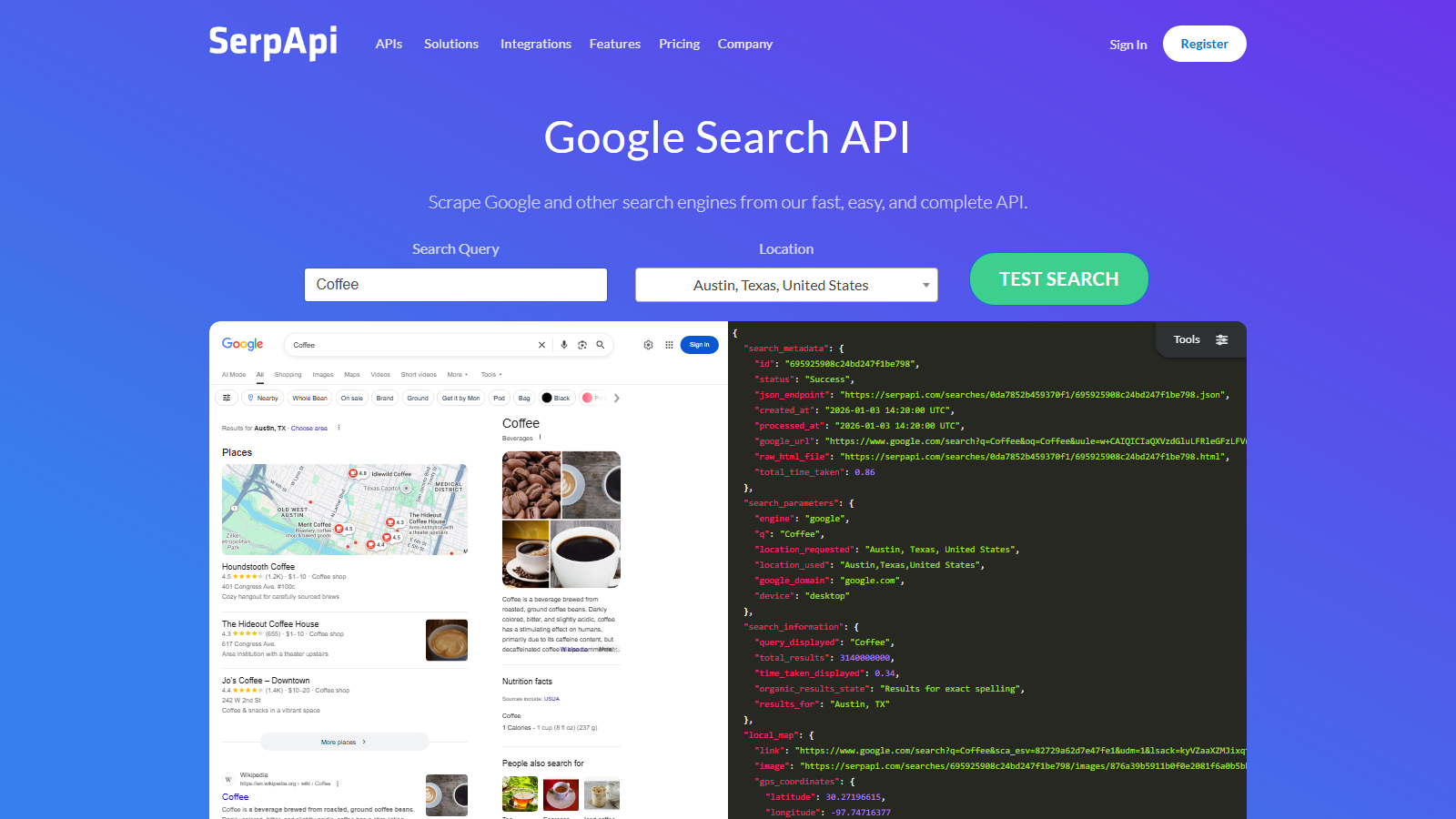
SerpApi is the most thoroughly documented SERP API in this directory and probably anywhere. The engine list runs well past Google organic into AI Mode, AI Overviews, Maps, Lens, Jobs, Flights, Hotels, Finance, Scholar, Ads Transparency and Autocomplete, plus Bing, Baidu, DuckDuckGo, Yandex, Yahoo, Naver and a set of marketplaces. If a surface exists in search, there is usually a documented endpoint and a live example for it.
The commercial model is a straight subscription with two dimensions: searches a month and throughput an hour. Free is 250 searches at 50 an hour, Starter $25 for 1,000 at 200 an hour, Developer $75 for 5,000, Production $150 for 15,000, Big Data $275 for 30,000 and Searcher $725 for 100,000 at 20,000 an hour. The unit cost falls from $0.025 to about $0.007 as you climb.
Two things make this page different from a normal review. SerpApi sells legal indemnification, up to $2 million of coverage for US claims, included from the Production plan upward. And Google sued SerpApi in January 2026 over the underlying activity. Both are covered in detail below, because a buyer choosing a SERP API in 2026 is choosing a legal posture as much as a data source.
Our scorecard
Our editorial read across six dimensions, scored 1 to 5. This is our own assessment, not an aggregate of user reviews, and it is deliberately kept out of the page's structured data.
- Data coverage5/5
The broadest engine list here, and one of the few with documented AI Mode and AI Overview endpoints.
- Pricing3/5
Clear and predictable, and a subscription rather than metered. You pay for the allowance whether you use it or not.
- Documentation5/5
The best in this directory. Every endpoint has a live playground and a real response to inspect.
- Ease of integration5/5
API key, JSON, one parameter to switch engine. You can be pulling structured SERPs in ten minutes.
- Reliability4/5
Hourly throughput caps are generous and speed modes let you buy latency. The litigation is the open risk.
- Support4/5
Priority support on the higher tiers, and unusually candid public communication about the court case.
An editorial read, not an aggregate of user reviews, and deliberately kept out of this page's structured data.
What you can pull
Google Search API
1 search per request
Organic results, ads, knowledge graph, related questions, inline images and shopping, local packs and the rest of the SERP as structured JSON
Google AI Mode and AI Overview APIs
1 search per request
The AI-generated answer surfaces as separate documented endpoints, which is the route to measuring answer-engine visibility from SERP data
Google Maps and Local
1 search per request
Map packs, place details, reviews, photos and Local Services listings for local SEO work
Google Shopping, Immersive Product and Ads Transparency
1 search per request
Product listings, pricing, merchant data and the Ads Transparency Center, which is competitor intelligence rather than SEO
Google Jobs, Flights, Hotels, Finance and Events
1 search per request
The vertical SERPs, each with its own documented schema rather than a generic blob
Google Scholar, Lens, Trends and Autocomplete
1 search per request
Academic results, reverse image search, interest over time and query suggestions
Other engines
1 search per request
Bing, Baidu, DuckDuckGo, Yahoo, Yandex and Naver, plus marketplaces including eBay, Walmart, Home Depot and the app stores
Speed modes
Available across plans
Best Effort, Ludicrous Speed and Ludicrous Speed Max, so latency is a setting rather than a fixed property of the service
Who SerpApi is for
Teams that need breadth and certainty rather than the lowest unit price. The engine list means one integration covers Google organic, the AI surfaces, maps, shopping and half a dozen other search engines, and the documentation is good enough that adding a new one is an afternoon rather than a project.
It is also the obvious choice for anyone whose legal team has opinions about scraping, because Production and above carries indemnification nothing else here offers. If you are optimising purely on cost per thousand, Serper and DataForSEO are several times cheaper and you should start there.
Strengths and limits
What it does well
- The broadest documented engine list in this directory, including separate Google AI Mode and AI Overview endpoints for answer-engine work.
- Legal indemnification up to $2m for US claims on Production and above, active automatically with no configuration. Nothing else here sells that.
- Documentation with a live playground on effectively every endpoint, so you can inspect a real response before writing any code.
- Throughput is metered per hour, so a batch job can burst without being throttled second by second.
- Speed modes let you trade latency for cost on the same plan rather than moving provider.
- A genuinely usable free tier at 250 searches a month with no card.
- Unusually candid public communication, including publishing its own legal filings and reasoning during active litigation.
Where it falls short
- It is a subscription, not pay as you go. You buy an allowance monthly whether or not you use it, which suits steady volume and punishes irregular work.
- Considerably more expensive per search than the cheapest credible options: $0.025 on Starter against roughly $0.001 elsewhere.
- The U.S. Legal Shield is NOT on Free, Starter or Developer. If the indemnity is the reason you are buying, the real entry price is $150 a month.
- Coverage is limited to claims under US state or federal law in a US court, and covers lawful collection rather than what you do with the data.
- Google's DMCA case is live. The first complaint was dismissed in July 2026, but an amended complaint is on foot and the second motion to dismiss was pending at review.
- Hourly throughput on the lower tiers is genuinely restrictive: 200 an hour on Starter is under four searches a minute.
- Refunds are limited to seven days and only if you have used less than 20% of your searches.
SerpApi pricing
A conventional subscription with two dimensions. Free gives 250 searches a month at 50 an hour. Starter is $25 for 1,000 at 200 an hour, Developer $75 for 5,000 at 1,000 an hour, Production $150 for 15,000 at 3,000, Big Data $275 for 30,000 at 6,000, and Searcher $725 for 100,000 at 20,000 an hour. Enterprise is quoted.
Unit economics improve steadily rather than dramatically: $0.025 a search on Starter, $0.015 on Developer, $0.01 on Production and about $0.007 on Searcher. That is roughly an order of magnitude above the cheapest credible providers in this directory, and the honest way to read it is that you are paying for coverage, documentation and, above Production, indemnity.
The throughput number deserves as much attention as the search count. Being measured per hour rather than per second is generous for batch work, but 200 an hour on Starter is under four searches a minute, so a nightly rank-tracking job of any size needs Developer at minimum.
On the Legal Shield, take the plan boundary literally. SerpApi's Legal Shield page states it is not available on Free, Starter or Developer, so if legal cover is the reason you are choosing SerpApi, your entry price is $150 a month rather than $25.
Free / Starter / Developer
$0 / $25 / $75
250, 1,000 and 5,000 searches a month
- Throughput 50, 200 and 1,000 an hour respectively
- $0.025 a search on Starter, $0.015 on Developer
- NO U.S. Legal Shield on any of these three
- Free needs no card and is genuinely usable for evaluation
Production
$150 / mo
15,000 searches, 3,000 an hour
- Marked Most popular, and $0.01 a search
- The FIRST tier carrying the U.S. Legal Shield
- Up to $2m of coverage, active automatically
- The tier to choose if the indemnity is why you are here
Big Data / Searcher / Enterprise
$275 / $725 / custom
30,000, 100,000 and custom searches
- 6,000 and 20,000 searches an hour respectively
- Unit cost falls to about $0.007 on Searcher
- ZeroTrace Mode and priority support on Enterprise
- Automatic Early Renewal tops you up mid-cycle
Request example
A minimal call against the live endpoint, with credentials read from the environment rather than pasted inline.
curl -s -G "https://serpapi.com/search" \
  --data-urlencode "engine=google" \
  --data-urlencode "q=best crm for small business" \
  --data-urlencode "location=Austin, Texas, United States" \
  --data-urlencode "hl=en" \
  --data-urlencode "gl=us" \
  --data-urlencode "api_key=$SERPAPI_KEY"

# One parameter switches the whole engine: set engine=google_ai_mode
# or engine=google_ai_overview to pull the AI answer surfaces
# instead of the classic SERP. That is the cheapest route in this
# directory to measuring answer-engine visibility from SERP data.
Rate limits and quotas
- Searches a month: 250 Free, 1,000 Starter, 5,000 Developer, 15,000 Production, 30,000 Big Data, 100,000 Searcher.
- Throughput an hour: 50, 200, 1,000, 3,000, 6,000 and 20,000 across those same tiers.
- U.S. Legal Shield is included from Production upward and is unavailable on Free, Starter and Developer.
- Legal Shield coverage is up to $2,000,000 and applies to US state or federal claims heard in a US court.
- The Shield covers lawful collection and parsing, not how the collected data is subsequently used.
- Automatic Early Renewal can be enabled to replenish searches when an allowance runs out mid-cycle.
- Full refund within 7 days of subscribing, unless more than 20% of the allowance has been used.
Third-party reviews
Scores read from each source on 3 September 2026. We report them as-is and publish no rating of our own.
A perfect 5.0 across 65 reviews is unusual enough to weigh carefully. Read it as a strong signal about a well-liked developer tool rather than as a measured comparison against alternatives.
What practitioners say on Reddit
Practitioners rate SerpApi's reliability and documentation and complain about the commercial shape rather than the product. The recurring theme in r/TechSEO is that subscription SERP APIs fit rank-tracking badly, because one new client can multiply keywords, locations and devices overnight, and a fixed monthly allowance is then either wasteful or exhausted.
That thread is worth reading in full if you are an agency, because it is really about the gap between how these products are marketed and how they bill. The complaint is not specific to SerpApi, and it explains why so many agencies end up on metered providers instead.
The other point raised, and it applies to every provider here, is that configuration drives cost as much as volume does. Device, country, city, language, engine and refresh frequency each multiply the request count, and none of them appear on a pricing page.
“I keep seeing pay as you go serp api mentioned across various tools but when I dig into actual pricing it almost always turns out to be a subscription with usage caps. The words say pay as you go but the billing says otherwise.”
r/TechSEO on Reddit“The hidden cost with SERP APIs is often configuration. Desktop versus mobile, country, city, language, search engine and refresh frequency can all change both cost and usefulness.”
r/TechSEO on Reddit“Rank tracking has awkward volume swings because one new client can multiply the number of keywords, locations and devices overnight. A fixed subscription can be fine for stable volume but it gets wasteful when client load changes month to month.”
r/TechSEO on Reddit“That's exactly the issue I'm running into. One client change can shift the whole query count. So fixed plans start feeling awkward pretty fast.”
r/TechSEO on Reddit“The gap between what a pricing page says and what the billing actually does is frustrating every single time.”
r/TechSEO on Reddit
Verdict
Buy SerpApi for breadth, documentation and legal cover, not for price. The engine list is the widest here, and Google's AI surfaces are first-class documented endpoints, which matters if answer-engine visibility is on your roadmap. The documentation is good enough to be a genuine cost saving on integration time.
The indemnity is the real differentiator and the plan boundary is the catch. Up to $2m of coverage for US claims, automatic, no configuration, and unavailable below the $150 Production tier. If your legal team is the reason you are shopping, that is your price.
On the Google case, hold two things at once. SerpApi won the first round in July 2026 when the court held that the DMCA does not protect uncopyrighted material, and the matter is not over: Google amended, SerpApi moved to dismiss again, and that motion was pending when we reviewed this. Nothing about that argues against using SerpApi today, and everything about it argues for checking the current position before signing a multi-year commitment.
SerpApi FAQ
How much does SerpApi cost?
Free is 250 searches a month. Starter is $25 for 1,000, Developer $75 for 5,000, Production $150 for 15,000, Big Data $275 for 30,000 and Searcher $725 for 100,000. Unit cost falls from $0.025 to about $0.007 a search across that range, and Enterprise is quoted.What is SerpApi's U.S. Legal Shield?
Legal indemnification of up to $2 million for the lawful collection and parsing of search data, covering claims brought under US state or federal law in a US court. It activates automatically with no configuration and is available to both US and international customers.Which plans include the Legal Shield?
Production at $150 a month and above. SerpApi's own Legal Shield page states plainly that it is not available with the Free, Starter or Developer plans, so if the indemnity is why you are buying, the entry price is $150 rather than $25.What does the Legal Shield not cover?
How you use the data. The Shield covers lawful collection, not downstream use, and explicitly excludes illegal use including copyright infringement, DMCA violations, other intellectual property infringement, privacy violations and fraud. SerpApi recommends taking your own legal advice on data usage.Is Google suing SerpApi?
Yes, and the case is live. Google filed a DMCA claim in January 2026 alleging circumvention of access controls. On 20 July 2026 the Northern District of California granted SerpApi's motion to dismiss, holding the DMCA does not protect uncopyrighted material. Google amended its complaint on 10 August and SerpApi moved to dismiss again on 25 August, which was pending at the time of this review.Should the lawsuit change my decision?
It should inform it rather than settle it. SerpApi won the first round and continues to operate, and the ruling was favourable to the whole category. It is still a district-court decision on a motion rather than settled appellate law, so check the current position before committing to a long contract, and keep your integration behind an interface you could repoint.Can SerpApi return AI Overviews?
Yes, through dedicated Google AI Mode and Google AI Overview endpoints rather than as a fragment of the organic response. Switching is one parameter, which makes it one of the cheaper routes in this directory to measuring answer-engine visibility alongside classic rankings.SerpApi or DataForSEO?
DataForSEO for cost at volume and true pay as you go with no monthly floor. SerpApi for engine breadth, the best documentation here, hourly rather than per-second throughput, and legal indemnity above $150 a month. On raw unit price the gap is roughly an order of magnitude, so the question is what the extra is buying you.
Other providers worth a look
This is an independent review. We have no affiliate relationship with SerpApi, earn nothing if you sign up, and no provider pays for placement in the directory. Prices were read from the vendor's own pages in September 2026 and change without notice.