
Skip to content

Car dealership SEO strategy

Regulated marketing

Service pays the bills and gets none of the SEO budget

Written by Eugene SuslovLast reviewed 28 August 2026No affiliate links
Sector
Retail and ecommerce
Model
Local service, Ecommerce
Competition
Brutal
Time to results
4 to 10 months
Typical monthly
$3,000 to $15,000

Key takeaways

  1. 1Most dealership profit comes from the service drive, and almost all the search budget chases vehicle sales. That inversion is the largest opportunity in this industry.
  2. 2You can have separate business profiles for sales, service and parts. It is free, it is permitted, and hardly any dealership has done it.
  3. 3Your inventory pages delete themselves. A vehicle sells and the page dies, so how you handle a sold vehicle detail page is a structural decision rather than a cleanup task.
  4. 4Three dealers within twenty miles have the same trim in the same colour. The vehicle query is not winnable and it is not where the money is anyway.
  5. 5The CARS Rule was vacated in January 2025 and enforcement continued. The FTC sent warning letters to 97 dealerships in 2026, so advertised pricing is still live territory.

SEO for car dealers is almost entirely aimed at the wrong department. Search budgets go to vehicle sales, and in most dealerships the service drive and the parts counter produce a far larger share of the gross profit.

That is not a small misallocation. Service queries are local, they repeat, they are barely contested by the marketplaces, and the customer already owns a car you are equipped to work on.

The most useful car dealership SEO strategy available to most stores therefore starts by moving attention to fixed operations, and only then worries about how the inventory ranks.

The vehicle side is a hard fight for structural reasons. Your inventory is syndicated to marketplaces with far more authority than you have, and unlike a house, a car is not unique: three dealers within twenty miles are listing the same trim in the same colour.

Then there is a constraint almost nothing else in this directory has. If you are a franchise dealer, the manufacturer usually decides which website vendors you may use, what the templates look like, and which content is mandated, which means a great deal of technical advice is simply not actionable for you.

What is actionable is everything the vendor template neglects: the service department, the recall and maintenance content, the local model pages, and the way sold vehicles are handled when their pages disappear.

Who already ranks in car dealerships

Every car dealership SEO audit finds the same split, and it takes two searches to see it: the vehicle query is marketplaces, the manufacturer and national retailers all the way down, and the service query is barely contested by anybody.

What is on the results page

  • Vehicle marketplaces occupying almost the entire first screen on inventory queries
  • Manufacturer inventory search ranking above its own dealers on brand queries
  • Vehicle listing surfaces in search results, fed by structured inventory data
  • Local pack on dealership, service and parts queries, with service far less contested
  • People Also Ask, dense on maintenance intervals, recalls and cost questions
  • National online retailers on used vehicle and trade-in queries
  • AI Overviews on maintenance and model comparison questions, drawn from publishers
  • Vehicle marketplaces

    cars.comClaim it

    They rank on inventory you syndicated to them, which is the same shape as the real estate portals with one important difference: a car is not unique. Several dealers are listing the identical vehicle, so the marketplace is arbitrating between you and your neighbours on price and photographs. Price the subscriptions on cost per sold unit, and be clear you are buying distribution rather than differentiation.

  • The manufacturer's own site

    toyota.com

    Outranks its own dealers for brand and model queries and increasingly runs its own inventory search. It is not a competitor exactly, and it does mean the brand-plus-model query is not available to you. Your dealer locator listing and the accuracy of the data feeding it are the parts you control.

  • Google Business Profile, in three parts

    google.comClaim it

    The most underused asset in this industry. A dealership may generally maintain separate profiles for its sales, service and parts departments where those are genuinely distinct with their own entrances, staff and hours. Almost nobody does it, which means service queries resolve to a sales profile that ranks on the wrong signals. Read the current guidelines, then set them up properly.

  • National online retailers

    carvana.com

    Rank hard on used and trade-in queries with a national footprint and a genuinely different buying experience. Not beatable on those terms. They are also the reason your trade-in content matters: the offer is the comparison a customer is running.

  • Review platforms, general and industry-specific

    dealerrater.comClaim it

    Reviews weigh heavily here and the industry has a documented manipulation problem, which cuts both ways: a suspiciously clean profile is a weak signal. Note that in this industry reviews attach to salespeople and service advisers as much as to the store, which is worth building into the process deliberately.

  • Vehicle history and valuation services

    carfax.comClaim it

    They rank on used inventory queries and on model reliability questions, and they hold data about the specific cars you are selling. Listing correctly on them is a data quality task rather than a marketing one, and it feeds the trust question a used buyer is actually asking.

  • Recall and safety databases

    nhtsa.gov

    Not claimable and worth naming because it is upstream of the most underused content cluster in this industry. Owners search recall information constantly, the official source is authoritative but generic, and a local dealer who explains what a specific recall means and books the appointment is answering a question nobody else is answering locally.

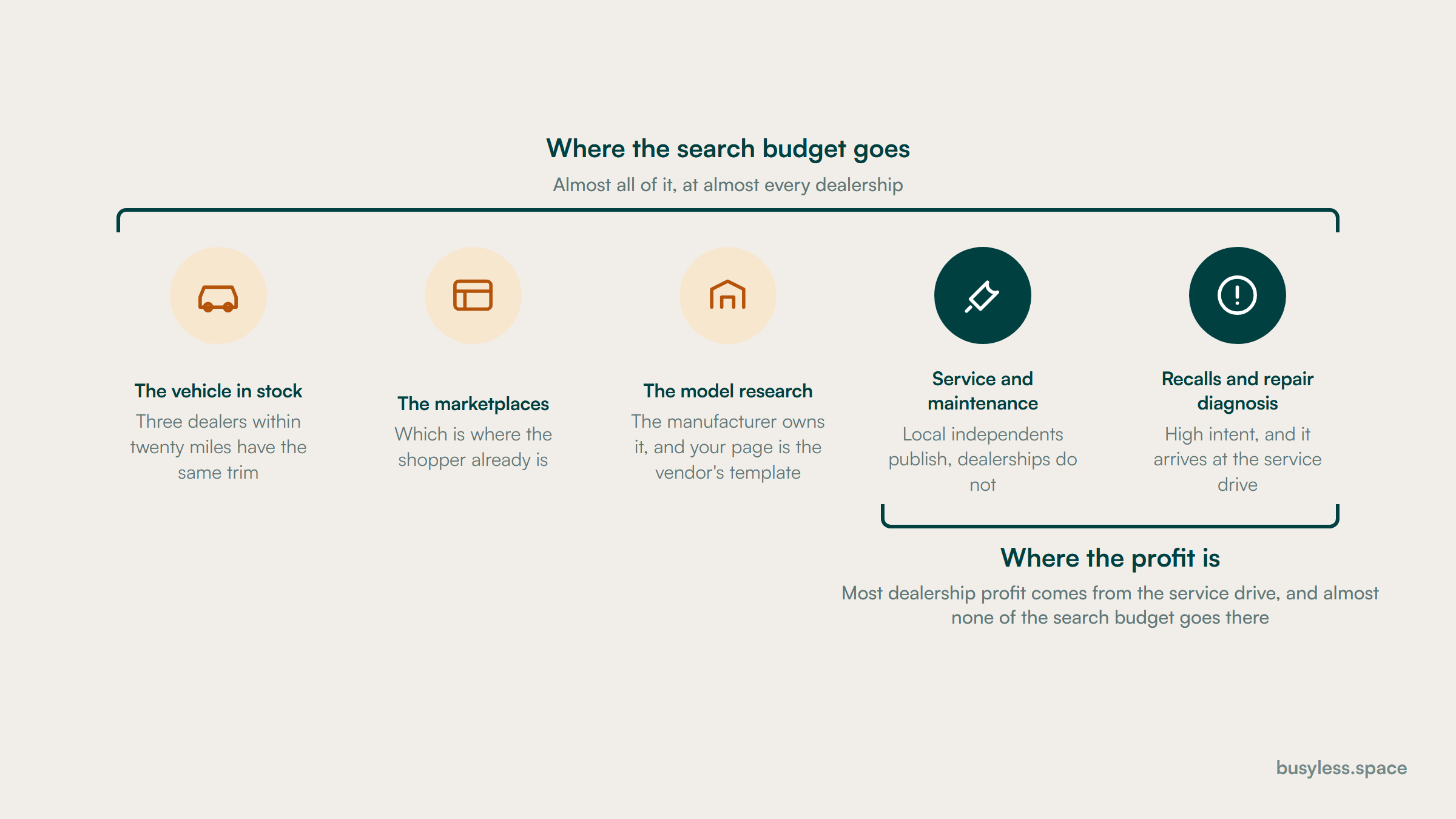
Five things a dealership is searched for under one bracket: the vehicle in stock, the marketplaces, model research, service and maintenance, and recalls and repair diagnosis. A narrower bracket covers only the last two, labelled where the profit is.
Almost all the search budget goes to the left of this picture, and almost all the profit sits on the right.

What people actually search

Dealership search divides into a vehicle side that is structurally hard and a service side that is structurally easy, and the budget is almost always allocated the other way round.

Service and maintenance

Local transactional

[make] oil change near me

The page that wins it: A page per service with real pricing and online booking

The profit centre, barely contested, and repeating. The customer already owns a car you are equipped to service, which is the cheapest acquisition in the business.

Recall and technical service

Informational, high intent

[make] [year] recall check

The page that wins it: A page per active recall affecting vehicles you service

The most underused cluster in the industry. Owners search it, the work is usually paid by the manufacturer, and it puts a local owner in your service drive.

Repair diagnosis

Informational

[make] [warning light] meaning

The page that wins it: A short explainer ending in a clear when-to-book threshold

Independent shops and content sites own this and dealers ignore it, despite having the technicians who actually know the answer.

Inventory

Transactional, local

used [make] [model] for sale near me

The page that wins it: A search results page that converts, not a page that competes

Conceded to the marketplaces. Build the browsing experience for people who arrive by other routes, and stop measuring it against a portal.

Model research

Commercial investigation

[model] vs [model]

The page that wins it: A local comparison including inventory, incentives and what you actually stock

The manufacturer and the publishers own the generic version. The local version, with what is on the lot and what a payment looks like here, is available.

Financing and credit

Commercial investigation

car loans for bad credit [city]

The page that wins it: An honest financing page with no payment figures unless the disclosures are right

High intent and heavily regulated. Read the credit and lease advertising rules before publishing a single monthly number.

Trade-in and valuation

Commercial investigation

what is my car worth [city]

The page that wins it: A trade-in page explaining how you actually appraise

The national retailers set the comparison here with an instant offer. Explaining your process, and being straight about when their offer will be better, is the credible response.

Parts and accessories

Transactional

[make] genuine parts [city]

The page that wins it: A parts page, and a separate profile for the parts department

Small, consistent, and almost entirely unserved by dealer websites, which typically give parts a phone number and nothing else.

What the rules change

Vehicle advertising is one of the most closely regulated forms of retail advertising there is, at both federal and state level, and the federal picture moved recently in a way that is easy to misread. Check your own state rules, which are frequently stricter. None of this is legal advice.

1

The CARS Rule was vacated, and enforcement did not stop

The Fifth Circuit vacated the Federal Trade Commission's Combating Auto Retail Scams Rule in January 2025 on procedural grounds; the FTC has continued to act under Section 5 of the FTC Act, sending warning letters to 97 dealerships in 2026

What it means

It is easy to conclude that the vacatur removed the obligations. It removed a specific rule, not the underlying prohibition on deceptive and unfair practices, and the Commission has kept enforcing in this sector. The substance that mattered still matters: the advertised price should be the price, add-ons should be disclosed and genuinely optional, and financing terms should not be misrepresented.

So do this

Treat your advertised pricing as though the rule were in force. Show the offering price with any mandatory charge disclosed clearly, make add-ons genuinely optional and clearly priced, and do not advertise a vehicle at a price only available with a financing product. Review every price on the website, not just the ones in paid campaigns.

2

Advertising a payment triggers credit and lease disclosure rules

Truth in Lending Act, Regulation Z advertising provisions at 12 CFR 1026.24 for credit; Consumer Leasing Act, Regulation M at 12 CFR Part 1013 for lease advertising

What it means

Stating a monthly payment, a down payment or a term in an advertisement triggers requirements to state other terms as well, and vehicle leasing has its own regulation with its own required disclosures. Dealership websites publish payment figures constantly, frequently on inventory pages generated automatically from a payment calculator.

So do this

Decide deliberately whether payment figures appear on the site at all. If they do, get the required disclosures right and check that any automatic payment calculator on inventory pages is producing compliant output, because that is where this usually goes wrong at scale rather than in a hand-written advert.

3

Your state has its own advertising regulations, and they are often stricter

State motor vehicle dealer advertising regulations, administered by dealer boards, motor vehicle departments or attorneys general

What it means

States regulate vehicle advertising in detail: documentary fee disclosure, how a price may be described, bait advertising, availability requirements, expiry of advertised offers, and required disclosures for used and demonstrator vehicles. The rules differ substantially and several states publish specific guidance for online advertising.

So do this

Get your own state's dealer advertising regulations, read them against the live website rather than against your ad copy, and put a named person in charge of the website's compliance rather than assuming the vendor handles it. They generally do not.

4

Co-operative advertising funds come with content rules

Manufacturer co-operative advertising programme terms and brand guidelines

What it means

Franchise dealers receive co-operative advertising support, and reimbursement is conditional on following the programme's rules about claims, imagery, logo use, disclaimers and sometimes which vendors may be used. Non-compliant work does not just risk a brand complaint, it risks the claim being denied after the money is spent.

So do this

Read the current programme rules before commissioning anything you intend to claim against, and keep the approval correspondence. Where the rules constrain what you can publish, that is a real limit on the strategy and should be written into the plan rather than discovered in a rejected claim.

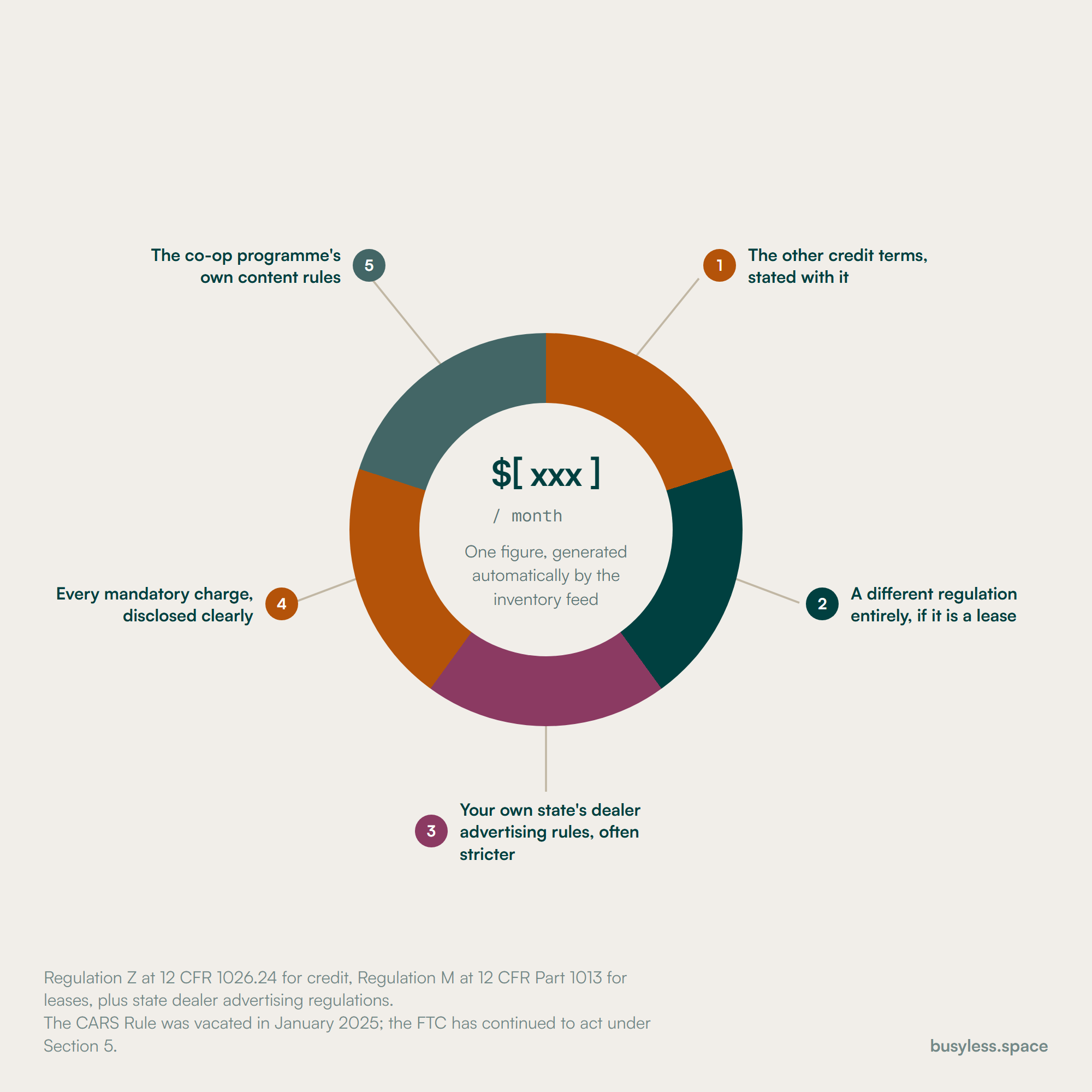
A bracketed monthly payment figure at the centre of a ring, with five callouts: the other credit terms stated with it, a different regulation entirely if it is a lease, the state's own dealer advertising rules, every mandatory charge disclosed clearly, and the co-operative advertising programme's content rules.
Five obligations attach to one automatically generated figure, and the inventory feed does not know about any of them.

Proving expertise

Trust in this industry is low by default and the signals that move it are unglamorous. Buyers and service customers are both looking for evidence that the price is the price and that the people are real.

  • Pricing shown with every mandatory charge disclosed, including the documentary fee
  • Named salespeople and service advisers with photographs and real histories at the store
  • Technician certifications named, including manufacturer training levels
  • Service pricing published for the common jobs, with what is included
  • Dealer licence number and the licensing authority stated
  • Vehicle history reports linked directly from used inventory
  • Warranty and certified pre-owned terms explained rather than badged
  • Reviews responded to individually, including the difficult ones, by a named person

How to build a car dealership SEO strategy

A realistic first six months, and the sequence is deliberately unusual. A car dealership SEO strategy that opens with inventory optimisation is starting with the hardest fight and the smallest margin, while the service drive sits unmarketed.

  1. 1

    Weeks 1 to 4

    Fix pricing and claim the service ground

    • Audit every price on the website against federal and state advertising rules
    • Check any automatic payment calculator on inventory pages for compliant output
    • Set up separate business profiles for service and parts where permitted
    • Publish service pricing for the common jobs
    • Establish what your website vendor will and will not let you change
    • Fix how sold vehicle pages are handled, which is usually a 404 or a home page redirect

    You end up with
    Compliant pricing, a service profile that can rank, and a known list of platform constraints

  2. 2

    Weeks 4 to 12

    Build the fixed operations content

    • A page per service you sell, with price, duration and what is included
    • Online service booking that works on a phone
    • Recall pages for the campaigns affecting vehicles you service
    • Maintenance schedule pages by model and mileage
    • Add AutoDealer and AutoRepair structured data as separate nodes
    • Name the technicians and their manufacturer training

    You end up with
    The profit centre finally has content, in a cluster nobody local is contesting

  3. 3

    Months 3 to 6

    Take the local vehicle ground that is actually available

    • Local model pages with what you stock, what incentives apply and what it costs here
    • Trade-in content explaining your appraisal process honestly
    • Financing content written against the credit and lease advertising rules
    • Vehicle listing structured data on inventory pages
    • Parts content and a parts department presence
    • Diagnostic explainers written with your own technicians

    You end up with
    Coverage of the vehicle-side queries that are not owned by marketplaces

  4. 4

    Months 5 to 12

    Measure gross, by department

    • Report service repair orders and gross separately from vehicle sales
    • Attribute service bookings to source, which almost no dealership does
    • Compare marketplace subscription cost per sold unit against organic honestly
    • Track sold vehicle page handling and its effect on index size
    • Review advertising compliance quarterly, on the live site
    • Report reviews by adviser and salesperson, since that is how they are earned

    You end up with
    A report a general manager can act on, with fixed operations visible for once

Technical fixes with the best payoff

Two technical realities dominate this industry and neither exists anywhere else in this directory: your inventory deletes its own pages every week, and if you are a franchise dealer your supplier chose your website vendor.

  • Sold vehicles 404 or redirect to the home page

    A sprint, then automatic

    Inventory turns over constantly, so thousands of vehicle detail pages appear and disappear. A sold page that returns an error wastes every signal it accumulated, and a blanket redirect to the home page is treated as a soft error and helps nobody.

    Redirect a sold vehicle to the most relevant remaining page: the same model in the same condition, or the model landing page. Keep a stable model and body-style structure that outlives any individual car, so there is always somewhere sensible to send people.

  • The website platform is chosen by the manufacturer

    An afternoon establishing the limits, then plan around them

    Franchise dealers usually pick from an approved vendor list with mandated templates and mandated content. Much of the standard technical advice is simply not executable, and every dealer on that platform publishes the same model boilerplate as every other.

    Find out precisely what you can change: page templates, custom pages, structured data, redirects, robots directives. Then concentrate entirely on the surfaces you control, which in practice is custom content, service pages and the business profiles. Do not budget for work the platform will not permit.

  • Model content is identical across every dealer on the platform

    A day per model that matters

    Vendors supply model description pages to every dealer they serve, so hundreds of dealerships publish word-for-word identical content about the same vehicle. There is nothing to distinguish yours, and the manufacturer's own page outranks all of it anyway.

    Rewrite the model pages around what is local: what you actually stock, what the trims cost here, which incentives apply in this state, what the trade-in market looks like locally, and what your service department sees on these cars at high mileage.

  • The service department has no pages

    A sprint

    It produces a large share of the gross profit and typically gets a phone number and a booking widget. Meanwhile local independents publish detailed pages about the same jobs and rank for them.

    A page per service: what it involves, what it costs, how long it takes, what is included, which models it applies to, and a booking route that works on a phone. This is the highest-return content work available to a dealership.

  • Faceted inventory search generates unbounded URLs

    A sprint, and a vendor conversation

    Filter combinations on a search results page multiply quickly, and inventory platforms frequently leave them crawlable. Crawl budget goes to near-identical filtered pages that will be empty next week, and the pages you wrote get less attention.

    Decide which facets deserve indexable pages, usually make and model plus condition, and keep the rest out of the index while remaining usable. This is a common vendor request, so ask rather than assuming it is impossible.

  • Departments share one business profile

    A day, plus verification time

    A dealership may generally have separate profiles for sales, service and parts where those are genuinely distinct operations. Sharing one means service queries are answered by a profile optimised for vehicle sales, with the wrong categories and the wrong hours.

    Read the current guidelines, then create the department profiles properly, each with its own category, hours, entrance, phone number and landing page. It is free and it is the largest single local gain available here.

  • Payment figures are generated automatically without disclosures

    A day, then a template change

    Inventory platforms include payment calculators that stamp a monthly figure onto every vehicle page. Stating a payment in an advertisement engages credit and lease advertising rules, and an automatically generated figure at scale is exactly where this goes wrong.

    Decide whether payments appear at all. If they do, make sure the required disclosures are generated with them on every page, and have somebody who knows the rules check a sample. This is a compliance review of a template rather than of a page.

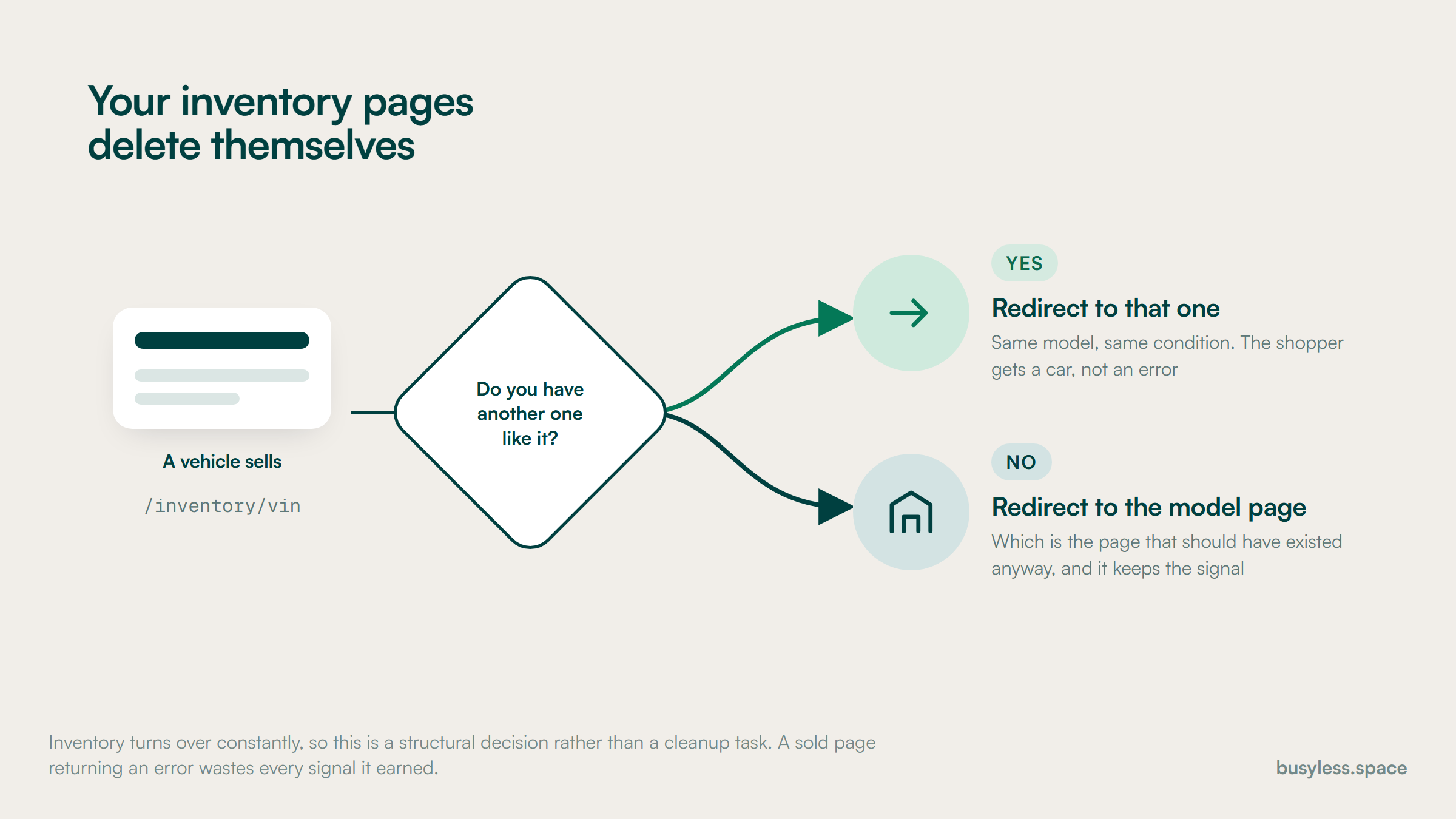
A decision gate. A vehicle sells, and the question is whether another like it is in stock. Yes means redirect to that vehicle. No means redirect to the model page.
Inventory turns over constantly, so this is a structural decision rather than a cleanup task.

Structured data that applies here

The types below fit this industry specifically. Most of them earn no rich result on their own, which is worth knowing before anyone sells the work on that basis. What they do is describe the entity precisely, which matters for how search engines and answer engines resolve who you are.

  • AutoDealer

    Home page and each rooftop

    A real schema.org type. One node per rooftop, and keep the identifiers accurate, since a dealer licence number is a checkable fact and a useful trust signal in a low-trust category.

    AutoDealer.jsonld
    {
      "@context": "https://schema.org",
      "@type": "AutoDealer",
      "@id": "https://[YOUR-DOMAIN]/#dealership",
      "name": "[DEALERSHIP NAME]",
      "url": "https://[YOUR-DOMAIN]",
      "telephone": "[+1-555-000-0000]",
      "priceRange": "[$$]",
      "image": "https://[YOUR-DOMAIN]/showroom.jpg",
      "address": {
        "@type": "PostalAddress",
        "streetAddress": "[123 Example St]",
        "addressLocality": "[CITY]",
        "addressRegion": "[ST]",
        "postalCode": "[00000]",
        "addressCountry": "US"
      },
      "geo": {
        "@type": "GeoCoordinates",
        "latitude": "[00.000000]",
        "longitude": "[-00.000000]"
      },
      "brand": { "@type": "Brand", "name": "[FRANCHISE BRAND]" },
      "identifier": [
        { "@type": "PropertyValue", "name": "Dealer licence", "value": "[NUMBER]" }
      ],
      "department": [
        { "@id": "https://[YOUR-DOMAIN]/service#service" },
        { "@id": "https://[YOUR-DOMAIN]/parts#parts" }
      ],
      "openingHoursSpecification": [{
        "@type": "OpeningHoursSpecification",
        "dayOfWeek": ["Monday","Tuesday","Wednesday","Thursday","Friday"],
        "opens": "[09:00]",
        "closes": "[19:00]"
      }]
    }
  • AutoRepair as a department

    The service department landing page

    The node that makes the profit centre a distinct entity rather than a page inside a sales site. It pairs with a separate business profile for the service department, and the two reinforce each other.

    AutoRepair as a department.jsonld
    {
      "@context": "https://schema.org",
      "@type": "AutoRepair",
      "@id": "https://[YOUR-DOMAIN]/service#service",
      "name": "[DEALERSHIP NAME] Service",
      "url": "https://[YOUR-DOMAIN]/service",
      "telephone": "[SERVICE DEPARTMENT NUMBER, not the sales line]",
      "parentOrganization": { "@id": "https://[YOUR-DOMAIN]/#dealership" },
      "address": {
        "@type": "PostalAddress",
        "streetAddress": "[SERVICE ENTRANCE ADDRESS]",
        "addressLocality": "[CITY]",
        "addressRegion": "[ST]",
        "postalCode": "[00000]",
        "addressCountry": "US"
      },
      "openingHoursSpecification": [{
        "@type": "OpeningHoursSpecification",
        "dayOfWeek": ["Monday","Tuesday","Wednesday","Thursday","Friday"],
        "opens": "[07:00]",
        "closes": "[18:00]"
      }],
      "makesOffer": [
        { "@type": "Offer", "itemOffered": { "@type": "Service", "name": "[Oil and filter change]" } },
        { "@type": "Offer", "itemOffered": { "@type": "Service", "name": "[Brake service]" } }
      ],
      "potentialAction": {
        "@type": "ReserveAction",
        "target": "https://[YOUR-DOMAIN]/service/book"
      }
    }
  • Vehicle with an Offer

    Each vehicle detail page

    The markup that lets an individual car be understood as a specific product rather than a page. Generate it from the inventory feed rather than by hand, and make sure the price matches the visible price exactly, including any mandatory charge disclosure.

    Vehicle with an Offer.jsonld
    {
      "@context": "https://schema.org",
      "@type": "Car",
      "name": "[YEAR MAKE MODEL TRIM]",
      "url": "https://[YOUR-DOMAIN]/inventory/[SLUG]",
      "vehicleIdentificationNumber": "[VIN]",
      "brand": { "@type": "Brand", "name": "[MAKE]" },
      "model": "[MODEL]",
      "vehicleModelDate": "[YEAR]",
      "itemCondition": "https://schema.org/UsedCondition",
      "mileageFromOdometer": {
        "@type": "QuantitativeValue",
        "value": "[00000]",
        "unitCode": "SMI"
      },
      "vehicleTransmission": "[Automatic]",
      "fuelType": "[Gasoline]",
      "color": "[COLOUR]",
      "numberOfDoors": "[4]",
      "offers": {
        "@type": "Offer",
        "price": "[00000]",
        "priceCurrency": "USD",
        "availability": "https://schema.org/InStock",
        "seller": { "@id": "https://[YOUR-DOMAIN]/#dealership" },
        "description": "[Any mandatory charges, stated exactly as they appear on the page.]"
      }
    }
  • Service with a published price

    Each service page

    The reason the service cluster works. Publishing a real price for a common job is unusual in this industry and it is exactly what the searcher wanted, so mark up only prices you will honour and that appear in the visible copy.

    Service with a published price.jsonld
    {
      "@context": "https://schema.org",
      "@type": "Service",
      "name": "[Oil and filter change]",
      "serviceType": "[Vehicle maintenance]",
      "provider": { "@id": "https://[YOUR-DOMAIN]/service#service" },
      "areaServed": { "@type": "City", "name": "[CITY]" },
      "offers": {
        "@type": "Offer",
        "priceSpecification": {
          "@type": "PriceSpecification",
          "minPrice": "[00]",
          "maxPrice": "[000]",
          "priceCurrency": "USD"
        },
        "description": "[What is included, which engines it covers, and what changes the price.]"
      },
      "additionalProperty": [
        { "@type": "PropertyValue", "name": "Typical duration", "value": "[45 minutes]" },
        { "@type": "PropertyValue", "name": "Applies to", "value": "[MODELS AND YEARS]" }
      ]
    }
  • FAQPage

    Service, financing and trade-in pages

    Service cost and recalls belong here. They are what is being asked, and nobody local is answering them. Match the visible text exactly and keep pricing consistent with the page.

    FAQPage.jsonld
    {
      "@context": "https://schema.org",
      "@type": "FAQPage",
      "mainEntity": [
        {
          "@type": "Question",
          "name": "[Question exactly as it appears on the page]",
          "acceptedAnswer": {
            "@type": "Answer",
            "text": "[Answer exactly as it appears. Give the real price, the real interval or the real recall status.]"
          }
        }
      ]
    }
  • BreadcrumbList

    Inventory, model and service pages

    Unusually valuable here because of inventory churn: a stable breadcrumb through make, model and body style gives every vehicle page a permanent parent to be redirected to when the car sells.

    BreadcrumbList.jsonld
    {
      "@context": "https://schema.org",
      "@type": "BreadcrumbList",
      "itemListElement": [
        { "@type": "ListItem", "position": 1, "name": "Home",
          "item": "https://[YOUR-DOMAIN]/" },
        { "@type": "ListItem", "position": 2, "name": "[Used inventory]",
          "item": "https://[YOUR-DOMAIN]/used" },
        { "@type": "ListItem", "position": 3, "name": "[MAKE MODEL]",
          "item": "https://[YOUR-DOMAIN]/used/[MAKE]/[MODEL]" },
        { "@type": "ListItem", "position": 4, "name": "[YEAR TRIM]",
          "item": "https://[YOUR-DOMAIN]/inventory/[SLUG]" }
      ]
    }

What it costs

Editorial estimates rather than quotes, and the highest range in this directory outside enterprise manufacturing, for a simple reason: dealerships already spend heavily on marketplace subscriptions and paid search, and this work usually has to be argued for against those. It is worth noting that a share of it may be claimable against co-operative advertising funds.

Funded

$3,000 to $6,000
  • Advertising compliance review of the live website, not just the ad copy
  • Separate business profiles for service and parts, set up properly
  • A service page per common job, with pricing and booking
  • Sold vehicle handling fixed so pages redirect somewhere sensible
  • Reporting split by department rather than blended

Who it suits

A single rooftop that wants the service drive marketed for the first time

Where it stops

The vendor platform limits how much of the vehicle side can be changed, and no budget removes that. It also will not out-rank the marketplaces on inventory queries.

Enterprise, single rooftop

$6,000 to $10,000
  • Local model pages rewritten around stock, incentives and local pricing
  • Recall and maintenance content built out by model
  • Diagnostic content written with your own technicians
  • Vehicle listing structured data and faceted crawl control
  • Service booking attribution, which almost no dealership has

Who it suits

Competitive metros, or stores where fixed operations has real capacity to fill

Where it stops

The manufacturer still outranks you for its own brand, and national retailers still own trade-in queries. This tier takes the local ground beside them.

Dealer group

$10,000 and up
  • Rooftops managed as a system with per-store reporting
  • Shared service and model content that stays distinct per location
  • Profile management across dozens of department listings
  • Integration work at acquisition, which is where groups lose the most
  • Recruitment content, which for technicians is frequently the binding constraint

Who it suits

Groups of several rooftops, particularly those acquiring stores

Where it stops

At group scale the problem is consistency and platform fragmentation across brands, which is an operational discipline rather than a budget line.

How to do it with no budget

Two of the items below are free and are probably the largest single gains available to a dealership, which is unusual in an industry that spends this much. Both of those come first.

  1. 1

    Set up separate profiles for service and parts

    A day, plus verification

    Google Business Profile

    Free, generally permitted where the departments are genuinely distinct, and almost nobody has done it. Read the current guidelines first, then give each its own category, hours, entrance, phone number and landing page.

  2. 2

    Audit every price on the live website

    A day

    Your own site and your state's dealer advertising rules

    The CARS Rule was vacated and enforcement continued, so treat advertised pricing as live territory. Check the automatic payment calculators on inventory pages specifically, because that is where this goes wrong at scale.

  3. 3

    Find out what your platform lets you change

    2 hours

    A conversation with your website vendor

    Templates, custom pages, structured data, redirects, robots directives. Everything else in this playbook depends on the answer, and budgeting for work the platform forbids is the most common waste here.

  4. 4

    Publish service prices for the ten most common jobs

    3 hours

    Your website editor and your service manager

    Price, what is included, how long it takes, which models. Independents publish this and dealers do not, which is most of why independents win the query.

  5. 5

    Fix what happens when a vehicle sells

    An afternoon to decide, then automatic

    Your vendor, or your redirect settings

    Redirect to the same model rather than to the home page. Thousands of pages a year go through this, so the policy matters far more than any individual page.

  6. 6

    Write recall pages for the active campaigns

    2 hours each

    Your website editor and the official recall data

    Owners search this, the work is usually manufacturer-funded, and it puts a local owner of a car you service into your booking system. Almost no dealership publishes them.

  7. 7

    Name your technicians and their training

    2 hours

    Your website editor

    Manufacturer training levels and certifications, with photographs. It is the trust signal a service customer is looking for and it costs nothing.

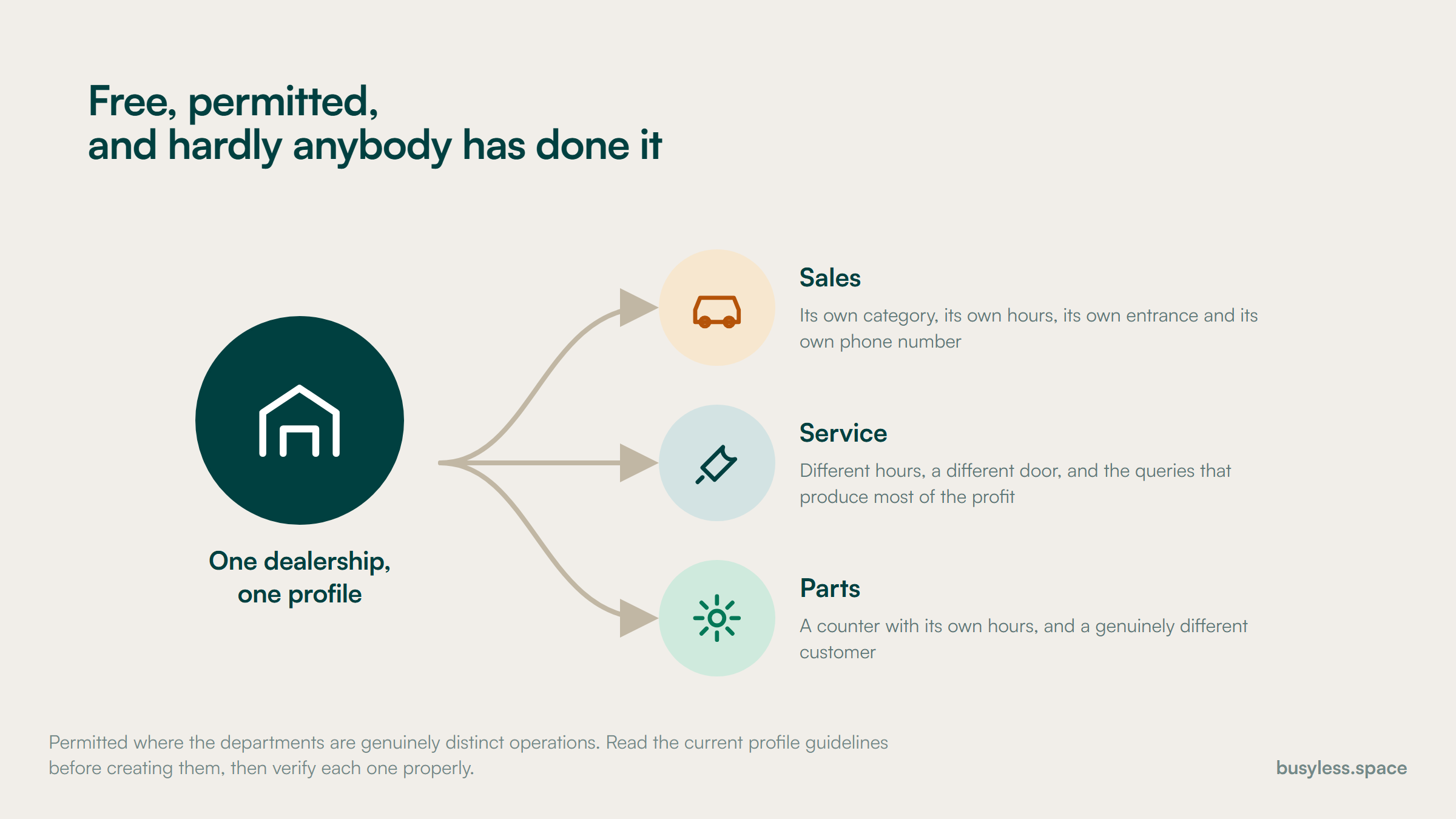
One dealership profile fanning out into three: sales, service and parts, each with its own category, hours, entrance and phone number.
Free, permitted where the departments are genuinely distinct, and hardly any dealership has done it.

The tool stack

Jobs first, tools second. The most consequential item on this list is not a tool at all: it is finding out what your website vendor will actually allow, because that decides which of the rest are even possible.

  • Establish what the platform permits

    Your website vendor's documentation and support

    Templates, custom pages, structured data, redirect rules, robots control, page speed levers. Get the answer in writing, because it decides the plan and it changes when the vendor updates the platform.

    Free routeFree, and the prerequisite for everything else

  • Track local pack position for sales and service separately

    DataForSEOSEO APIRead the review

    Once the department profiles exist, they rank independently and should be tracked independently. Service position against local independents is a different competitive picture from sales position against other dealers.

    Free routeManual checks from a few points in the catchment

  • Find the service and recall queries you are missing

    Google Search Console plus your own service advisers

    Write down what customers say when they ring the service drive. That phrasing is the content plan, and it is the one place a dealership has knowledge no marketplace can replicate.

    Free routeBoth free, and the advisers are the better source

  • Model what a service customer is worth

    SEO Revenue Growth CalculatorFree toolOpen the tool

    Use retained service relationship value rather than one repair order, and model it separately from vehicle gross. That comparison is the entire argument for reallocating budget to fixed operations.

    Free routeFree

  • Compare marketplace spend against organic

    SEO Budget CalculatorFree toolOpen the tool

    Set it against what you currently pay for marketplace subscriptions per sold unit. Also check what portion of the work is claimable against co-operative advertising funds before agreeing a number.

    Free routeFree

  • Generate vehicle and service markup at scale

    Schema Markup GeneratorFree toolOpen the tool

    Get the pattern right once and generate vehicle markup from the inventory feed. Hand-maintained markup on an inventory that turns over weekly is not maintainable for a month.

    Free routeFree

  • Publish service, model and recall content the platform will not host

    PayloadHeadless CMSRead the review

    Where the mandated platform will not allow the content you need, a separate content system on a subdirectory or a controlled subdomain is a common answer. Check the franchise agreement first, because some brands restrict this.

    Free routeFree and self-hosted

  • See what assistants recommend for local service

    LLM visibility trackerOur toolSee the tool

    Owners increasingly ask an assistant what a warning light means and where to get it fixed. Those answers draw on clear maintenance and diagnostic content, which independents publish and dealers do not.

Take it from here

Everything below is yours to take. Fill the [BRACKETS] and it is ready to use. Start with the department profile setup: it is free, it is generally permitted, and it is the largest single local gain available to a dealership.

Checklist

A dealership may generally maintain separate profiles for sales, service and parts where those are genuinely distinct. It is free, it is the largest local gain available here, and hardly anybody has done it.

DEPARTMENT PROFILE SETUP - [DEALERSHIP]
Date: [____]     Owner: [NAME]

WHY THIS IS FIRST
Service queries currently resolve to a profile built for vehicle
sales: wrong primary category, wrong hours, wrong phone number,
wrong landing page. Separating the departments fixes all four at
once and costs nothing.

READ THE CURRENT GUIDELINES FIRST
The rules for departments of a business are published and they do
change. Confirm what qualifies before creating anything, because
a rejected or suspended profile is a slow problem to unwind.

1. DOES EACH DEPARTMENT QUALIFY
   | Department | Own entrance | Own phone | Own hours | Own staff |
   |------------|--------------|-----------|-----------|-----------|
   | Sales      | [ Y / N ]    | [ Y / N ] | [ Y / N ] | [ Y / N ] |
   | Service    | [ Y / N ]    | [ Y / N ] | [ Y / N ] | [ Y / N ] |
   | Parts      | [ Y / N ]    | [ Y / N ] | [ Y / N ] | [ Y / N ] |
   | Collision  | [ Y / N ]    | [ Y / N ] | [ Y / N ] | [ Y / N ] |

2. FOR EACH PROFILE YOU CREATE
   [ ] Name follows the required format for a department
   [ ] Primary category correct and specific to that department
   [ ] Its OWN phone number, not the main switchboard
   [ ] Its OWN hours (service opens earlier than sales, almost
       always, and this alone changes who appears in an
       open-now search)
   [ ] Its OWN address, including the service entrance where
       that differs
   [ ] Landing page pointing at THAT department's page, not
       the home page
   [ ] Services listed individually
   [ ] Photographs of that department, not of the showroom
   [ ] Appointment link where available

3. AFTER VERIFICATION
   [ ] Structured data added: AutoDealer with department nodes
   [ ] Each department page linked from the main navigation
   [ ] Reviews monitored per profile
   [ ] Rank tracking set up per department

4. THE MEASUREMENT
   Before: service calls from profile [____]/month
   After 90 days: [____]/month
   This is usually the clearest before-and-after in the whole
   playbook.

5. WHAT NOT TO DO
   [ ] Do not create a profile for a department that is not
       genuinely separate
   [ ] Do not point every profile at the home page
   [ ] Do not use the sales number on the service profile

What to publish

This list is ordered by contribution to gross profit rather than by traffic. That ordering is the whole argument of this page, and it puts the service department first.

  • A page per service, with prices

    Ten to start, then as the menu changes

    The profit centre, barely contested, and independents are winning these queries purely by publishing a number the dealership will not.

  • Recall and campaign pages

    One per active campaign affecting your brands

    Owners search them, the work is usually manufacturer-funded, and it puts a local owner of a car you are equipped to service into the booking system.

  • Maintenance schedules by model and mileage

    One per model you service, reviewed with the schedules

    Evergreen, searched constantly, and the natural bridge between an owner's question and a booked appointment.

  • Local model pages

    One per model that matters, refreshed each model year

    Replaces vendor boilerplate that hundreds of dealerships publish identically with what only you can say: your stock, your incentives, your local pricing, what your technicians see on these cars.

  • Diagnostic explainers

    Two a month, from what the advisers are asked

    Written with your own technicians, who actually know. Independents and content sites own this cluster despite having less expertise than your service drive.

  • Trade-in and financing content

    Once, reviewed against the advertising rules every quarter

    High intent, and the honest version is a genuine differentiator in a category where the reader expects to be handled rather than informed.

And what not to

  • Advertised prices that are not available without a financing product or an add-on
  • Automatically generated monthly payment figures without the required disclosures
  • Vendor model boilerplate identical to every other dealer on the platform
  • Sold vehicle pages returning errors or redirecting to the home page
  • Review incentives, in an industry with a documented manipulation problem
  • Claims or imagery that breach co-operative advertising programme rules you intend to claim against
  • Stock manufacturer photography where a photograph of the actual vehicle is expected

The expensive mistakes

Spending the whole budget on vehicle sales

Costs you The hardest competitive fight in the business, against marketplaces holding your own feed, while the profit centre goes unmarketed

Move a meaningful share to fixed operations, where the queries are local, repeating and barely contested

Running one business profile for the whole store

Costs you Service queries answered by a sales profile with the wrong categories and hours, and the largest free local gain left unclaimed

Separate profiles for sales, service and parts, set up against the current guidelines

Letting sold vehicles 404

Costs you Thousands of pages a year discarding every signal they accumulated, in an industry with more page churn than any other

Redirect to the same model or the model landing page, on a stable structure that outlives the car

Assuming the vacated rule ended the obligation

Costs you Enforcement continued after the vacatur and reached 97 dealerships in warning letters, on pricing that was live on their websites

Treat advertised pricing as though the rule applied, and audit the live site rather than the ad copy

Budgeting for work the platform forbids

Costs you A plan that cannot be executed, discovered three months in, on a website the manufacturer chose

Establish the platform's limits in writing first, then plan only against the surfaces you control

Reporting blended traffic to the general manager

Costs you A number that hides the department where the profit is, in a business that already reports by department for everything else

Report vehicle and fixed operations separately, with gross rather than volume

What to measure

Dealerships already measure by department for everything except marketing, which is the anomaly worth correcting. Fixed operations and variable operations have different economics, different cycles and different competitors, and blending them hides the argument this page is making.

Leading indicators

Move first. They predict, they do not prove.

  • Local pack position, sales and service separately

    Geo-specific rank tracking

    Once the department profiles exist they rank independently. Service position is measured against local independents, sales position against other dealers, and they move for different reasons.

  • Profile actions by department

    Google Business Profile insights per profile

    The clearest early evidence that separating the profiles worked. Service direction requests and calls are the ones to watch, since they convert quickly.

  • Impressions on the service and recall clusters

    Search Console, filtered by cluster

    The ground this playbook is built on. It should grow steadily and independently of anything happening on the vehicle side.

  • Indexed pages against live inventory

    Search Console coverage against your feed count

    A dealership-specific health check. A large gap between indexed vehicle pages and vehicles actually in stock means the sold-vehicle handling is not working.

Business indicators

The ones a manager acts on.

  • Service repair orders and gross from search

    Dealer management system, with booking source captured

    The headline number this page exists to move, and almost no dealership captures the source of a service booking. Adding one field to the booking flow makes the whole report possible.

  • Vehicles sold from organic, and front-end gross

    Dealer management system reconciled with lead source

    Report gross rather than units. Volume from a marketplace and volume from your own site frequently carry very different gross, and the units number conceals that entirely.

  • Cost per sold unit by channel

    Dealer management system plus channel spend

    Compare organic honestly against marketplace subscriptions and paid search. Include co-operative advertising funds in the arithmetic, since they change the real cost of each channel.

  • Service customer retention

    Dealer management system

    The reason fixed operations deserves the budget. A retained service customer returns for years and buys the next car; a single vehicle sale does not repeat for six.

The verdict

Car dealerships run the strangest allocation in this directory. The department producing the largest share of gross profit gets almost none of the search budget, while the rest goes into the one fight that cannot be won, against marketplaces ranking on inventory the dealership sent them.

The correction is not subtle and it is largely free. Separate the service profile, publish service prices, write the recall and maintenance content, and fix what happens when a car sells. None of that requires the manufacturer's permission and all of it is uncontested locally.

The shortest assessment of car dealership SEO services I know is three questions long. Will they set up separate department profiles? Will they audit the live site's pricing against the advertising rules? Will they report fixed operations gross separately from vehicle sales?

Vehicle sales is the number the industry has always reported, and fixed operations is somebody else's department, so the third is rarely offered at all. Nobody selling SEO services for car dealers has much incentive to change that, which is exactly why the opportunity is still there.

FAQ

Car dealerships SEO questions

  • Why focus on service rather than vehicle sales?
    Because that is where most of the gross profit is, and almost none of the search budget goes there. Service queries are local, they repeat, the customer already owns a car you are equipped to work on, and the competition is local independents rather than national marketplaces with your own inventory feed. It is the largest available gain in this industry and it is mostly free work.
  • Can we really have more than one business profile?
    Generally yes, where the departments are genuinely distinct operations with their own entrance, staff, phone number and hours. A dealership's service and parts departments usually qualify. Read the current guidelines before creating anything, because the rules do change and a rejected profile is slow to unwind, then give each its own category, hours, phone number and landing page. Almost nobody has done this, which is why it works.
  • What should happen when a vehicle sells?
    A 301 redirect to the same model in the same condition if one is in stock, or to the model landing page. Not a 404, and not a redirect to the home page, which is treated as a soft error. Your inventory creates and destroys thousands of pages a year, so this is a structural policy rather than a cleanup task, and it depends on having permanent model pages that outlive any individual car.
  • The CARS Rule was struck down. Does advertising compliance still matter?
    Yes. The Fifth Circuit vacated the rule in January 2025 on procedural grounds, which removed a specific rule rather than the underlying prohibition on deceptive practices, and the FTC has continued acting in this sector, sending warning letters to 97 dealerships in 2026. Treat advertised pricing as though the rule applied, audit the live website rather than just the ad copy, and check your state's rules, which are frequently stricter.
  • Our website is controlled by the manufacturer. What can we actually do?
    Find out precisely, in writing, before you plan anything. Ask about custom pages, template changes, structured data, redirect rules and crawl control. Then concentrate on the surfaces you control, which almost always include the business profiles, service content, custom pages and the redirect policy. Budgeting for work the platform forbids is the most common waste in dealership marketing.
  • Should we publish service prices?
    Yes, and it is the reason local independents win those queries. They publish a price and a description; the dealership publishes a phone number and a booking widget. Publish a starting price per common job with what is included, how long it takes and which models it covers. Then add the honest paragraph about when an independent is a perfectly reasonable choice, because that is what makes the rest credible.
  • What does car dealership SEO cost?
    The tiers above are editorial estimates rather than quotes, and they are high compared with most of this directory because dealerships already spend heavily on marketplaces and paid search, so this work is usually argued for against those budgets. A store running a real programme is realistically at $3,000 to $15,000 a month. Check what portion may be claimable against co-operative advertising funds before agreeing a number.
  • Can AI write our model and service content?
    For drafting, yes, and it will produce exactly the generic model description your vendor already supplies to every other dealer. The content that works here is local and specific: what is on your lot, what incentives apply in your state, what your technicians see on these cars at high mileage. Interview a technician for fifteen minutes and you will have more usable material than any model can generate.

Run it yourself, or have someone own it

Everything above is written to be run without us, and the free path is genuinely most of the value for a single-location business. Where these plans stall is almost never the plan. It is that nobody owns it after the first month. That is the job we do, with search as one distribution layer inside a wider system rather than the whole engagement.