
Skip to content

Enterprise SEO strategy

Regulated marketing

Approval is the bottleneck, not production

Written by Eugene SuslovLast reviewed 28 August 2026No affiliate links
Sector
Business services
Model
Multi-location, National service
Competition
High
Time to results
12 to 24 months, much of it spent getting permission
Typical monthly
$15,000 to $80,000

Key takeaways

  1. 1Production is not your problem. A large organisation can write anything it wants and frequently cannot publish it, so the work that moves the number is usually a governance change rather than a content plan.
  2. 2The template beats the page. One change applied across two hundred thousand URLs outperforms two years of individual pages, which is why the highest-value negotiation is with whoever owns the template.
  3. 3You are competing with yourself. A country site, an acquired brand and a product microsite ranking for the same query is the most common finding in an enterprise audit and the least likely to be fixed by a specialist.
  4. 4The same sentence is not legal everywhere. From 27 September 2026 the EU rules on environmental claims apply, and a sustainability line that is fine in one market becomes a compliance question in another.
  5. 5Your brand does most of the work and the report cannot separate it. Any measurement that does not exclude brand queries is describing the company's reputation and calling it search performance.

SEO for enterprise inverts the assumption every other page in this directory makes. Elsewhere the question is what to publish and how to find the budget. Here the budget exists, the writers exist, the agency exists, and none of it moves because a nine-hundred-word page needs six approvals and a quarter.

That changes what the work actually is. The highest-return activity in a large organisation is frequently a conversation with the team that owns the global template, because one change applied across two hundred thousand pages does more than a year of individual publishing ever will.

So an enterprise SEO strategy is mostly an exercise in leverage and permission. Find the changes that apply once and land everywhere, then find the people who can authorise them, then spend the time it takes to get the authorisation.

The second peculiarity is scale, and it is not just a bigger version of the same thing. At a few hundred pages, crawl budget is a myth. At four hundred thousand, with faceted navigation and thirty locales, it is a real constraint that decides whether new pages are ever seen.

The third is that the organisation competes with itself. A country site, an acquired brand still on its own domain, a product microtsite built for a campaign and a regional partner page all rank for the same query, and no single person has the authority to resolve it.

A word on who this excludes. A fast-growing company with three hundred employees and one website is running the playbook of its own market rather than this one. The threshold here is organisational rather than financial: several publishing teams, several domains and a real approval chain.

Who already ranks in enterprise

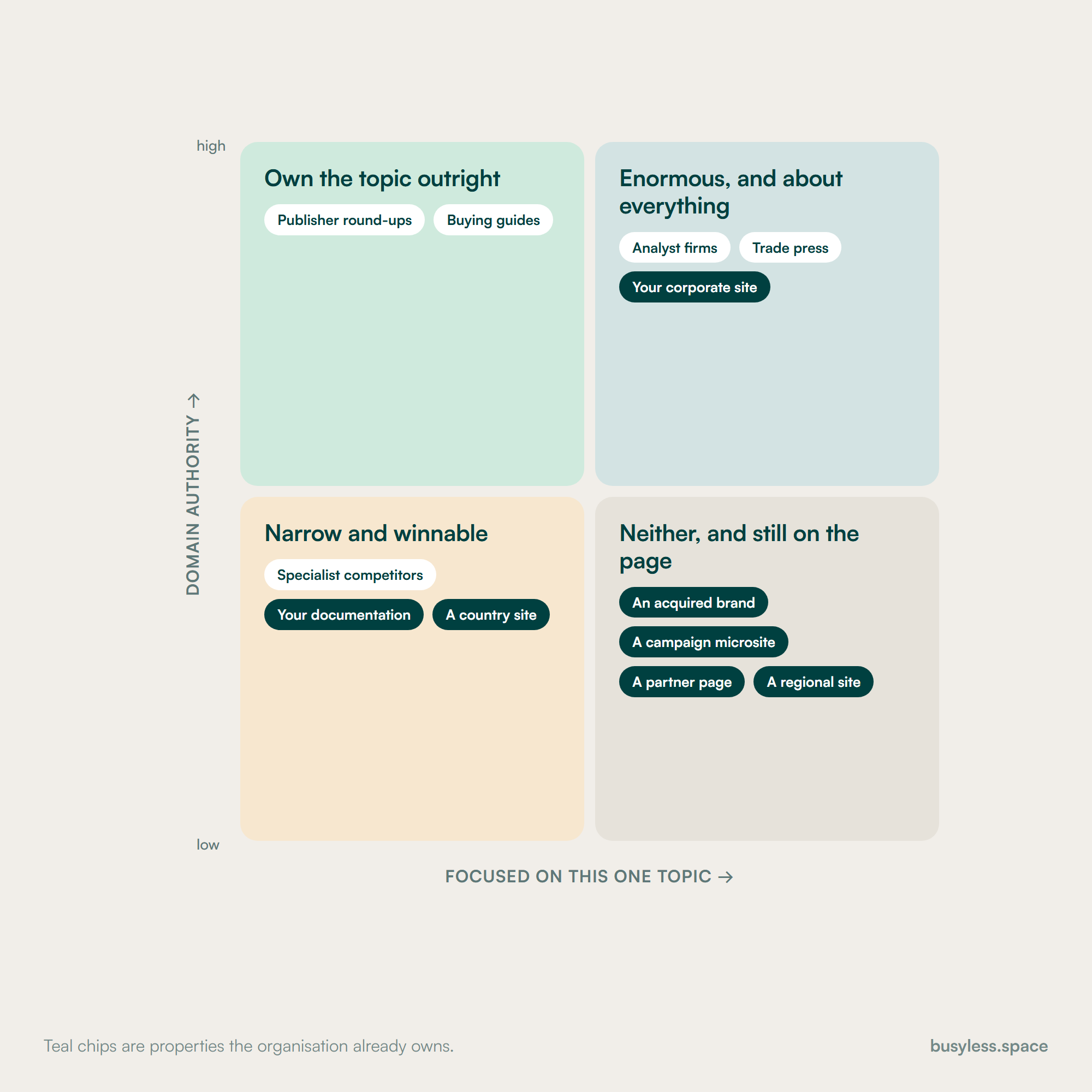
The first surprise in enterprise SEO is who you are actually competing with. Some of it is the expected mix of publishers, review platforms and competitors. A meaningful share of it, on the queries that matter most, is other parts of your own company.

What is on the results page

  • Your own brand dominating everything branded, which makes aggregate reporting look healthy regardless of what the work achieved.
  • Two or three of your own properties on the same results page, competing for a query none of them wins outright.
  • Publisher round-ups and buying guides holding the non-brand commercial terms, with authority no corporate domain can match.
  • Review platforms and analyst content on the category and evaluation queries, in the markets where those exist.
  • Locale mismatches, where the wrong country's page ranks for a market it does not serve and cannot transact in.
  • Acquired brands still ranking under their old names, sometimes better than the properties that replaced them.
  • Your own subsidiaries and country sites

    varies

    The gatekeeper unique to this segment. Several properties under one corporate umbrella compete for the same terms, split the links and confuse the engines about which is canonical. Nobody owns the resolution, which is why it survives audit after audit.

  • Acquired brands on their own domains

    varies

    Each carries real accumulated authority and a real reason it was left alone. The consolidation question is genuinely difficult and is usually deferred rather than decided. Deferring it is itself a decision and it should be written down as one.

  • Large publishers and buying guides

    varies

    The commercial non-brand terms in most enterprise categories belong to publishers with editorial authority a corporate site cannot approach. Concede those and take the qualified and product-specific versions underneath them.

  • Analyst firms

    gartner.com

    In enterprise categories the analyst layer sits between you and the buyer in a way no content programme reaches. The relationship is real work and it is not marketing's to run alone, but the criteria are worth reading because they describe the evaluation.

  • Review platforms, where the category has them

    g2.comClaim it

    Enterprise buyers use them differently from small ones: as evidence inside an evaluation document rather than as a shortlist. That makes the longer, more structured platforms disproportionately worth the effort.

  • Regional partners and resellers

    varies

    Frequently ranking above the parent in their own markets, using product copy you supplied. Rarely a problem worth fighting and often worth formalising, since a partner ranking is better than a competitor ranking.

  • Wikipedia and the knowledge graph

    wikipedia.org

    Large organisations have articles that shape what an engine believes about them, and nobody internally owns it. Editing it yourself is against the rules. Publishing accurate, citable facts on your own site is the legitimate route.

  • Employee and alumni content

    varies

    Conference talks, engineering blogs, LinkedIn posts and open source repositories from your own staff frequently outrank the corporate site on technical queries. Worth treating as an asset to support rather than a governance problem to close down.

A quadrant plotting brand strength against topical focus. Publishers sit high on both, competitors in the middle, and a cluster of the organisation's own country sites, acquired brands and campaign microsites occupies the same region as the competitors.
The cluster in the competitor region is the finding. Nobody in the building has authority over all of it, which is why it survives every audit.

What people actually search

The clusters below are grouped by who inside the organisation owns the answer, because that is the thing that decides whether anything gets published. Ownership is the constraint here, not intent.

Brand and navigational

Navigational

[company name] login

The page that wins it: Whatever page the person is actually looking for, findable in one step

Enormous volume, close to zero incremental value, and it dominates every aggregate report. Its only real job is to be excluded from the numbers so the rest of the work can be seen.

Product and solution, owned by product marketing

Commercial investigation

[product category] for [industry]

The page that wins it: One canonical page per product per market, with a named owner

The revenue cluster and the one with the worst duplication. Global, regional and campaign versions of the same product page compete, and resolving it requires an authority conversation rather than a redirect.

Support and documentation, owned by another department

Informational

how to [task] in [product]

The page that wins it: Public documentation and support articles, indexed, on the main domain

Usually the largest source of non-brand traffic in the whole organisation and almost never counted as marketing. It is also where an evaluator checks whether the product does the specific thing they need.

Careers, owned by human resources

Informational

[company] [role] salary

The page that wins it: Real role pages rather than a job board embed

Included because it is often the second largest non-brand cluster and belongs to a team that has never spoken to search. The job board embed usually renders nothing crawlable at all.

Investor and corporate, owned by communications

Informational

[company] annual report [year]

The page that wins it: HTML versions of documents currently published only as PDFs

Low volume, high stakes, and structurally interesting because it is where the organisation publishes its most carefully checked language. It is also where the accessibility obligations are hardest to argue away.

Market-specific regulatory and compliance

Commercial investigation

[product] [regulation] compliance

The page that wins it: A page per market, written by somebody who knows that market's rules

The cluster that cannot be translated. A compliance page for one jurisdiction is wrong in the next one, and machine translation of it is worse than having nothing.

Competitive and evaluation

Commercial investigation

[you] vs [competitor] for [use case]

The page that wins it: Comparison content, which large organisations are usually forbidden to publish

The cluster where enterprise loses to smaller competitors reliably. Legal declines the comparison page, the competitor publishes theirs, and it ranks unopposed for years.

Post-acquisition brand queries

Navigational

[acquired brand] [product]

The page that wins it: A decision about the acquired domain, then pages that honour it

Real demand that persists for years after an acquisition. It usually lands on a redirect chain to a corporate home page, which loses both the query and the customer.

What the rules change

Nothing here is specific to a sector. What makes it hard is that a large organisation publishes into many jurisdictions at once, and a sentence that is fine in one market is a violation in the next. Every item names its source and none of it is legal advice.

1

Environmental claims are about to be enforced much harder in Europe

Directive (EU) 2024/825 on empowering consumers for the green transition, which member states transposed by 27 March 2026 and which applies from 27 September 2026

What it means

Generic environmental claims without demonstrated excellent performance become prohibited, sustainability labels need to rest on a certification scheme or public authority, and claims about future environmental performance need clear commitments and independent verification. It reaches product pages, category pages and corporate content alike.

So do this

Inventory every environmental claim across every European locale before the date, and route each to whoever can evidence it. Words like carbon neutral, eco-friendly and climate positive are the ones to search for first, and translation means the same claim exists in twelve places.

2

Accessibility is a market access requirement in Europe, not a best practice

The European Accessibility Act, Directive (EU) 2019/882, with member state measures applying from 28 June 2025

What it means

Certain products and services, including e-commerce and a range of consumer-facing digital services, have to meet accessibility requirements to be placed on the EU market. The practical standard organisations work to is the harmonised European standard, which aligns closely with the international web content guidelines.

So do this

Treat it as a template and content programme rather than a project. The template fixes apply everywhere at once, which is the leverage; the content failures are in PDFs, video and image-only graphics that individual teams published.

3

A claim approved centrally can still be wrong locally

National consumer protection and advertising regimes, and sector regulators in each market you operate in

What it means

Comparative advertising, superlatives, pricing presentation and health or financial claims are treated differently by different regulators. Central approval of a global message does not constitute approval in any specific market, and a translated page carries the original claim into a regime that may not permit it.

So do this

Build market review into the publishing workflow rather than bolting it on, and keep a register of which claims have been cleared where. The register is what stops the same argument being had four times a year.

4

Personal data obligations reach the whole estate at once

The GDPR and the ePrivacy rules in Europe, and the state privacy statutes in the United States

What it means

Consent, rights requests and data transfers apply across every property the organisation runs, including the acquired domains nobody has looked at since the deal closed and the campaign microsites built by an agency three years ago. Tag managers on forgotten properties are a recurring finding.

So do this

Inventory every domain and subdomain the organisation controls, then check the tag stack and the consent mechanism on each. The forgotten properties are the exposure, and finding them is a search task as much as a legal one.

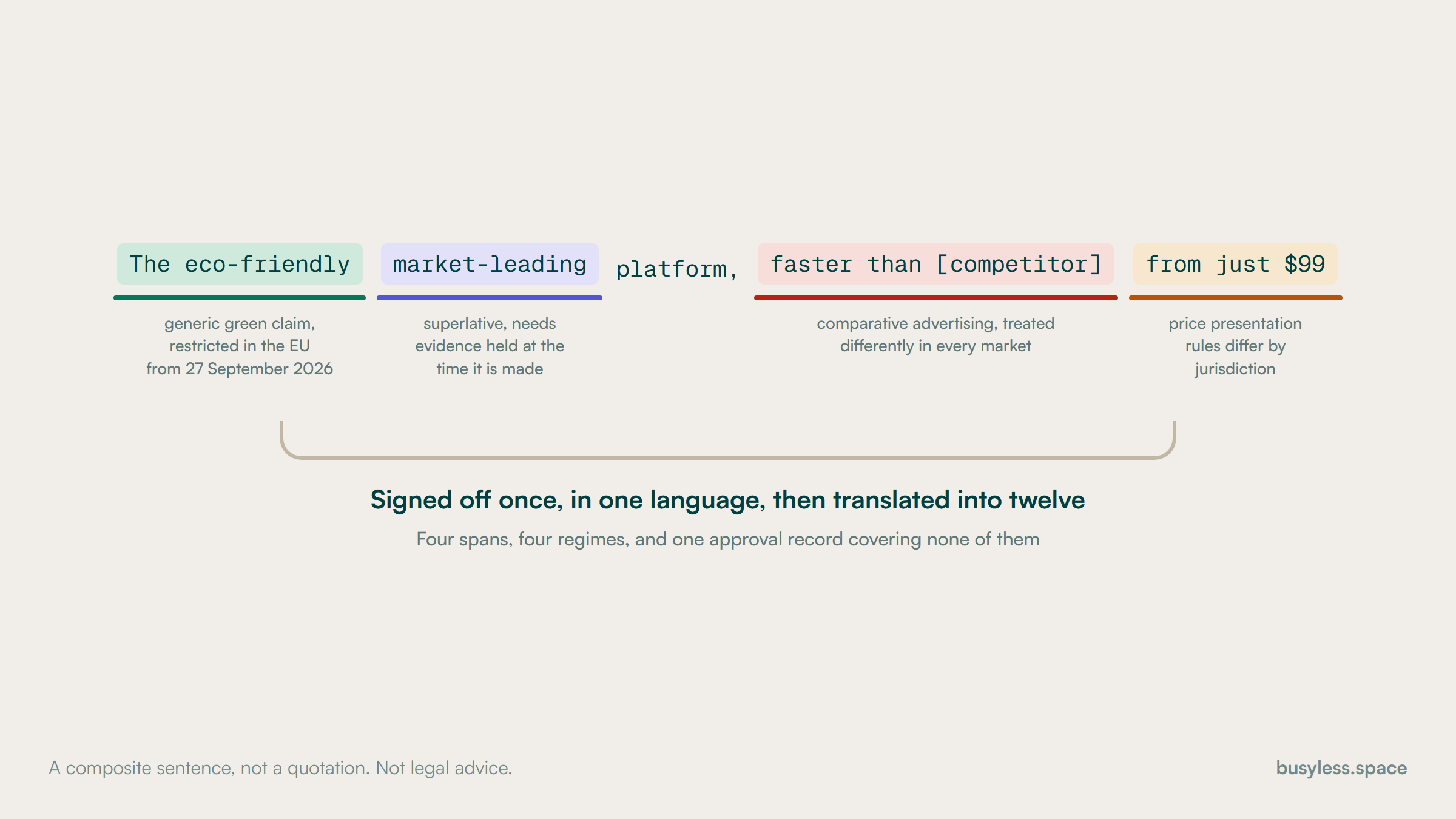
One product sentence broken into four coloured spans: an environmental claim, a superlative, a comparison against a named competitor, and a price presentation. Under each span, a note naming which markets permit it and which require verification or forbid it.
It was signed off once, centrally, and then translated. Sign-off in the language something was written in is not sign-off in the market it lands in.

Proving expertise

Large organisations have more genuine expertise than almost anybody and publish it in the most anonymous voice available. The signals below are mostly about undoing that, which is a governance argument rather than a writing one.

  • Named authors with real credentials, instead of a page attributed to the company or to a content team.
  • Original research the organisation is uniquely placed to run, published in full rather than gated behind a form.
  • Public documentation and engineering content from the people who built the thing.
  • Corporate disclosures published as HTML pages rather than only as documents, so the facts are readable and citable.
  • Clear market-level information: which entity serves which country, under which registration, with which contact.
  • Named customers at scale rather than a logo wall, with the outcome method stated.
  • A consistent, accurate presence across the identifier surfaces an engine uses to resolve a large company.

How to build a enterprise SEO strategy

Ninety days in a large organisation buys you a diagnosis and two approvals, which is a realistic ambition rather than a pessimistic one. An enterprise SEO strategy that promises published content in the first month has not met the review process yet.

  1. 1

    Weeks 1 to 6

    Map the estate and the permissions

    • Inventory every domain, subdomain and microsite the organisation controls, including the ones from acquisitions
    • Crawl the largest properties and find where they compete with each other for the same terms
    • Identify who owns the global template, who owns each locale, and who has to approve a copy change
    • Time the actual approval path for one small change, end to end, and write down what it cost
    • Separate brand from non-brand in every existing report, and show the difference to whoever commissioned it

    You end up with
    A map of the properties, a map of the permissions, and a measured approval cycle time that everybody can now see

  2. 2

    Weeks 4 to 16

    Win the template arguments

    • Prioritise the changes that apply once and land on every page, and cost each one in approvals rather than in hours
    • Take the two highest-leverage template fixes through the full process, deliberately, as a demonstration
    • Fix the internal linking and navigation patterns that the template controls
    • Resolve the worst self-competition case with a written ownership decision, not a redirect
    • Get the documentation and support estate indexed properly and attributed to the right property

    You end up with
    Two template changes live across the whole estate, and a precedent for how the next one gets approved

  3. 3

    Weeks 12 to 32

    Fix the international estate

    • Audit hreflang, canonical and locale routing market by market, and fix the worst offenders first
    • Decide which locales genuinely need original content and which are being served badly by translation
    • Run the environmental claim inventory across every European locale ahead of the September 2026 date
    • Retire or properly consolidate the microsites and campaign properties nobody owns
    • Settle the acquired-domain question in writing, whichever way it goes

    You end up with
    An estate where each market is served by one correct property, and a written decision on every domain the organisation holds

  4. 4

    Weeks 24 to 52

    Report something the board can use

    • Report non-brand performance separately from brand, permanently, with the reason stated
    • Segment by the internal owner of each cluster, so the numbers land on the teams that can act on them
    • Track approval cycle time as a first-class metric alongside traffic
    • Model the revenue contribution with the attribution method named, and state what it cannot prove

    You end up with
    A report that survives a board meeting because it distinguishes what the work did from what the brand did

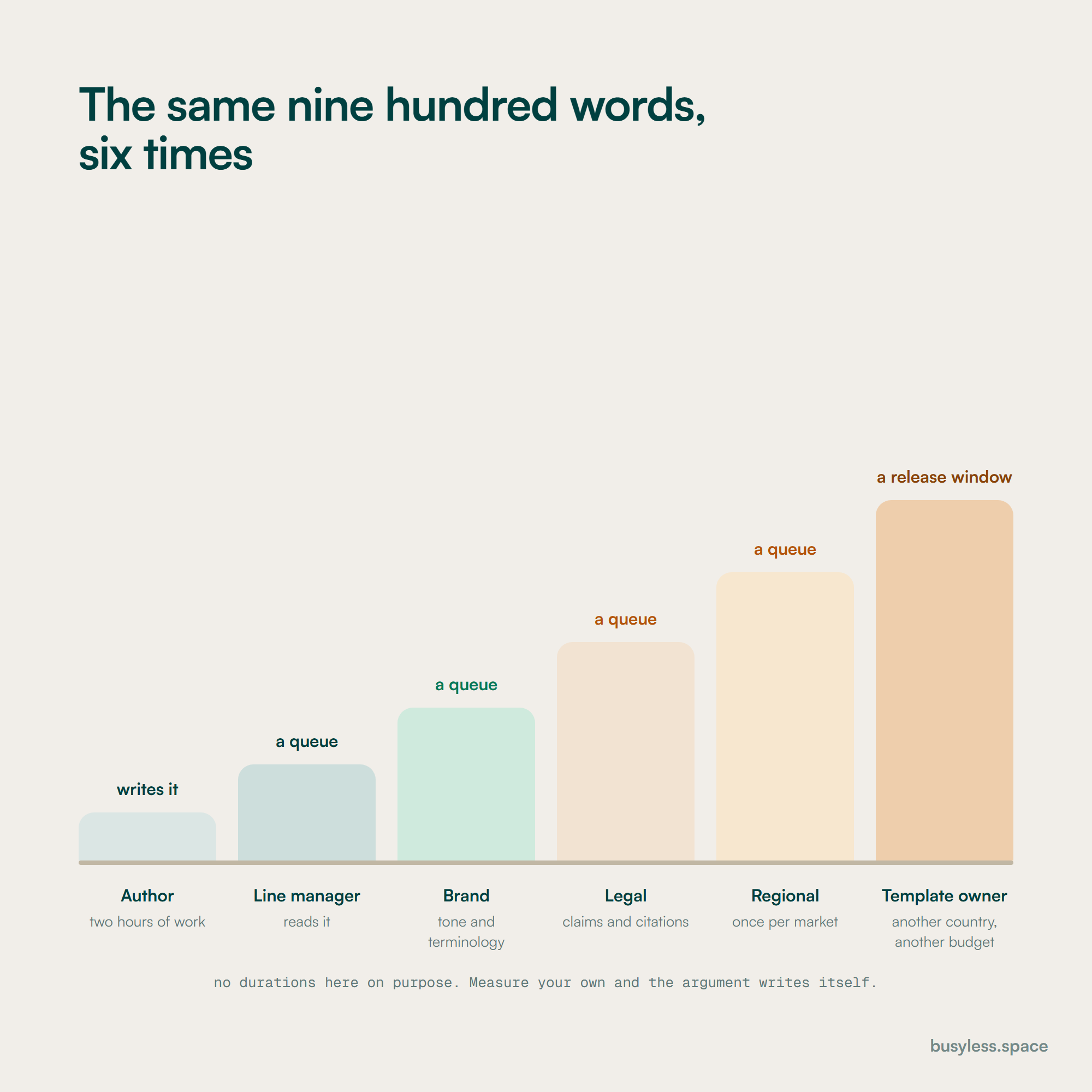
An escalating series of stages for a single page change: author, line manager, brand, legal, regional marketing, global template owner. Each stage adds another queue, and only the last one can change anything that applies estate-wide.
No durations here because yours are the ones that matter. Measure your own version of this once and it stops being a mystery and becomes a budget line.

Technical fixes with the best payoff

At this scale the defects are systemic rather than local, and almost all of them come from the same source: many teams publishing into one system over many years without a single owner. The fixes are template-level, which is what makes them worth the approval cost.

  • hreflang is wrong across most of the estate

    A quarter, and then permanent monitoring

    Thirty locales, generated by a system nobody maintains, with missing return tags, mismatched language codes and pages pointing at markets that no longer exist. It is the single most common enterprise technical defect and it is almost never fully correct.

    Generate the annotations from one authoritative locale map rather than per template, validate every return tag, and monitor it continuously. Fix the worst markets first rather than attempting the whole set at once.

  • Faceted navigation generates more URLs than the business has products

    A sprint, plus an argument with merchandising

    Filters combine into millions of addresses, all crawlable, most near-identical. At small scale this is untidy. At enterprise scale it consumes the crawl budget that new and updated pages need.

    Decide which facet combinations have genuine demand and give those real, indexable URLs. Block the rest at the parameter and link level rather than relying on canonical tags alone.

  • Three of your own pages compete for the same query

    A sprint, plus a quarter of diplomacy

    A global page, a regional page and a campaign page, published by three teams, each convinced theirs is canonical. The engine picks one, usually not the one the business wants, and the links divide three ways.

    Resolve ownership in writing first, then consolidate. The technical work is trivial and the negotiation is not, which is why starting with the redirect always fails.

  • The template cannot be changed by anybody you can reach

    A quarter of preparation, an afternoon of work

    The global template is owned by a team in another country, on another budget cycle, with a request queue measured in quarters. Meanwhile every page in the estate carries the same defect.

    Build the business case in their language: one change, one deployment, every page. Bring the measured cost of not doing it. Template changes are the highest-leverage work available and they are won on preparation.

  • Machine translation was applied to everything

    A programme, prioritised by revenue

    Locale expansion was solved by running the English site through a translation layer. The result reads badly to a native speaker, misses market-specific vocabulary entirely, and in regulated content carries claims into jurisdictions that do not permit them.

    Rank locales by revenue, translate the top ones properly with in-market review, and reduce the rest to a smaller set of genuinely useful pages rather than a full mirror.

  • Documents instead of pages

    A programme, and the accessibility deadline funds it

    Product specifications, annual reports, compliance summaries and technical notes are published as PDFs because that is how they were produced. They rank poorly, cannot be updated in place, and are the hardest part of the estate to make accessible.

    Publish an HTML version of anything somebody might search for, keeping the document for people who want to print it. Start with the ones that are the only source of information a customer needs.

  • Acquired domains sit in redirect chains

    A sprint per acquisition

    Each acquisition redirected a brand to the corporate home page in a hurry, sometimes through two intermediate hops. Real demand for the acquired brand persists for years and every bit of it lands somewhere useless.

    Map each acquired URL to the page that inherited its job, one hop, and keep a real page for the acquired brand name explaining what happened to it.

  • Nobody knows how many properties exist

    A month to find them, a quarter to decide

    Campaign microsites, event sites, agency-built landing domains and country properties accumulate over a decade with no register. Some still run tag managers, some have expired certificates, and some rank for brand terms.

    Build the register from certificate transparency logs, the DNS records, the analytics account and the invoices. Then decide, one by one, keep or retire. The retiring is the easy half.

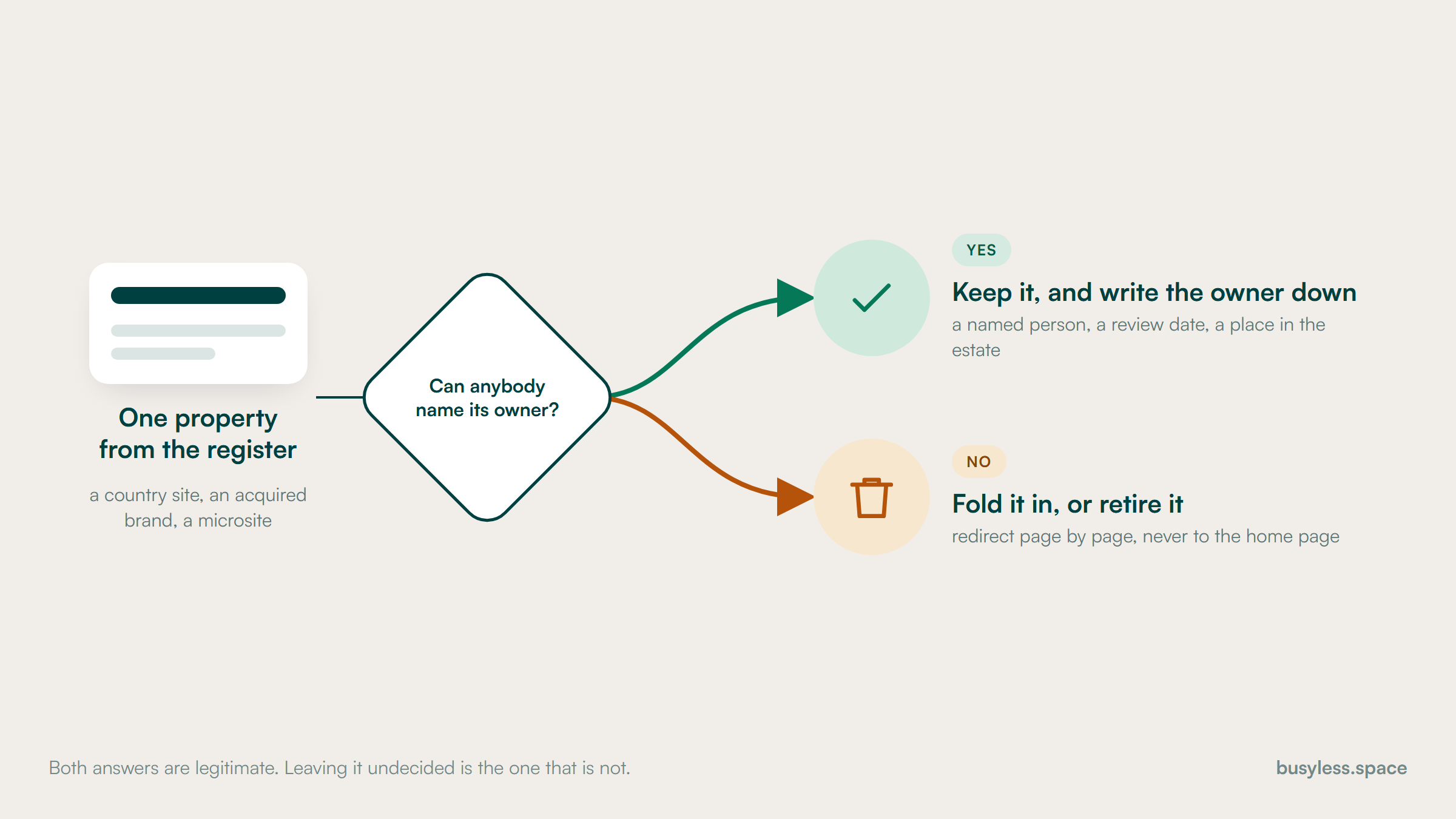
A decision gate for one property found in the register, asking whether anybody can name its owner. The yes branch leads to keeping it and giving it a place in the estate. The no branch leads to folding it in or retiring it, with the redirects mapped page by page.
Run every property through the same gate, including the ones somebody will defend. Leaving it undecided is itself a decision, and a worse one.

Structured data that applies here

The types below fit this industry specifically. Most of them earn no rich result on their own, which is worth knowing before anyone sells the work on that basis. What they do is describe the entity precisely, which matters for how search engines and answer engines resolve who you are.

  • Organization with subOrganization

    The corporate home page, referenced across the estate

    The node that resolves a complicated corporate structure into something an engine can follow. For a group with subsidiaries and acquired brands, expressing the relationship explicitly is more useful than any individual page-level markup.

    Organization with subOrganization.jsonld
    {
      "@context": "https://schema.org",
      "@type": "Organization",
      "@id": "https://[YOUR-DOMAIN]/#organization",
      "name": "[GROUP NAME]",
      "legalName": "[REGISTERED LEGAL NAME]",
      "url": "https://[YOUR-DOMAIN]",
      "logo": "https://[YOUR-DOMAIN]/[LOGO.PNG]",
      "foundingDate": "[YYYY]",
      "identifier": [
        {
          "@type": "PropertyValue",
          "propertyID": "LEI",
          "value": "[LEGAL ENTITY IDENTIFIER]"
        },
        {
          "@type": "PropertyValue",
          "propertyID": "VAT",
          "value": "[VAT NUMBER]"
        }
      ],
      "subOrganization": [
        {
          "@type": "Organization",
          "name": "[SUBSIDIARY OR ACQUIRED BRAND]",
          "url": "https://[THEIR-DOMAIN-OR-SECTION]"
        }
      ],
      "sameAs": [
        "[WIKIPEDIA URL]",
        "[LINKEDIN COMPANY URL]",
        "[STOCK EXCHANGE PROFILE URL]"
      ]
    }
  • Organization per market entity

    Each country or regional site

    Where a different legal entity trades in a market, say so. It gives the engine a reason to associate the right property with the right country and it answers a question regulators and customers both ask, which is who exactly they are dealing with.

    Organization per market entity.jsonld
    {
      "@context": "https://schema.org",
      "@type": "Organization",
      "@id": "https://[YOUR-DOMAIN]/[LOCALE]/#entity",
      "name": "[LOCAL ENTITY NAME]",
      "parentOrganization": { "@id": "https://[YOUR-DOMAIN]/#organization" },
      "url": "https://[YOUR-DOMAIN]/[LOCALE]/",
      "areaServed": {
        "@type": "Country",
        "name": "[COUNTRY]"
      },
      "address": {
        "@type": "PostalAddress",
        "streetAddress": "[STREET]",
        "addressLocality": "[CITY]",
        "postalCode": "[POSTCODE]",
        "addressCountry": "[COUNTRY CODE]"
      },
      "identifier": {
        "@type": "PropertyValue",
        "propertyID": "[LOCAL REGISTRATION TYPE]",
        "value": "[REGISTRATION NUMBER]"
      },
      "contactPoint": {
        "@type": "ContactPoint",
        "contactType": "customer service",
        "availableLanguage": ["[LANGUAGE]"],
        "areaServed": "[COUNTRY CODE]"
      }
    }
  • Product with variant offers

    Product and catalogue pages at scale

    Generated from the product information system rather than hand-written, which is the only way it stays true across a large catalogue. The identifiers matter more than the description: they are what let an engine recognise the same product across your markets and your resellers.

    Product with variant offers.jsonld
    {
      "@context": "https://schema.org",
      "@type": "Product",
      "name": "[PRODUCT NAME]",
      "sku": "[SKU]",
      "gtin13": "[GTIN, IF YOU HAVE ONE]",
      "mpn": "[MANUFACTURER PART NUMBER]",
      "brand": {
        "@type": "Brand",
        "name": "[BRAND]"
      },
      "manufacturer": { "@id": "https://[YOUR-DOMAIN]/#organization" },
      "description": "[FROM THE PRODUCT INFORMATION SYSTEM, NOT WRITTEN TWICE]",
      "offers": {
        "@type": "Offer",
        "url": "https://[YOUR-DOMAIN]/[LOCALE]/products/[SLUG]",
        "price": "[PRICE]",
        "priceCurrency": "[CURRENCY]",
        "availability": "https://schema.org/InStock",
        "areaServed": "[COUNTRY CODE]",
        "seller": { "@id": "https://[YOUR-DOMAIN]/[LOCALE]/#entity" }
      }
    }
  • TechArticle

    Documentation and technical support content

    Distinguishes technical documentation from marketing articles, which matters here because the support estate is frequently the largest source of non-brand traffic and is usually marked up as nothing at all. The proficiency level and dependencies are genuinely useful properties.

    TechArticle.jsonld
    {
      "@context": "https://schema.org",
      "@type": "TechArticle",
      "headline": "[DOCUMENT TITLE]",
      "url": "https://[YOUR-DOMAIN]/docs/[PATH]",
      "datePublished": "[YYYY-MM-DD]",
      "dateModified": "[YYYY-MM-DD]",
      "proficiencyLevel": "[Beginner | Expert]",
      "dependencies": "[VERSIONS OR PREREQUISITES THIS APPLIES TO]",
      "about": {
        "@type": "Product",
        "name": "[PRODUCT NAME]"
      },
      "author": {
        "@type": "Person",
        "name": "[AUTHOR NAME]"
      },
      "publisher": { "@id": "https://[YOUR-DOMAIN]/#organization" },
      "inLanguage": "[LANGUAGE CODE]"
    }
  • Report

    Annual reports, research and corporate disclosures

    A specific type for the documents corporate communications publishes, and worth using because those pages carry the organisation's most carefully verified facts. Marking them up makes them citable, which is exactly what you want when an answer engine is describing your company.

    Report.jsonld
    {
      "@context": "https://schema.org",
      "@type": "Report",
      "name": "[REPORT TITLE] [YEAR]",
      "url": "https://[YOUR-DOMAIN]/investors/[SLUG]",
      "datePublished": "[YYYY-MM-DD]",
      "reportNumber": "[IDENTIFIER, IF ANY]",
      "author": { "@id": "https://[YOUR-DOMAIN]/#organization" },
      "publisher": { "@id": "https://[YOUR-DOMAIN]/#organization" },
      "about": "[WHAT PERIOD AND WHAT SUBJECT]",
      "inLanguage": "[LANGUAGE CODE]",
      "encoding": {
        "@type": "MediaObject",
        "contentUrl": "https://[YOUR-DOMAIN]/[FILE.PDF]",
        "encodingFormat": "application/pdf"
      }
    }
  • BreadcrumbList

    Everywhere below the top level, generated from the template

    Trivial individually and valuable at this scale, because a deep estate across many locales gives an engine very little else to work from. Generate it from the template rather than per page, which is also the only way it stays correct across a hundred thousand URLs.

    BreadcrumbList.jsonld
    {
      "@context": "https://schema.org",
      "@type": "BreadcrumbList",
      "itemListElement": [
        {
          "@type": "ListItem",
          "position": 1,
          "name": "[COUNTRY OR LOCALE HOME]",
          "item": "https://[YOUR-DOMAIN]/[LOCALE]/"
        },
        {
          "@type": "ListItem",
          "position": 2,
          "name": "[SECTION]",
          "item": "https://[YOUR-DOMAIN]/[LOCALE]/[SECTION]/"
        },
        {
          "@type": "ListItem",
          "position": 3,
          "name": "[PAGE NAME]",
          "item": "https://[YOUR-DOMAIN]/[LOCALE]/[SECTION]/[SLUG]"
        }
      ]
    }

What it costs

The bands here are editorial estimates rather than quotes, and they behave differently from the rest of the directory: a large share of the spend goes on coordination rather than on output, and that is not waste so much as the cost of operating at this size.

One market, one property

$8,000 to $15,000
  • A full technical audit of a single large property and the template changes that follow
  • Non-brand reporting separated out and defended
  • One self-competition case resolved with a written ownership decision
  • Support and documentation content brought into scope and measured

Who it suits

A division or a single-market business inside a larger group

Where it stops

It cannot resolve anything owned by another country or another function, which is where most of the value in a group actually sits.

Multi-market programme

$15,000 to $40,000
  • The international estate audited and the locale routing fixed market by market
  • Template changes taken through the full approval process, repeatedly
  • Locale content prioritised by revenue rather than mirrored everywhere
  • The claim inventory and market-level review process built into publishing

Who it suits

A group operating in several markets with separate regional teams

Where it stops

It does not settle the acquired-domain question, which is a corporate decision with commercial and legal weight beyond a marketing budget.

Estate-wide

$40,000 to $80,000 and above
  • The full property register, and a keep-or-retire decision on every domain
  • Documents moved to pages across the estate, which the accessibility obligations also require
  • Governance that survives a reorganisation, including a named owner per cluster
  • Reporting the board reads, with brand excluded and the attribution method stated

Who it suits

A group with several brands, many markets and a decade of accumulated properties

Where it stops

No budget shortens an approval cycle by itself. That is changed by demonstrating a template win and using it as precedent, which takes a year rather than money.

How to do it with no budget

The free work here is unusually valuable because it is mostly diagnosis, and in a large organisation the diagnosis is the thing that unlocks the budget. None of the items below needs a purchase order.

  1. 1

    Time one small copy change from request to live

    Whatever it takes, which is the point

    A calendar and a note

    The single most useful number you will produce in the first quarter. Nobody has measured it and everybody assumes it is shorter than it is.

  2. 2

    Separate brand from non-brand in every existing report

    A day

    Search Console, filtered

    Usually changes the story completely, and it is the finding that makes the rest of the programme fundable.

  3. 3

    Find every property the organisation owns

    A week

    Certificate transparency logs, DNS records, the analytics account

    The register nobody has. Expect to find campaign sites and acquired domains that are still running tag managers.

  4. 4

    Search your five most valuable queries and note how many results are yours

    An hour

    A browser

    The cheapest way to demonstrate self-competition to somebody senior, because they can see it themselves in ten seconds.

  5. 5

    Inventory every environmental claim across your European locales

    Two days

    A site search per phrase, per locale

    Ahead of 27 September 2026. Translation means one approved claim now exists in a dozen places, none of which was reviewed locally.

  6. 6

    Ask who owns the global template, and what a change request costs

    A fortnight of waiting

    An email, then a meeting

    The highest-leverage relationship in the whole programme, and most search teams have never had the conversation.

  7. 7

    Check what your support and documentation estate earns

    2 hours

    Search Console, by directory

    Frequently the largest non-brand cluster in the organisation, owned by a team with no search input at all.

The tool stack

Tooling matters more here than anywhere else in the directory, because the estate exceeds what anybody can inspect by hand. What you are buying is the ability to see a pattern across hundreds of thousands of URLs, not a keyword list.

  • Crawl and monitor an estate of hundreds of thousands of URLs

    BotifySEO APIRead the review

    The useful output is the join between what exists, what gets crawled and what earns anything. At this scale that join is the whole diagnosis, and no spreadsheet holds it.

    Free routeA desktop crawler on one section at a time, which works up to the low hundreds of thousands and not beyond

  • Run reporting several teams and several markets will actually use

    ConductorSEO APIRead the review

    What you are buying is workflow rather than data: many users, many market views, and reporting that lands on the team that owns each cluster. Judge it on whether regional teams open it.

    Free routeSearch Console properties per market, exported and joined yourself

  • See visibility by market across Europe

    SistrixSEO APIRead the review

    Strongest in the European markets, which is where a multi-locale estate usually has the least visibility internally. Useful specifically for showing a regional team what is happening in their own market.

    Free routeSearch Console per property, which shows your own performance but not the market

  • Publish across many locales without mirroring everything

    ContentstackHeadless CMSRead the review

    The requirement is a locale model where a market can diverge from the global version deliberately, plus a workflow that records approvals. Anything that forces either a full mirror or a full rewrite per market will be worked around within a year.

    Free routeNone at this scale, realistically

  • See real-world performance rather than lab scores

    Chrome UX ReportSEO APIRead the review

    At this scale a synthetic test on a handful of templates tells you very little. Field data segmented by country and device is what shows that one market is being served badly by a shared template.

    Free routeIt is free and it is field data

  • Model the return before asking for the budget

    Enterprise SEO ROI CalculatorFree toolOpen the tool

    Useful mainly for the template argument, where one change lands on every page. Put the number of affected pages and your own conversion rate in it rather than a benchmark, and show the working.

    Free routeIt is free

Take it from here

Everything below is yours to take. Fill the [BRACKETS] and it is ready to use. Start with the approval cycle measurement, because it is the number that reframes every other conversation you are about to have.

Checklist

The instrument for timing how long a change actually takes to go live, which is the number that explains most enterprise search programmes.

APPROVAL CYCLE MEASUREMENT
Organisation: [NAME]     Property: [WHICH SITE]
Run by: [NAME]     Started: [YYYY-MM-DD]

WHY MEASURE THIS
Everybody assumes publishing is a decision. In a large organisation it is
a process with a queue at every stage, and nobody has ever timed it end to
end. This number explains why the content calendar is behind, and it is
the single most persuasive artefact a search team can produce in its first
quarter.

PICK THREE CHANGES, DELIBERATELY SMALL
  1. A title tag and meta description on one existing page
  2. A paragraph of body copy on one existing page
  3. One new internal link in a template

  Do not pick anything important. The point is to measure the process,
  not to achieve the change.

FOR EACH ONE, LOG EVERY STAGE

  CHANGE: [WHAT]     Raised: [YYYY-MM-DD HH:MM]

  Stage                          Reached      Left        Waiting
  Request raised                 [DATE]       [DATE]      [DAYS]
  Assigned an owner              [DATE]       [DATE]      [DAYS]
  Copy drafted                   [DATE]       [DATE]      [DAYS]
  Line manager review            [DATE]       [DATE]      [DAYS]
  Brand review                   [DATE]       [DATE]      [DAYS]
  Legal review                   [DATE]       [DATE]      [DAYS]
  Regional or market review      [DATE]       [DATE]      [DAYS]
  Translation, if applicable     [DATE]       [DATE]      [DAYS]
  Development queue              [DATE]       [DATE]      [DAYS]
  Release window                 [DATE]       [DATE]      [DAYS]
  Live                           [DATE]

  Total elapsed: [DAYS]
  Total hands-on work: [HOURS]
  Ratio of waiting to working: [X : 1]   <- this is the finding

  Stages that could be removed for a change this small: [WHICH]
  Stages nobody could explain the purpose of: [WHICH]
  Who has authority to remove one: [NAME]

THE THREE NUMBERS TO PUBLISH
  Median elapsed time for a small change:        [DAYS]
  Median hands-on time for the same change:      [HOURS]
  Approvers involved in a change of this size:   [N]

WHAT TO DO WITH IT
[ ] Put it in the first monthly report, without comment
[ ] Use it to re-baseline the content calendar
[ ] Use it as the opening of the template-change business case, where
    the argument is that one approval should serve every page
[ ] Re-measure every six months. It moves, in both directions.

Measured by: [NAME]     Date: [YYYY-MM-DD]

What to publish

The content question at this scale is not what to write. It is which of the things already written can be published, translated, or made findable, and who has to agree.

  • Documentation and support content, treated as marketing

    Continuous, as part of the product cycle

    Usually the largest non-brand cluster the organisation has, owned by a team that has never been asked about search, and the place an evaluator checks whether the product does a specific thing.

  • One canonical page per product per market

    Rebuilt once, then maintained by a named owner

    It is the revenue cluster and it is the one most damaged by duplication. The work is a naming and ownership decision far more than a writing one.

  • Original research only you could run

    One or two a year, done properly

    A large organisation holds data nobody else has. Published in full rather than gated, it earns the kind of citation and link a corporate site cannot otherwise get.

  • Market-specific regulatory pages

    One per market, reviewed when the rules move

    The content that cannot be translated, because the answer differs by jurisdiction. It converts well in regulated categories and it is the clearest possible signal of local competence.

  • HTML versions of corporate documents

    A programme, prioritised by what customers search for

    Specifications, reports and compliance summaries currently locked in PDFs. Publishing them as pages makes them findable, citable and accessible, which the European obligations require anyway.

  • Named expert content from the people who build things

    Whatever a named person will genuinely sustain

    Engineers, researchers and specialists inside the organisation hold the expertise that a corporate voice erases. Publishing under their names is the cheapest available trust signal.

And what not to

  • A global blog translated into thirty languages. It multiplies the review burden by thirty and serves no market particularly well.
  • Campaign microsites on their own domains. They start with a deadline, outlive their owner, and become the properties nobody can account for.
  • Corporate voice on technical subjects. The expert exists inside the building and the anonymous version convinces nobody who knows the field.
  • Thought leadership commissioned to fill a quarterly slot. It reaches peers and analysts, which is a real audience and not the one being measured.
  • Anything that requires the global template to change but has not been through the approval conversation. It will sit in a queue and be presented as a delivery failure.

The expensive mistakes

Planning content before mapping the approval path

Costs you A calendar that meets none of its dates, and a search team blamed for it

Measure the real approval cycle first, publish that number, and plan against it.

Chasing individual pages instead of template changes

Costs you A year of effort where one deployment would have moved two hundred thousand pages

Rank every opportunity by how many URLs it touches, then spend the time on getting the biggest one approved.

Treating self-competition as a technical problem

Costs you A consolidation that is quietly reversed by whichever team lost

Get the ownership decision in writing from somebody with authority over both teams, then do the redirects.

Reporting brand and non-brand together

Costs you A number that describes the company's reputation and is presented as the work

Split them permanently, explain why once, and never merge them again even when the split looks worse.

Mirroring the whole site into every locale

Costs you Thirty times the review burden and no market served well

Rank locales by revenue, translate properly at the top, and reduce the tail to a smaller useful set.

Redirecting an acquired brand to the corporate home page

Costs you Years of persistent demand for that brand landing somewhere useless

Map each acquired URL to the page that inherited its job, and keep a real page explaining what happened.

Assuming a centrally approved claim is approved everywhere

Costs you The same sentence in twelve markets, reviewed in one

Build market-level review into the workflow and keep a register of what has been cleared where.

What to measure

One decision determines whether an enterprise report is useful, and it is made in the first week: whether brand queries are excluded. A brand of this size generates enough search demand to hide everything the work did or failed to do.

Leading indicators

Move first. They predict, they do not prove.

  • Non-brand impressions and clicks, reported separately

    Search Console, with a brand regex agreed and documented

    Agree the brand pattern once, write it down, and never change it quietly. Including acquired brand names in that pattern is the decision people forget, and it moves the number materially.

  • Performance by internal owner, not by page type

    Search Console segmented by directory, mapped to the team that owns it

    The segmentation that makes a report actionable in a large organisation, because it lands each number on somebody who can do something about it.

  • Approval cycle time

    Your own tracking of requests from raised to live

    Unusual to report and the best predictor of everything else here. When it rises, output falls two months later, and having the number is what makes the conversation possible.

  • Pages affected by shipped template changes

    Your own change log, multiplied by the crawl count

    The metric that makes leverage visible. One approved change touching two hundred thousand URLs reads very differently from four articles, and both took a quarter.

  • Locale correctness: hreflang, canonical and routing

    A crawl of the international estate, run monthly

    Report it as a count of markets that are correct rather than as a total error figure. Regional teams act on their own market and ignore an aggregate.

  • Self-competition: queries where more than one property ranks

    Rank tracking across all owned properties

    A governance metric that shows whether ownership decisions are holding. It is also the finding senior people grasp fastest, because they can verify it themselves.

Business indicators

The ones a manager acts on.

  • Revenue or pipeline from non-brand organic entry

    The analytics and commerce or CRM systems, with the model named

    State the attribution method and its limits in the same breath. At this scale the model choice moves the number more than the work does, and pretending otherwise is how a report loses credibility.

  • Market-level share of the categories you compete in

    A visibility index, per market

    Directional rather than precise, and useful because it is the only number that lets a regional team compare itself against its own market rather than against another country.

The verdict

The hardest part of working at this scale is that the obvious answer is almost never the constraint. There is enough budget, enough writers and enough agency capacity. There is not enough permission.

So the work that actually moves a large organisation looks unglamorous from outside. A template change, a written ownership decision, a locale map, a brand exclusion in a report. Each of them lands on more pages than a year of publishing would.

The most useful question to put to anybody selling enterprise SEO services is how they plan to get anything approved. A roadmap that assumes publishing is a decision rather than a process was written for a different kind of company.

Watch, too, for a provider of SEO services for enterprise who reports on aggregate traffic. At this size the brand supplies most of that number, and a report that does not separate it is describing your reputation back to you.

FAQ

Enterprise SEO questions

  • Why is nothing shipping when we have the budget?
    Because production was never the constraint. Measure the actual time from a change being requested to it going live, end to end. That number usually explains the whole situation and nobody has ever written it down.
  • Should we consolidate our acquired brand domains?
    Sometimes, and it is a genuinely difficult commercial decision rather than a technical one. What is not defensible is leaving it undecided for years while demand for the acquired brand lands on a redirect chain.
  • How do we stop our own sites competing with each other?
    With a written ownership decision from somebody senior to both teams, before any redirect is built. Consolidations done without that agreement are reversed within two quarters by whichever team lost.
  • Is crawl budget a real thing?
    At a few hundred pages, no. At several hundred thousand with faceted navigation and thirty locales, yes, and it decides whether new and updated pages are seen at all. Scale is what changes the answer.
  • Do we need original content in every market?
    No, and mirroring everything is the more common mistake. Rank locales by revenue, invest properly in the top few with in-market review, and reduce the tail to a smaller set of genuinely useful pages.
  • How do we report this to a board?
    Exclude brand, segment by the team that owns each cluster, name the attribution model and state what it cannot prove. A single blended traffic number will be picked apart by the first person who asks a hard question.
  • Are the budget figures on this page quotes?
    No. They are editorial estimates, and an unusually large share of the spend at this scale goes on coordination rather than output. That is the cost of the size rather than waste.
  • What is the one thing to do first?
    Time one small copy change from request to live. It is the number nobody has, it is always longer than people assume, and it reframes every conversation about why the programme is not delivering.

Run it yourself, or have someone own it

Everything above is written to be run without us, and the free path is genuinely most of the value for a single-location business. Where these plans stall is almost never the plan. It is that nobody owns it after the first month. That is the job we do, with search as one distribution layer inside a wider system rather than the whole engagement.