
Contentstack review
Best for content and customer data on one contract
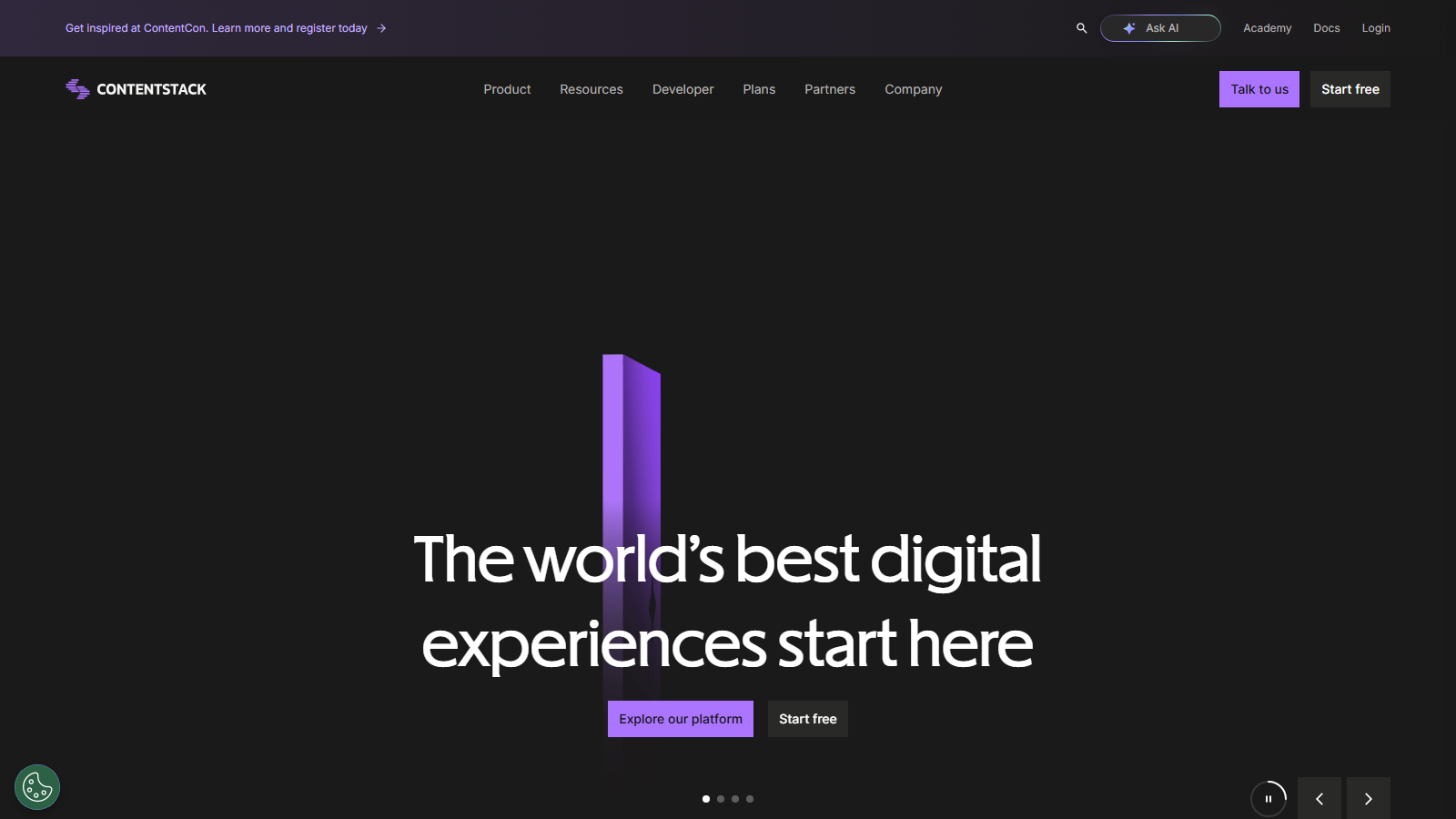
The Contentstack headless CMS is now sold as one part of an Agentic Experience Platform, announced on 9 June 2026. The CMS sits in Content Cloud beside asset management, front-end hosting and brand controls. Data Cloud adds the Lytics customer data platform, bought in a deal that closed in December 2024, and Agent OS adds AI agents. The company began as a sister business of Built.io.
Nothing on the pricing page tells you what any of this costs. It shows a single plan card of capability ticks, a demo button and a start-free button, with no figure in any currency. The tier names, uptime commitments, support hours and usage caps live somewhere else entirely: Contentstack's legal Services Description, last updated on 28 July 2026.
That document deserves an hour before the first sales call. It names Start, Grow and Scale tiers alongside X1, X3 and X5, and promises 99.50% uptime on four of them and 99.95% on Scale and X5. It also limits Explorer stacks to 50 content types, 200 entries and 10,000 API calls a month. The free Explorer accounts launched in September 2025 were headlined "Build without limits, for free".
Our scorecard
Our editorial read across six dimensions, scored 1 to 5. This is our own assessment, not an aggregate of user reviews, and it is deliberately kept out of the page's structured data.
- Content modelling4/5
Modular blocks, global fields, taxonomies, variants and five branches per stack. Reference depth is capped at three levels in GraphQL.
- Developer experience3/5
Published limits, seven regional hosts and eleven delivery SDKs, offset by organisation-wide rate limits and documents that disagree with each other.
- Editor experience3/5
Visual Editor and Timeline preview are real features. Practitioners still describe the admin as clunky for simple jobs.
- Pricing2/5
A permanent free Explorer to learn on, and not a single published price for anything you can launch.
- Governance5/5
Workflows, publish rules, SSO and SCIM, branches, audit logs, ISO 27001 and SOC 2, and a choice of AWS, Azure or Google Cloud.
- Ecosystem4/5
Marketplace apps, Automate recipes, Launch hosting and a CDP in the same account. Heavier on partners than on community.
An editorial read, not an aggregate of user reviews, and deliberately kept out of this page's structured data.
Contentstack in their own words
From Contentstack's own YouTube channel. Vendor marketing rather than an independent review, included because it is the quickest way to see the product before you sign up.
What you can query
Content Delivery API
100 req/s per organisation at origin
Published entries, assets and content types as JSON from the CDN, filtered with a JSON query parameter and returned 100 records at a time by default.
GraphQL Content Delivery API
80 req/s per organisation at origin
The same published content through a generated schema, capped at 7,500 objects, three reference levels and three content types per query.
Content Management API
10 reads and 10 writes a second, org-wide
Entries, assets, content types, branches, releases, workflows, tokens and webhooks, read and written through the management API. Imports, migrations and bulk publishing run here.
Image Delivery API
Counts toward the delivery origin limit
Resizing, cropping and format conversion to WebP, AVIF and others through URL parameters, for inputs up to 50MB and 12,000 pixels a side.
Live Preview and Visual Editor
Preview hosts in all seven regions
Draft content rendered inside your own front end through regional preview hosts, with on-canvas editing and audience variants for marketers.
MCP server
@contentstack/mcp 0.9.0, stdio, OAuth or tokens
AI-client access to the Management and Delivery APIs plus Launch, Brand Kit, Personalize, Analytics, Automations, Developer Hub and Lytics, loaded in groups.
Who Contentstack is for
Large brands that want content, customer data and AI agents from one vendor and one support contract, and whose buying process runs through procurement. Retail, travel and financial-services teams running many locales and many sites are the natural fit, particularly where the choice of AWS, Azure or Google Cloud hosting is itself a requirement.
The wrong buyer is a developer who wants to launch a small site this month. Explorer is free to learn on but written as non-production, and everything above it is a sales conversation.
Strengths and limits
What it does well
- Seven regional delivery hosts across AWS, Azure and Google Cloud, which settles hosting-region questions that otherwise stall a procurement review.
- A permanent free Explorer account, with no expiry date, for learning the model and APIs before anyone books a demo.
- The Services Description publishes uptime commitments, support hours, service credits and fair-use caps, so the contract terms can be read before a sales call even though the price cannot.
- Branches, publish rules, workflows, SSO and SCIM give large editorial teams real separation of duties.
- Lytics CDP and personalisation sit in the same platform as the CMS, so audience data does not need a third vendor.
- Beyond content, the MCP server reaches Launch deployments, Brand Kit, Personalize, Analytics and Lytics.
- Eleven delivery SDKs, from TypeScript and Python to Dart and React Native, plus Kickstarts for Next.js, Nuxt, Astro, Angular and SvelteKit.
Where it falls short
- NO PRICE ANYWHERE. The pricing card lists capabilities only, so every figure beyond Explorer comes from a quote.
- The Explorer launch post promises no limits and no rate limiting, while the Services Description caps Explorer stacks at 200 entries and 10,000 API calls a month.
- The base uptime commitment is 99.50% on Start, Grow, X1 and X3. The 99.99% on the pricing card is an add-on package.
- Every stack and site in an organisation draws on one pool of 100 uncached delivery requests a second.
- Contentstack's own documents disagree: the Image Delivery API page gives 80 requests a second for the pool the Delivery API page puts at 100.
- Features using AI are excluded from the definition of Software in the Services Description and may be discontinued at any time.
- The contract reserves the right to bill for extra stacks retroactively, so stack sprawl is a commercial risk as well as a technical one.
- One practitioner who migrated content reports thin documentation, a CLI export that failed at a few thousand entries, and asset deletion ten at a time.
Contentstack pricing
Contentstack publishes no price in any currency, so there is no dollar or euro list price to compare. Its pricing page carries a single "Contentstack AXP - CMS" card whose ticks run from the headless CMS through personalisation, dedicated infrastructure and 24/7 support, then asks you to request a demo or start free. Its introduction says every tier includes Agent OS, while showing no tiers at all.
The Services Description fills the gap on everything except money. It names Start, Grow and Scale, plus X1, X3 and X5, which it does not define. Start, Grow and X1 get 24x5 chat support; Scale, X3 and X5 get 24x7. Uptime is 99.50% on Start, Grow, X1 and X3 and 99.95% on Scale and X5, with a 10% credit per incident capped at 30% of the month's fees.
The add-ons are where the pricing card's ceilings come from. A High Availability package buys 24x7 support and 99.95%, a Premium Availability package buys 99.99%, and custom rate limits require dedicated infrastructure. Automate includes 5,000 executions a month with no overages. Stacks beyond the Order Form may cost extra, and the document reserves the right to bill for them retroactively.
Explorer is the free way in. The launch post of 29 September 2025 calls it a permanent playground with no time limits. The Services Description defines Explorer stacks as non-production, outside the SLA, and capped at 50 content types, 200 entries and 10,000 API calls a month. Confirming that the two are the same thing needs a login we did not use, though nothing suggests otherwise.
The Terms of Service, effective August 2022, add one more wrinkle. They cap any Trial Subscription at 90 days and let Contentstack end one at any time, while the Explorer post says there is no trial period. Neither document says which governs a free account, so ask before you build anything you would miss.
Explorer
Free
No time limit, non-production use
- Launched 29 September 2025 as a permanent free account
- Services Description cap: 50 content types and 200 entries
- 10,000 API calls a month under the same document
- Outside the SLA, so not something to launch on
Start and Grow
Quote only
Tier names taken from the Services Description
- 99.50% monthly uptime commitment
- 24x5 in-product chat support
- Fair-use caps of 2,000,000 entries and 1,000 content types per organisation
- Service credits of 10% per incident, capped at 30% of the month
Scale
Quote only
The top shared-cloud tier the document names
- 99.95% monthly uptime commitment and 24x7 chat support
- Fair-use limits can be extended on Scale and X5
- 99.99% needs the separately sold Premium Availability package
- Dedicated infrastructure is the only route to custom rate limits
Query example
A minimal fetch against the live API, with credentials read from the environment rather than pasted inline.
curl -s -G "https://cdn.contentstack.io/v3/content_types/blog_post/entries" \
  -H "api_key: $CONTENTSTACK_API_KEY" \
  -H "access_token: $CONTENTSTACK_DELIVERY_TOKEN" \
  --data-urlencode "environment=production" \
  --data-urlencode "locale=en-us" \
  --data-urlencode "include[]=author" \
  --data-urlencode "desc=updated_at" \
  --data-urlencode "limit=10" \
  --data-urlencode "include_count=true"

# Credentials must travel as headers: api_key and access_token
# are rejected as query parameters. The delivery token goes in
# the access_token header despite the name.
#
# Cached CDN hits are not rate limited, but uncached requests
# share one pool across the whole ORGANISATION, not per stack,
# and every call counts toward usage. Read X-RateLimit-Remaining.
Limits and quotas
- Uncached Content Delivery API requests: 100 a second per organisation. Cached CDN hits are unlimited but still counted.
- Uncached GraphQL delivery requests: 80 a second per organisation.
- Management API calls: 10 reads and 10 writes a second per organisation, bulk actions 1 a second, and one new stack a minute.
- GraphQL queries: 7,500 objects, three reference levels, 100 items per reference field, three content types and a 7MB response.
- Delivery requests: 8KB maximum URL, 100 records per page by default, embedded-item depth capped at 5.
- Per organisation by default: 2,000,000 entries, 1,000 content types and 500,000 assets, with a 700MB ceiling per asset.
- Per stack: 5 environments, 5 branches and 150 locales.
- Explorer stacks: 50 content types, 200 entries, 10,000 API calls a month, non-production, outside the SLA.
- Uptime: 99.50% on Start, Grow, X1 and X3; 99.95% on Scale and X5; credits of 10% per incident, capped at 30%.
- Launch hosting on a subscription: 250 GB-hours of build and of compute, 500GB transfer, 5 environments and 5 custom domains.
What developers say on Reddit
Discussion is thinner than Contentstack's enterprise footprint would suggest, and much of what surfaces is a name in a shortlist rather than an experience. Several recent shortlist comments come from accounts that promote competing platforms, and one enthusiastic post about Launch was written by a member of Contentstack's own development team, so we left all of those out.
The first-hand accounts that remain split cleanly. Developers who migrated content or built against the APIs are critical, and specifically so: documentation gaps, a CLI export failing at a few thousand entries, reference depth limits and no tooling for field renames. Two of those complaints line up with limits Contentstack documents itself, the five-level embedded depth and the ten-asset selection cap.
The positive reads are about the company rather than the code. One practitioner who has worked with both Contentstack and Contentful credits Contentstack's support, and a team using it calls the unopinionated model the right fit while conceding it is pricey. None of the useful comments are about the 2026 agentic platform, which is too new to have a practitioner record.
“There is no data migration tooling: if you rename a field, you lose its data. You are on your own: you will have to manually create a new field, move the data to the new field, remove the old one... [...] We are struggling with API depth limitation (5 levels maximum).”
r/nextjs on Reddit“exporting the data using their cli just failed. our record entries was 5-6K entries. and again, no help on this”
r/cms on Reddit“i wanted to delete 50+ assets and u can select 100 at a time but i cannot delete more than 10 at a time, so i had to select 10 at a time to delete. this was definitely a very unintuitive ui experience”
r/cms on Reddit“Also based on experience contenful and contentstack have a lot of similarities, but I've had better support on content stack when working on it in the past.”
r/cms on Reddit“The unopinianated nature of Contentstack felt right. Pretty pricey but so are a lot of the more enterprise offerings.”
r/webdev on Reddit
Verdict
Shortlist Contentstack when the requirement is a CMS, a customer data platform and AI agents under one vendor, with hosting on the cloud your security team already approved. In that comparison it is a serious, well-governed option, and its contractual commitments are there to read in public.
Just do not start from the pricing page. The price is not there, and the ticks on it describe what the platform can do at its most expensive, not what an entry contract includes. The Services Description tells you that the default uptime is 99.50%, that 24x7 support depends on the tier, and that extra stacks can be billed retroactively.
Treat Explorer as a sandbox and read its limits before you rely on it. Two hundred entries and ten thousand API calls a month is enough to learn the model and not enough to run anything, whatever the launch post said. Then ask sales two questions in writing: which tier your quote is, and which of the pricing card's ticks it actually includes.
Contentstack FAQ
What is Contentstack?
Contentstack is a hosted headless CMS, now sold as the content layer of Contentstack's Agentic Experience Platform alongside the Lytics customer data platform, personalisation and AI agents. It started as a sister company of Built.io and has run independently since early 2018. It serves content through REST and GraphQL delivery APIs from AWS, Azure or Google Cloud regions.How much does Contentstack cost?
Nobody outside a sales conversation can say, because Contentstack publishes no price in any currency. Its pricing page lists capabilities and offers a demo or a free start. The Services Description names Start, Grow, Scale, X1, X3 and X5 tiers and their uptime and support terms, but not their fees. The only published figure is zero, for Explorer.Is the Contentstack Explorer account really unlimited?
The launch post in September 2025 promised no limits, no rate limiting and no time limit. Contentstack's Services Description limits Explorer stacks to 50 content types, 200 entries and 10,000 API calls a month, for non-production use and outside the SLA. Whether both documents describe the same thing can only be confirmed from inside an account, so check before relying on it.What are the Contentstack API rate limits?
Uncached Content Delivery API requests are limited to 100 a second, GraphQL to 80, and the Management API to 10 reads and 10 writes, all per organisation rather than per stack. Bulk actions run at 1 a second. Cached CDN requests are not limited but still count toward usage, and the Image Delivery docs quote 80 for the delivery pool.Which uptime commitments are in the Contentstack SLA?
99.50% a month on Start, Grow, X1 and X3, and 99.95% on Scale and X5, excluding planned maintenance. The 99.99% shown on the pricing page belongs to a separately sold Premium Availability package. A breach earns a 10% service credit per incident, capped at 30% of that month's fees, and repeated breaches give you a right to terminate.Was Contentstack part of Built.io?
It grew up beside it. Contentstack's CEO wrote on 28 September 2018 that Software AG had acquired its sister company Built.io, and that Contentstack had been independent since the start of that year. Old Built.io plans and prices therefore say nothing about Contentstack today. It has since raised Series A, B and C rounds, the last $80 million in November 2022.Does Contentstack have an MCP server?
Yes, documented on contentstack.com and published to npm as @contentstack/mcp. It runs locally over stdio, authenticates with OAuth or tokens, and loads tool groups for the Management and Delivery APIs, Launch, Brand Kit, Personalize, Analytics, Automations, Developer Hub and Lytics. The GitHub repository its npm entry links to returned a 404 when we checked.Contentstack or Contentful?
Contentful publishes its entry prices; Contentstack publishes none, but its free Explorer account has no expiry date. Contentstack bundles a CDP and AI agents, and lets you pick AWS, Azure or Google Cloud. It also ran a migration offer for Contentful customers from 16 June 2026. Compare written quotes, not feature ticks.
Other platforms worth a look
This is an independent review. We have no affiliate relationship with Contentstack, earn nothing if you sign up, and no vendor pays for placement in the directory. Prices were read from the vendor's own pages in September 2026 and change without notice.