
Skip to content

Veterinary SEO strategy

Regulated marketing

Health search behaviour, none of the health privacy constraints

Written by Eugene SuslovLast reviewed 29 August 2026No affiliate links
Sector
Health and medical
Model
Local service, Multi-location
Competition
High
Time to results
3 to 8 months
Typical monthly
$1,000 to $4,500

Key takeaways

  1. 1The most valuable question a pet owner asks is not what is wrong. It is whether this can wait until morning, and almost no practice website answers it.
  2. 2You are not competing with the practice down the road for symptom queries. You are competing with a pet food retailer that bought a medical publisher, and you will not win that fight head on.
  3. 3The word specialist is a licence-level claim in most states, and board eligible is prohibited outright by the profession's own bodies. It is the fastest way to turn a team page into a complaint.
  4. 4Whether you may publish a virtual visit page depends on which state you are in. California changed its position in January 2024 and most states have not, which makes this a jurisdiction question rather than a copy question.
  5. 5Your client education library, your booking flow and your new client forms are probably all on somebody else's domain. That is not duplicate content. It is content your practice does not own at all.

SEO for vets looks like healthcare and behaves like a trade. The searching is identical: a frightened owner at two in the morning describing a symptom, exactly as a frightened patient does, with the same urgency and the same willingness to act.

What is missing is the machinery. There is no federal health privacy regime sitting between a veterinary practice and its own analytics, no bulletin about tracking technologies, and no prohibition on remarketing to somebody who read a page about a limping dog.

So a veterinary SEO strategy can measure things a medical practice cannot, and that freedom turns out to matter less than it sounds. The constraint here is not measurement. It is that the queries with the most volume are already answered by companies with a different business model.

A pet food retailer owns a great deal of the symptom cluster through acquired medical media. The corporate groups publish condition libraries running to thousands of articles. Between them they have made general pet health content a losing proposition for a single practice.

What is left is better anyway. The question an owner is really asking is whether to come in now, and answering it honestly, by species and by symptom, is something only a practice with a waiting room can credibly do.

Underneath all of it sits consolidation. In most metros the practice down the road is now part of a group with national domain authority and a shared template, which changes who you are actually competing with on every local term.

Who already ranks in veterinary

Search a symptom, then search the emergency term, then search your own town, and notice that three different kinds of organisation answer them. Almost every veterinary SEO plan goes wrong by treating those as one problem with one content strategy behind it.

What is on the results page

  • Local pack on practice, emergency and species queries
  • Retailer-owned medical media holding the symptom and condition results
  • Corporate group condition libraries occupying most of the rest
  • National emergency chains ranking through a location page per market
  • People Also Ask, heavy on urgency, toxicity and cost
  • Review aggregators ranking on best-vet-in-town queries
  • Pet insurance comparison sites answering every question about price
  • Almost nothing on triage, species specialism and end of life
  • Google Business Profile

    google.comClaim it

    The most important asset a practice owns and the one most often wrong in the detail. Hours have to be exact, because the emergency searcher is checking whether you are open right now, and a profile claiming to be open when the phone is not answered does more damage than a closed one. List the services explicitly, including exotics and end of life.

  • PetMD and the retailer-owned medical media

    petmd.com

    The symptom and condition results are largely held by medical publishers now owned by pet retailers, whose commercial interest is in selling food, medication and insurance rather than in filling your appointment book. You will not outrank them on what a condition is. You can outrank them on whether this particular animal needs to be seen tonight.

  • Corporate group condition libraries

    vcahospitals.com

    The national groups publish condition libraries running to thousands of articles on a single high-authority domain, and many independent practices unknowingly republish the same syndicated material from their software vendor. Writing another general article about kennel cough is competing with that library using a fraction of its authority.

  • The national emergency chains

    veterinaryemergencygroup.com

    The most urgent query in this industry is now frequently answered by a chain with a location page in every market it operates in, sitting above every independent hospital. If they are in your city, plan around them. If they are not yet, the emergency and after-hours pages are the most valuable unwritten asset you have.

  • Yelp

    yelp.comClaim it

    Still ranks on best-vet-in-town queries in many metros and feeds map results elsewhere. Claim it, keep the hours and services current, and answer the difficult reviews properly. Unlike human healthcare there is no privacy rule stopping you discussing the visit, which is a freedom worth using carefully rather than fully.

  • AAHA accredited practice directory

    aaha.orgClaim it

    Only available if the practice is genuinely accredited, which is the point of it. A small minority of practices in the region will be, so the directory listing is a real differentiator and a credible citation, and the accreditation itself is one of the few claims on a veterinary website that a client can independently verify.

  • Pet insurance comparison sites

    pawlicy.com

    They own almost every query about what veterinary care costs, which is a large and growing cluster. Their answer is an insurance product; yours can be an actual price for an actual procedure at your practice. That is a better answer and virtually nobody publishes it.

  • Nextdoor and local groups

    nextdoor.comClaim it

    Not search, and unusually influential here, because choosing a veterinarian is a trust decision people ask their neighbours about. Recommendation threads convert reliably and occasionally rank. There is no substitute for being the practice somebody names without being prompted.

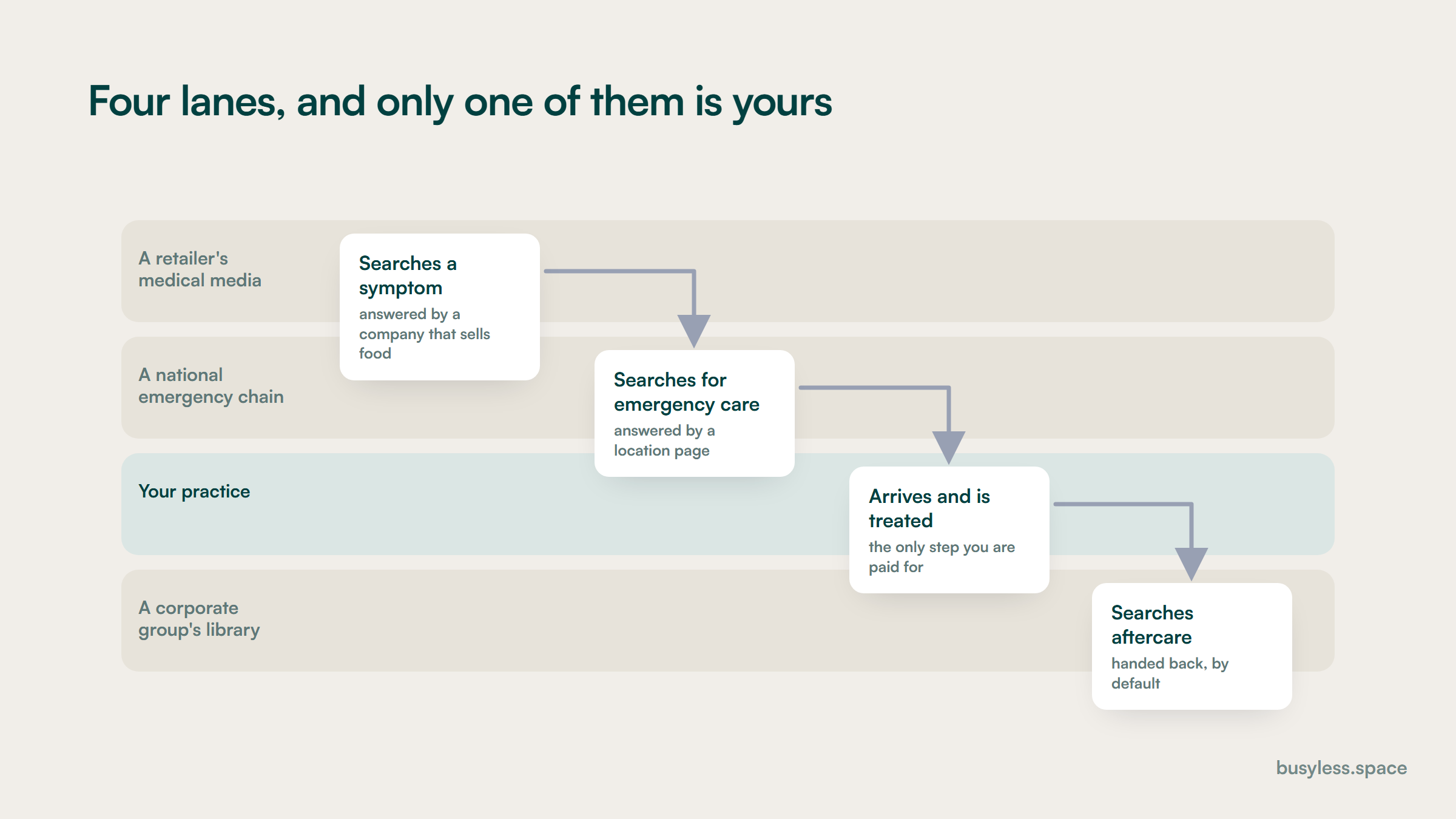
Four lanes carrying a worried owner from symptom to appointment: retailer-owned medical media, a national emergency chain, a corporate group's condition library, and the practice itself, which only enters at the last hand-off.
Three of the four lanes have no interest in your appointment book. The hand-offs are where the practice can enter earlier.

What people actually search

Sort these by how long the searcher has. Two of the clusters below have no research phase at all, three have a week, and the rest have as long as they like. The plan should follow that order rather than the volume order.

Emergency

Local, immediate

emergency vet open now

The page that wins it: An emergency page with hours, what to do first and what it costs

No research phase and no price sensitivity. The searcher wants to know where to drive and whether you will be there, so the page has to answer both above the fold and the profile hours have to be right.

Triage

Informational, minutes from a decision

dog limping but still eating

The page that wins it: A page per symptom answering whether to come in now

The cluster this whole playbook is built on. Everybody publishes what a symptom means; almost nobody publishes the threshold at which it becomes an appointment, which is the only part an owner actually needs.

Toxicity and ingestion

Informational, panicked

my dog ate [substance]

The page that wins it: A page per common ingestion with weight-based guidance and a phone number

The highest-urgency informational queries in the vertical and among the most searched. They also carry real risk, so the page's job is to route to a call quickly rather than to be comprehensive.

New client and capacity

Local commercial

vet accepting new patients near me

The page that wins it: A new client page that says plainly whether you are taking any

A cluster created by a genuine capacity shortage. Saying you are full is better than silence, because the owner who bookmarks an honest practice comes back when a slot opens.

Cost of a named procedure

Commercial investigation

how much is a dog dental cleaning

The page that wins it: A price band per common procedure, with what changes it

Answered almost entirely by insurance comparison sites, whose interest is in selling a policy. A real band from a real practice is a more useful answer and it filters the enquiry before it reaches the front desk.

Species and exotics

Local commercial

avian vet near me

The page that wins it: A page per species you genuinely treat, with the equipment named

Thin competition, high loyalty and long travel radius. An owner with a parrot or a bearded dragon will drive an hour, and the query set is small enough to own outright.

Procedure and surgery

Commercial investigation

TPLO surgery cost [city]

The page that wins it: A page per procedure with the approach, the recovery and the band

High value, considered, and the place where credentials matter most. It is also where the word specialist most often appears on a page that is not entitled to use it.

End of life

Local, immediate, emotionally loaded

at home euthanasia [city]

The page that wins it: A page written with restraint, naming the process and the cost

The hardest page anything in this directory asks you to write, and one of the most searched in this vertical. The reader is deciding today. Plain language, a real price and no marketing tone at all.

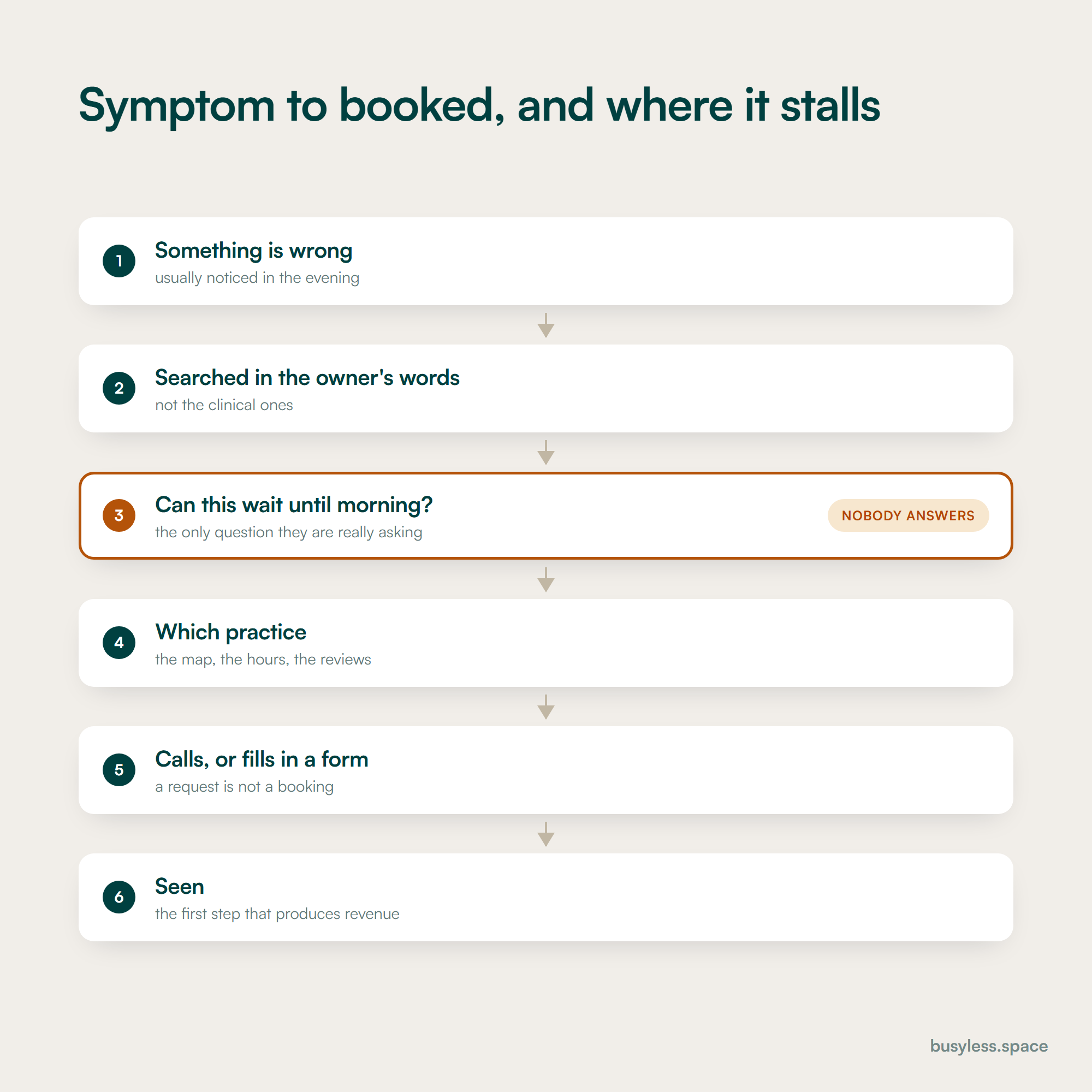
A vertical pipeline from symptom noticed, through searching, triage, deciding and calling, to booked. The triage stage is marked as the bottleneck, and it is the only stage no practice website answers.
Every other stage on this pipeline is already served by somebody. The bottleneck is the one nobody has written.

What the rules change

Lighter than the human health verticals in this directory and easier to breach, because the rules land on ordinary team-page and service-page wording. Everything below varies by state, so check your own board; none of this is legal advice.

1

Specialist is a claim about certification, not about interest

State veterinary board advertising rules, including Massachusetts and Washington, together with the AVMA and the American Board of Veterinary Specialties guidance on identifying board-certified veterinarians

What it means

A licensee may not advertise as a veterinary specialist unless certified by a specialty board the AVMA recognises. Georgia treats identifying as a member of a recognised specialty organisation without certification as unprofessional conduct. The AVMA and the ABVS also say board eligible and board qualified are misleading and should not be used by anybody.

So do this

Audit every team biography and service page for the words specialist, specialising, board eligible and board qualified. Where a veterinarian is genuinely certified, write it as diplomate of the named college. Where they merely have a strong interest, say special interest in, and let the case volume make the argument instead.

2

Whether you may see a patient by video depends on the state

State practice acts governing the veterinarian-client-patient relationship, including California AB 1399, signed 8 October 2023 and in force from 1 January 2024

What it means

Most states still require an in-person examination before that relationship exists, and without it a veterinarian cannot diagnose or prescribe remotely. California now permits the relationship to be established electronically on stated conditions, reversing its earlier position. The rules differ enough that the same service page is lawful in one state and not in the next.

So do this

Scope the telemedicine page to the states you are licensed in, name them, and say what you can and cannot do without an examination. Where the answer is advice only, use that word. A page that implies remote diagnosis in a state that forbids it is a complaint waiting to be made by a competitor.

3

Recommending pet insurance can put you near a regulated product

The NAIC Pet Insurance Model Act, adopted 13 August 2022 and enacted in a growing number of states, which requires a producer to be licensed and trained before selling, soliciting or negotiating pet insurance

What it means

The model act sets disclosure requirements, defines what may be said about pre-existing conditions and wellness programmes, and requires producer licensing and training. A practice with a recommended insurer page, a referral arrangement or a commission is closer to soliciting than it feels, and more states adopt the framework each year.

So do this

Explain how pet insurance works, what waiting periods and pre-existing exclusions mean, and what questions to ask, without recommending a named product you are paid for. If there is a commercial relationship, disclose it clearly on the page and check your state's position before the page goes live.

4

Hours and availability are a claim like any other

Google Business Profile representation guidelines, together with state consumer protection law on advertising services you cannot supply

What it means

The emergency searcher is not reading your page, they are reading your hours. A profile showing open when nobody answers, an emergency category on a practice that refers everything out after six, or an after-hours number that reaches a voicemail are all misrepresentations to somebody in genuine distress.

So do this

Set special hours for every holiday, state the after-hours arrangement explicitly on the site and on the profile, and name the emergency hospital you refer to with its address. Referring well is a service. Appearing to be something you are not is the fastest way to earn the review that stays at the top for a year.

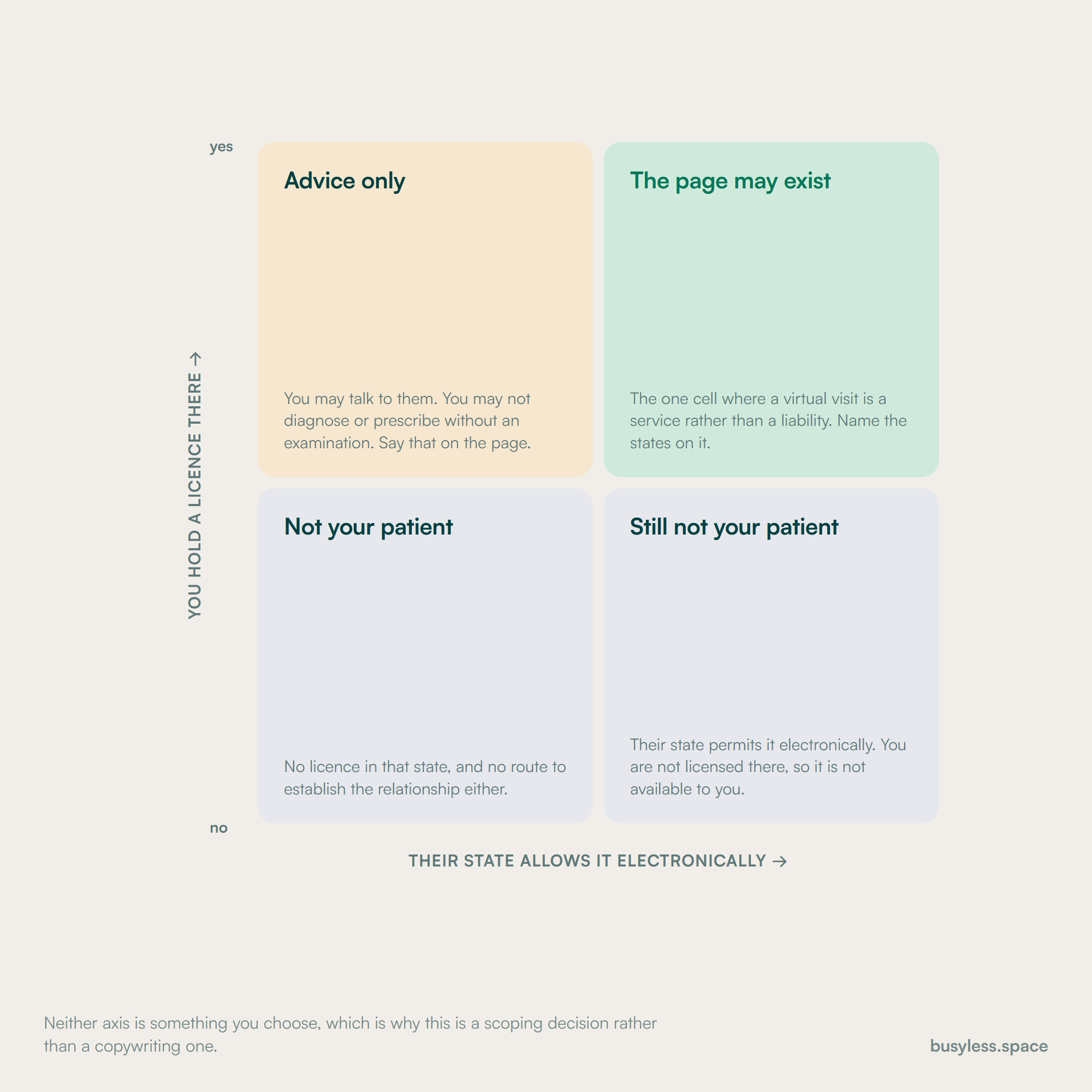
A quadrant on two jurisdictional axes: whether your state allows the veterinarian-client-patient relationship to be established electronically, and whether the animal is in a state where you hold a licence. Only one cell permits a virtual visit page.
Neither axis is something you can choose. That is why this is a scoping decision rather than a copywriting one.

Proving expertise

The owner is deciding whether to hand an animal to a stranger, often at speed, often in distress. Every proof signal here is about the individual clinician and the equipment in the building, not about the brand.

  • Every veterinarian named with their degree, school and year of qualification
  • State licence numbers, where your board permits publishing them
  • Board certification written as diplomate of the named college, or not claimed
  • Areas of special interest, described as interest rather than as specialism
  • The equipment you actually have on site, listed by name
  • Which species you treat and which you refer, stated plainly
  • AAHA accreditation or equivalent, with the year
  • The after-hours arrangement, and the hospital you refer emergencies to
  • Nurses and technicians named with their credentials, because clients meet them most

How to build a veterinary SEO strategy

Six months, ordered so that the pages with no research phase behind them exist first. A veterinary SEO strategy usually produces calls in the second month, because triage and emergency content is barely contested and answers a question at the moment it is being asked.

  1. 1

    Weeks 1 to 3

    Fix what an emergency searcher sees

    • Correct the profile hours, including every holiday, and set special hours
    • State the after-hours arrangement on the profile and on the site
    • Audit every use of specialist, board eligible and board qualified
    • Publish whether you are accepting new clients, either way
    • Write the emergency page with hours, address, parking and what to do first
    • Name the hospital you refer emergencies to, with its address

    You end up with
    A practice that can be found and reached when it matters most

  2. 2

    Weeks 3 to 10

    Answer the question that is actually being asked

    • Write a triage page per common symptom, answering whether to come in now
    • Write a page per common ingestion with weight-based guidance and a phone number
    • Publish price bands for the six procedures people ask about most
    • Give end of life a page of its own, written plainly
    • Rewrite the team page with degrees, schools and honest credentials
    • List the on-site equipment by name

    You end up with
    Coverage of every decision an owner makes in under an hour

  3. 3

    Weeks 8 to 18

    Own the things the national sites cannot

    • Write a page per species you genuinely treat, naming the equipment
    • Write a page per procedure with the approach, the recovery and the cost
    • Move the client education library onto your own domain, rewritten
    • Move the booking flow and the forms onto your own domain where possible
    • Add veterinary care, emergency service and clinician structured data
    • Scope the telemedicine page to the states you are licensed in

    You end up with
    A domain that holds the practice's own expertise rather than a vendor's

  4. 4

    Weeks 14 to 26

    Measure appointments, not sessions

    • Track calls and bookings by source, with one question asked consistently
    • Track new client registrations rather than form submissions
    • Report revenue per appointment type against the pages that produce it
    • Watch capacity: report the wait for a routine appointment every month
    • Review the review profile weekly and answer within two days
    • Re-check every credential claim and date the check

    You end up with
    A report that distinguishes a visitor from a registered client

Technical fixes with the best payoff

The endemic problem here is ownership rather than optimisation. A small number of practice management vendors build most veterinary websites, and the three most valuable things on them belong to somebody else.

  • The client education library is on a vendor's domain

    A sprint, then an hour per condition

    Most practice websites carry a condition library supplied by the software or website vendor, and it is frequently served from a subdomain or an iframe belonging to that vendor. This is not the duplicate-content problem it looks like. The content is not the practice's at all, so nothing it earns accrues to the practice.

    Stop treating the library as a benefit. Choose ten conditions you genuinely see, write them yourself with your own cases and your own thresholds, and put them on your own domain. Ten real pages will outperform four hundred borrowed ones, and they are the only ones a client will recognise as yours.

  • The site never answers whether to come in

    An hour per page

    Every condition page in this vertical explains what a condition is. The searcher already suspects what it is. What they cannot find anywhere is the threshold: at what point does this stop being something to watch and become something to drive in for tonight.

    Add a decision block to every symptom page. Come in now if, call us today if, monitor at home if, with real signs rather than hedged language. Then put your phone number beside it. This single change converts better than anything else in this playbook.

  • Booking happens on somebody else's domain

    An afternoon of configuration

    The appointment widget usually lives on the scheduling vendor's site, so the moment of conversion, the abandonment rate and the reason people leave are all invisible. Worse, most practices offer a request form rather than a booking, which is a different and much weaker promise.

    Put the booking flow on your own subdomain where the vendor permits it, and if it cannot move, at least measure the click out as a conversion. Then check whether the flow actually books an appointment or merely requests one, and say which on the button.

  • There is no price anywhere

    An afternoon

    What veterinary care costs is one of the largest clusters in this market and the answer is currently supplied by insurance comparison sites. Practices avoid the question because every case differs, which is true and is not a reason to leave the answer to somebody selling a policy.

    Publish bands for the six things people ask about most, with the variables named: weight, age, whether pre-anaesthetic bloods are included, whether extractions are likely, what the recheck costs. Bands with reasons are more honest than a single figure and they shorten every phone call.

  • The team page has no credentials on it

    A day

    Half the practice sites in any market list a first name, a photograph and a sentence about loving animals. The client is choosing who to trust with a family member, and the two facts that matter most, where the veterinarian qualified and what they are certified in, are the two most often missing.

    Degree, school, year, licence where your board permits it, board certification written correctly or not claimed, species and procedures they take. Do the same for the nurses and technicians, because they are who the client actually spends the visit with.

  • Every service is one line on one page

    A day per service

    Dentistry, soft tissue surgery, orthopaedics, exotics, end of life, boarding and behaviour are entirely different searches with different urgency and different value, and in this vertical they are usually seven bullets on a page called Services.

    One page each for the services you want more of, with the equipment named, the approach described, the recovery explained and a price band. Leave the rest as a list. Six real pages beat a comprehensive menu that ranks for nothing.

  • The forms are PDFs

    A day

    New client registration, pre-anaesthetic consent, boarding requirements and post-operative care instructions are among the most requested documents a practice owns. As PDFs they are unreadable on a phone, unindexable, and impossible to update without republishing.

    Publish each as a page, with the download underneath for anyone who wants it. The post-operative instructions in particular earn their place: owners search them at ten at night, and a page that answers at that hour prevents a call and builds more trust than any blog post.

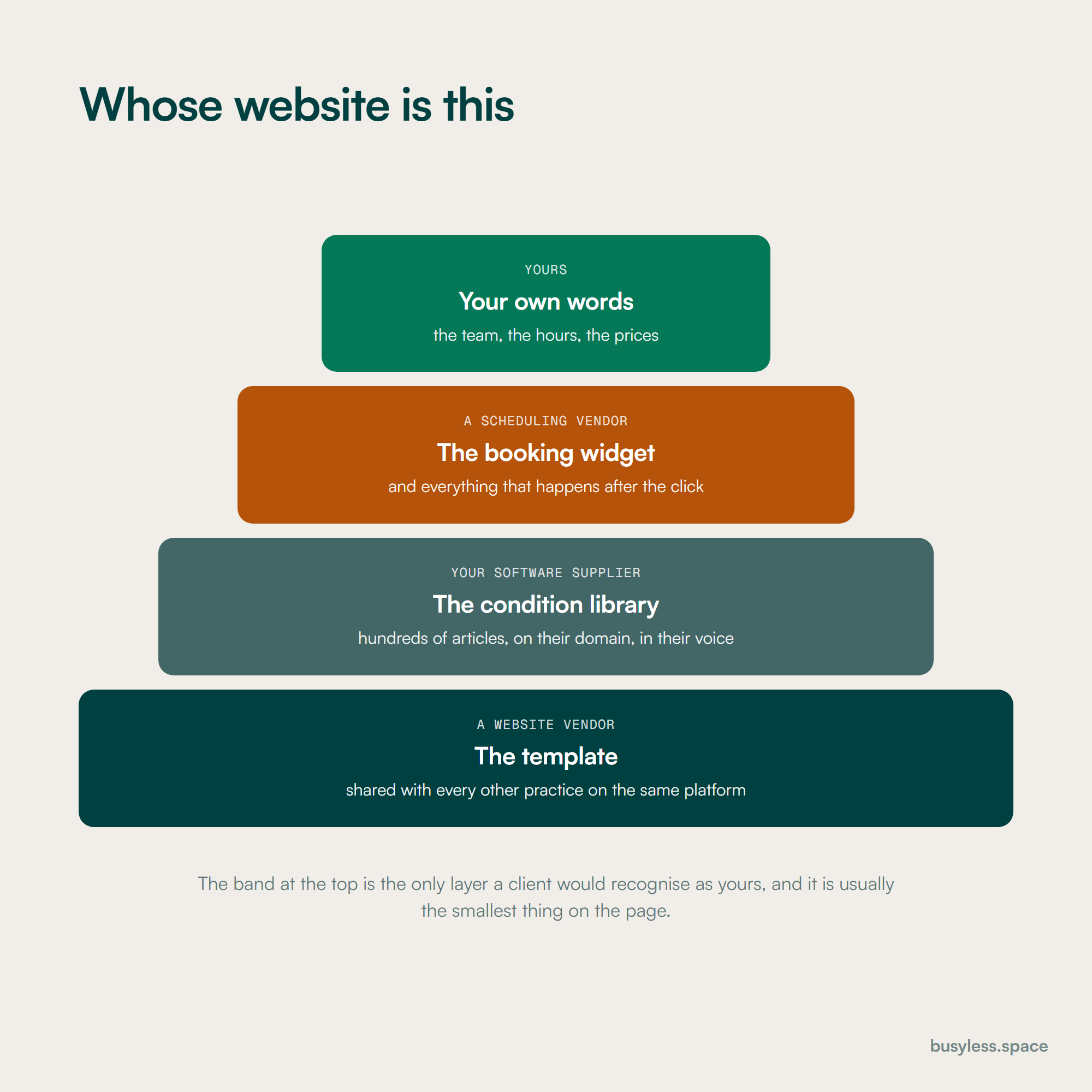
A stack of four layers: the vendor's template at the base, a syndicated condition library above it, a third-party booking widget above that, and a thin band of the practice's own words at the top.
The top band is the only layer a client would recognise as yours, and it is usually the smallest thing on the page.

Structured data that applies here

The types below fit this industry specifically. Most of them earn no rich result on their own, which is worth knowing before anyone sells the work on that basis. What they do is describe the entity precisely, which matters for how search engines and answer engines resolve who you are.

  • VeterinaryCare

    Home page and every location

    A dedicated type rather than a generic local business, and worth using for that reason alone. The two fields that do real work are the opening hours, which the emergency searcher is checking, and the available services, which the profile category will not describe on its own.

    VeterinaryCare.jsonld
    {
      "@context": "https://schema.org",
      "@type": "VeterinaryCare",
      "@id": "https://[YOUR-DOMAIN]/#practice",
      "name": "[PRACTICE NAME]",
      "url": "https://[YOUR-DOMAIN]/",
      "telephone": "[+1-555-000-0000]",
      "priceRange": "[$$]",
      "image": "https://[YOUR-DOMAIN]/practice-front.jpg",
      "address": {
        "@type": "PostalAddress",
        "streetAddress": "[STREET]",
        "addressLocality": "[CITY]",
        "addressRegion": "[ST]",
        "postalCode": "[00000]",
        "addressCountry": "US"
      },
      "geo": {
        "@type": "GeoCoordinates",
        "latitude": "[00.0000]",
        "longitude": "[-00.0000]"
      },
      "openingHoursSpecification": [
        {
          "@type": "OpeningHoursSpecification",
          "dayOfWeek": ["Monday","Tuesday","Wednesday","Thursday","Friday"],
          "opens": "[08:00]",
          "closes": "[18:00]"
        },
        {
          "@type": "OpeningHoursSpecification",
          "dayOfWeek": "Saturday",
          "opens": "[09:00]",
          "closes": "[13:00]"
        }
      ],
      "availableService": [
        { "@type": "MedicalProcedure", "name": "[Dentistry]" },
        { "@type": "MedicalProcedure", "name": "[Soft tissue surgery]" },
        { "@type": "MedicalProcedure", "name": "[Exotic and avian medicine]" }
      ],
      "hasCredential": {
        "@type": "EducationalOccupationalCredential",
        "credentialCategory": "[AAHA accreditation]",
        "recognizedBy": { "@type": "Organization", "name": "[American Animal Hospital Association]" },
        "validFrom": "[YYYY-MM-DD]"
      }
    }
  • EmergencyService

    The emergency and after-hours page

    Only use this where the claim is genuinely true, because it is the one node in this set that a distressed person acts on immediately. If you close at six and refer out, do not mark the practice as an emergency service; mark the page as describing the arrangement instead.

    EmergencyService.jsonld
    {
      "@context": "https://schema.org",
      "@type": "EmergencyService",
      "@id": "https://[YOUR-DOMAIN]/emergency#service",
      "name": "[PRACTICE NAME] emergency and urgent care",
      "parentOrganization": { "@id": "https://[YOUR-DOMAIN]/#practice" },
      "telephone": "[+1-555-000-0000]",
      "url": "https://[YOUR-DOMAIN]/emergency",
      "address": { "@id": "https://[YOUR-DOMAIN]/#practice" },
      "openingHoursSpecification": {
        "@type": "OpeningHoursSpecification",
        "dayOfWeek": ["Monday","Tuesday","Wednesday","Thursday","Friday","Saturday","Sunday"],
        "opens": "[00:00]",
        "closes": "[23:59]"
      },
      "areaServed": [
        { "@type": "City", "name": "[CITY]" },
        { "@type": "AdministrativeArea", "name": "[COUNTY]" }
      ],
      "description": "[What you can handle on site, what you stabilise and refer, and where you refer it to. Name the receiving hospital and its address.]"
    }
  • Person, with the credential written correctly

    Every clinician's page

    This block is the compliance rule rendered as markup. credentialCategory takes the qualification and the board certification, and if the veterinarian is not a diplomate of an AVMA-recognised college, the certification object simply does not appear. There is no field for board eligible because there is no such status.

    Person, with the credential written correctly.jsonld
    {
      "@context": "https://schema.org",
      "@type": "Person",
      "@id": "https://[YOUR-DOMAIN]/team/[SLUG]#person",
      "name": "[Dr FIRST LAST]",
      "honorificSuffix": "[DVM or VMD]",
      "jobTitle": "[Veterinarian]",
      "worksFor": { "@id": "https://[YOUR-DOMAIN]/#practice" },
      "alumniOf": {
        "@type": "CollegeOrUniversity",
        "name": "[VETERINARY SCHOOL]"
      },
      "hasCredential": [
        {
          "@type": "EducationalOccupationalCredential",
          "credentialCategory": "degree",
          "educationalLevel": "[Doctor of Veterinary Medicine]",
          "recognizedBy": { "@type": "Organization", "name": "[VETERINARY SCHOOL]" },
          "dateCreated": "[YYYY]"
        },
        {
          "@type": "EducationalOccupationalCredential",
          "credentialCategory": "[Diplomate, AMERICAN COLLEGE OF ___]",
          "recognizedBy": { "@type": "Organization", "name": "[AVMA-RECOGNISED COLLEGE]" },
          "dateCreated": "[YYYY]"
        }
      ],
      "knowsAbout": ["[Special interest, described as interest]", "[Species treated]"]
    }
  • Service scoped to the states you are licensed in

    The telemedicine or virtual consultation page

    areaServed is doing legal work here rather than marketing work. List only the states where you hold a licence and where the relationship may lawfully be established the way this page describes, and keep the description honest about whether this is advice or care.

    Service scoped to the states you are licensed in.jsonld
    {
      "@context": "https://schema.org",
      "@type": "Service",
      "@id": "https://[YOUR-DOMAIN]/telemedicine#service",
      "name": "[Virtual consultation / Telehealth advice]",
      "serviceType": "[Advice only, or care where the relationship already exists]",
      "provider": { "@id": "https://[YOUR-DOMAIN]/#practice" },
      "areaServed": [
        { "@type": "State", "name": "[STATE WHERE LICENSED]" }
      ],
      "audience": {
        "@type": "Audience",
        "audienceType": "[Existing clients only, or new clients where permitted]"
      },
      "offers": {
        "@type": "Offer",
        "price": "[00]",
        "priceCurrency": "USD"
      },
      "termsOfService": "https://[YOUR-DOMAIN]/telemedicine#what-we-can-and-cannot-do",
      "description": "[Say plainly whether a diagnosis or prescription is possible without an in-person examination in this state, and what happens if it is not.]"
    }
  • FAQPage

    The emergency, cost and procedure pages

    The three questions that stop an owner acting are whether it can wait, what it will cost and whether you are open. Answer them in the visible copy and mirror the wording exactly, and keep every clinical answer inside what you would say on the phone.

    FAQPage.jsonld
    {
      "@context": "https://schema.org",
      "@type": "FAQPage",
      "mainEntity": [
        {
          "@type": "Question",
          "name": "[Question exactly as it appears on the page]",
          "acceptedAnswer": {
            "@type": "Answer",
            "text": "[Answer exactly as it appears. Give the real band, the real hours and a real threshold for coming in.]"
          }
        }
      ]
    }
  • BreadcrumbList

    Service, species, procedure and symptom pages

    Worth adding once there is a genuine hierarchy under services and species. Building it usually reveals that the symptom pages have no parent, which is the reason a set of them behaves like a pile rather than a section.

    BreadcrumbList.jsonld
    {
      "@context": "https://schema.org",
      "@type": "BreadcrumbList",
      "itemListElement": [
        { "@type": "ListItem", "position": 1, "name": "Home",
          "item": "https://[YOUR-DOMAIN]/" },
        { "@type": "ListItem", "position": 2, "name": "[Services]",
          "item": "https://[YOUR-DOMAIN]/services" },
        { "@type": "ListItem", "position": 3, "name": "[SERVICE]",
          "item": "https://[YOUR-DOMAIN]/services/[SLUG]" }
      ]
    }

What it costs

Editorial estimates rather than quotes. They sit low in this directory because the winnable pages are short and local, and the expensive part is clinician time, which is the scarcest thing in the building.

Do it yourself

$0 to $300
  • Profile hours corrected and special hours set for every holiday
  • The emergency page and the after-hours arrangement written
  • The credential audit across every team biography
  • Price bands for the six most asked-about procedures
  • New client availability stated either way

Who it suits

A single-site practice with a practice manager and two hours a week

Where it stops

It fixes what an emergency searcher sees and publishes what nobody else will. It will not build a symptom library or move anything off the vendor's domain.

Lean

$1,000 to $2,500
  • A triage page per common symptom with a real decision block
  • Ingestion and toxicity pages with weight-based guidance
  • A page per service you want more of, with equipment named
  • The team page rebuilt with degrees, schools and honest credentials
  • Structured data for the practice, the clinicians and the emergency service

Who it suits

An independent practice competing with a consolidated group in the same metro

Where it stops

It will not out-publish a retailer's medical library on general condition content, and it is not meant to. The ground it takes is the ground that library cannot occupy.

Funded

$2,500 to $4,500
  • A page per species with the equipment and referral position named
  • Procedure pages with approach, recovery and real bands
  • The education library rewritten and moved onto your own domain
  • Multi-site structure with a genuine page per location
  • Reporting from registrations and revenue rather than from sessions

Who it suits

Multi-site practices, referral hospitals and groups with an exotics or surgical draw

Where it stops

The diary caps this, not the budget. If routine bookings are already three weeks out, more demand lengthens the wait, and the right recommendation that month is recruitment.

How to do it with no budget

Most of the highest-value work here is free and takes an afternoon. Two of the steps below are corrections rather than creations, and they are the two that matter most to somebody in distress.

  1. 1

    Correct the profile hours and set special hours

    1 hour

    Google Business Profile

    Including every public holiday for the next twelve months. The emergency searcher is reading the hours rather than the page, and a profile showing open when the phone is not answered causes real distress and lasting reviews.

  2. 2

    Write the emergency and after-hours page

    2 hours

    Your website editor

    What you handle, what you refer, who you refer to and where they are, what to do on the way, and what it costs. Naming the hospital you refer to is a service to the reader and costs you nothing.

  3. 3

    Audit the site for the word specialist

    1 hour

    Your browser's search function

    Also specialising, board eligible and board qualified. Rewrite anything that is not a diplomate credential from an AVMA-recognised college as a special interest, which is both accurate and perfectly persuasive.

  4. 4

    Add a decision block to your existing symptom pages

    1 hour per page

    Your website editor

    Come in now if, call today if, monitor at home if. Real signs, not hedged language, with the phone number beside them. The highest-converting change available and it needs no new pages.

  5. 5

    Publish price bands for six procedures

    2 hours

    Your practice management reports

    Pull the actual invoiced range for each, round it honestly, and name the variables. The alternative is leaving the answer to an insurance comparison site with a policy to sell.

  6. 6

    Say whether you are accepting new clients

    20 minutes

    Your website editor

    Either way, prominently, with a date. Owners are searching for this specifically because of the capacity shortage, and honesty here earns the bookmark that becomes a registration in six weeks.

  7. 7

    Publish the post-operative instructions as a page

    2 hours

    Your existing discharge PDFs

    They are searched at ten at night by an anxious owner who has lost the paper copy. A page prevents a call, builds real trust, and is already written.

The tool stack

A short list, because the work is clinical writing rather than tooling. Two entries below are systems the practice already pays for and has never used to answer a marketing question.

  • Check the local pack from where your clients actually are

    Scale SERPSEO APIRead the review

    Rankings for a practice collapse within a mile or two. Check from the neighbourhoods your clients drive from rather than from the practice car park, because the second one always looks fine.

    Free routeManual checks from three or four points across the catchment

  • Find the symptom and ingestion phrasings owners actually use

    HaloscanSEO APIRead the review

    Owners describe symptoms in their own words, not in clinical ones, and the gap between the two is where the winnable queries live. The front desk hears the real phrasing forty times a day and nobody writes it down.

    Free routeYour own call log, which is more accurate

  • Make the reminder and recall emails do more

    Email Marketing ROI CalculatorFree toolOpen the tool

    Reminders are the highest-return channel a practice owns and they are usually sent by the practice software on a default template. Working out what a recovered lapsed client is worth normally changes how much attention that template gets.

    Free routeFree

  • Publish symptoms, species, procedures and clinicians as related records

    ButterCMSHeadless CMSRead the review

    A symptom page should automatically list the clinicians who treat it and the species it applies to. Modelling those relationships once is what stops a symptom library becoming forty orphaned articles nobody links to.

    Free routeFree tier for a small site

  • Find out which appointment types are actually profitable

    Your practice management system

    Revenue by appointment type against clinician hours consumed. The service worth building three pages about is rarely the one with the most appointments, and this report takes about twenty minutes.

    Free routeAlready paid for

  • Know what a new client is worth over their pet's life

    Your practice management system, again

    Average lifetime value by species and by age at registration. A kitten registration and a senior dog registration are completely different acquisitions, and only one of them justifies a long payback.

    Free routeFree

  • Watch the reviews properly

    The profile dashboards, checked weekly

    There is no privacy rule here preventing a reply, which is a freedom to use carefully. Answer within two days, never argue about clinical detail in public, and invite the conversation offline.

    Free routeFree

  • Track appointment wait times as a marketing number

    Your booking system

    The days until the next routine slot is the single most useful number in this report. When it passes three weeks, more demand makes the service worse, and the recommendation should change accordingly.

    Free routeFree

Take it from here

Everything below is yours to take. Fill the [BRACKETS] and it is ready to use. Start with the credential audit, because it is the one item here that carries a regulatory consequence if it is left undone.

Checklist

Walks every page for the words that are licence-level claims in most states, and gives you the replacement wording for each one.

CREDENTIAL AND CLAIMS AUDIT - [PRACTICE] - [DATE]

WHY THIS IS FIRST
Specialist is a claim about board certification in most states,
and the profession's own bodies say board eligible and board
qualified should not be used by anyone. This audit takes an hour
and removes the only regulatory exposure on a typical practice
website.

1. SEARCH THE WHOLE SITE FOR THESE WORDS
   Use your browser's find function on every page, and check the
   page titles and meta descriptions separately.

   Word                    Found on           Action
   specialist              [_____________]    [_________]
   specialises / specializing [__________]    [_________]
   board eligible          [_____________]    [_________]
   board qualified         [_____________]    [_________]
   certified in            [_____________]    [_________]
   expert in               [_____________]    [_________]

2. FOR EACH CLINICIAN
   Name:                       [_______________]
   Degree and school:          [_______________]  [YYYY]
   State licence number:       [_______________]
   May we publish it here?     [ Yes / No / check board ]
   Diplomate of an AVMA-recognised college?
                               [ Yes: __________ / No ]
   If yes, exact wording:
     "Diplomate, [FULL NAME OF COLLEGE]"
   If no, replacement wording:
     "Special interest in [AREA]"
   Residency completed but not certified?
     Write: "[Completed a residency in ___ at ___]"
     Never write: board eligible.

3. THE PRACTICE-LEVEL CLAIMS
   [ ] AAHA accreditation: [ current / lapsed / never ]
       Year:      [______]   Expires: [______]
   [ ] Emergency claim: do we genuinely provide it, and when?
       Hours:     [_______________]
       After those hours we refer to: [_______________]
   [ ] Any "the only practice in [AREA] that..." claim
       Is it still true?  [ Yes / No ]  Checked: [______]
   [ ] Equipment claimed but no longer on site: [__________]

4. SIGN OFF
   Audited by:    [_______________]
   Reviewed by a clinician: [_______________]
   Next review:   [__________]  (annually, and at every hire)

What to publish

Write what only a practice with a waiting room can write. General pet health content is a fight with a retailer's medical library; thresholds, prices and species depth are not.

  • Triage pages with a real decision block

    One per common symptom, then leave them

    The owner already suspects what it is. What they cannot find is when it becomes an appointment, and only somebody who sees these cases can write that threshold honestly.

  • Ingestion and toxicity pages

    One per common substance, reviewed annually

    Panicked, high volume and immediate. Weight-based guidance and a phone number at the top, with the detail below rather than above it.

  • Price bands for named procedures

    Once, reviewed when the fee schedule changes

    The cost cluster is currently answered by companies selling insurance. A real range from a real practice is both more useful and easier to trust.

  • Species pages for what you genuinely treat

    One per species, written properly

    Exotic and avian owners travel and stay loyal, and the query set is small enough for one practice to own outright. Naming the equipment is what makes it credible.

  • The end of life page

    Once, revisited rarely and carefully

    One of the most searched and least well written pages in the vertical. Plain language, the process described, a real cost, and no marketing tone whatsoever.

  • Discharge and aftercare instructions as pages

    One per procedure, from paperwork you already have

    Searched at night by owners who have lost the paper copy. They prevent calls, they build trust at the exact moment it is fragile, and they already exist as documents.

And what not to

  • General condition articles competing with a retailer's medical library
  • A vendor's education library served from a domain you do not own
  • The word specialist anywhere it is not a diplomate credential
  • Board eligible or board qualified, which the profession's own bodies call misleading
  • A telemedicine page that implies remote diagnosis where the state forbids it
  • Recommending a named pet insurer you are paid by without disclosing it
  • Emergency claims on a practice that refers everything out after six
  • Team biographies with a first name, a photograph and a sentence about loving animals

The expensive mistakes

Publishing general pet health content

Costs you Months of writing aimed directly at a retailer-owned medical library and a national group's condition archive, both of which will win

Thresholds, prices, species depth and aftercare, none of which those sites can credibly write

Letting the vendor's education library stand in for your own

Costs you Hundreds of pages on the site that are not on your domain, earn you nothing and sound like nobody who works there

Ten conditions written from your own cases, on your own domain, with your own thresholds

Using the word specialist loosely

Costs you A licence-level advertising claim in most states, made on a page a competitor reads more carefully than any client does

Diplomate of the named college where it is true, special interest where it is not, and let case volume argue the rest

Leaving the hours wrong

Costs you An owner driving to a closed practice with a sick animal, and the review that follows sitting at the top of your profile for a year

Exact hours, special hours for every holiday, and the after-hours arrangement stated in both places

Refusing to publish any prices

Costs you The cost cluster answered entirely by insurance comparison sites, and a front desk fielding the same call all day

Bands for the six most asked-about procedures with the variables named

Marketing hard while the diary is full

Costs you A longer wait, a worse service for existing clients, and churn among the people who already chose you

Report the wait for a routine appointment every month and let it decide whether acquisition spend goes up or down

What to measure

Two adjustments make this report honest. Count registered clients rather than form submissions, because the two diverge badly here, and put appointment capacity in the marketing report so demand and delivery are argued in the same room.

Leading indicators

Move first. They predict, they do not prove.

  • Local pack position across the catchment

    Geo-specific rank tracking from several points

    Measured from the neighbourhoods clients drive from rather than from the practice. Visibility falls away within a mile or two, so a single check at the address is close to meaningless.

  • Profile calls, direction requests and website clicks

    Google Business Profile insights

    The fastest signal available. Calls matter more than clicks in this vertical, because most urgent traffic phones rather than fills anything in, and direction requests track the emergency page directly.

  • Impressions on triage, ingestion and cost clusters

    Search Console, filtered by cluster

    The ground this playbook is built on. These move within about two months of the pages existing, well before anything shows up in registrations.

  • Review volume and response time

    The profile dashboards, checked weekly

    Response time is the half practices ignore. In a category where the decision is emotional, an unanswered complaint does more damage than the complaint itself.

Business indicators

The ones a manager acts on.

  • New client registrations

    The practice management system

    Not form submissions, which include existing clients, product enquiries and people who never arrive. The gap between the two numbers is usually large enough to change what you would have concluded.

  • Revenue per appointment type

    Practice management reports

    The report that decides which service pages to build. Appointment volume and appointment value order the list very differently, and only one of those orderings is worth following.

  • Lifetime value by species and age at registration

    Practice management reports

    A kitten and a senior dog are different acquisitions with different paybacks. Content aimed at new pet owners is worth far more than the enquiry count alone suggests.

  • Days to the next routine appointment

    The booking system

    A clinical operations number belonging in a marketing report. Past about three weeks, additional demand degrades the service and the honest recommendation that month is recruitment rather than acquisition.

The verdict

Veterinary medicine gets the hardest part of healthcare search for free. Nobody stops you measuring, remarketing or replying to a review, which removes most of what makes the human health pages in this directory complicated.

What it gets instead is a set of competitors with no interest in your appointment book. A pet retailer owns the symptom results through acquired medical media, and a national chain answers the emergency query with a location page.

So the winnable ground is narrow and unusually good. Thresholds, prices, species depth and aftercare are all things only a practice with a waiting room can write, and almost nobody in the market has written them.

A proposal for veterinary SEO services is worth reading for one thing above all: whether every symptom page gets a threshold on it. That single element is the difference between an article and a page a frightened owner can act on. And ask what anybody offering SEO services for vets would do differently if your diary were already three weeks full.

FAQ

Veterinary SEO questions

  • Can we call one of our veterinarians a specialist?
    Only if they are certified by a specialty board the AVMA recognises, and in most states that is a licence-level advertising rule rather than a preference. The AVMA and the American Board of Veterinary Specialties also say board eligible and board qualified are misleading and should not be used at all. Where the interest is real but the certification is not, write special interest in.
  • Should we write condition articles like the big pet health sites?
    No, and it is the most common way a budget disappears here. The symptom and condition results are largely held by medical publishers now owned by pet retailers, on domains with authority a single practice cannot match. Write the part they cannot: the threshold at which a symptom becomes an appointment, by species, from cases you actually see.
  • Can we offer video consultations?
    It depends entirely on your state. Most still require an in-person examination before a veterinarian-client-patient relationship exists, without which you cannot diagnose or prescribe remotely. California changed its position with AB 1399, in force from January 2024, and permits the relationship to be established electronically on stated conditions. Scope the page to the states you are licensed in and say what you cannot do.
  • What is the single highest-value change we could make?
    Put a clear threshold at the top of each symptom page: the signs that mean tonight, the signs that mean a call in the morning, and the signs that mean watching at home. Every competing page explains what a condition is. Almost none answers whether to drive in tonight, which is the only thing the searcher is actually trying to decide.
  • Should we publish prices when every case is different?
    Publish bands rather than figures, and name what moves them: weight, age, whether pre-anaesthetic bloods are included, whether extractions are likely, what a recheck costs. Every case being different is true and is not a reason to leave the question to insurance comparison sites, which currently answer it for you and have a policy to sell.
  • Can we recommend a pet insurance provider?
    Be careful, and check your state first. The NAIC Pet Insurance Model Act, adopted in August 2022 and enacted in a growing number of states, requires a producer to be licensed and trained before selling, soliciting or negotiating pet insurance. Explaining how cover works and what to ask is safe ground. A named recommendation you are paid for is closer to soliciting than it feels.
  • How do we compete with the corporate group that bought the practice nearby?
    Not on domain authority, which you will not win. Compete on the things a shared template cannot carry: named clinicians with real credentials, the equipment actually in your building, honest waiting times, species you genuinely treat, and prices. Consolidation has made most practice websites in any metro interchangeable, which is an opening rather than a threat.
  • What does veterinary SEO cost?
    The tiers above are editorial estimates rather than quotes. A practice running a real programme is realistically at $1,000 to $4,500 a month, and the lower half of that buys most of the value, because the triage, emergency and pricing pages are short. The expensive part is clinician time to review them, which is also what makes them worth reading.

Run it yourself, or have someone own it

Everything above is written to be run without us, and the free path is genuinely most of the value for a single-location business. Where these plans stall is almost never the plan. It is that nobody owns it after the first month. That is the job we do, with search as one distribution layer inside a wider system rather than the whole engagement.