
Skip to content

Cleaning company SEO strategy

Regulated marketing

The same crew sells to homeowners and to facilities managers

Written by Eugene SuslovLast reviewed 29 August 2026No affiliate links
Sector
Business services
Model
Local service, Multi-location
Competition
High
Time to results
3 to 7 months
Typical monthly
$800 to $4,000

Key takeaways

  1. 1You are running two businesses on one website. Residential is booked online and decided on price; commercial janitorial is decided in a scored proposal that search barely touches. Split the site before you split the budget.
  2. 2The word disinfect is regulated. An EPA-registered product may only be advertised for the uses approved on its label, which makes "kills 99.9% of germs" a claim about somebody else's registration.
  3. 3Move-out cleaning is the best query in the industry. A deadline, no research phase, a buyer who cannot postpone, and far less competition than the recurring term everybody chases.
  4. 4Your growth ceiling is staff, not demand. Recruitment pages are an acquisition channel for the thing that actually limits the business, and almost no cleaning company treats them that way.
  5. 5Six services across forty towns is 240 URLs. That arithmetic is why this vertical generates more near-duplicate location pages than almost any other, and why most of them rank for nothing.

SEO for cleaning companies has to serve two customers who share almost nothing. One is a homeowner who wants a price and a date. The other is a facilities manager who wants a certificate of insurance and a references list.

The homeowner is reachable. They search, they compare, they book online, and a marketplace is usually sitting between you and them taking a fee for the introduction. Everything a search strategy normally does works on this half.

The facilities manager mostly is not. Commercial janitorial contracts are awarded through proposals scored against insurance floors, bonding, references and certifications, and the buyer often arrives from a referral or an approved vendor list rather than from a results page.

So a cleaning company SEO strategy that treats those two as one funnel produces a website that half-convinces both. The residential pages read too corporate to book, and the commercial pages read too domestic to shortlist.

There is a vocabulary problem underneath as well. Cleaning and disinfecting are different activities with different regulators, and a business that advertises the second while performing the first has made a claim about a registered pesticide rather than a boast about thoroughness.

The last fact decides more than any of it. Almost every cleaning company that stops growing stops because it cannot hire, not because the phone stopped ringing, and a marketing plan that ignores that is solving the wrong shortage.

Who already ranks in cleaning companies

Search your main residential term with a town attached, then search the janitorial equivalent, and compare what comes back. Almost every cleaning company SEO audit finds the same split: the residential page is stacked with lead marketplaces and review aggregators, and the commercial page is thin enough that a decent site could own it outright.

What is on the results page

  • Local pack on residential near-me queries, taking the top of the screen
  • Lead marketplaces ranking above every independent operator
  • Review aggregators with best-of listings for each town
  • Franchise brands with a page per territory on recurring service terms
  • People Also Ask, dense on price, frequency and what is included
  • Very thin competition on commercial and janitorial queries
  • Recruitment results competing for your own brand plus the word jobs
  • Thumbtack

    thumbtack.comClaim it

    Frequently the first organic result on residential queries in a given metro. Worth understanding as a paid channel rather than a directory: you are usually buying a lead that has also been sold to several competitors, so the economics turn on your close rate rather than on the listing. Measure cost per won job, not cost per lead.

  • Angi

    angi.comClaim it

    Same shape and the same warning. It ranks on terms you cannot outrank quickly, and it will send work. Treat both marketplaces as a bridge that funds the period before your own pages rank, and set a date to review whether they are still worth the margin.

  • Google Business Profile

    google.comClaim it

    The most valuable free asset and the one most often set up wrong here. A cleaning business usually visits the customer, so it is a service-area business: hide the address, set the service areas honestly, and list the services explicitly rather than relying on the category. Photographs of finished work do more than photographs of the van.

  • Yelp

    yelp.comClaim it

    Still ranks in a lot of metros for home services and feeds Apple Maps. Claim it, keep the service list current, and answer the negative reviews properly, because the complaints in this category are specific and answerable. Do not filter which customers get asked.

  • Nextdoor and neighbourhood groups

    nextdoor.comClaim it

    Not search, and unusually important in this category because cleaning is a trust purchase made inside somebody's home. Recommendation threads rank occasionally and convert reliably. Being genuinely present in the neighbourhood beats any listing you could buy.

  • Government and institutional vendor portals

    sam.govClaim it

    The gatekeeper for the commercial half, and it is not a search engine at all. School districts, municipalities, hospital systems and federal agencies publish solicitations through registration portals. Registering is free, tedious and the single highest-value hour available to a company that wants janitorial work.

  • Certification registries

    issa.comClaim it

    Industry certification bodies publish searchable directories of certified contractors, and those directories are what a buyer checks when your website claims a logo. A listing there is a citation, a credential and a lead source at once, and it is only available if the certification is real.

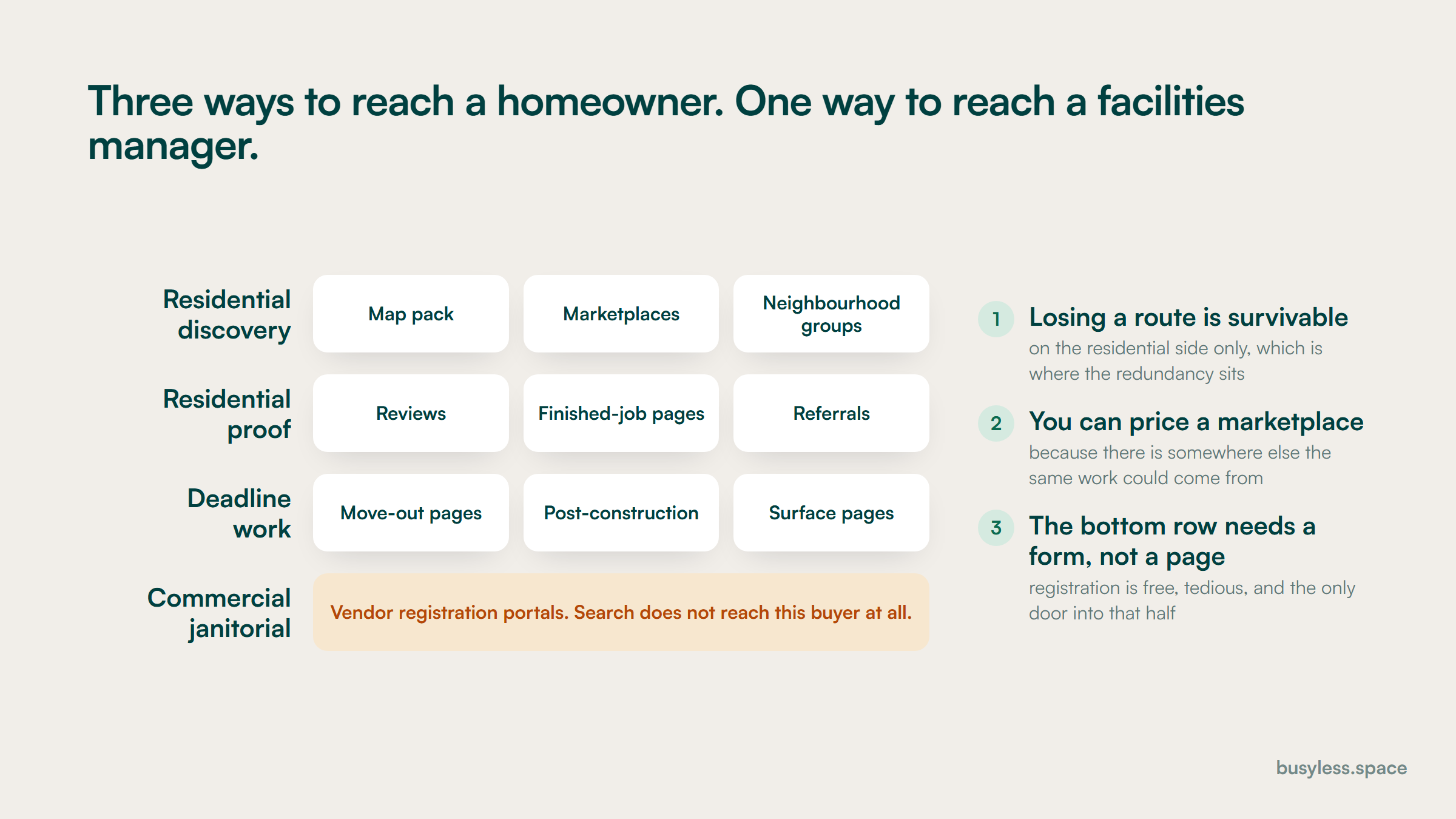
A matrix with three rows holding several routes each to a residential customer, and a fourth row holding a single one: commercial janitorial, reached through vendor registration portals rather than through search.
A single-slot row is a dependency rather than a gap. That one needs a registration form, not a page.

What people actually search

Residential search divides into a contested recurring term, a deadline cluster that is far easier and far more valuable, and a price cluster nobody answers. Commercial search barely exists by comparison, which is exactly why it is winnable.

Recurring residential

Local commercial

house cleaning services near me

The page that wins it: A profile and a service page that both name your real service area

The term everybody chases and the one the marketplaces already own. Worth contesting, not worth building the plan around, because the pages below convert better for a fraction of the effort.

Move-out and end of tenancy

Transactional, deadline-driven

move out cleaning [city]

The page that wins it: A page per move-related job with a checklist of what is included

The best query in the industry. There is a handover date, no research phase, a deposit at stake, and the buyer cannot postpone. It is also a job most competitors describe in one line on a services page.

Price

Commercial investigation

how much does house cleaning cost

The page that wins it: A pricing page with real bands and the variables named

Very large and almost universally answered with a quote form. Publishing bands with the reasons they vary, by size and by frequency, wins the visitor who was about to open three more tabs.

Post-construction and post-renovation

Transactional

post construction cleaning [city]

The page that wins it: A page written for the contractor, not the homeowner

High ticket, repeat buyer, and searched by a builder rather than an occupant. The vocabulary is different enough that a page aimed at homeowners will not rank for it.

Speciality surface

Local commercial

carpet cleaning [city]

The page that wins it: A page per surface with method, drying time and price band

Behaves like a product search rather than a service one. Buyers compare methods and want to know how long before they can use the room, which is the question almost no page answers.

Commercial and janitorial

Commercial investigation

janitorial services [city]

The page that wins it: A commercial section with insurance, bonding, certifications and references

Low volume, high contract value, and thin competition. The visitor is usually verifying a company they already heard of, so this page's job is to survive scrutiny rather than to persuade.

Disinfection and specialist decontamination

Commercial investigation

commercial disinfection service [city]

The page that wins it: A carefully worded page naming the products actually used

The regulated cluster. Whatever you claim here has to match the registered label of the product you use, which makes it the one page on the site a lawyer should read.

Recruitment

Navigational and transactional

cleaning jobs [city]

The page that wins it: Real job pages with pay, hours and travel written out

The cluster nobody counts as marketing. Growth in this industry is capped by hiring, so a page that fills a shift is worth more than a page that fills the enquiry form.

What the rules change

Lighter than the health verticals in this directory and sharper than most operators expect, because the constraints land on ordinary marketing copy rather than on the service itself. Check your own state and your own counsel; none of this is legal advice.

1

Disinfection claims are pesticide claims

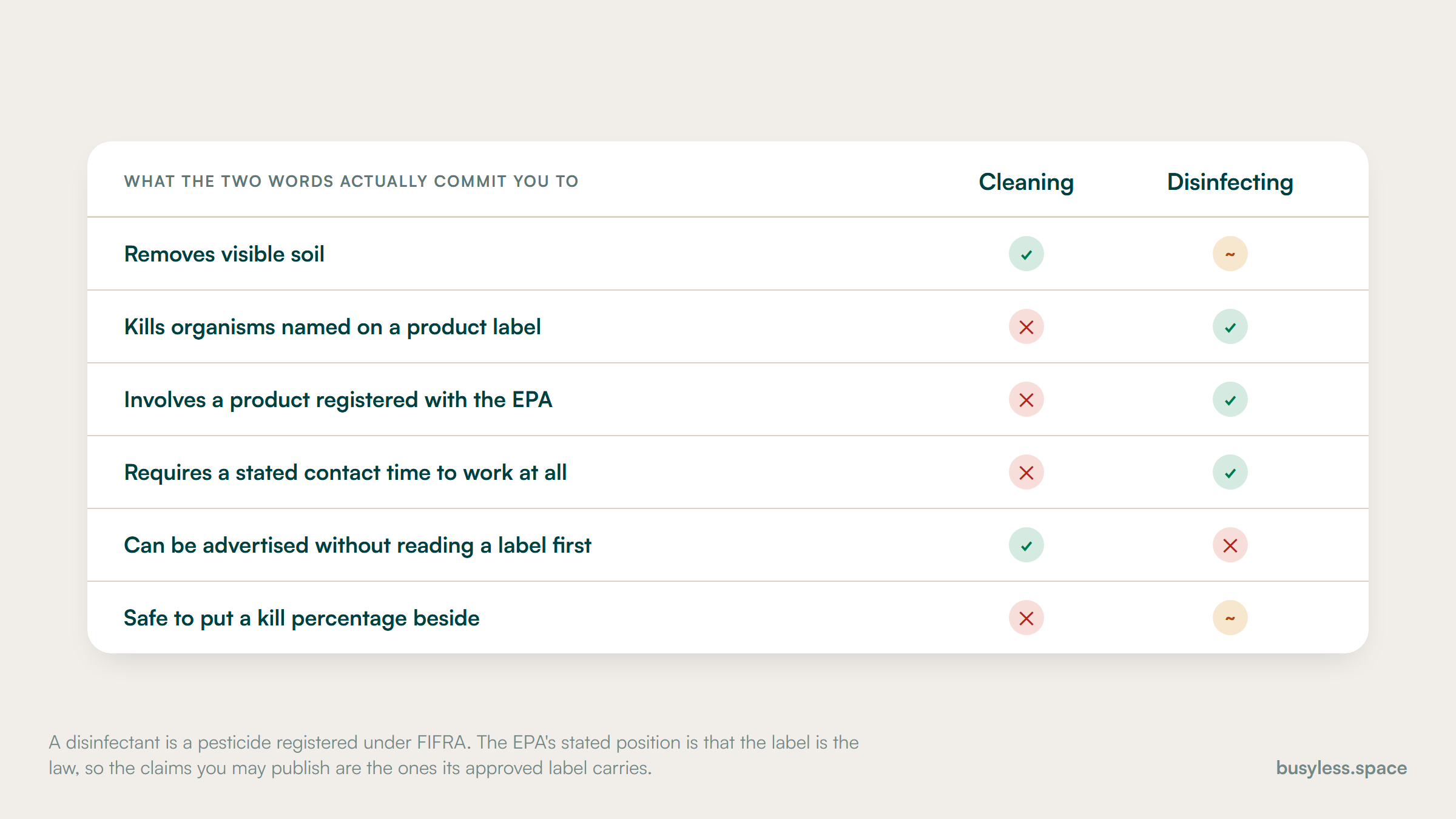
The Federal Insecticide, Fungicide, and Rodenticide Act, administered by the EPA, whose stated position is that the label is the law

What it means

A disinfectant is a registered pesticide, and an EPA-registered product may only be advertised for the uses and organisms its approved label covers. When a service business writes that it kills a named pathogen, or quotes a kill percentage, it is repeating an efficacy claim tied to somebody else's registration and to the exact conditions and contact time on that label.

So do this

List the products you actually use, link to their labels, and describe your method in terms of dwell time and surfaces rather than percentages. Keep the words clean, sanitise and disinfect apart on the site, because they mean different things. This is a different rule from the one covering who may apply a pesticide.

2

Bonded, insured and certified are claims a buyer will check

Section 5 of the FTC Act on deceptive practices, together with the public registries maintained by certification bodies such as ISSA

What it means

Commercial buyers verify credentials against the issuing body's register rather than against your website, and certification logos are among the most commonly overstated things in this industry. Insurance floors, surety bonds and certificates naming the client as an additional insured are routine requirements in a janitorial proposal, and a claim that fails verification usually ends the bid rather than starting a dispute.

So do this

Publish the certification number and the issuing body beside every logo, with the expiry date, and remove anything lapsed the week it lapses. Say exactly what your bond and your cover are, and be precise about the difference between bonded, insured and background checked.

3

Whether your cleaners are employees changes what you may say

State worker classification tests, including the ABC test codified in California Labor Code section 2775

What it means

The strongest trust claim in residential cleaning is about the workforce: employed, trained, background checked, covered by our insurance. Several states apply strict tests to whether a worker is genuinely an independent contractor, and the marketing copy is evidence about how the relationship is actually run. Describing contractors as your employees is both a misstatement to customers and an admission about classification.

So do this

Write what is true. If your cleaners are employees, say so plainly, because it is a real differentiator against marketplace labour. If they are contractors, describe the vetting honestly and do not imply an employment relationship you do not have.

4

Federal work puts a wage determination inside your pricing

The McNamara-O'Hara Service Contract Act, 41 U.S.C. sections 6701 to 6707, which reaches prime service contracts over $2,500 and covers janitorial services

What it means

Contractors on covered federal service contracts must pay the wage rates and fringe benefits set in the Department of Labor wage determination incorporated into the contract. Janitorial is one of the classic covered categories. That means the price you can offer on federal work is partly fixed before you quote, and it is often above what you charge commercially.

So do this

Do not advertise a single hourly rate across residential, commercial and public-sector work. Give the public-sector section its own page explaining registration, wage determinations and references, because the buyer reading it is testing whether you have done this before.

Six criteria scored against two words, cleaning and disinfecting. Cleaning wins on freedom to advertise, disinfecting wins on what it actually achieves, and neither column sweeps.
The two are priced differently as well, which is part of why the words get used as though they meant the same thing.

Proving expertise

This is a trust purchase made inside somebody's home or after hours in an empty building, with no supervision either way. The proof that matters is about who turns up and what happens when something goes wrong.

  • Whether your cleaners are employees or contractors, stated plainly
  • What vetting actually happens, named: identity, references, background check, by whom
  • Insurance and bond amounts, with the policy type rather than the word insured
  • Certification numbers and issuing bodies beside every logo, with expiry dates
  • The products you use, by name, with a link to the label
  • Named supervisors and how long the team has been together
  • A written service guarantee saying what happens when a clean is not right
  • Photographs of finished work in real properties, not stock interiors

How to build a cleaning company SEO strategy

Six months, ordered so the fastest-converting work happens first. A cleaning company SEO strategy usually starts producing enquiries in the second month, because the deadline clusters are barely contested and require nothing more than a page that exists.

  1. 1

    Weeks 1 to 3

    Decide which business you are marketing

    • Split the site into a residential section and a commercial section, with separate navigation
    • Set the profile up as a service-area business with the address hidden
    • List services explicitly on the profile rather than leaving the category to describe you
    • Publish price bands for residential work with the variables named
    • Register on the vendor portals for every institution in your area
    • Audit every certification logo against the issuing body's register

    You end up with
    Two clear audiences, an accurate profile, and free access to commercial solicitations

  2. 2

    Weeks 3 to 8

    Take the deadline work

    • Build a page per move-related job with a full inclusion checklist
    • Build the post-construction page in a contractor's vocabulary
    • Build a page per speciality surface with method and drying time
    • Write the commercial page around insurance, bonding, references and certifications
    • Add service-area, service and job structured data
    • Collect reviews on the specific jobs, not on the company in general

    You end up with
    Coverage of the highest-intent work, and a commercial page that survives verification

  3. 3

    Weeks 6 to 16

    Build the towns you can actually serve

    • List the towns where you genuinely have route density, and only those
    • Write one real page per town with local detail a competitor could not copy
    • Write the disinfection page against the labels of the products you use
    • Publish the service guarantee and what happens when a clean is wrong
    • Build real recruitment pages with pay, hours and travel written out
    • Kill any generated location page that is the same page with the noun swapped

    You end up with
    A geography you can defend, and a hiring channel that removes the growth ceiling

  4. 4

    Weeks 12 to 26

    Measure retained contracts and filled shifts

    • Track enquiries by source with one question asked the same way
    • Track the conversion from enquiry to first clean, by source
    • Track how many first cleans become recurring, by source
    • Report revenue per route hour rather than per job
    • Report applications and filled shifts beside the marketing numbers
    • Review the marketplace channels on cost per won job, not cost per lead

    You end up with
    A report that distinguishes a booking from a customer, and demand from capacity

Technical fixes with the best payoff

One arithmetic problem produces most of the technical damage in this industry, and it comes from good intentions. Six services across forty towns is two hundred and forty pages, and the tooling to generate them is cheaper than the judgement to decide which forty towns are real.

  • Location pages generated with the town name swapped

    A sprint, then an afternoon per town

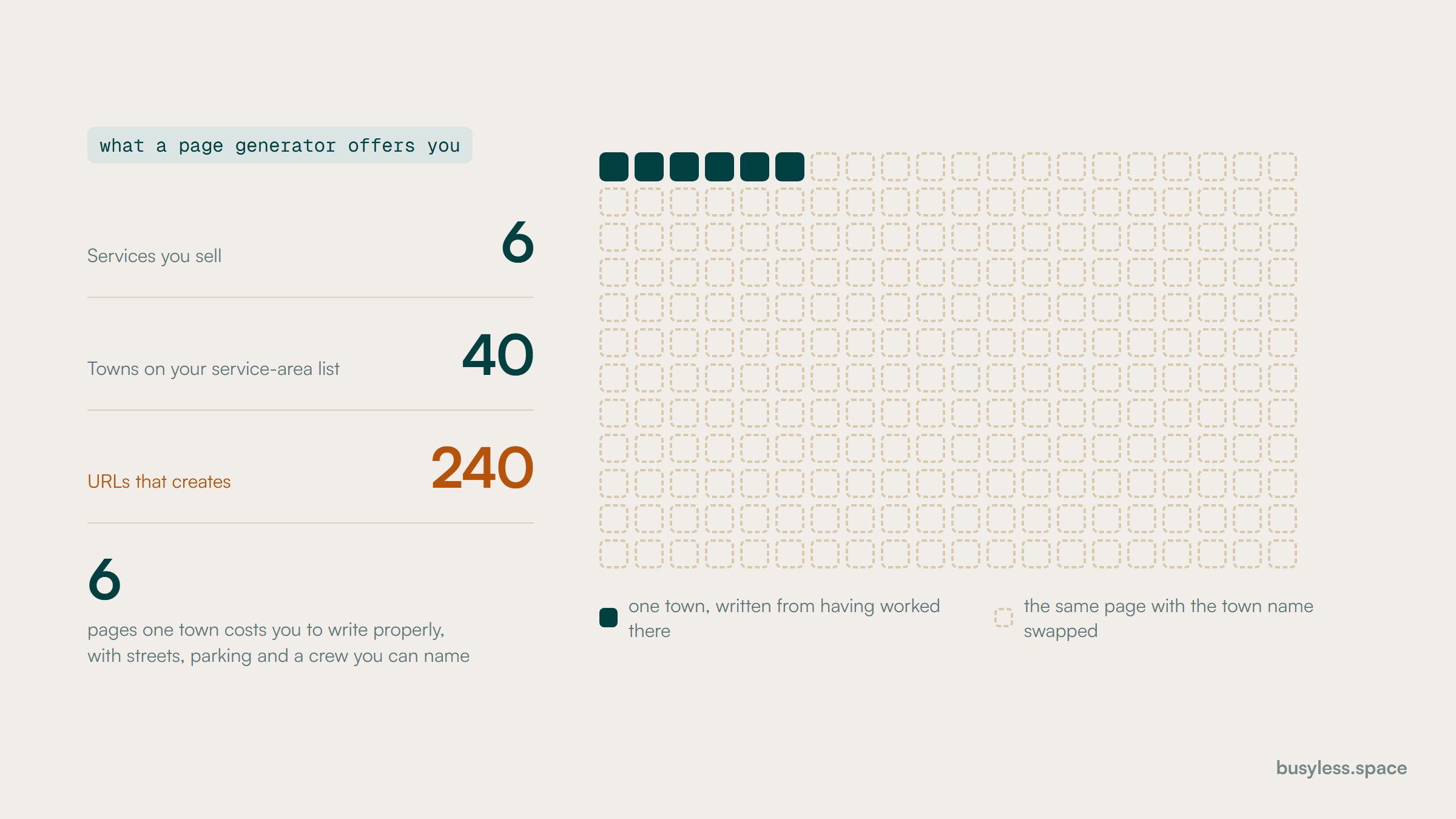
    Six services multiplied by forty towns is 240 URLs, and every content platform in this vertical offers to build them. The result is a set of near-identical pages differing only by a place name, which is the exact shape of scaled content abuse and reliably ranks for nothing.

    Take the list of towns where you genuinely have route density, which is usually a lot shorter, and write one real page each. Local landmarks, the parking situation, the property types, the crew that covers it, jobs you have done there. Delete the rest rather than leaving them.

  • The profile has a street address it should not have

    An hour

    Most cleaning companies work at the customer's premises, which makes them a service-area business. A visible address at a residential unit or a small unit office both narrows the area you can appear in and, in some cases, puts the listing at risk.

    Hide the address, set the service areas to the places you actually travel to, and keep them consistent with the towns you have pages for. Then list your services explicitly, because the default category description will not include move-out or post-construction work.

  • Residential and commercial share the same pages

    A sprint

    One buyer wants a price and a date, the other wants a certificate of insurance and references. A single services page written for both reads as generic corporate copy to the homeowner and as a domestic operation to the facilities manager, and loses both.

    Two sections with separate navigation, separate language and separate calls to action. Book online on one side, request a proposal on the other. The commercial side should read like a bid document, because that is what it is being used as.

  • There is no price anywhere

    An afternoon

    How much cleaning costs is one of the largest clusters in this market, and the standard answer is a quote form. The visitor who wanted a number opens three more tabs and books with whoever gave one, which is usually a marketplace.

    Publish bands by property size and frequency, and name the variables that move them: square footage, condition, pets, frequency, whether it is a first deep clean. That is a more honest answer than a single figure and it stops the comparison happening elsewhere.

  • The booking flow lives on a scheduling platform's domain

    An afternoon of configuration

    Online booking is the main advantage an independent has over a marketplace, and most operators hand the moment of conversion to a platform hosted somewhere else. Behaviour after the click belongs to the platform, and the abandonment rate is invisible.

    Put the booking flow on your own subdomain where the platform allows it, and make sure the price estimate appears before the form asks for a phone number. If it cannot be moved, at least track the step where people leave.

  • The careers page is a mailto link

    A day

    Hiring is the growth constraint in this business and the careers page is usually one line and an email address. Meanwhile people search for cleaning work by town and by shift pattern, and those searches are cheap, local and entirely uncontested by employers.

    Real job pages with pay, hours, travel expectations, whether equipment is supplied and how long the application takes, with job structured data. Treat filled shifts as a conversion and report them beside the enquiries.

  • The proof is on social and nowhere else

    An hour per job

    Cleaning is a visual result and every operator photographs finished work, then posts it somewhere that does not belong to them and cannot be indexed usefully. The website meanwhile shows stock photographs of interiors nobody cleaned.

    Publish real jobs as short pages: property type, what condition it was in, what was done, how long it took, what it cost as a band. Those pages rank for job-type queries and they answer the question a nervous customer is actually asking.

A field of 240 outlined squares, twenty across and twelve down, being six services multiplied by forty towns. Six squares are filled: one town, written by somebody who has worked in it.
Nothing here is estimated. It is the arithmetic your website platform will offer to run for you this afternoon.

Structured data that applies here

The types below fit this industry specifically. Most of them earn no rich result on their own, which is worth knowing before anyone sells the work on that basis. What they do is describe the entity precisely, which matters for how search engines and answer engines resolve who you are.

  • LocalBusiness as a service-area business

    Home page, and one per genuine service area

    The important detail is what you leave out. A business that travels to the customer should express its geography through areaServed rather than a street address, and the areas in the markup should match the towns you actually have pages for.

    LocalBusiness as a service-area business.jsonld
    {
      "@context": "https://schema.org",
      "@type": "LocalBusiness",
      "@id": "https://[YOUR-DOMAIN]/#business",
      "name": "[COMPANY NAME]",
      "url": "https://[YOUR-DOMAIN]/",
      "telephone": "[+1-555-000-0000]",
      "priceRange": "[$$]",
      "image": "https://[YOUR-DOMAIN]/team-at-work.jpg",
      "address": {
        "@type": "PostalAddress",
        "addressLocality": "[CITY]",
        "addressRegion": "[ST]",
        "postalCode": "[00000]",
        "addressCountry": "US"
      },
      "areaServed": [
        { "@type": "City", "name": "[TOWN]" },
        { "@type": "City", "name": "[TOWN]" },
        { "@type": "City", "name": "[TOWN]" }
      ],
      "openingHoursSpecification": [{
        "@type": "OpeningHoursSpecification",
        "dayOfWeek": ["Monday","Tuesday","Wednesday","Thursday","Friday"],
        "opens": "[07:00]",
        "closes": "[18:00]"
      }],
      "hasOfferCatalog": { "@id": "https://[YOUR-DOMAIN]/services#catalog" }
    }
  • OfferCatalog with real price bands

    The residential services index

    Worth building only once the bands are on the visible page too. The exercise itself is useful: it forces you to decide which of your services are genuinely separate offers, which is the same decision that produces the page set.

    OfferCatalog with real price bands.jsonld
    {
      "@context": "https://schema.org",
      "@type": "OfferCatalog",
      "@id": "https://[YOUR-DOMAIN]/services#catalog",
      "name": "[COMPANY NAME] cleaning services",
      "itemListElement": [
        {
          "@type": "Offer",
          "url": "https://[YOUR-DOMAIN]/services/[SLUG]",
          "itemOffered": {
            "@type": "Service",
            "name": "[SERVICE, e.g. Move-out cleaning]",
            "serviceType": "[Plain description of the job]",
            "provider": { "@id": "https://[YOUR-DOMAIN]/#business" },
            "areaServed": { "@type": "City", "name": "[TOWN]" }
          },
          "priceSpecification": {
            "@type": "PriceSpecification",
            "minPrice": "[000]",
            "maxPrice": "[000]",
            "priceCurrency": "USD"
          },
          "description": "[What moves the price: size, condition, frequency, pets.]"
        }
      ]
    }
  • JobPosting

    Every open role, one page each

    This node appears on no other playbook in this directory, and it belongs here because the growth constraint in cleaning is staff rather than demand. Fill the salary fields honestly; a posting with no pay range is skipped by the people you most want to reach.

    JobPosting.jsonld
    {
      "@context": "https://schema.org",
      "@type": "JobPosting",
      "title": "[Cleaner / Team lead / Site supervisor]",
      "description": "[What the job is, the shift pattern, the travel, whether equipment and transport are provided, and what training is given.]",
      "datePosted": "[YYYY-MM-DD]",
      "validThrough": "[YYYY-MM-DD]",
      "employmentType": ["PART_TIME"],
      "hiringOrganization": { "@id": "https://[YOUR-DOMAIN]/#business" },
      "jobLocation": {
        "@type": "Place",
        "address": {
          "@type": "PostalAddress",
          "addressLocality": "[TOWN]",
          "addressRegion": "[ST]",
          "addressCountry": "US"
        }
      },
      "baseSalary": {
        "@type": "MonetaryAmount",
        "currency": "USD",
        "value": {
          "@type": "QuantitativeValue",
          "minValue": "[00]",
          "maxValue": "[00]",
          "unitText": "HOUR"
        }
      },
      "jobBenefits": "[Paid travel time, equipment supplied, uniform, training]"
    }
  • Organization with verifiable credentials

    The commercial section and the about page

    The counterpart to the compliance rule about logos. A credential is only worth marking up if the number and the issuing body are published beside it in the visible copy, because that is what a commercial buyer will check.

    Organization with verifiable credentials.jsonld
    {
      "@context": "https://schema.org",
      "@type": "Organization",
      "@id": "https://[YOUR-DOMAIN]/#organization",
      "name": "[COMPANY NAME]",
      "url": "https://[YOUR-DOMAIN]/",
      "hasCredential": [
        {
          "@type": "EducationalOccupationalCredential",
          "credentialCategory": "[CERTIFICATION NAME]",
          "recognizedBy": { "@type": "Organization", "name": "[ISSUING BODY]" },
          "identifier": "[CERTIFICATE NUMBER]",
          "validFor": "[EXPIRY DATE]"
        }
      ],
      "knowsAbout": ["[Janitorial]", "[Post-construction]", "[Floor care]"],
      "memberOf": { "@type": "Organization", "name": "[TRADE ASSOCIATION]" }
    }
  • FAQPage

    Pricing, service and commercial pages

    The pair to cover is price and access: what it costs, and who has the key. Those are the two questions that stop a booking. Match the visible text exactly and keep any disinfection wording inside what the product label supports.

    FAQPage.jsonld
    {
      "@context": "https://schema.org",
      "@type": "FAQPage",
      "mainEntity": [
        {
          "@type": "Question",
          "name": "[Question exactly as it appears on the page]",
          "acceptedAnswer": {
            "@type": "Answer",
            "text": "[Answer exactly as it appears. Give the real band, the real cancellation terms and the real entry arrangements.]"
          }
        }
      ]
    }
  • BreadcrumbList

    Service, town and job pages

    Useful once the site has a genuine hierarchy of services and areas. Building it is also the quickest way to notice that half the location pages have no parent and no reason to exist.

    BreadcrumbList.jsonld
    {
      "@context": "https://schema.org",
      "@type": "BreadcrumbList",
      "itemListElement": [
        { "@type": "ListItem", "position": 1, "name": "Home",
          "item": "https://[YOUR-DOMAIN]/" },
        { "@type": "ListItem", "position": 2, "name": "[Residential]",
          "item": "https://[YOUR-DOMAIN]/residential" },
        { "@type": "ListItem", "position": 3, "name": "[SERVICE]",
          "item": "https://[YOUR-DOMAIN]/residential/[SLUG]" }
      ]
    }

What it costs

Editorial estimates rather than quotes, and among the lowest in this directory because the winnable ground is specific and the pages are short. The larger cost in this industry is usually the marketplace fee, which sits outside every band below.

Do it yourself

$0 to $300
  • Profile set up correctly as a service-area business
  • Services listed explicitly rather than left to the category
  • Price bands published with the variables named
  • A page each for move-out and post-construction work
  • Vendor portal registrations completed

Who it suits

An owner-operator with one or two crews and two hours a week

Where it stops

It reaches the deadline queries and the profile, and it will not produce a real town-by-town page set or a commercial section that survives procurement scrutiny.

Lean

$800 to $2,000
  • Residential and commercial split into separate sections
  • A real page per town where you genuinely have route density
  • Speciality surface pages with method and drying times
  • Recruitment pages with structured data, treated as a channel
  • Job photography published as pages rather than posts

Who it suits

A company with several crews trying to reduce its marketplace dependence

Where it stops

It will not win a large janitorial contract on its own. Those are decided in a proposal, and the site's job there is to be verifiable rather than persuasive.

Funded

$2,000 to $4,000
  • A commercial section built as sales collateral for the bid process
  • Case pages by building type and by sector
  • Continuous recruitment content across every town you serve
  • Reporting split by service line, by town and by route
  • Systematic review collection tied to job type

Who it suits

Multi-crew operators running both a residential book and a janitorial division

Where it stops

Above this the constraint is hiring rather than demand. If you cannot staff another route, the correct recommendation is to spend the money on recruitment instead.

How to do it with no budget

Nearly everything valuable in this industry is free and unglamorous. The first item is a profile setting and the second is a registration form, and between them they beat most of what a budget would buy.

  1. 1

    Set the profile up as a service-area business

    1 hour

    Google Business Profile

    Hide the address, set the real service areas, and list the services explicitly. Most cleaning companies leave the default category to describe them, which means move-out and post-construction work is never mentioned anywhere Google can read it.

  2. 2

    Register on every institutional vendor portal in your area

    3 hours

    Federal, state, district and municipal procurement portals

    Free, tedious, and the only route to a large share of janitorial contracts. Solicitations are published to registered vendors, so this is the closest thing the commercial half of this business has to a results page.

  3. 3

    Write the move-out page

    2 hours

    Your website editor

    A deadline, a deposit and no research phase. Include the full checklist of what is covered, what is not, and how long it takes for a typical property size. Almost every competitor gives this one line.

  4. 4

    Publish price bands

    2 hours

    Your website editor

    By property size and frequency, with the variables named. The alternative is a quote form, and the visitor who wanted a number will get one from a marketplace instead.

  5. 5

    Check every certification logo against the register

    1 hour

    The issuing body's public directory

    Buyers verify logos against the issuer, not against you. Publish the number and the expiry beside each one, and remove anything lapsed the week it lapses.

  6. 6

    Turn finished jobs into pages

    1 hour per job

    A phone and your website editor

    Property type, condition, what was done, how long it took, the price band. You are already taking these photographs and posting them where they cannot rank.

  7. 7

    Write one real job advert per role and town

    2 hours

    Your website editor

    Pay, hours, travel, equipment, how long the application takes. Uncontested searches, and they solve the constraint that is actually holding the business back.

The tool stack

A short list, because most of the work here is writing and registration rather than tooling. Two of the entries below are systems you already pay for and have never used to answer a marketing question.

  • Track the local pack across every town you serve

    ValueSERPSEO APIRead the review

    Check from inside each town rather than from the office. A cleaning company routinely ranks well in its own postcode and nowhere in the town its crews actually drive to every morning.

    Free routeManual checks from three or four points per town

  • Find which towns and job types have real demand

    SerpstatSEO APIRead the review

    Cross the keyword data against the jobs you have already done. Route density decides which towns are worth a page, so demand alone is the wrong input if a town is forty minutes from every other job.

    Free routeYour own enquiry log, which is more accurate

  • Work out what a recurring customer is worth

    MRR CalculatorFree toolOpen the tool

    Recurring cleaning is a subscription and behaves like one. Use average retained months rather than job value, because a one-off deep clean and a fortnightly contract are not the same acquisition at all.

    Free routeFree

  • Find where the booking flow loses people

    SEO Conversion Rate CalculatorFree toolOpen the tool

    The usual answer is the step that asks for a phone number before showing an estimate. Fix the order before you spend anything on getting more people to the form.

    Free routeFree

  • Publish services, towns, jobs and vacancies as related content

    HygraphHeadless CMSRead the review

    Services, areas, completed jobs and open roles are related entities, and modelling them properly is what stops a town page becoming a template with a noun swapped. It also makes the job postings maintainable.

    Free routeFree tier for a small site

  • Verify what you are allowed to claim about a product

    The product label and the EPA registration

    Read the registered label of the disinfectant you actually buy and write the page from it. Manufacturer marketing copy is not the label, and the label is what a claim is measured against.

    Free routeFree, and the only correct source

  • Measure enquiry to recurring conversion

    Your scheduling and invoicing software

    The one report that reorders the channels. Marketplace work and organic work usually convert to first clean at similar rates and to recurring contracts at completely different ones.

    Free routeAlready paid for, and rarely used this way

  • Track applications the way you track enquiries

    Your applicant tracking or a shared spreadsheet

    Not a marketing tool and arguably the most important line in the report. If the constraint is staff, applications per town is a growth metric and enquiries are not.

    Free routeFree

Take it from here

Everything below is yours to take. Fill the [BRACKETS] and it is ready to use. Start with the two-buyer split: it takes an afternoon on paper and it decides what every other item here is for.

Brief

The decision that makes the rest of the site coherent. Residential and commercial want different things, and a page trying to satisfy both satisfies neither.

TWO-BUYER SPLIT - [COMPANY] - [DATE]

WHY THIS IS FIRST
You are running two businesses. One customer wants a price and a
date. The other wants a certificate of insurance and three
references. A single set of pages written for both reads as
corporate boilerplate to the homeowner and as a domestic
operation to the facilities manager.

1. WHAT EACH HALF IS WORTH TO YOU TODAY
                              Residential    Commercial
   Revenue last 12 months     $[________]    $[________]
   Gross margin               [____]%        [____]%
   Number of customers        [______]       [______]
   Average retained months    [______]       [______]
   Crew hours per week        [______]       [______]
   Where the work comes from  [________]     [________]

2. WHERE YOU WANT TO BE IN 12 MONTHS
   Residential: [_____________________________________]
   Commercial:  [_____________________________________]
   If the answer is "mostly the same", say so and put the
   budget behind one of them rather than half behind each.

3. THE SITE STRUCTURE THAT FOLLOWS
   /residential/          book online, price bands, checklists
     /[service]/          one per job type
     /[town]/             only where route density is real
     /jobs-we-have-done/  photographs as pages
   /commercial/           request a proposal, verification first
     /janitorial/
     /[sector, e.g. schools, medical offices]/
     /insurance-and-certifications/
     /public-sector/      registration, wage determinations
   /careers/              one page per role and town

4. LANGUAGE TEST
   Read one residential page and one commercial page aloud.
   [ ] Residential page names a price and a date
   [ ] Residential page shows a real finished job
   [ ] Commercial page names bond and insurance amounts
   [ ] Commercial page names certifications with numbers
   [ ] Commercial page names references and sectors served
   [ ] Neither page uses the other's vocabulary

5. THE CALL TO ACTION ON EACH SIDE
   Residential: [ Book online / Instant estimate / _________ ]
   Commercial:  [ Request a proposal / Site walk / _________ ]
   They should not be the same button.

What to publish

Write what somebody deciding this week needs to read. Cleaning tips compete with the entire internet, bring in nobody who will book, and quietly teach your prospect to do the job themselves.

  • Deadline job pages

    One per job type, then leave them

    Move-out, end of tenancy, post-construction and pre-sale. A date, a consequence and no research phase, which is the best combination of conditions in this industry.

  • The pricing page

    Once, reviewed when rates change

    One of the largest clusters in the market, usually answered with a form. Bands with named variables convert the visitor who was about to open three more tabs.

  • Real town pages, only where you have route density

    One per town you actually serve, written properly

    A short list of genuine pages beats a generated set of two hundred. The test is whether a competitor could reuse the page by changing the town name.

  • Completed job pages

    Weekly, from work you are doing anyway

    You already photograph the work. Published as pages with condition, method, duration and price band, they rank for job-type queries and answer a nervous customer directly.

  • The commercial proposal section

    Once, reviewed at every insurance renewal

    Read during verification rather than discovery. Insurance, bonding, certifications, references, staffing model and supervision, written to survive a scored evaluation.

  • Recruitment pages by town and shift

    Continuously, as roles open

    The growth constraint is staff. These searches are local, specific and almost entirely uncontested by employers who post to a job board instead.

And what not to

  • Cleaning tips, which teach the reader to cancel the service
  • Kill percentages or pathogen claims not supported by the label of the product you use
  • Two hundred generated town pages differing only by a place name
  • Certification logos with no number, issuing body or expiry date
  • Describing contractors as employees, or implying vetting you do not perform
  • Stock photographs of interiors nobody on your team has cleaned
  • One hourly rate advertised across residential, commercial and public-sector work
  • A careers page that is an email address
The expensive mistakes

Running one website for two different buyers

Costs you Residential pages that read as corporate boilerplate and commercial pages that read as a domestic operation, converting neither

Two sections, two vocabularies, two calls to action, and a commercial page written as bid collateral

Generating a page for every service in every town

Costs you Hundreds of near-identical URLs that rank for nothing and look exactly like scaled content abuse

One real page per town where you have route density, with detail nobody could copy

Repeating a disinfectant's kill claim on your own website

Costs you An efficacy claim about somebody else's registered product, tied to conditions your crew probably does not replicate

Name the products, link to the labels, and describe your method in dwell time and surfaces

Treating the marketplaces as free traffic

Costs you A lead sold to several competitors, priced as an introduction, gradually becoming the whole acquisition model

Measure cost per won job, set a review date, and fund your own pages out of the margin

Chasing the recurring term and ignoring the deadline ones

Costs you Competing for the hardest query in the industry while easier, higher-intent work goes to whoever wrote a paragraph

Move-out, post-construction and speciality surface pages first, recurring terms afterwards

Marketing harder when you cannot staff another route

Costs you Longer lead times, worse quality on existing contracts, and churn on the customers you already had

Point the same effort at recruitment pages and report filled shifts beside enquiries

What to measure

Two adjustments make the reporting honest here. Judge a channel on whether its customers became recurring rather than on whether they booked, and put a hiring number in the marketing report, because capacity is what actually caps growth.

Leading indicators

Move first. They predict, they do not prove.

  • Local pack position by town

    Geo-specific rank tracking from inside each town

    Measured where your crews work rather than where the office is. A company can be first at its own address and invisible in the town it visits every day.

  • Profile actions: calls, direction requests, website clicks

    Google Business Profile insights

    The fastest indicator in this industry. Calls matter more than clicks here, because a large share of residential work is still booked by phone after reading the page.

  • Impressions on deadline and speciality clusters

    Search Console, filtered by cluster

    Move-out, post-construction and surface queries. This is the ground the playbook is built on and it should move within two months of the pages going live.

  • Applications per town

    Your applicant tracking or a shared sheet

    A recruitment number in a marketing report, deliberately. If hiring is the constraint, this is a leading indicator of revenue and enquiry volume is not.

Business indicators

The ones a manager acts on.

  • Enquiries by source

    One question asked the same way at booking

    Reported because it feeds the two lines below, not because it is the outcome. On its own it flatters the marketplaces.

  • First clean to recurring conversion, by source

    Scheduling and invoicing software

    The number that separates the channels. Marketplace and organic customers often book at similar rates and stay at completely different ones.

  • Revenue per route hour

    Scheduling software set against invoices

    Geography is the margin in this business. A well-priced job forty minutes away can be worth less than a cheaper one on an existing round, and only this metric shows it.

  • Filled shifts against booked work

    Rota and scheduling software

    An operations number that belongs in the marketing report. If shifts are going unfilled, the correct recommendation is to spend on recruitment rather than on acquisition, and the report should say so.

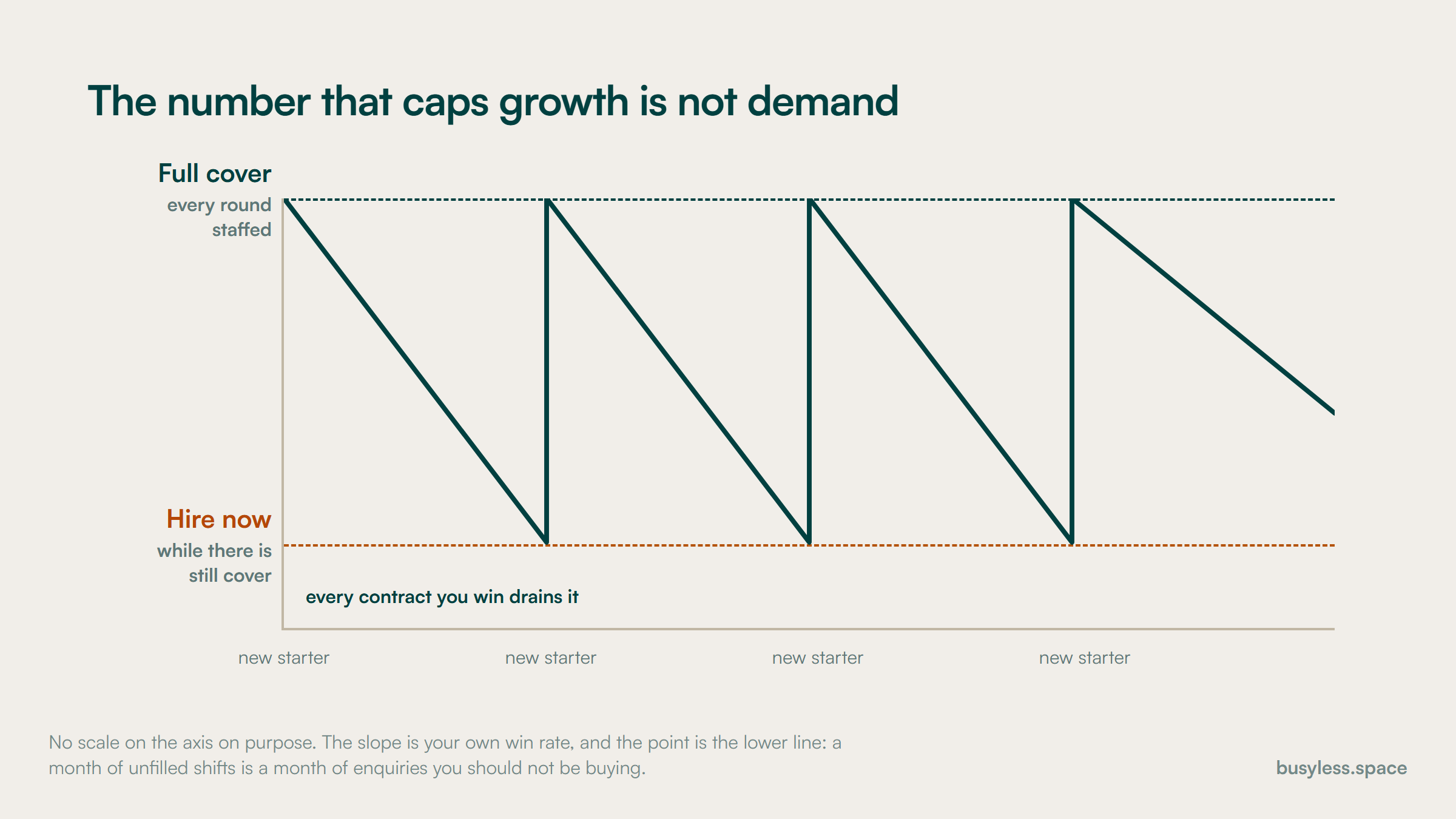
A sawtooth of spare crew hours between two reference lines. It drains as contracts are won and jumps back at every new starter, and the lower line is where you hire.
Put this beside the enquiry count and a good many reports in this industry change their recommendation.

The verdict

Cleaning looks like a simple local business and is really two businesses sharing a van. Decide which one the website is for, section by section, and most of the confusion in this market resolves itself.

The residential half rewards speed and honesty. Publish bands, take the deadline queries nobody has written properly, put your finished work on your own domain, and stop paying an introduction fee for customers who were searching for you anyway.

For the commercial half, be sceptical of anybody selling cleaning company SEO services on rankings alone. Janitorial contracts are decided in a scored proposal, and the useful question is whether the site would survive the verification stage of a bid.

One test separates a real proposal from a template: ask whether recruitment is in scope. Hiring is the growth ceiling in this industry, and a plan that has nothing to say about it is only half a plan, whatever else is promised by anybody offering SEO services for cleaning companies.

FAQ

Cleaning companies SEO questions

  • Should residential and commercial live on the same website?
    On the same domain, in two clearly separated sections. The buyers want opposite things: a homeowner wants a price and a date, a facilities manager wants a certificate of insurance and references. A single set of pages written for both reads as corporate boilerplate to one and as a domestic operation to the other. Separate navigation, separate language and a different call to action on each side.
  • Can we say our cleaning kills 99.9% of germs?
    Only if the registered label of the product you actually use supports it, under the conditions that label sets. A disinfectant is a pesticide registered under FIFRA, and the EPA's position is that the label is the law, so an efficacy claim belongs to that registration rather than to your service. Name the products, link to the labels, and describe your method in dwell time and surfaces instead.
  • Are lead marketplaces like Thumbtack and Angi worth it?
    As a bridge, often yes. As a permanent model, rarely. They rank on terms you cannot outrank quickly and they will send work, but you are usually buying a lead sold to several competitors, so the number that matters is cost per won job rather than cost per lead. Use the margin to fund your own pages and set a date to review whether the channel still earns its place.
  • How many location pages should we build?
    Far fewer than your website platform will offer to generate. Six services across forty towns is 240 near-identical URLs, which rank for nothing and look exactly like scaled content abuse. Build a real page only for towns where you have genuine route density, with detail a competitor could not reproduce by swapping the place name, and put the rest on a service-area list instead.
  • What is the easiest win available to us?
    Move-out cleaning. There is a handover date, a deposit at stake and no research phase, so the buyer decides quickly and cannot postpone. Most competitors give the job one line on a services page. A proper page with price bands by property size, a full inclusion checklist and an honest answer about what you cannot fix will usually produce enquiries within weeks.
  • Why does recruitment belong in an SEO plan?
    Because staff is the growth ceiling in this industry, not demand. If shifts go unfilled, more enquiries make the service worse and increase churn on the customers you already have. Searches for cleaning work by town and shift pattern are local, specific and almost entirely uncontested by employers, so job pages with real pay and hours are among the cheapest wins available.
  • Do we need to publish prices?
    Publish bands rather than a single figure. What cleaning costs is one of the largest clusters in this market and it is usually answered with a quote form, which sends the visitor to open three more tabs. Bands by property size and frequency, with the variables that move them named, are more honest than one number and they keep the comparison on your page rather than somewhere else.
  • What does cleaning company SEO cost?
    The tiers above are editorial estimates rather than quotes, and they sit at the lower end of this directory because the winnable ground is specific and the pages are short. A company running a real programme is realistically at $800 to $4,000 a month. The larger cost in most cleaning businesses is the marketplace fee, which sits outside those bands entirely.

Run it yourself, or have someone own it

Everything above is written to be run without us, and the free path is genuinely most of the value for a single-location business. Where these plans stall is almost never the plan. It is that nobody owns it after the first month. That is the job we do, with search as one distribution layer inside a wider system rather than the whole engagement.