
Skip to content

Optometry SEO strategy

YMYL and regulated

The regulator hands your customer the prescription your competitor needs

Written by Eugene SuslovLast reviewed 29 August 2026No affiliate links
Sector
Health and medical
Model
Local service, Multi-location
Competition
High
Time to results
4 to 8 months
Typical monthly
$1,500 to $6,000

Key takeaways

  1. 1Federal rules move your customer to your competitor. You must hand over the eyeglass prescription automatically, before offering to sell anything, at no extra charge. The strategy has to assume the patient can buy elsewhere, because the law guarantees it.
  2. 2Silence is consent, on an eight hour clock. Under the Contact Lens Rule a seller may fill an order if you do not answer a verification request within eight business hours. An unstaffed inbox is a competitor's sale.
  3. 3Your gatekeepers are insurers, not directories. VSP and EyeMed find-a-doctor tools intercept the search at the moment coverage is being checked, and a stale listing there loses patients no ranking can win back.
  4. 4You are running a clinic and a shop on one site. Medical eye care and retail eyewear want opposite architecture, opposite language and opposite conversions, and merging them produces a site that half-convinces both.
  5. 5Recall is the cheapest growth available and almost nobody publishes for it. The annual exam is a genuine repeating cycle, which no other retail-adjacent health business gets for free.

SEO for optometrists has to start from an unusual fact: a federal regulator requires you to give every patient the thing your largest competitors need in order to sell to them, and forbids you from charging for it.

The Eyeglass Rule, as amended and effective 24 September 2024, requires the prescriber to hand over the eyeglass prescription automatically and immediately after the refraction, before offering to sell any eyewear, and to keep a signed confirmation for three years.

The Contact Lens Rule does the same on the other product. It exists so that the patient can comparison shop, and it works: the prescription walks out of the room and can be filled by an online retailer that never paid for a chair, a lane or an optometrist.

So an optometry SEO strategy cannot be built on capturing the eyewear sale by default. It has to be built on being chosen for the things the prescription does not transfer: the examination, the fitting, the judgement, the aftercare and the relationship.

Underneath that sits a second problem, which is architectural. Medical eye care and retail eyewear are two businesses with different language, different urgency and different conversions, and most practice websites run them through one navigation and one tone.

The last piece is who already answers the query. In most health verticals the gatekeepers are directories. Here the biggest ones are payers: patients look up who takes their plan before they look up who is any good, and the insurer's own tool answers first.

Who already ranks in optometrists

Search your town plus eye exam, then search it plus your main vision plan, and notice that the second search barely involves you. Almost every optometry SEO audit finds the practice competing reasonably on the first and completely absent from the second, which is the search closer to the money.

What is on the results page

  • Local pack on exam and near-me queries
  • Vision plan provider directories ranking on plan plus location
  • National retail chains occupying the eyewear and frames terms
  • Online contact lens sellers owning brand and reorder queries
  • People Also Ask, heavily weighted to insurance coverage and cost
  • Health knowledge panels on condition and symptom queries
  • Booking platforms ranking above practices on appointment terms
  • VSP

    vsp.comClaim it

    The largest vision benefits provider in the country, with a network spanning tens of thousands of provider locations, and its find-a-doctor tool answers the query at the exact moment a patient is checking coverage. Your listing there is a marketing asset most practices have never audited. Check the address, hours, services and accepting-new-patients flag this quarter.

  • EyeMed

    eyemed.comClaim it

    The other large network directory, with the same dynamic and the same neglect. Both are worth more attention than any review site, because a patient filtering by plan has already excluded every practice not listed, no matter how well it ranks.

  • Zocdoc

    zocdoc.comClaim it

    Ranks on appointment and insurance queries and converts well, because it answers coverage and availability in one step. The trade is that it teaches the patient to book through a platform rather than through you, so treat it as acquisition rather than as a booking system.

  • 1-800 Contacts

    1800contacts.com

    Not a directory but a direct beneficiary of the rules on this page, and it owns the reorder queries outright. You will not outrank it and should not try. What you can win is the fitting, the follow-up and the reason to come back for an exam.

  • Warby Parker

    warbyparker.com

    Occupies the frames and glasses head terms and increasingly the exam ones too, since it now operates physical locations. Study its appointment flow rather than its rankings: it has made booking an eye exam feel like buying a product, and that is the comparison a patient is making.

  • Google Business Profile

    google.comClaim it

    Carries more weight here than in most health categories because it can hold both halves of the business: exam services and the optical dispensary. List the insurance plans you take in the profile description and the services list, since coverage is the first filter a patient applies.

  • Healthgrades

    healthgrades.comClaim it

    Worth claiming and correcting rather than investing in. It ranks on your name plus reviews, so an unclaimed profile with stale details is doing quiet damage on a branded query, which is the query most likely to be searched by somebody about to book.

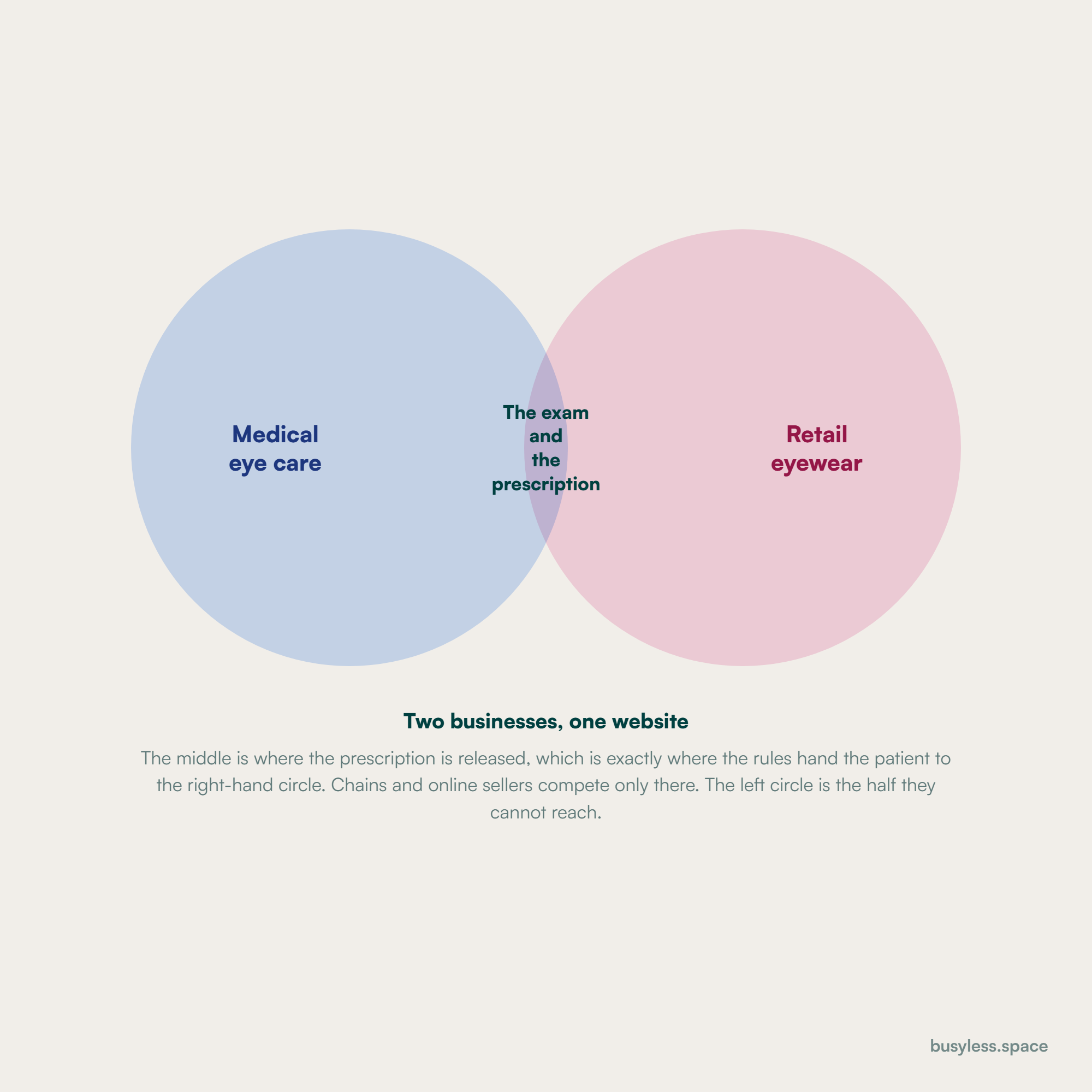
Two overlapping circles showing medical eye care and retail eyewear, with the contested overlap where online retailers and chains compete
The overlap is the part everybody else wants. The left circle is the part no online retailer can reach, and most practice websites give it the least room.

What people actually search

The two clusters that matter most here are the ones a general health playbook would not have: people searching by their insurance plan rather than by a symptom, and people searching to compare what you charge against an online retailer they can legally use.

Plan coverage

Local commercial, coverage-gated

optometrist that takes vsp near me

The page that wins it: A page per major plan you accept, naming what it covers here

The highest-converting query in the category and the one most practices answer with a logo strip. A patient filtering by plan has already excluded everyone not listed, so this cluster is a qualification step disguised as a search.

Routine exam

Local transactional

eye exam near me

The page that wins it: Exam page stating price, duration, and what is included

Contested by chains and by Warby Parker, and decided largely on availability and price transparency. Saying what the exam costs without insurance is unusual enough in this category to be a differentiator.

Medical eye care

Clinical, informational to commercial

dry eye treatment specialist

The page that wins it: Condition pages under a clearly clinical section of the site

The half of the business online retailers cannot touch, and the half most practice websites bury under the frames. Dry eye, myopia management and specialty lenses carry the margin and the loyalty.

Contact lens fitting

Clinical commercial, specialist

scleral lens fitting near me

The page that wins it: Fitting pages by lens type, with the clinical reason for each

The correct answer to the reorder problem. You cannot win the reorder and should stop trying; you can own the fitting, which is skilled, billable and impossible to buy online.

Eyewear retail

Local retail commercial

designer frames in [town]

The page that wins it: Dispensary pages by brand and lens type, priced honestly

Where you compete with national retail on their terms, and mostly lose on price. Win instead on what a chain cannot do: measurement accuracy, adjustment, repair and a person who remembers the last pair.

Children and school vision

Local, seasonal and deadline-led

children's eye exam before school

The page that wins it: Paediatric page plus a myopia management page for parents

Genuinely seasonal and genuinely urgent, and it converts a whole family rather than one patient. Myopia management is the specialist thread underneath it and it has almost no local competition anywhere.

Urgent eye problem

Clinical urgent

eye pain and light sensitivity

The page that wins it: A triage page that says plainly when to go to an emergency room

Low volume and high stakes, and the only cluster where the right answer is often to send the reader somewhere else. Doing that properly is the clearest expertise signal a practice can publish.

Recall and reorder

Informational, cyclical

when should i get my eyes tested

The page that wins it: A recall page plus the email and text programme behind it

The annual exam is a real repeating cycle, which very few local businesses get for free. Most practices run recall as an operational chore rather than as a channel, and publish nothing for the query that starts it.

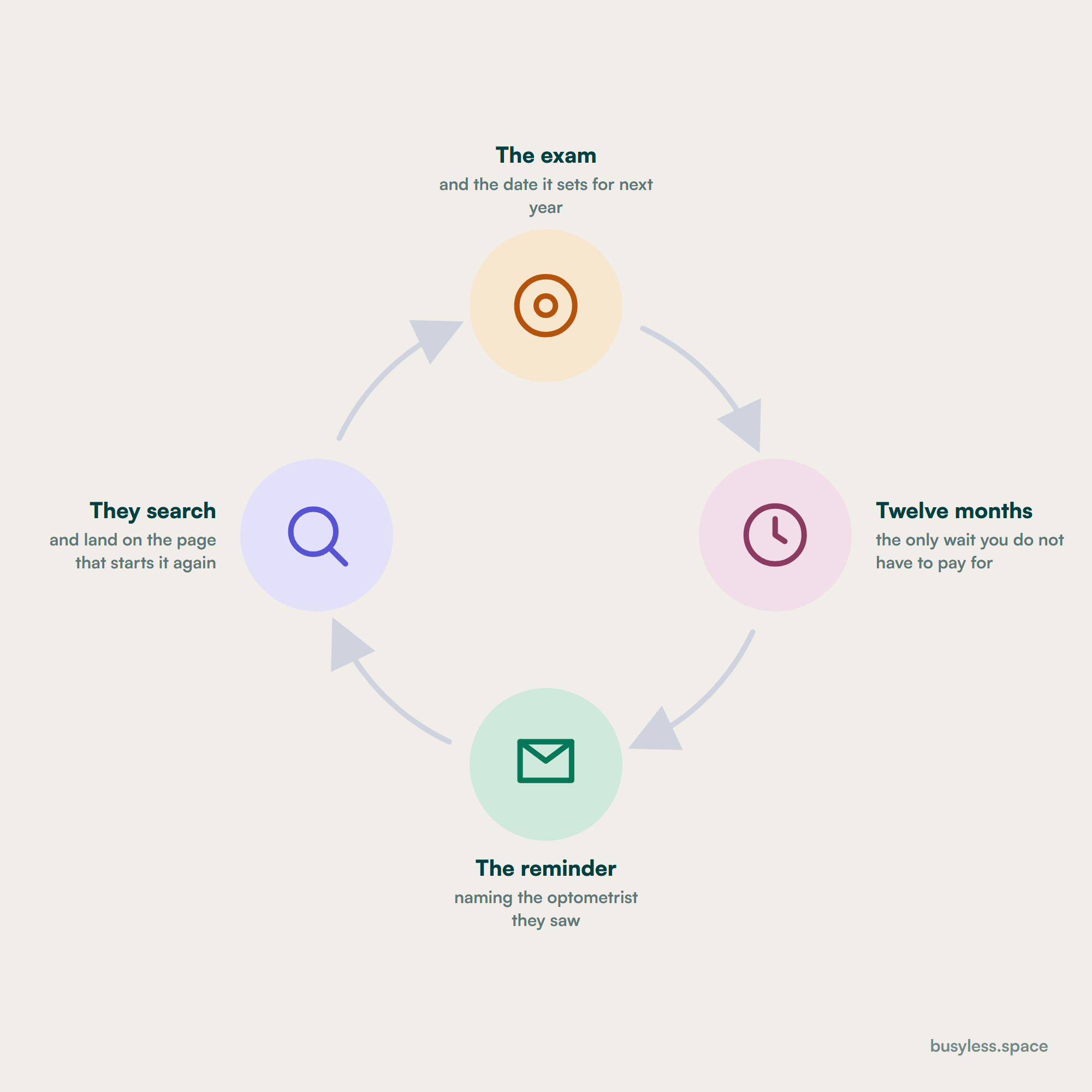
The annual recall cycle from exam to reminder to search to booking, drawn as a loop that turns on its own
Almost no local business gets a genuine annual cycle for nothing. Most practices run it as an administrative chore and publish nothing for the search it produces.

What the rules change

The rules below are not marketing regulations that happen to touch the website. They are the commercial terms of the industry, and two of them are the reason this playbook looks different from every other health page here. This is my reading rather than legal advice.

1

The eyeglass prescription must be released automatically, immediately and free

FTC Eyeglass Rule, 16 CFR 456, final rule 26 July 2024, effective 24 September 2024

What it means

The prescriber must give the patient the prescription immediately after the refraction and before offering to sell any eyewear, at no additional fee, then obtain a signed confirmation of receipt and keep it for not less than three years.

So do this

Stop building the strategy on capturing the sale by default, because the rule guarantees the patient can leave with what they need to buy elsewhere. Compete on the fitting, the accuracy and the aftercare, and say so on the page.

2

Digital delivery of a prescription needs consent, recorded and kept

FTC Eyeglass Rule, 16 CFR 456, as amended

What it means

A prescriber may release by portal, email or text only after obtaining the patient's verifiable affirmative consent, and must keep evidence of that consent, and of delivery, for at least three years.

So do this

If your booking flow or patient portal is doing this, check that consent is captured as its own step rather than buried in an intake form. The website is where this either works cleanly or quietly does not.

3

Passive verification: silence lets a competitor fill the order

FTC Contact Lens Rule, 16 CFR 315.5

What it means

A seller may fill a contact lens order if the prescriber does not respond to a verification request within eight business hours, counted between 9am and 5pm on weekdays excluding federal holidays. Not answering is treated as confirming.

So do this

Staff the verification inbox like a revenue channel, because it is one. This is an operations point that belongs in a marketing plan, since every unanswered request is a sale completed by somebody else on your clinical authority.

4

State board rules constrain what you may claim about care

State optometry board advertising regulations, varying by state

What it means

Boards commonly restrict superiority claims, the use of specialist or doctor titles in ways that could mislead, and statements about scope of practice, which differs by state more than most practices realise.

So do this

Check your own board before writing service pages, particularly around procedures your state allows and a neighbouring one does not. Write the page for the state you practise in rather than copying a competitor from elsewhere.

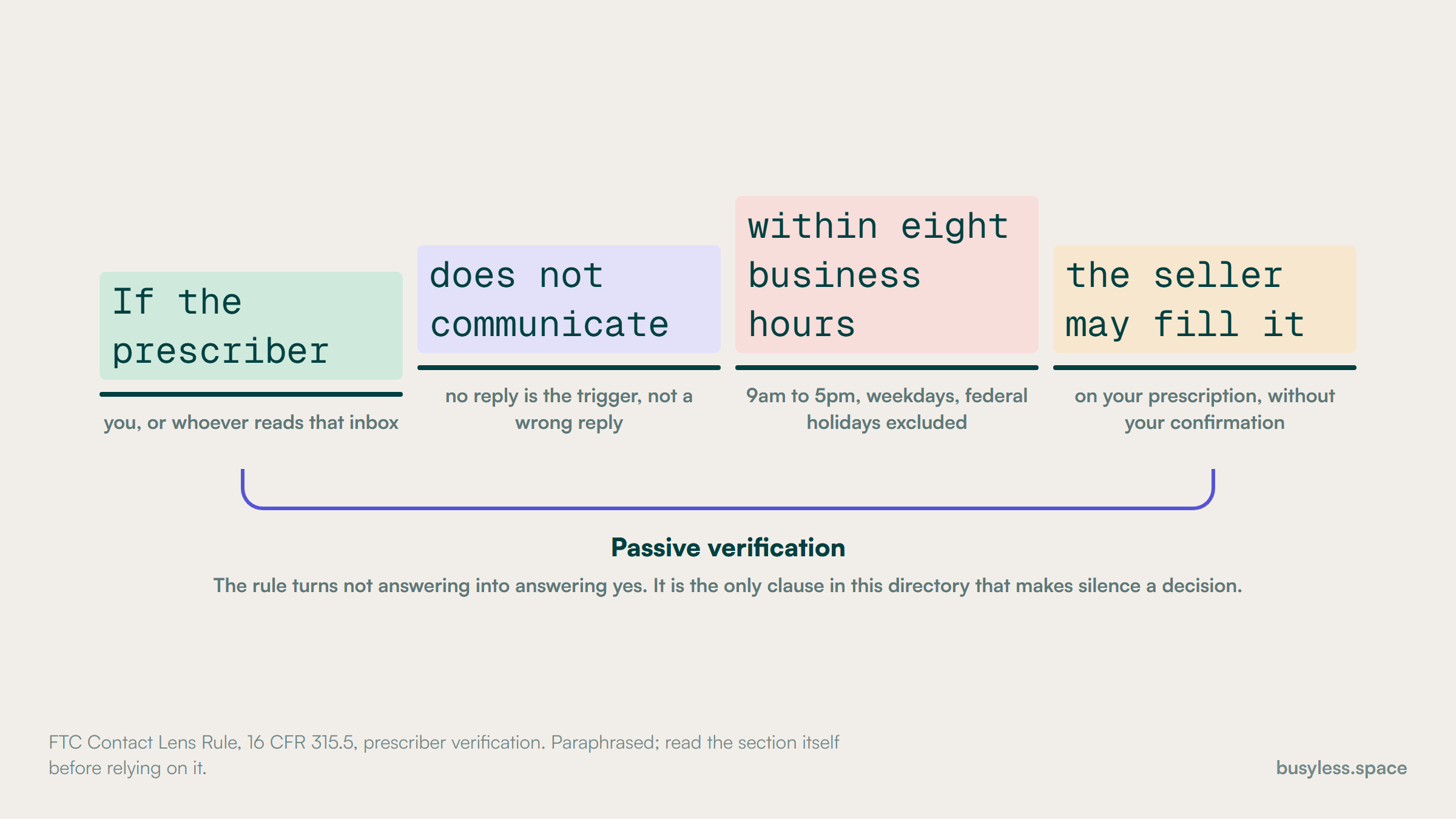
The passive verification sentence from the Contact Lens Rule broken into its parts: who, the eight business hour window, what silence means and who may then fill the order
Every part of this sentence is doing work, and the one that catches practices out is the third. Not replying is not neutral.

Proving expertise

This is a YMYL category, so the clinical half of the site is held to a health standard while the retail half is held to an ordinary one. The signals below are the ones that separate a practice from a chain and from an online seller.

  • Named optometrists with licence numbers and the state that issued them
  • Board certifications and residency training, stated plainly
  • Fellowships and specialty credentials for myopia management or scleral lenses
  • The equipment you actually own, named, with what it detects
  • Clinical pages reviewed and dated by a named optometrist
  • The plans you accept, current and checked against the insurer's own directory
  • Honest triage advice, including when to go somewhere other than you
  • Reviews that name the optometrist and the reason for the visit

How to build a optometry SEO strategy

The order below fixes the two things that leak patients before it tries to attract more of them. An optometry SEO strategy that opens with condition content while the plan directories are stale and the verification inbox is unmanned is filling a bucket with a hole in it.

  1. 1

    Weeks 1-3

    Stop the leaks

    • Audit every vision plan directory listing and correct it
    • Confirm who monitors the contact lens verification inbox, and when
    • Check the prescription release flow against the rule, including consent
    • Claim and correct the Business Profile, Zocdoc and Healthgrades
    • Set up separate conversion tracking for exam bookings and enquiries

    You end up with
    Accurate listings everywhere a patient checks coverage, and a staffed verification process

  2. 2

    Weeks 4-7

    Answer the coverage question

    • Write a page for each major plan, naming what it covers at this practice
    • Publish exam pricing, including the self-pay price
    • Rewrite the exam page to state duration, tests included and what to bring
    • Separate the clinical and retail sections of the navigation
    • Add optometrist bios with credentials and licence numbers

    You end up with
    A site that answers coverage and cost before a patient has to phone to find out

  3. 3

    Weeks 8-12

    Build the half nobody can buy online

    • Write the specialty pages: dry eye, myopia management, scleral lenses
    • Write the paediatric and school vision pages
    • Add the urgent triage page, with honest referral advice
    • Add clinical review bylines and dates to every medical page
    • Publish the equipment you own and what it finds

    You end up with
    A clinical section that competes on judgement rather than on price

  4. 4

    Weeks 13-16

    Turn recall into a channel

    • Publish the recall page and connect it to the reminder programme
    • Start the review habit, asking patients to name the optometrist
    • Report exam bookings separately from eyewear enquiries
    • Review whether platform bookings are worth their commission
    • Set a quarterly diary note to re-check plan directory listings

    You end up with
    A repeating cycle that produces appointments without new acquisition spend

Technical fixes with the best payoff

Optometry has a small number of specialist website vendors serving most independent practices, so the defects recur across the market rather than one practice at a time. The first two below are consequences of running a clinic and a shop through one template.

  • Clinical and retail content share one navigation

    A week

    The vendor template ships a single services menu, so dry eye treatment sits three items away from designer frames and the site reads as neither a clinic nor a shop.

    Split them at the top level and let each half have its own tone, its own conversion and its own internal linking. This is the single largest structural gain available here.

  • The plans you accept appear only as a logo strip

    A page a day

    Templates offer an insurance logo row, which is invisible to search and answers nothing. Meanwhile the highest-intent query in the category is a plan name plus a place.

    One page per major plan, naming what it covers at your practice, what a patient typically pays, and how to check. Logos can stay; they just cannot do the work.

  • Booking is an iframe with no measurable conversion

    Half a day

    Scheduling is a third-party embed, so the appointment, which is the only conversion that matters, happens outside anything the practice can see.

    Fire an event on booking start and, where the vendor allows, on completion. Otherwise reconcile against the practice management system monthly and report that number instead.

  • Condition pages carry no author and no date

    A condition a week

    Vendor-supplied clinical libraries are syndicated across hundreds of practices with no byline, which is the worst combination available in a YMYL category: duplicated and unattributed.

    Rewrite the conditions you actually treat and put a named optometrist and a review date on each. Delete the syndicated remainder rather than leaving it.

  • Every photograph is stock

    An afternoon

    The template arrives with a library of models in glasses, and it is the same library every other practice on that vendor is using.

    Photograph the practice, the lanes, the equipment and the team. In a category where the differentiator is that you are a real clinic, looking like one is not decoration.

  • Nothing on the site states the self-pay exam price

    An hour

    Practices avoid it because insurance makes pricing complicated, so the answer becomes phone us, on the query where a chain answers instantly.

    State the self-pay price and one line on how insurance changes it. Complexity is a reason to explain, not a reason to withhold.

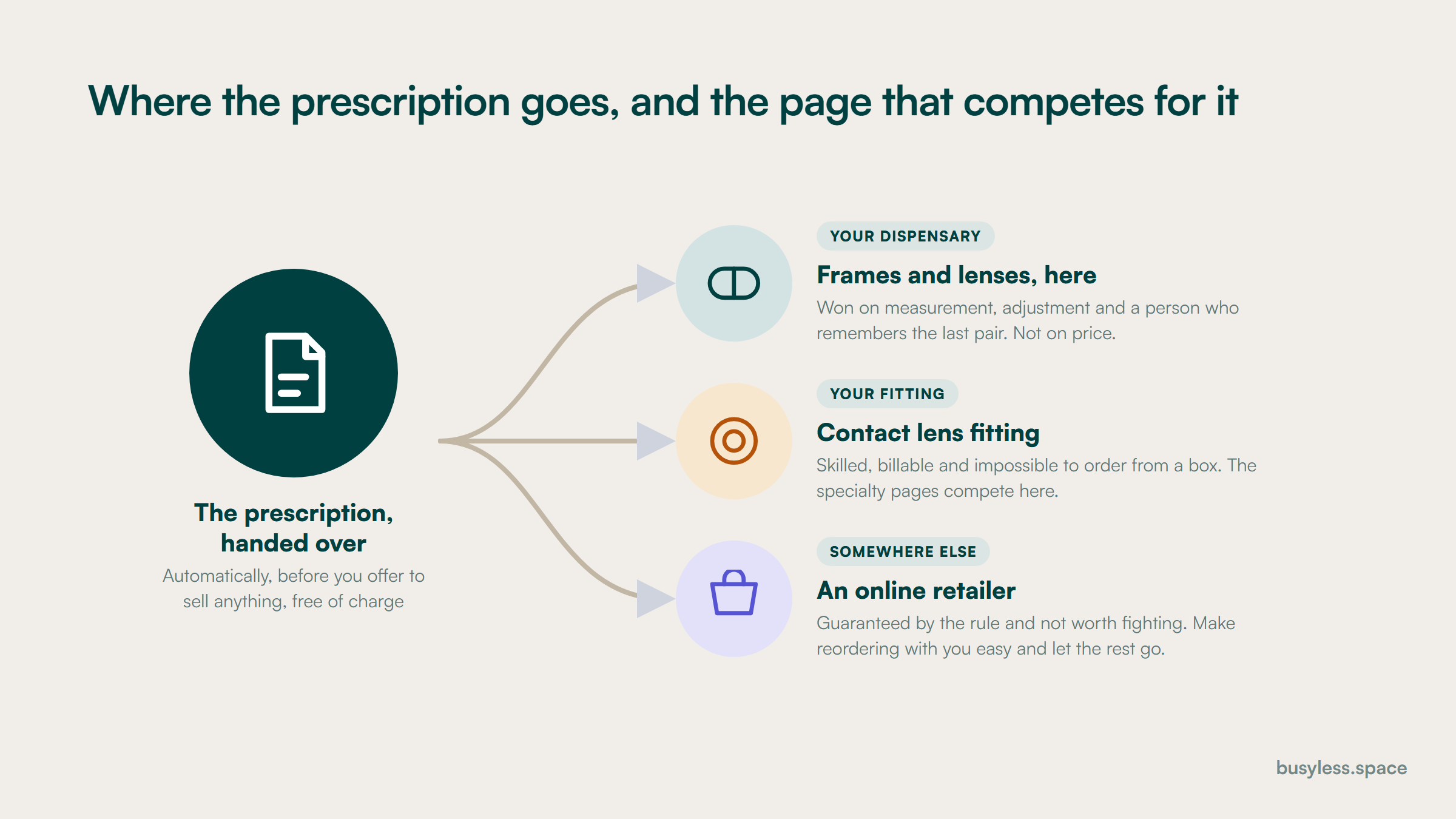
A released prescription branching to three destinations, your dispensary, your contact lens fitting, and an online retailer, each labelled with what wins it
The branch is created by a federal rule, so it cannot be closed. It can only be won, and the pages named here are what wins it.

Structured data that applies here

The types below fit this industry specifically. Most of them earn no rich result on their own, which is worth knowing before anyone sells the work on that basis. What they do is describe the entity precisely, which matters for how search engines and answer engines resolve who you are.

  • Optometric

    Home page and the contact page

    schema.org has a dedicated Optometric type under MedicalBusiness, which is more precise than the generic LocalBusiness most vendor templates emit and which correctly signals the clinical half of the business.

    Optometric.jsonld
    {
      "@context": "https://schema.org",
      "@type": "Optometric",
      "name": "[PRACTICE NAME]",
      "url": "https://[YOUR-DOMAIN]/",
      "telephone": "[+1-555-000-0000]",
      "image": "https://[YOUR-DOMAIN]/[PHOTO-OF-YOUR-PRACTICE].jpg",
      "address": {
        "@type": "PostalAddress",
        "streetAddress": "[STREET]",
        "addressLocality": "[CITY]",
        "addressRegion": "[STATE]",
        "postalCode": "[ZIP]",
        "addressCountry": "US"
      },
      "geo": {
        "@type": "GeoCoordinates",
        "latitude": "[LATITUDE]",
        "longitude": "[LONGITUDE]"
      },
      "openingHoursSpecification": [
        {
          "@type": "OpeningHoursSpecification",
          "dayOfWeek": ["Monday","Tuesday","Wednesday","Thursday","Friday"],
          "opens": "[09:00]",
          "closes": "[17:30]"
        }
      ],
      "medicalSpecialty": "https://schema.org/Optometric",
      "availableService": [
        { "@type": "MedicalTest", "name": "[Comprehensive eye examination]" },
        { "@type": "MedicalTherapy", "name": "[Dry eye treatment]" }
      ]
    }
  • Physician for each optometrist

    Every practitioner biography page

    The credential markup matters more here than the practice markup, because the thing an online retailer cannot replicate is a named, licensed clinician. Mark up the person and link them from the clinical pages they review.

    Physician for each optometrist.jsonld
    {
      "@context": "https://schema.org",
      "@type": "Physician",
      "name": "[DR FULL NAME], OD",
      "url": "https://[YOUR-DOMAIN]/team/[SLUG]",
      "image": "https://[YOUR-DOMAIN]/[REAL-PHOTOGRAPH].jpg",
      "medicalSpecialty": "https://schema.org/Optometric",
      "worksFor": {
        "@type": "Optometric",
        "name": "[PRACTICE NAME]",
        "url": "https://[YOUR-DOMAIN]/"
      },
      "alumniOf": {
        "@type": "CollegeOrUniversity",
        "name": "[SCHOOL OF OPTOMETRY]"
      },
      "hasCredential": [
        {
          "@type": "EducationalOccupationalCredential",
          "credentialCategory": "[State licence]",
          "recognizedBy": { "@type": "Organization", "name": "[STATE BOARD OF OPTOMETRY]" },
          "identifier": "[LICENCE NUMBER]"
        },
        {
          "@type": "EducationalOccupationalCredential",
          "credentialCategory": "[Fellowship or board certification]",
          "recognizedBy": { "@type": "Organization", "name": "[AWARDING BODY]" }
        }
      ]
    }
  • MedicalWebPage with reviewedBy

    Every clinical condition or treatment page

    The property that does the YMYL work. It names who reviewed the page and when, which is exactly what a syndicated vendor condition library cannot claim, and it should match a visible byline on the page itself.

    MedicalWebPage with reviewedBy.jsonld
    {
      "@context": "https://schema.org",
      "@type": "MedicalWebPage",
      "url": "https://[YOUR-DOMAIN]/[CONDITION-PAGE]",
      "name": "[Dry eye: causes, tests and treatment]",
      "about": {
        "@type": "MedicalCondition",
        "name": "[Dry eye disease]"
      },
      "lastReviewed": "[YYYY-MM-DD]",
      "reviewedBy": {
        "@type": "Physician",
        "name": "[DR FULL NAME], OD",
        "url": "https://[YOUR-DOMAIN]/team/[SLUG]"
      },
      "specialty": "https://schema.org/Optometric"
    }
  • Service with an accepted insurance list

    Each plan coverage page

    The highest-intent query in the category is a plan name plus a place, and this is how you say in markup what the logo strip says in pictures. Keep it in step with the insurer's own directory, because a mismatch is worse than silence.

    Service with an accepted insurance list.jsonld
    {
      "@context": "https://schema.org",
      "@type": "Service",
      "serviceType": "[Comprehensive eye examination]",
      "provider": {
        "@type": "Optometric",
        "name": "[PRACTICE NAME]",
        "url": "https://[YOUR-DOMAIN]/"
      },
      "areaServed": { "@type": "City", "name": "[CITY]" },
      "offers": {
        "@type": "Offer",
        "priceSpecification": {
          "@type": "PriceSpecification",
          "price": "[SELF-PAY PRICE]",
          "priceCurrency": "USD",
          "description": "[Self-pay price. Covered in full or in part by the plans listed below.]"
        }
      },
      "isRelatedTo": [
        { "@type": "Organization", "name": "[PLAN NAME]" },
        { "@type": "Organization", "name": "[PLAN NAME]" }
      ]
    }
  • Product for frames and lens packages

    The dispensary pages

    The retail half of the site deserves retail markup, and separating it from the clinical markup is what lets each half compete in the results it belongs in rather than blurring into one ambiguous medical shop.

    Product for frames and lens packages.jsonld
    {
      "@context": "https://schema.org",
      "@type": "Product",
      "name": "[FRAME BRAND AND RANGE]",
      "brand": { "@type": "Brand", "name": "[BRAND]" },
      "description": "[WHO IT SUITS, IN YOUR OWN WORDS, NOT THE BRAND'S COPY]",
      "image": "https://[YOUR-DOMAIN]/[PHOTO-IN-YOUR-DISPENSARY].jpg",
      "offers": {
        "@type": "AggregateOffer",
        "priceCurrency": "USD",
        "lowPrice": "[LOW]",
        "highPrice": "[HIGH]",
        "offerCount": "[N]",
        "seller": { "@type": "Optometric", "name": "[PRACTICE NAME]" }
      }
    }
  • FAQPage

    The plan pages and the exam page

    Mark up the questions that decide the booking: what the exam costs without insurance, what a plan actually covers here, and whether the prescription is provided. That last one is a rule, and answering it publicly is reassuring rather than risky.

    FAQPage.jsonld
    {
      "@context": "https://schema.org",
      "@type": "FAQPage",
      "mainEntity": [
        {
          "@type": "Question",
          "name": "[Do I get a copy of my prescription?]",
          "acceptedAnswer": {
            "@type": "Answer",
            "text": "[Yes. We give you your prescription at the end of your exam, automatically and at no extra cost. You are free to use it wherever you like.]"
          }
        },
        {
          "@type": "Question",
          "name": "[What does an eye exam cost without insurance?]",
          "acceptedAnswer": {
            "@type": "Answer",
            "text": "[$X for a comprehensive exam, including NAMED TESTS. Here is what changes it and which plans cover it in full.]"
          }
        }
      ]
    }

What it costs

These bands are editorial estimates of the work rather than a price list or survey data. Optometry sits at the higher end of the local health group in this directory for one reason: the clinical half needs writing that a named optometrist has genuinely reviewed, and review time is the scarce input.

Do it yourself

$0 to $400
  • Every vision plan directory listing audited and corrected
  • The self-pay exam price published
  • A page for your two biggest plans
  • Business Profile, Zocdoc and Healthgrades claimed
  • Practice photography replacing the stock library

Who it suits

A single-location practice where an optometrist or practice manager can give it an hour a week and already knows the plan mix.

Where it stops

The specialty clinical pages need writing and reviewing, and that is the work that separates you from a chain.

Lean

$1,500 to $3,000
  • Everything above, plus a writer working with your optometrists
  • The plan pages built out across your whole mix
  • Clinical pages rewritten with named reviewers and dates
  • Clinical and retail separated in the site structure

Who it suits

One or two locations with a specialty interest worth marketing, such as dry eye or myopia management.

Where it stops

Recall as a genuine channel needs process and software work inside the practice, not more pages.

Funded

$3,000 to $6,000
  • Specialty programmes marketed properly, with their own funnels
  • A page per location with genuinely local content
  • Paid search on plan and exam terms
  • Reporting that separates exam bookings from eyewear enquiries

Who it suits

Multi-location groups, or a single practice building a referral-led specialty where the patient travels further than a chain's catchment.

Where it stops

Beyond this the constraint is lane capacity and optometrist hours, and marketing past that damages the reviews it depends on.

How to do it with no budget

Unusually productive here, because two of the highest-value actions cost nothing and neither is really marketing: correcting the insurer directories, and making sure somebody answers the verification requests.

  1. 1

    Audit every vision plan directory listing

    3 hours

    The insurers' own provider portals

    Address, hours, phone, services and whether you are shown as accepting new patients. A patient filtering by plan never sees the practices with wrong details, and no amount of ranking compensates.

  2. 2

    Staff the contact lens verification inbox

    An hour to set up

    Your existing inbox and a rota

    Eight business hours of silence lets a seller fill the order. This is the only item in this directory where a free operational fix directly stops revenue leaving.

  3. 3

    Publish the self-pay exam price

    An hour

    Your website editor

    One number and one line on how insurance changes it. Chains answer this instantly and practices rarely do, which loses the comparison before it starts.

  4. 4

    Write your two biggest plan pages

    2 hours each

    Your website editor

    Name the plan, say what it covers at your practice, what a patient typically pays and how to check. This is the highest-intent query in the category and almost nobody answers it in text.

  5. 5

    Put a named optometrist on every clinical page

    2 hours

    Your website editor

    A byline and a review date. In a YMYL category this is the cheapest meaningful quality signal, and it is what a syndicated condition library can never have.

  6. 6

    Photograph the practice

    An afternoon

    A phone

    The lanes, the equipment, the dispensary, the team. The argument is that you are a real clinic rather than a website, so look like one.

  7. 7

    Write the recall page

    2 hours

    Your website editor

    Answers how often somebody should have their eyes tested, which is the query that starts the annual cycle, and gives every reminder message somewhere to link to. It turns the cheapest appointments in the practice into something you can measure.

The tool stack

Deliberately short. The two genuinely useful tools here track things a practice cannot see from inside: where it ranks on plan queries, and whether patients come back.

  • Track ranking on plan and exam queries separately

    AccuRankerSEO APIRead the review

    Plan queries and exam queries behave completely differently, and reporting them together hides the one that converts. Separate them from the first report rather than a year in.

    Free routeSearch Console, with a filter for each plan name

  • Understand whether patients actually come back

    Customer Churn Analysis CalculatorFree toolOpen the tool

    Recall is the cheapest growth in this business and most practices have never quantified how much of it they lose. Run it before deciding that the answer is more acquisition spend.

    Free routeFree

  • Publish clinical pages with reviewers and dates as real fields

    CosmicHeadless CMSRead the review

    A reviewer, a review date and a specialty are structured data, not formatting. Modelling them once means the byline, the schema and the review reminder all read from the same record and cannot drift apart.

    Free routeWhatever your practice vendor allows, documented honestly

  • Measure appointments, not form views

    Your scheduling vendor's event hooks

    Most practice sites cannot say how many bookings the website produced. If the embed will not report it, count it manually rather than reporting a number you know is wrong.

    Free routeReconcile against the practice management system monthly

  • Watch the plan directories for drift

    A quarterly diary note

    Insurer directories go stale silently after any change of hours, phone system or provider. A quarterly check takes twenty minutes and protects the highest-intent traffic you have.

    Free routeFree

  • Collect reviews that name the optometrist

    Your recall messaging

    A review naming a clinician and a reason for the visit is worth several generic five-star ratings, and the request costs nothing because the message is already going out.

    Free routeAsk in the existing reminder

Take it from here

Everything below is meant to be filled in and used rather than read. Bodies are plain text, so what lands on your clipboard is exactly what you see, brackets and all.

Checklist

Checks every insurer listing a patient can filter you out of, which is where the highest-intent traffic is decided.

VISION PLAN DIRECTORY AUDIT
Practice: [NAME]
Audited by: [NAME]        Date: [DATE]
Repeat: quarterly, and after any change of hours, phone or provider

FOR EACH PLAN YOU PARTICIPATE IN
Plan: [PLAN NAME]
Portal URL: [URL]
Login held by: [NAME]

[ ] Practice name matches your signage and website exactly
[ ] Street address correct, including suite number
[ ] Phone number correct, and it is answered by a person
[ ] Opening hours correct, including the day you close early
[ ] Website URL correct and not a redirect
[ ] Every optometrist listed, none missing, none who have left
[ ] Accepting new patients flag set correctly
[ ] Services listed match what you actually offer
[ ] Languages spoken correct
[ ] Accessibility details correct

FOUND WRONG                     CORRECTED ON
[WHAT]                          [DATE]
[WHAT]                          [DATE]

CROSS-CHECK
[ ] Does the insurer directory agree with your Business Profile?
[ ] Does it agree with your website contact page?
[ ] Does it agree with Zocdoc and Healthgrades?

WHY THIS IS FIRST
A patient filtering by plan never sees a practice with wrong details.
No amount of ranking reaches them, because they are not searching Google.

What to publish

The content that works here is whatever an online retailer cannot deliver and a chain cannot staff. Everything below is either about coverage, which is administrative, or about judgement, which is clinical.

  • A page per vision plan

    One a day until the mix is covered, then quarterly checks

    Answers the query closest to the booking, and a patient filtering by plan cannot find you any other way. Most practices publish a logo strip instead, which is invisible to search.

  • Specialty clinical pages

    One a fortnight, each with a named reviewer

    Dry eye, myopia management and specialty lenses are billable, defensible and impossible to buy online. They also attract patients who travel further than a chain's catchment.

  • The exam page with real pricing

    Once, reviewed twice a year

    Removes the reason to phone a competitor. Stating the self-pay price and what the exam includes is unusual enough in this category to differentiate on its own.

  • Paediatric and school vision pages

    Once, refreshed before each school year

    Seasonal, deadline-driven and family-converting. Myopia management sits underneath as the specialist thread with almost no local competition.

  • Optometrist biographies

    Once per clinician, updated on new credentials

    The credential is the differentiator against an online seller, and the biography is what a clinical page's byline links to. Treat them as landing pages, not as an About section.

  • The recall explainer

    Once, reviewed annually

    Turns an operational chore into a channel by answering the query that starts the cycle, and gives the reminder programme somewhere to link to.

And what not to

  • Syndicated vendor condition libraries, unattributed and duplicated across hundreds of practices
  • Frames trend posts that never mention a price, a brand you stock or an appointment
  • Attempts to rank for contact lens reorder terms, which belong to the online sellers
  • Stock photography of models in glasses, which every practice on your vendor is also using
  • Insurance logo strips presented as an answer to a coverage query

The expensive mistakes

Building the plan around keeping the eyewear sale

Costs you You compete on price with retailers who have no clinical overhead, on a transaction the law lets the patient take elsewhere.

Compete on the exam, the fitting, the accuracy and the aftercare, and say plainly on the page that the prescription is theirs to use anywhere.

Leaving the verification inbox unmanned

Costs you Eight business hours of silence and a seller may fill the order. Revenue leaves on your clinical authority and nothing in the analytics shows it.

Give it an owner and a response window shorter than the rule allows. Treat it as a sales channel, because that is what it is.

Answering coverage with a logo strip

Costs you The highest-intent query in the category has no page to land on, so the insurer's own directory answers it and the patient picks from a list.

One page per plan, in text, naming what it covers at your practice and what a patient typically pays.

Running the clinic and the shop through one navigation

Costs you A site that reads as too commercial for a medical query and too clinical for a retail one, so it half-convinces both audiences.

Split them at the top level. Two tones, two conversions, two internal linking structures, one practice.

Publishing the vendor's condition library

Costs you Duplicated, unattributed medical content in a YMYL category, which is the worst possible combination and can drag the whole domain.

Rewrite the conditions you actually treat, put a named optometrist and a date on each, and delete the rest.

Ignoring recall because it is not marketing

Costs you The cheapest appointments in the business go uncollected while the budget chases new patients who cost several times more.

Publish for the query that starts the cycle and connect it to the reminder programme. Then measure returning patients as a marketing number.

What to measure

Two things make measurement here different. A booking usually happens inside a third-party scheduler the practice cannot see into, and a large share of the value is a patient returning in a year, which no monthly report can capture. Report both halves and say which is which.

Leading indicators

Move first. They predict, they do not prove.

  • Exam bookings from the website

    Scheduler events, reconciled against practice management

    The only conversion that matters, and the one most practice sites cannot report. Where the embed will not fire an event, count manually and say so rather than substituting form views.

  • Plan query rankings

    Search Console and rank tracking, filtered per plan

    Track each major plan separately. Movement here is the clearest early sign the strategy is working, because it is the query closest to a booking.

  • Plan directory listings correct

    The insurers' provider portals

    A simple count of listings verified this quarter. Unglamorous, and it protects the highest-intent traffic the practice has.

  • Verification requests answered within the window

    The verification inbox

    Belongs in a marketing report even though it is an operations number, because every miss is a completed sale for a competitor and nothing else will surface it.

  • Clinical pages with a named reviewer

    Your own count

    A production metric that proxies for YMYL quality. Report it as a fraction of clinical pages, because the syndicated remainder is the part doing harm.

Business indicators

The ones a manager acts on.

  • New patient exams

    Practice management system

    The business number the leading indicators are trying to move. Split new from returning, because a strategy that grows recall and a strategy that grows acquisition look identical in a total.

  • Recall rate and returning exams

    Practice management system

    The cheapest revenue in the practice, and the number most likely to improve first. Measure it annually rather than monthly, because the cycle is annual.

  • Revenue per exam, split clinical and optical

    Your billing

    The honest test of whether competing on clinical judgement is working. Optical revenue may fall while clinical revenue and loyalty rise, which is the intended outcome rather than a failure.

The verdict

Most optometry SEO services sell condition content and a review widget, which is the plan for a medical practice. This is a medical practice attached to a shop, competing with online retailers the federal rules deliberately empower.

So the honest starting point is that you cannot keep the eyewear sale by default and should stop building around it. Compete where the prescription does not transfer: the examination, the fitting, the follow-up, and being the person who knows the eye.

Good SEO services for optometrists therefore begin somewhere unglamorous. Correct the insurer directories, answer the verification requests, publish what the exam costs, and write a page for every plan you take.

Then build the clinical half properly, with named optometrists on every page. That is the part no retailer can copy and no chain can staff, and it is the only durable answer to a rule designed to let your patient shop elsewhere.

FAQ

Optometrists SEO questions

  • Do I really have to give patients their prescription?
    Yes, automatically and immediately after the refraction, before offering to sell eyewear, and at no additional charge. The amended Eyeglass Rule took effect on 24 September 2024 and also requires a signed confirmation of receipt kept for at least three years.
  • What is passive verification and why does it matter for marketing?
    Under the Contact Lens Rule a seller may fill an order if the prescriber does not respond to a verification request within eight business hours. Silence counts as confirmation, so an unmonitored inbox quietly hands orders to competitors.
  • Why are the insurance directories more important than review sites?
    Because coverage is the first filter a patient applies. Someone searching their plan's find-a-doctor tool has already excluded every practice not listed there, however well it ranks. A stale listing loses patients that no ranking wins back.
  • Should the practice website be clinical or retail?
    Both, separated at the top level. Medical eye care and eyewear want different language, different urgency and different conversions. Merging them into one navigation produces a site that half-convinces a patient and half-convinces a shopper.
  • Can I compete with online contact lens sellers?
    Not on reorders, and chasing those terms wastes budget. Compete on the fitting, which is skilled and billable, and on specialty lenses that cannot be ordered from a box. Then make reordering with you genuinely easy for the patients who prefer it.
  • Should I publish exam prices when insurance makes it complicated?
    Yes. Publish the self-pay price and one line on how coverage changes it. Complexity is a reason to explain rather than to withhold, and the chains are already answering this question in one click.
  • Is the condition library my website vendor supplies worth keeping?
    Usually not. It is duplicated across hundreds of practices and carries no author, which is the worst combination in a health category. Rewrite the conditions you actually treat, sign and date them, and remove the rest.
  • How long before this produces new patients?
    Four to eight months for the plan and exam pages, longer for specialty clinical pages that need to build authority. The directory corrections can pay back within weeks, which is why they come first rather than last.

Run it yourself, or have someone own it

Everything above is written to be run without us, and the free path is genuinely most of the value for a single-location business. Where these plans stall is almost never the plan. It is that nobody owns it after the first month. That is the job we do, with search as one distribution layer inside a wider system rather than the whole engagement.