
Skip to content

Moving company SEO strategy

Regulated marketing

Buyers arrive assuming fraud, so proof outranks persuasion

Written by Eugene SuslovLast reviewed 28 August 2026No affiliate links
Sector
Business services
Model
Local service, National service
Competition
Brutal
Time to results
4 to 9 months
Typical monthly
$1,500 to $7,000

Key takeaways

  1. 1Your customer has probably read a government warning about your industry before they read your website. Proof beats persuasion here, and it is not close.
  2. 2Federal rules reach your website directly. Your USDOT number has to appear in a specific form in every advertisement, and a mover's site must display the FMCSA's consumer publication or a link to it.
  3. 3Your safety and complaint record is a public federal database, and consumers are actively told to look it up. Whatever is in there is part of your search result whether you like it or not.
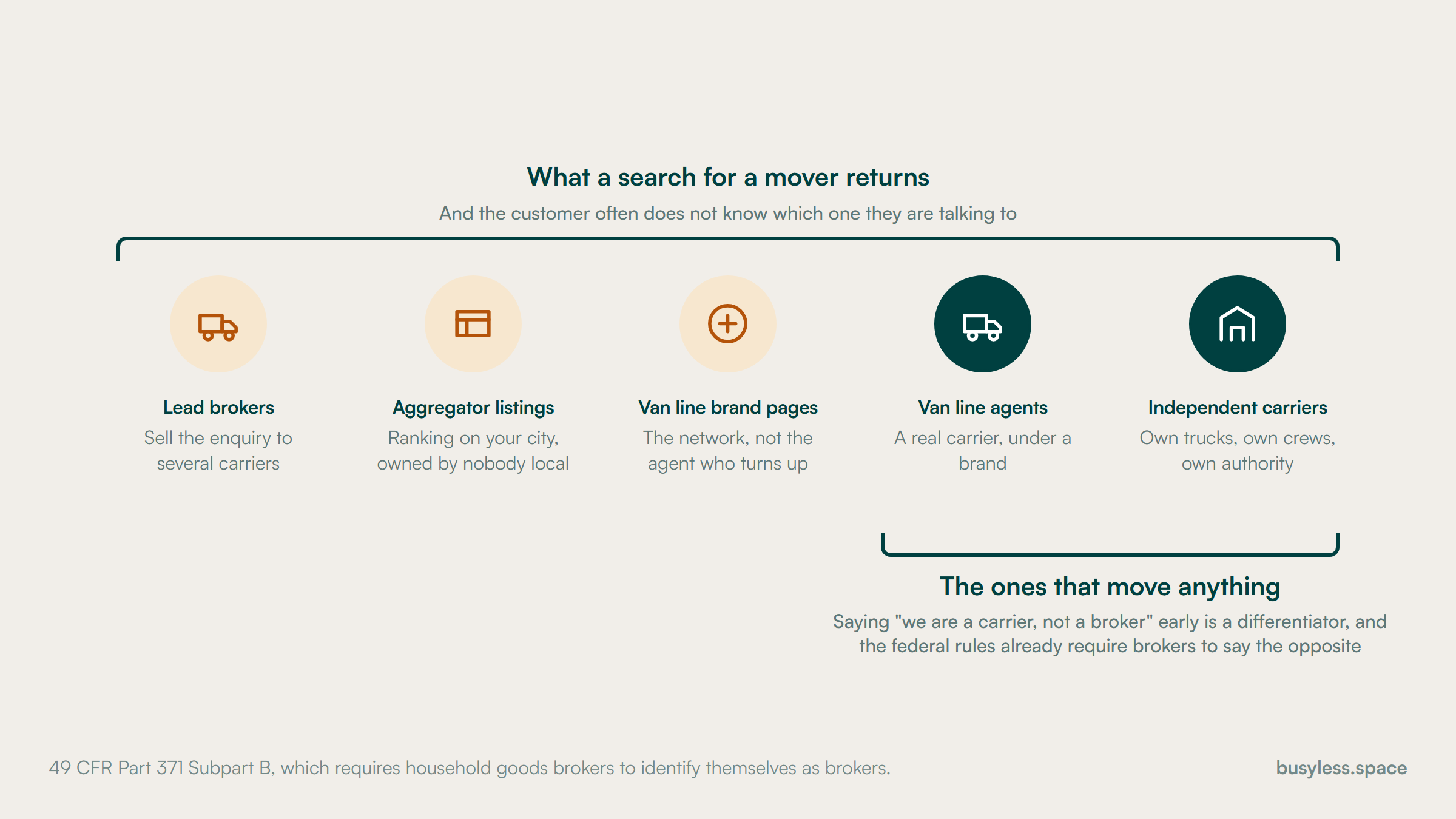
  4. 4Most of the results page is lead brokers, not movers. They sell the same enquiry to several companies, and the customer often does not know they are not talking to a mover at all.
  5. 5City-pair lane pages are the biggest opportunity here and the biggest doorway-page risk. The difference is whether you actually run the lane and can say something true about it.

SEO for moving companies begins somewhere no other industry in this directory does. The Federal Motor Carrier Safety Administration runs a public campaign warning consumers about movers, and a meaningful share of your prospects have read it.

Which means the visitor arrives already suspicious. They have been told to check a federal database, to be wary of low estimates, to expect a demand for more money on delivery day, and to look out for companies that are not really movers at all.

That inverts the usual priorities. A moving company SEO strategy is a proof problem before it is a ranking problem, because a first-place result that cannot be verified loses to a third-place result that can.

Who you are competing with is the other thing to be clear about. A large share of the first page belongs to lead brokers, which are not moving companies and are frequently not identified as such to the consumer. They sell one enquiry to several carriers.

The third is that the regulator has opinions about your website. Advertising rules for household goods carriers specify how your operating authority number must appear and require a mover's site to carry a particular consumer publication. Almost nobody complies, which means almost nobody is doing the easy part.

And underneath all of it is a demand pattern that is sharper than any trade: the industry moves most of its volume in a few summer months, with a spike at the end of every month as leases turn over. Content that arrives in June has missed the year.

Who already ranks in moving companies

Count how much of the first page for a mover query is actually a moving company. The uncomfortable finding in most moving company SEO audits is how little of it is: lead brokers, aggregators and review platforms selling the same enquiry onward, with actual carriers underneath them.

What is on the results page

  • Lead brokers and aggregators occupying much of the first screen on mover-plus-city queries
  • Local pack on almost everything carrying a place name
  • Review platforms ranking prominently, including the industry-specific ones
  • Government consumer protection pages ranking on scam and complaint queries
  • People Also Ask, dense on cost, timing and how-to-avoid-scams questions
  • AI Overviews on cost and process questions, drawn from whoever gave real numbers
  • Extreme seasonality in all of it, with volume concentrated in a few summer months
  • The federal carrier database

    safer.fmcsa.dot.gov

    Not claimable, not optional, and part of your search result whether you engage or not. Consumers are told directly to look up a mover's operating authority, insurance and complaint history. Whatever the database says about you is what a careful customer will find, so the practical job is making sure your own website says the same thing and that the record itself is current.

  • Moving lead brokers and aggregators

    moving.comClaim it

    The dominant force on the results page and frequently not a mover at all. They collect an enquiry and sell it to several carriers, so you are buying a shared lead and competing on response speed. Price it as lead buying with your win rate in the arithmetic, and understand that the customer may not know they were not talking to a mover.

  • Van line agent networks

    unitedvanlines.comClaim it

    For interstate work the major van lines operate agent networks with locators that rank for brand and long-distance queries. Agency status is a real credential with real obligations, the locator listing is usually incomplete, and being an agent is one of the clearest trust signals available in this industry.

  • Trade association certification programmes

    moving.orgClaim it

    The industry's certified mover programme exists precisely because of the fraud problem, which makes it unusually useful here compared with association membership in other trades. The directory ranks, the badge is checkable, and the certification carries requirements you can describe on your own site.

  • Better Business Bureau

    bbb.orgClaim it

    More important in this industry than in almost any other, because consumer guidance specifically directs people to check complaint records before hiring a mover. The profile frequently ranks for your company name. Claim it, respond to complaints properly, and treat the record as public-facing content.

  • Review platforms, general and industry-specific

    yelp.comClaim it

    Reviews carry more weight here than in most local industries because the purchase is high-anxiety and effectively one-shot. The industry also has a well-documented fake review problem, which means a suspiciously clean profile reads as evidence rather than reassurance. Volume and honest responses beat a perfect average.

  • Real estate and relocation referral networks

    nar.realtor

    Not a search channel and the strongest offline source in this industry. Agents, property managers and corporate relocation coordinators refer constantly, and they check your credentials before they do. The website's job for this audience is to survive that check in under a minute.

Five kinds of result from a search for a mover, under one bracket: lead brokers, aggregator listings, van line brand pages, van line agents and independent carriers. A narrower bracket covers only the last two, labelled the ones that move anything.
Most of the page is not a mover. Saying that you are a carrier rather than a broker is a differentiator the federal rules already set up for you.

What people actually search

Moving search separates by distance, by anxiety and by speciality, and the anxiety cluster is the one that does not exist anywhere else in this directory. People search whether a company is a scam before they search whether it is good.

Local move

Local commercial

movers in [city]

The page that wins it: A local page with credentials, pricing approach and real proof

The contested head term, occupied by brokers. Winnable in the pack, and the page has to do the trust work because the searcher has already been warned about you.

Lane and long distance

Commercial investigation

moving from [city] to [city]

The page that wins it: A page per lane you genuinely run, with real detail about that route

The biggest opportunity in this industry and the biggest doorway risk. The test is whether you actually run the lane and can say something true about it.

Trust and verification

Informational, defensive

how to avoid moving scams

The page that wins it: A genuinely useful guide that tells people how to check you as well

The cluster no other industry has. Answering it honestly, including how to verify your own credentials, is the single most differentiating thing you can publish.

Cost

Commercial investigation

how much does it cost to move a 3 bedroom house

The page that wins it: A cost page explaining how estimates actually work, with real ranges

Read the estimate rules before writing it. The honest version explains binding, non-binding and what can lawfully change, which is exactly what a nervous buyer wants.

Speciality items

Local commercial

piano movers [city]

The page that wins it: A page per speciality you genuinely handle, with the equipment and method

Low volume, high margin, low competition, and usually buried under general moving copy. Pianos, safes, art, laboratory and medical equipment all behave this way.

Timing and planning

Informational

how far in advance should you book movers

The page that wins it: A planning guide that is honest about peak season

Reaches people weeks before they book, in an industry where the summer and end-of-month peaks genuinely constrain availability. Saying so is useful and it sets expectations.

Storage and combined services

Local commercial

moving and storage [city]

The page that wins it: A page explaining how storage in transit actually works

Common in real moves, poorly explained everywhere, and it changes the liability and pricing picture in ways customers do not expect.

Commercial and office

Commercial investigation

office relocation company [city]

The page that wins it: A separate section for facilities and operations buyers

Different buyer, different cycle, insurance and after-hours requirements, and counter-seasonal in a useful way because offices move outside the residential peak.

What the rules change

This is the only industry in this directory where a federal regulation specifies what has to be on your website. Interstate household goods carriers are regulated by the FMCSA, intrastate moves are regulated by the state, and the two are separate. Check your own authority and your own state; none of this is legal advice.

1

Your operating authority number must appear in every advertisement, in a specific form

Federal Motor Carrier Safety Administration household goods consumer protection regulations, 49 CFR Part 375, including the advertising requirements at 375.207

What it means

The regulation requires a household goods carrier's assigned USDOT number to be displayed in advertisements in a prescribed form, and advertising is read broadly enough to include your website. It also requires that a mover with a website display prominently either a link to the FMCSA publication "Ready to Move? Tips for a Successful Interstate Move" or a true and accurate copy of that document.

So do this

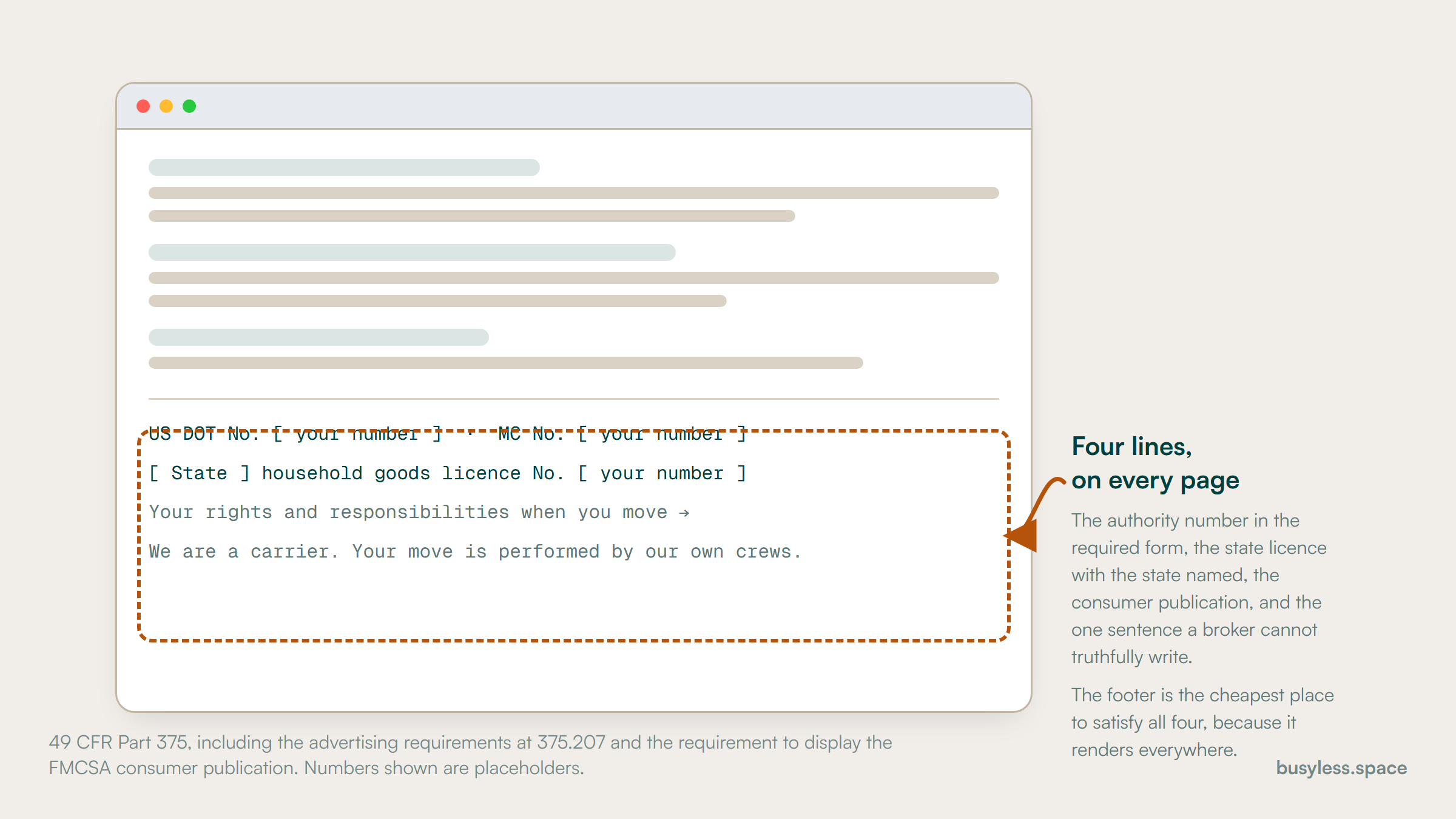
Put the number in the required form in the site footer so it appears on every page, and add the required link or copy of the publication somewhere prominent rather than buried. It takes an afternoon, almost nobody does it, and it is simultaneously a compliance fix and a trust signal in an industry where trust is the whole problem.

2

Brokers must say they are brokers

Federal regulations on household goods brokers, 49 CFR Part 371 Subpart B, which set out disclosure and website requirements for brokers

What it means

Household goods brokers arrange transportation rather than performing it, and they are subject to their own disclosure requirements including identifying themselves as brokers and publishing specified information. A great deal of consumer confusion and a large share of complaints originate in a customer believing they hired a mover when they hired a broker.

So do this

If you are a carrier, say so plainly and early: "We are a moving company, not a broker. Your move is performed by our own crews." It is a genuine differentiator on a results page full of brokers. If you operate as a broker, meet the disclosure requirements properly rather than blurring the line.

3

An estimate is not a price, and the difference is regulated

FMCSA household goods regulations on estimates, 49 CFR Part 375 Subpart D, including the distinction between binding and non-binding estimates and limits on what may be collected at delivery on a non-binding estimate

What it means

The rules distinguish binding from non-binding estimates and limit what a carrier may require the customer to pay at delivery against a non-binding estimate. Advertising a guaranteed price while issuing non-binding estimates, or publishing a headline figure that the process cannot honour, creates exposure and is also the exact practice consumers have been warned about.

So do this

Explain on the pricing page which kind of estimate you issue, what can change and what cannot, and what happens at delivery. That explanation is more persuasive than a number, and it directly answers the fear the customer arrived with. Do not mark up a price as a firm offer in structured data when you issue non-binding estimates.

4

Interstate and intrastate authority are different things

Federal operating authority for interstate household goods transportation, and separate state regulators such as public utilities commissions or transport departments for intrastate moves

What it means

Federal authority covers interstate moves. Moves entirely within a state are regulated by that state, which usually requires its own licence, and requirements differ substantially. A website advertising both without holding both, or a lane page implying interstate service you are not authorised for, is a licensing problem rather than a marketing one.

So do this

List exactly what you hold: federal authority number, state licence numbers with the state named, and which services each covers. Then check your lane and service-area pages against that list, because those pages are where an unlicensed claim usually hides.

A mock website footer annotated with four required lines: the USDOT and MC numbers in the required form, the state household goods licence with the state named, a link to the consumer publication, and a sentence stating the company is a carrier rather than a broker.
Four lines, and the footer is the cheapest place to satisfy all of them because it renders on every page.

Proving expertise

This is the industry where credentials do the most work, because the customer arrived expecting to be deceived. Every signal below is checkable by the reader in under a minute, and being checkable is the entire point.

  • Federal operating authority number displayed in the required form on every page
  • State licence numbers with the state named, for every state you operate intrastate in
  • A link to the federal carrier lookup so a customer can verify you themselves
  • Insurance and valuation coverage explained, including the difference between released value and full value protection
  • Whether you are a carrier or a broker, stated in the first screen
  • Van line agency or certification programme membership, named with the programme
  • Years trading, crew size and fleet size, which a customer can sanity-check against the public record
  • Complaint handling described, including who to contact and what happens
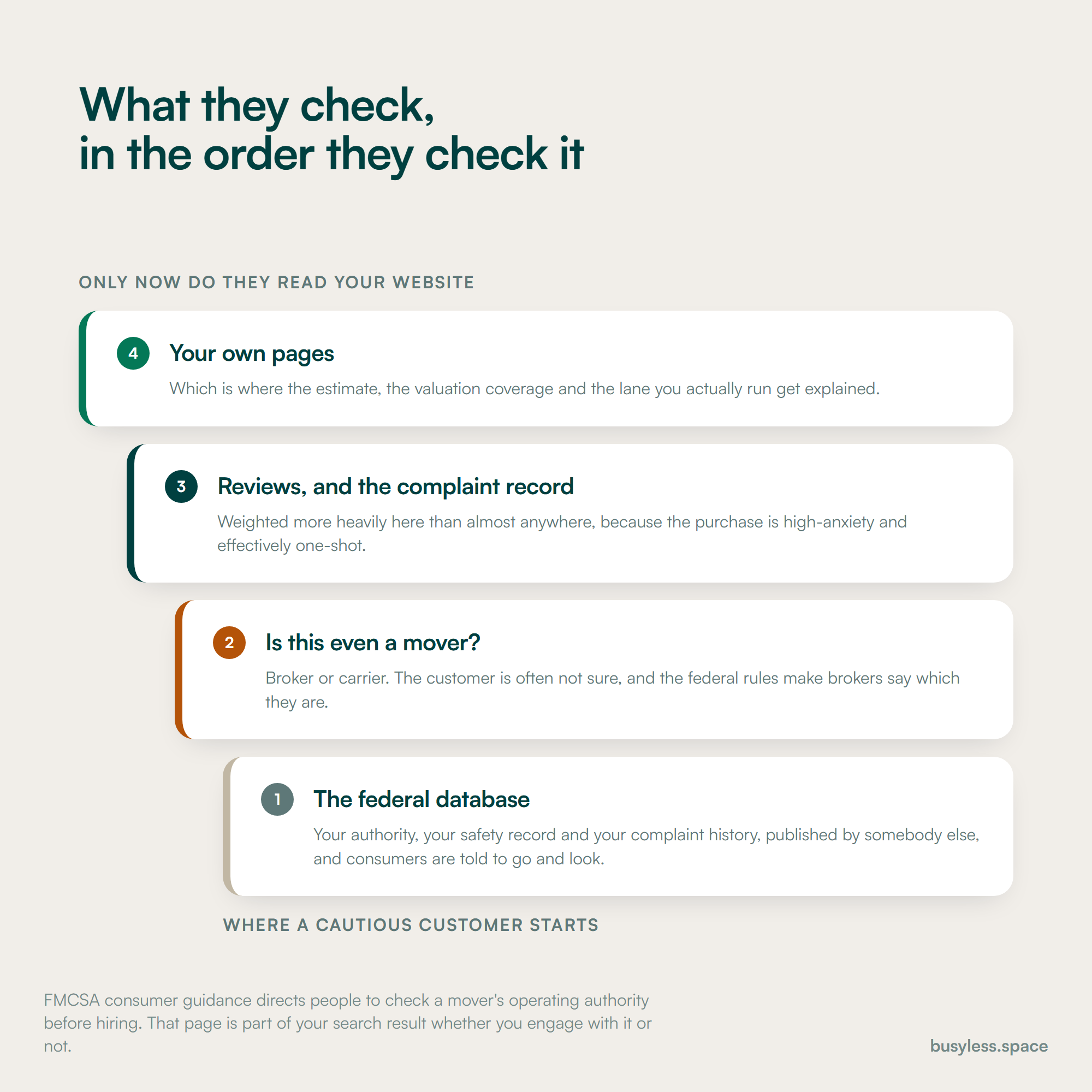
A four-rung ladder read from the bottom. First the federal database with the authority, safety record and complaint history. Then whether the company is even a mover. Then reviews and the complaint record. Only at the top, the company's own pages.
Your website is the last thing they read, not the first. That is the whole reason proof beats persuasion here.

How to build a moving company SEO strategy

A realistic first six months, sequenced against a season that is sharper than any other in this directory. A moving company SEO strategy has to be finished before May, because the industry moves most of its volume in a few summer months and content published into the peak has already missed it.

  1. 1

    Weeks 1 to 3

    Meet the rules and make yourself verifiable

    • Put the operating authority number in the required form in the site footer
    • Add the required consumer publication link or copy, prominently
    • List every state licence you hold, with the state named
    • Say plainly whether you are a carrier or a broker, in the first screen
    • Check your own record in the federal database and fix anything out of date
    • Complete the Google Business Profile and claim the review platforms

    You end up with
    A site that meets the advertising rules and survives a suspicious customer's check

  2. 2

    Weeks 3 to 8

    Answer the fear and the cost question

    • Write the how-to-choose-a-mover guide, including how to verify you
    • Write the pricing page explaining how estimates actually work
    • Explain valuation coverage properly, which almost nobody does
    • Audit the existing city pages and delete the ones you cannot justify
    • Add MovingCompany structured data with the regulatory identifiers
    • Publish the complaint and claims process

    You end up with
    The two questions a nervous customer has, answered better than by anyone else on the page

  3. 3

    Weeks 6 to 16

    Build the lanes and the specialities

    • Write a page per lane you genuinely run, with real detail about that route
    • Write a page per speciality item you genuinely handle
    • Build the commercial and office relocation section
    • Explain storage in transit and how it changes liability and price
    • Write the planning guide, honest about peak season constraints
    • Get on the van line or certification directories you qualify for

    You end up with
    Coverage of the high-margin and long-distance work, without a doorway page in sight

  4. 4

    Weeks 12 to 26

    Measure booked moves, not enquiries

    • Track booked moves by source, separating local, long distance and commercial
    • Compare broker lead cost per booked move against everything else, honestly
    • Report revenue per move and crew utilisation alongside enquiry volume
    • Track the seasonal curve and report against the same period last year
    • Review the regulatory items on the site whenever authority or licences change
    • Report complaint volume and resolution, since it is public anyway

    You end up with
    A view of which channels produce booked moves at what cost, across a seasonal year

Technical fixes with the best payoff

Two of the fixes below are regulatory requirements that take an afternoon, and one of them is the largest structural risk in the industry. Moving companies generate more near-duplicate location pages than any other vertical here, for an obvious reason: every pair of cities looks like a page.

  • The operating authority number is missing or in the wrong format

    An afternoon

    The advertising rules specify how it must appear, and a website is advertising. It is also the first thing a cautious customer looks for, and its absence reads exactly the way the federal consumer guidance says it should.

    Put it in the footer in the required form so it appears site-wide, add state licence numbers with the state named, and link to the federal lookup so a customer can verify it in one click.

  • The required consumer publication is not on the site

    An hour

    A mover with a website is required to display prominently either a link to the FMCSA's "Ready to Move?" publication or a true and accurate copy of it. Almost no mover does, which means almost nobody is doing the easy part of being trustworthy.

    Add it, prominently rather than in a legal page nobody visits. Then go further and write your own honest guide beside it, because the company that hands you the government's warning document is not the company the warning is about.

  • There is a page for every city pair

    A sprint, mostly deletion

    Long-distance lanes are city pairs, and it is trivially easy to generate thousands of pages that differ by two place names. This industry does it more than any other in this directory, and it is close to Google's own definition of a doorway page.

    One page per lane you genuinely run, with real content: how often you run it, transit time, what the route involves, seasonal considerations, what you have learned moving people between those two places. If you cannot write that, delete the page.

  • There is no pricing content at all

    A day

    Cost is the most searched question in the industry and the one the fraud warnings are mostly about. Silence does not read as discretion here; it reads as the thing the consumer was told to expect.

    Explain how estimates work, what kind you issue, what can lawfully change, what happens at delivery, and what a move of a given size typically costs in your market. The explanation is worth more than the number.

  • Valuation coverage is not explained

    An afternoon

    Customers believe their belongings are insured and they usually are not, in the way they imagine. It is the single largest gap between expectation and reality in the industry, and it produces most of the anger after a bad move.

    Explain released value protection and full value protection plainly, with what each actually pays, and what your default is. Being the company that explained it before the move is worth more than any testimonial.

  • The website contradicts the public record

    An afternoon

    Fleet size, years trading, authority status and DBA names are all publicly checkable, and a customer who has been told to check will. A mismatch, even an innocent one from an old page, reads as exactly the deception they were warned about.

    Pull your own record from the federal database and reconcile it line by line with the website. Fix whichever is wrong. Then put a reminder on it, because records go stale on both sides.

  • Speciality work is buried

    Two hours per speciality

    Pianos, safes, art and equipment moves are low volume, high margin and low competition, and they are usually one line on a services page. The searcher for these is highly qualified and easy to win.

    A page per speciality you genuinely handle, with the equipment, the method, the crew training and what it costs. Do not create pages for things you would subcontract without saying so.

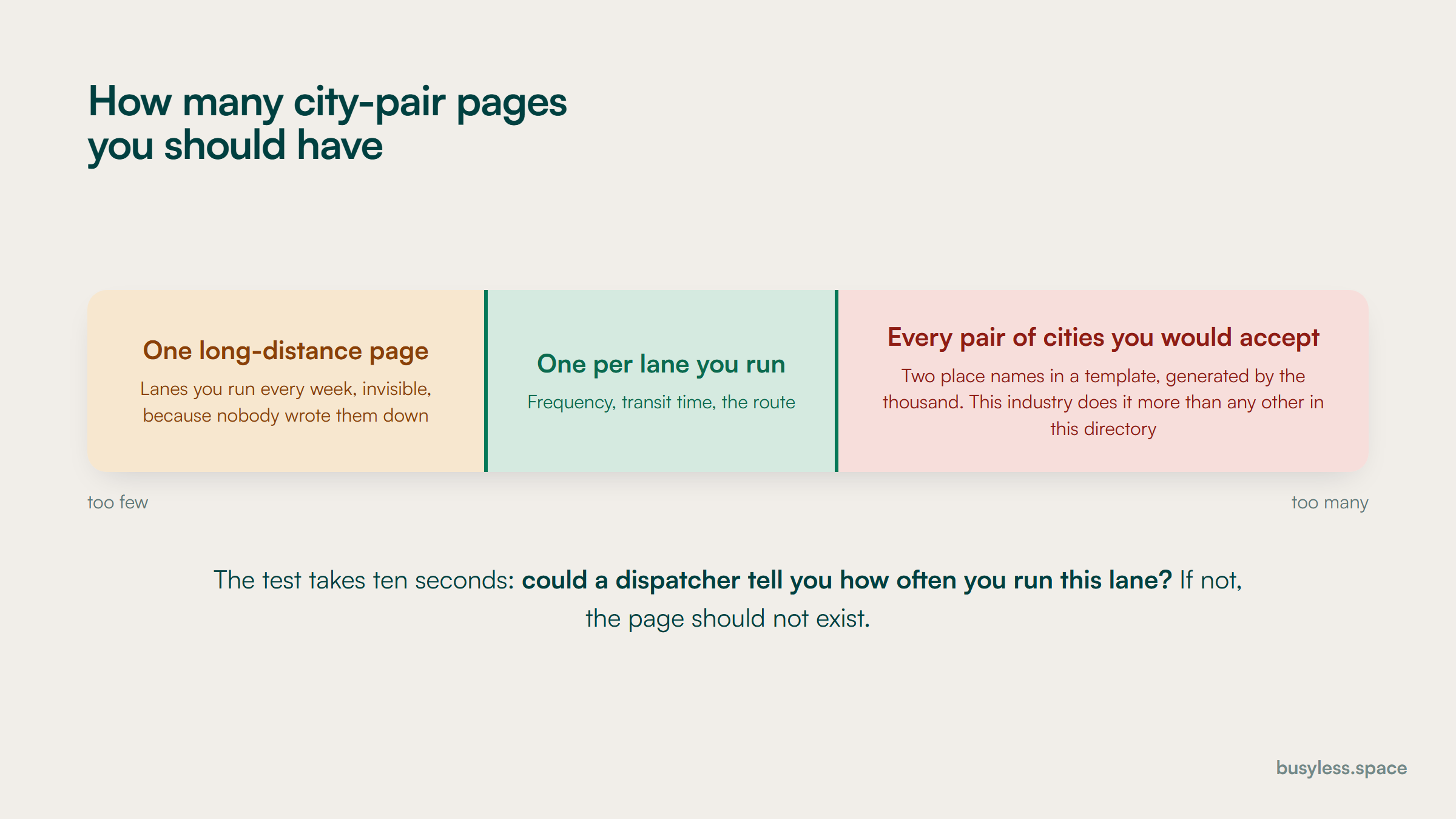
A band with a different failure at each end. One long-distance page leaves lanes you run weekly invisible. A page for every pair of cities you would accept is a template generated by the thousand. The narrow safe band is one page per lane you genuinely run.
The test takes ten seconds: could a dispatcher tell you how often you run this lane? If not, the page should not exist.

Structured data that applies here

The types below fit this industry specifically. Most of them earn no rich result on their own, which is worth knowing before anyone sells the work on that basis. What they do is describe the entity precisely, which matters for how search engines and answer engines resolve who you are.

  • MovingCompany

    Home page and any location pages

    MovingCompany is a type in its own right, so use it rather than a generic node, and carry the regulatory identifiers on it, because in this industry those are the most valuable structured facts you have.

    MovingCompany.jsonld
    {
      "@context": "https://schema.org",
      "@type": "MovingCompany",
      "@id": "https://[YOUR-DOMAIN]/#business",
      "name": "[BUSINESS NAME]",
      "url": "https://[YOUR-DOMAIN]",
      "telephone": "[+1-555-000-0000]",
      "image": "https://[YOUR-DOMAIN]/fleet.jpg",
      "priceRange": "[$$]",
      "foundingDate": "[YYYY]",
      "address": {
        "@type": "PostalAddress",
        "streetAddress": "[123 Example St]",
        "addressLocality": "[CITY]",
        "addressRegion": "[ST]",
        "postalCode": "[00000]",
        "addressCountry": "US"
      },
      "areaServed": [
        { "@type": "City", "name": "[CITY]" },
        { "@type": "State", "name": "[STATE]" }
      ],
      "identifier": [
        { "@type": "PropertyValue", "name": "USDOT", "value": "[NUMBER]" },
        { "@type": "PropertyValue", "name": "MC", "value": "[NUMBER]" }
      ]
    }
  • Organization with regulatory identifiers

    The credentials page

    The node that carries what a suspicious customer is checking. Publish the federal authority and every state licence separately, because they cover different services and a customer who understands the difference is the one most likely to book.

    Organization with regulatory identifiers.jsonld
    {
      "@context": "https://schema.org",
      "@type": "Organization",
      "@id": "https://[YOUR-DOMAIN]/#business",
      "name": "[BUSINESS NAME]",
      "legalName": "[REGISTERED ENTITY NAME]",
      "foundingDate": "[YYYY]",
      "numberOfEmployees": { "@type": "QuantitativeValue", "value": "[00]" },
      "identifier": [
        { "@type": "PropertyValue", "name": "USDOT", "value": "[NUMBER]" },
        { "@type": "PropertyValue", "name": "MC", "value": "[NUMBER]" },
        { "@type": "PropertyValue", "name": "[STATE] intrastate licence", "value": "[NUMBER]" }
      ],
      "hasCredential": [{
        "@type": "EducationalOccupationalCredential",
        "credentialCategory": "[CERTIFICATION PROGRAMME]",
        "recognizedBy": { "@type": "Organization", "name": "[AWARDING BODY]" }
      }],
      "memberOf": [
        { "@type": "Organization", "name": "[VAN LINE OR ASSOCIATION]" }
      ]
    }
  • Service for a lane or a speciality

    Lane and speciality pages

    Use this only where the service is real. A lane node for a route you do not run is the structured-data equivalent of a doorway page, and it is exactly as easy to spot.

    Service for a lane or a speciality.jsonld
    {
      "@context": "https://schema.org",
      "@type": "Service",
      "name": "[Moving from [CITY A] to [CITY B]]",
      "serviceType": "[Long distance household goods moving]",
      "provider": { "@id": "https://[YOUR-DOMAIN]/#business" },
      "areaServed": [
        { "@type": "City", "name": "[CITY A]" },
        { "@type": "City", "name": "[CITY B]" }
      ],
      "description": "[How often you run this lane, typical transit time, what the route involves, and what is specific to moving between these two places.]",
      "additionalProperty": [
        { "@type": "PropertyValue", "name": "Typical transit time", "value": "[__ to __ days]" },
        { "@type": "PropertyValue", "name": "Frequency", "value": "[__ per month]" }
      ]
    }
  • An estimate, marked up honestly

    The pricing page

    The unusual recommendation on this page, and it is deliberate. Because estimates are regulated and a non-binding estimate is not a price, the honest markup describes the estimate process rather than asserting a figure you may not be able to hold. Do not publish a firm Offer price if you issue non-binding estimates.

    An estimate, marked up honestly.jsonld
    {
      "@context": "https://schema.org",
      "@type": "Service",
      "name": "[Local moving]",
      "provider": { "@id": "https://[YOUR-DOMAIN]/#business" },
      "areaServed": { "@type": "City", "name": "[CITY]" },
      "offers": {
        "@type": "Offer",
        "availability": "https://schema.org/InStock",
        "description": "[We issue [binding / non-binding] estimates following a [virtual / in-home] survey. What can change, what cannot, and what is due at delivery.]",
        "eligibleCustomerType": "https://schema.org/Consumer"
      },
      "description": "[Typical cost range for a move of this size in this market, described in the page copy with the estimate type stated.]"
    }
  • FAQPage

    Pricing, valuation and how-to-choose pages

    Valuation and estimates are what a nervous customer searches, and what almost nobody answers, so start there. Match the visible text exactly.

    FAQPage.jsonld
    {
      "@context": "https://schema.org",
      "@type": "FAQPage",
      "mainEntity": [
        {
          "@type": "Question",
          "name": "[Question exactly as it appears on the page]",
          "acceptedAnswer": {
            "@type": "Answer",
            "text": "[Answer exactly as it appears. Be specific about estimates, valuation and what happens at delivery.]"
          }
        }
      ]
    }
  • BreadcrumbList

    Lane, speciality and service pages

    Worth it once lanes and specialities form a real hierarchy. It doubles as a quick way to find the generated city-pair pages, since they fit nowhere sensible.

    BreadcrumbList.jsonld
    {
      "@context": "https://schema.org",
      "@type": "BreadcrumbList",
      "itemListElement": [
        { "@type": "ListItem", "position": 1, "name": "Home",
          "item": "https://[YOUR-DOMAIN]/" },
        { "@type": "ListItem", "position": 2, "name": "[Long distance moving]",
          "item": "https://[YOUR-DOMAIN]/long-distance" },
        { "@type": "ListItem", "position": 3, "name": "[CITY A] to [CITY B]",
          "item": "https://[YOUR-DOMAIN]/long-distance/[SLUG]" }
      ]
    }

What it costs

Editorial estimates rather than quotes. The variable is not company size but how much long-distance and commercial work you want, since local moving is largely a pack and reviews game while lanes and specialities need real content behind them.

Lean

$1,500 to $3,000
  • Regulatory items fixed and credentials published properly
  • The how-to-choose, pricing and valuation pages written
  • Existing city pages audited and the indefensible ones removed
  • Business profile and review platforms maintained
  • Reporting on booked moves rather than enquiries

Who it suits

A local mover with a few trucks who wants to stop depending on brokered leads

Where it stops

It will not build a lane programme and it does nothing about crew capacity in July, which is when the demand actually is.

Funded

$3,500 to $7,000
  • A lane page programme covering the routes you genuinely run
  • Speciality item pages for the high-margin work
  • A commercial and office relocation section, which is counter-seasonal
  • Storage in transit explained properly
  • Attribution reconciled against booked moves, by service type

Who it suits

Movers with real interstate volume or a commercial division to grow

Where it stops

Lead brokers still own a large share of the results page and always will. This tier reduces dependence on them rather than removing it.

Multi-branch

$7,000 and up
  • Branch pages and profiles managed as a system with per-branch reporting
  • A lane network modelled as data so a real route publishes once
  • Recruitment content, which in this industry is frequently the binding constraint
  • Corporate relocation content aimed at HR and mobility buyers
  • Complaint and quality reporting handled as public-facing content

Who it suits

Multi-branch movers and van line agents with several markets

Where it stops

At this scale the risk is the lane network drifting back toward generated pages. It is a content modelling discipline rather than a budget question.

How to do it with no budget

The first two items here are regulatory requirements that take an afternoon and simultaneously do more for trust than anything you could buy. Start with those two.

  1. 1

    Put the authority number on the site in the required form

    1 hour

    Your website editor

    Footer, so it appears site-wide, plus state licence numbers with the state named. It is required, it is checked, and its absence reads exactly the way the consumer warnings say it should.

  2. 2

    Add the required consumer publication

    30 minutes

    Your website editor

    A prominent link to the FMCSA's "Ready to Move?" or a true copy of it. Required for movers with a website, almost never done, and handing the customer the government's own guidance is a strong signal in an industry defined by suspicion.

  3. 3

    Check your own federal record

    1 hour

    The public carrier lookup

    Read what a customer will read. Authority status, insurance on file, complaint history, fleet size. Reconcile it against the website and fix whichever is wrong.

  4. 4

    Say whether you are a carrier or a broker

    20 minutes

    Your website editor

    One sentence in the first screen. On a results page dominated by brokers, being clearly a carrier with your own crews is a real differentiator and it costs nothing.

  5. 5

    Write the how-to-choose guide

    3 hours

    Your website editor

    Including how to verify you specifically, with the lookup link. The company that tells you how to check them is not the company you were warned about, and readers understand that immediately.

  6. 6

    Explain valuation coverage

    2 hours

    Your website editor

    Released value against full value protection, what each actually pays and what your default is. It is the largest gap between expectation and reality in the industry and nobody explains it before the move.

  7. 7

    Audit and delete the city-pair pages

    3 hours

    Your website and a spreadsheet

    Keep the lanes you genuinely run and can write about. Delete the rest. This is one of the few situations where removing hundreds of pages improves the site immediately.

The tool stack

Jobs first, tools second. The most important input here is not a tool but a decision: which lanes you actually run. Everything else follows from that list.

  • Track local pack position across your service area

    DataForSEOSEO APIRead the review

    Local moving is largely a pack game, so geo-specific tracking matters more than national position. Track lanes separately, since those behave like national queries rather than local ones.

    Free routeManual checks from a few postcodes

  • Decide which lanes deserve a page

    Your own dispatch history

    Pull twelve months of long-distance jobs and count the city pairs. The lanes you actually run are the pages you can defend, and everything outside that list is a doorway page waiting to be built.

    Free routeFree, and the only correct source

  • Model what a booked move from search is worth

    SEO Revenue Growth CalculatorFree toolOpen the tool

    Run local, long distance and commercial separately. They differ by an order of magnitude in value and by a lot in close rate, and a blended figure describes none of them.

    Free routeFree

  • Compare broker lead spend against organic

    SEO Budget CalculatorFree toolOpen the tool

    Set it against what you currently pay for brokered leads, including the ones you lose because four other companies got the same enquiry. That is usually the comparison that decides the budget.

    Free routeFree

  • Generate the MovingCompany and identifier markup

    Schema Markup GeneratorFree toolOpen the tool

    The identifier fields carrying your authority numbers are the part worth getting right, because in this industry those are the most valuable structured facts on the site.

    Free routeFree

  • Publish lanes and specialities as related entities

    PayloadHeadless CMSRead the review

    Lanes, branches, specialities and services intersect. Modelling them properly is also the discipline that stops the lane network drifting back into generated city pairs, which is the failure mode here.

    Free routeFree and self-hosted

  • Monitor what the public record says about you

    The federal carrier lookup and the complaint databases

    Not a marketing tool and it belongs on this list, because it is part of your search result. Check it quarterly and reconcile it with the website, in both directions.

    Free routeFree

  • See what assistants say when somebody asks if you are legitimate

    LLM visibility trackerOur toolSee the tool

    The verification question is increasingly asked of an assistant rather than a search box. The answer is assembled from your credentials page, the public record and your review profile, which is an argument for all three being consistent.

Take it from here

Everything below is yours to take. Fill the [BRACKETS] and it is ready to use. Start with the compliance and trust audit: two of its items are federal requirements, both take an afternoon, and both do more for conversion than anything else on this page.

Checklist

Two federal requirements reach your website directly, and almost no mover meets them. Fixing them is a compliance job and the strongest available trust signal in the same afternoon.

ADVERTISING COMPLIANCE AND TRUST AUDIT - [COMPANY]
Date: [____]     Owner: [NAME]

WHY THIS IS FIRST
Household goods carrier advertising rules reach your website, and
your customer has probably read a federal warning about this
industry before they read your home page. These items are
requirements AND they are the most persuasive content you have.

1. OPERATING AUTHORITY, DISPLAYED PROPERLY
   [ ] USDOT number shown in the required form
       Displayed as: [_______________________]
   [ ] Appears site-wide (footer), not on one page
   [ ] MC number shown where applicable: [__________]
   [ ] Shown in every other advertisement too:
       [ ] Vehicles      [ ] Print      [ ] Paid search
       [ ] Social profiles              [ ] Directory listings

2. THE REQUIRED CONSUMER PUBLICATION
   Movers with a website must display prominently either a link
   to the FMCSA's "Ready to Move? Tips for a Successful
   Interstate Move" or a true and accurate copy of it.
   [ ] Present on the site
   [ ] PROMINENT, not buried in a legal page
   [ ] Link tested and working
   [ ] Our own honest guide published beside it

3. CARRIER OR BROKER
   [ ] Stated plainly in the first screen of the home page
   Wording: "[We are a moving company, not a broker. Your move
   is performed by our own crews and our own trucks.]"
   [ ] If we broker any portion, that is disclosed properly

4. STATE AUTHORITY
   | State | Licence type | Number | Covers | Expires |
   |-------|--------------|--------|--------|---------|
   | [___] | [__________] | [____] | [____] | [_____] |
   | [___] | [__________] | [____] | [____] | [_____] |
   [ ] Every state we advertise intrastate service in is listed
   [ ] No page implies service we lack authority for

5. LET THEM CHECK
   [ ] Link to the federal carrier lookup, on the credentials page
   [ ] Sentence: "Look us up. Our USDOT number is [NUMBER]."
       This is the most persuasive line on the site and it costs
       nothing.

6. RECONCILE WITH THE PUBLIC RECORD
   Pull your own record and compare, line by line.
   | Field                  | Public record | Our website |
   |------------------------|---------------|-------------|
   | Legal name             | [___________] | [_________] |
   | DBA                    | [___________] | [_________] |
   | Authority status       | [___________] | [_________] |
   | Insurance on file      | [___________] | [_________] |
   | Fleet size             | [___________] | [_________] |
   | Years in operation     | [___________] | [_________] |
   Any mismatch: fix whichever is wrong, this week.
   REVIEW: quarterly, and on any authority change.

What to publish

Ordered by how directly it answers the suspicion the reader arrived with. In most industries content sells. Here it mostly reassures, and reassurance is what converts.

  • The credentials page

    Once, updated whenever anything on it changes

    Authority numbers, state licences, insurance, certifications and a link to verify all of it. It is the page a suspicious customer is actually looking for and most movers do not have one.

  • A how-to-choose-a-mover guide that includes checking you

    Once, reviewed yearly

    The cluster no other industry has. Telling somebody how to verify you is the strongest possible signal that you will survive the check.

  • The pricing and estimate explainer

    Once, reviewed before each season

    The most searched question and the one the fraud warnings are mostly about. Explaining how estimates work is more valuable than any number.

  • Valuation coverage explained

    Once, properly

    The largest gap between what customers expect and what they have, and the source of most anger after a bad move. Explaining it beforehand is a genuine differentiator.

  • Lane pages for routes you actually run

    One per real lane, from your dispatch history

    The biggest long-distance opportunity, and defensible only where you can say something true about the route.

  • Speciality item pages

    One per speciality you genuinely handle

    Low volume, high margin, low competition, and usually one line on a services page. The searcher is highly qualified.

And what not to

  • A page for every city pair, which is the clearest doorway pattern in this directory
  • Any advertisement, including the website, without the operating authority number in the required form
  • Guaranteed price language where you issue non-binding estimates
  • Lane or service pages implying authority you do not hold
  • Testimonials with no verifiable detail, in an industry with a documented fake review problem
  • "Fully insured" with no explanation of what valuation coverage actually pays
  • Content published into the summer peak, which has already missed the season it was written for

The expensive mistakes

Treating trust as a section rather than the strategy

Costs you A well-ranked page that loses to a lower-ranked competitor whose credentials the customer could actually verify

Lead with authority numbers, licences, carrier-or-broker status and a link to verify all of it

Generating city-pair pages

Costs you Thousands of near-identical pages matching Google's own doorway description, in the industry most prone to it

One page per lane you genuinely run, written from dispatch history, with real detail about the route

Ignoring the advertising rules

Costs you A regulatory exposure and a missed trust signal in the same omission, both fixable in an afternoon

Authority number in the required form site-wide, plus the required consumer publication, prominently

Saying nothing about price

Costs you Silence read as evasion, by a customer who was specifically warned about movers who avoid the question

Explain the estimate process, what can change and what happens at delivery, with real ranges

Letting the website contradict the public record

Costs you A mismatch found by a customer who was told to check, which reads as exactly the deception they feared

Reconcile the website against the federal record quarterly and fix whichever is wrong

Reporting enquiries to the owner

Costs you A number dominated by brokered and duplicate leads, in a business where four companies got the same one

Booked moves by service type and channel, with revenue per move and cost per booked move

What to measure

Two things make measurement here distinctive: the seasonal curve is sharper than anywhere else in this directory, and a large share of enquiries are shared leads that several competitors received at the same time. Both have to be visible in the report or the numbers mislead.

Leading indicators

Move first. They predict, they do not prove.

  • Local pack position across the service area

    Geo-specific rank tracking

    Local moving is largely decided in the pack. Track lanes separately, because long-distance queries behave nationally and respond to entirely different work.

  • Impressions on trust and cost clusters

    Search Console, filtered to how-to-choose, pricing and valuation queries

    The clusters this playbook is built on. They are also counter-seasonal in a useful way, since people research months before they book.

  • Credentials page engagement

    Analytics on that specific page

    An unusual metric and a meaningful one here. Somebody reading your licence numbers is doing the check, and reaching that page is a strong predictor of an enquiry.

  • Review volume and response rate

    The review platforms and the complaint databases

    Report volume and responses rather than average. In an industry with a documented fake review problem, a perfect average with few reviews is a weaker signal than an honest distribution.

Business indicators

The ones a manager acts on.

  • Booked moves by service type and channel

    Your dispatch or CRM system

    Local, long distance, speciality and commercial reported separately, because they differ enormously in value. Broker leads reported as their own channel with the shared-lead reality noted.

  • Revenue per booked move

    Invoicing

    Enquiry counts in this industry are dominated by shared brokered leads, so volume tells you very little. Revenue per move by channel tells you which enquiries were worth having.

  • Cost per booked move by channel

    Invoicing plus channel spend

    For brokered leads, divide by your actual win rate against the other companies who received the same enquiry. That arithmetic is usually the whole business case for doing this work.

  • Crew utilisation through the season

    Scheduling

    In peak weeks the constraint is crews and trucks. Leads you could not service are a capacity fact, and reporting them beside demand stops the two being confused in either direction.

The verdict

In moving, the first job is proving you are not a criminal. That sounds harsh and it is simply the market: a federal agency runs a consumer campaign about this sector, and your prospect has probably read it.

The useful consequence is that the highest-value work is also the cheapest. Authority numbers in the right format, the required consumer publication, state licences, a link to verify all of it, and an honest explanation of estimates and valuation. That is an afternoon and a couple of days of writing.

Before you sign for moving company SEO services, put these three to whoever is selling them. Do they know what the advertising rules require on your website? Will they delete your city-pair pages rather than generate more? Will they report booked moves rather than enquiries?

Generating lane pages is the easiest thing to sell in this industry and the hardest thing to defend, so the second is where SEO services for moving companies usually fail. I would ask how many pages they intend to delete before I asked how many they intend to write.

FAQ

Moving companies SEO questions

  • Does our website really have to carry a government publication?
    If you are a household goods carrier with a website, the federal consumer protection regulations require you to display prominently either a link to the FMCSA's "Ready to Move? Tips for a Successful Interstate Move" or a true and accurate copy of it. The same rules require your assigned USDOT number to appear in a specific form in your advertising, which includes your site. Almost no mover does either.
  • Should we build a page for every city we move to?
    No. City-pair pages are the single clearest doorway pattern in this directory, and this industry generates them more than any other. Pull twelve months of long-distance jobs, keep a page for each lane you genuinely run, and write real content about that route: frequency, transit time, access at both ends, seasonal considerations, what you have learned moving people between those two places. Delete the rest and redirect them to the long-distance hub.
  • How much should we say about price?
    More than you are currently saying. Your customer has been warned specifically about movers who avoid the question and then ask for more at delivery, so silence confirms the fear rather than protecting your margin. Explain what kind of estimate you issue, what a survey involves, what can lawfully change and what is due at delivery, then give typical ranges by home size with a date on them. The explanation matters more than the number.
  • What is the single most persuasive thing we can put on the site?
    Your USDOT number with a link to the federal lookup and the sentence "look us up". In an industry where the buyer arrives suspicious, inviting the check is the strongest possible signal that you will pass it. Add your state licences, whether you are a carrier or a broker, and a guide explaining how to verify any mover including you. The companies the warnings are about will never do this.
  • Are broker leads worth buying?
    Price them properly and then decide. A brokered enquiry typically goes to several carriers, so your real cost is the lead price divided by your win rate against the others, not the lead price. Include response speed in the calculation, because these are usually won by whoever calls first. Then compare that number against your cost per booked move from your own channels, honestly, including the internal time each takes.
  • When should we do this work?
    Between autumn and spring, and finish before May. This industry has the sharpest seasonal curve in the directory, with most volume in a few summer months and a spike at every month end as leases turn over. Content published in June has missed the season it was written for, and in peak weeks nobody has time to write anything anyway.
  • What does moving company SEO cost?
    The tiers above are editorial estimates rather than quotes. A mover running a real programme is realistically at $1,500 to $7,000 a month, driven by how much long-distance and commercial work you want rather than by company size. The highest-value items, the compliance fixes and the trust content, cost an afternoon and a few days of writing, and they are the ones most directly connected to conversion.
  • Can AI write our lane pages?
    This is the industry where I would be most careful about that, because AI-generated lane pages are exactly how you end up with two thousand near-identical city-pair pages. If a model can write the page without you, so can every competitor, and the result is a doorway pattern at scale. Use it to structure and edit, and insist that every lane page contains facts only somebody who runs that route could supply.

Run it yourself, or have someone own it

Everything above is written to be run without us, and the free path is genuinely most of the value for a single-location business. Where these plans stall is almost never the plan. It is that nobody owns it after the first month. That is the job we do, with search as one distribution layer inside a wider system rather than the whole engagement.