
Skip to content

Locksmith SEO strategy

Fake listings are the competition, so verification outranks optimisation

Written by Eugene SuslovLast reviewed 29 August 2026No affiliate links
Sector
Home and trades
Model
Local service
Competition
High
Time to results
3 to 6 months
Typical monthly
$700 to $3,500

Key takeaways

  1. 1Your competitor is often not a locksmith. Google removed over 13 million fake Business Profiles in 2025, and it named locksmiths as one of the verticals the fraud concentrates in. Plan against an impostor, not against the shop across town.
  2. 2Verification is a gate, not a tactic. Google restricts locksmith advertising and requires advanced verification, a background check on the owner, before you may run ads at all. It takes weeks. Start it on day one or your plan stalls in week three.
  3. 3Most states do not licence this trade. Roughly a dozen do, which means for most of the country the verified profile is the only credential a frightened customer can actually check. That is why proof beats persuasion here.
  4. 4Publish the callout fee. The scam's signature is a two-figure price that becomes a three-figure invoice on the doorstep, so a real price stated plainly is a conversion asset and a differentiator at the same time.
  5. 5Automotive is the underpriced half. Car key and fob replacement carries a higher ticket, a longer research window and far less impostor competition than house lockouts, and most locksmith sites give it one line.

SEO for locksmiths starts from a problem no other trade has in this form. When a customer searches at eleven at night, some of what they see is not a business at all. It is a listing created to sell the call.

Google has been explicit about where this concentrates. Announcing its March 2025 lawsuit over more than ten thousand fake listings, it described the fraud as clustering in what it calls duress verticals, the services people reach for when they are stressed and cannot wait. Locksmiths and towing were the examples it gave.

The mechanics matter because they change what you are optimising against. A fake profile does not need to outrank you on merit. It needs to sit near you in a map pack for long enough to take a call, and the operator behind it can create another one on Monday.

So a locksmith SEO strategy that opens with keywords and content is starting three steps in. The first job is establishing that you are a real business at a real address with a real person behind it, in the places a customer can verify that.

The fraud has also devalued the trade's own proof. Customers have been burned often enough that the usual reassurances stopped reassuring, and a five-star average means less here than in almost any other trade, because the impostors have five-star averages too.

What still works is specificity. A named person, a fixed callout fee, a photograph of a van with plates visible, a licence number where the state issues one, and an answer to the question the customer is actually asking, which is whether the price on the screen is the price at the door.

Who already ranks in locksmiths

Search your main emergency term with your town attached and look at what comes back before you look at where you sit in it. Almost every locksmith SEO audit finds the same three layers: a map pack containing at least one profile nobody can trace to premises, a band of lead marketplaces above every independent operator, and a thin organic layer where the genuinely local sites sit.

What is on the results page

  • Local pack on every emergency and near-me query, above everything else
  • Lead marketplaces ranking above independent operators on service terms
  • Impostor and hijacked profiles inside the map results themselves
  • People Also Ask, unusually dominated by price and scam-check questions
  • Automotive queries returning dealerships and parts sites, not locksmiths
  • Review aggregators with best-of pages per city
  • Local Services Ads occupying the top slot where advertisers are verified
  • Google Business Profile

    google.comClaim it

    Not a directory here so much as the battlefield. It is where the impostors live and where you displace them, and it is the only place a customer can see that a business has been verified rather than merely listed. Set it up as a service-area business, hide the address if you travel to customers, and keep the category exact.

  • Find A Locksmith

    findalocksmith.comClaim it

    Run by ALOA, the trade association founded in 1955, and the closest thing the industry has to a vetted register: applicants are cleared by existing members and held to a published code. It carries weight disproportionate to its traffic, because in the states with no licensing it is one of very few third-party credentials a customer can check.

  • Yelp

    yelp.comClaim it

    Ranks in most metros and feeds Apple Maps, so it matters more than its own traffic suggests. It has also been more aggressive than most platforms about impostor listings in this category. Claim it, keep the service list current, and answer price complaints in public with the actual pricing.

  • Angi

    angi.comClaim it

    A lead marketplace that outranks independents on service terms and will sell you the introduction back. Useful as a bridge while your own pages mature. Measure it on cost per won job rather than cost per lead, because the same lead is usually sold several times.

  • Thumbtack

    thumbtack.comClaim it

    Same shape and the same caution. Its advantage in this trade is that its profiles carry a background-check badge, which does part of the trust job for you. Its disadvantage is that it teaches the customer to shop the category rather than to remember you.

  • Better Business Bureau

    bbb.orgClaim it

    Worth more here than in most trades for one reason: it is where people go specifically to check whether a locksmith is a scam, so the page ranks on your brand plus words like reviews and complaints. An unclaimed profile with an unanswered complaint is doing real damage on a query with buying intent.

  • Nextdoor

    nextdoor.comClaim it

    Not search, and unusually valuable in a trade bought on trust after somebody has been let down. Recommendation threads convert reliably and occasionally rank. Being genuinely known in a few neighbourhoods beats a wider thin presence.

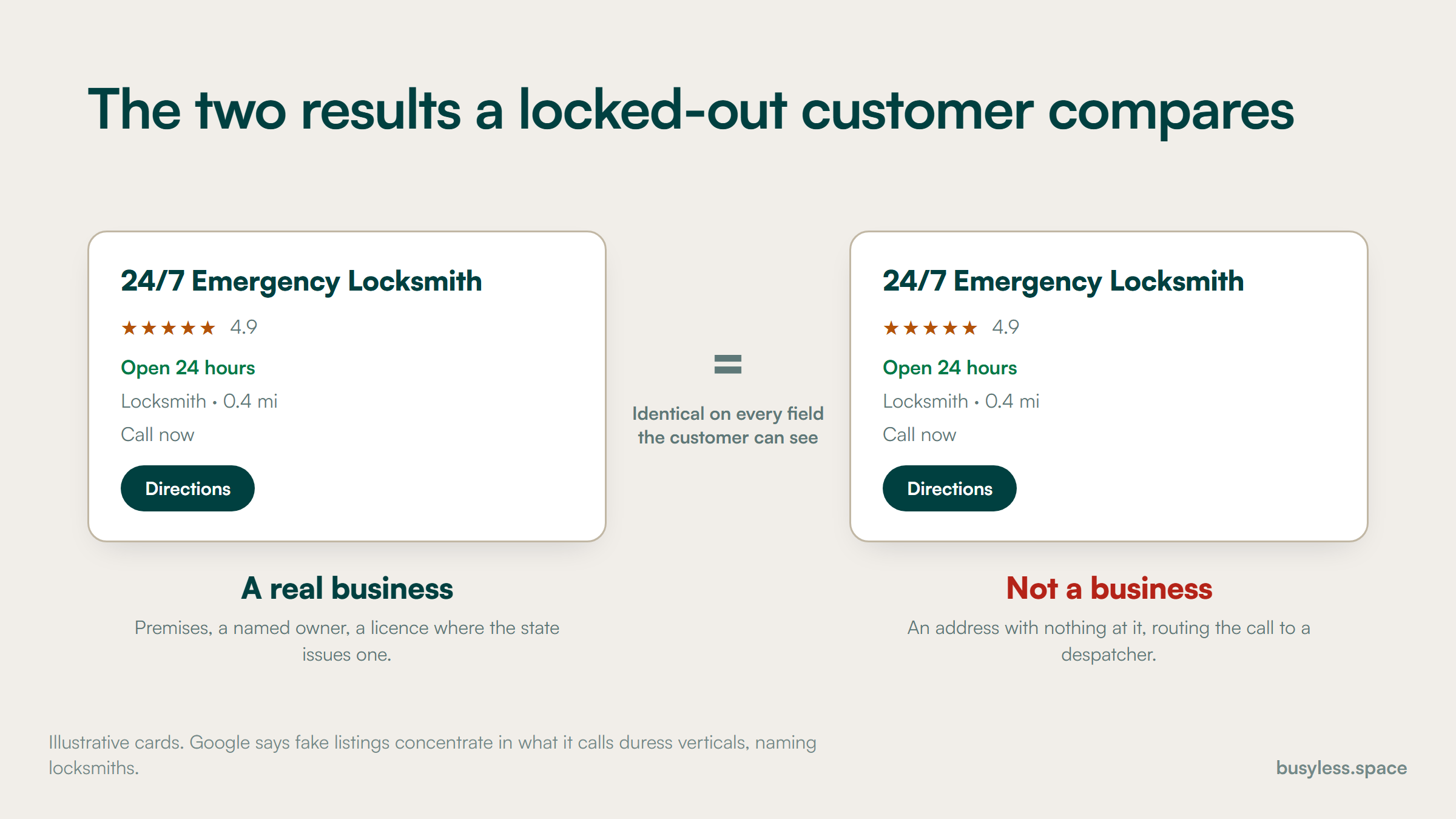
Two identical map results side by side joined by an equals sign, labelled a real business and not a business, with the same name, rating, hours and distance on each
The reason verification comes before optimisation: at the moment of choosing, the two are indistinguishable on everything the customer can actually see.

What people actually search

Two of the clusters below exist because of the fraud rather than because of the service, and they are the ones almost no locksmith site answers. People search to check a price before they call, and they search to check a credential before they open the door. Both are commercial queries wearing informational clothes.

Residential emergency

Local transactional, immediate

locked out of house

The page that wins it: Emergency lockout page with the callout fee and a phone number above the fold

The highest-volume cluster and the most contested, because it is the one the impostors are built for. Winning it on organic alone is slow. Winning it on a verified profile with a real address and a stated price is faster.

Automotive keys

Local commercial, urgent but researched

car key replacement near me

The page that wins it: Make and model key replacement pages with programming capability stated

The most underserved cluster in the trade. The ticket is higher, the customer usually has a day rather than an hour, and the query is often answered by dealerships quoting far more. Capability by make is the differentiator and almost nobody publishes it.

Rekey and moving in

Local transactional, planned

rekey locks after moving

The page that wins it: Rekey service page written for new owners and landlords

Planned work with no panic, which makes it the profitable half of residential. It also has a predictable trigger, so it pairs naturally with estate agents and property managers rather than with search alone.

Commercial and access control

Commercial investigation, multi-visit

master key system for office

The page that wins it: Access control and master keying page with a project enquiry form

A completely different buyer with a completely different clock. Facilities managers research, compare and specify, and they do not call the first result. This is the cluster where a genuinely good page can win without competing on the map.

Safes

Local transactional, specialist

safe opening service

The page that wins it: Safe opening and servicing page listing types and manufacturers handled

Low volume, high margin, and almost no impostor competition, because the fraud model needs a job an unskilled subcontractor can attempt. Listing the specific safe types you handle is what separates a real capability page from a keyword page.

Repair or replace

Informational, pre-commercial

lock keeps sticking

The page that wins it: Diagnostic article that ends in a repair booking

The only genuinely informational cluster with a short path to work. A page that honestly says a lock can be fixed rather than replaced converts unusually well, because it is the opposite of what the customer expects to be told.

Price check

Informational, with suspicion behind it

how much should a locksmith cost

The page that wins it: Pricing page with real figures, callout fee and what changes it

This cluster exists because of the scam, and it is the clearest example of an industry where publishing your prices is a competitive advantage rather than a concession. Everybody hiding the number makes the one who states it the trustworthy option.

Credential check

Local commercial, verification-led

licensed locksmith near me

The page that wins it: Credentials page naming the licence, the association and the insurer

The other cluster the fraud created. In the roughly dozen states that licence the trade, the licence number answers it. In the rest, the answer has to be assembled from association membership, verification badges and a traceable address.

What the rules change

Several playbooks here carry a platform rule: local-businesses has the profile naming guidelines, musicians-artists has Spotify's streaming policy. This one differs in kind. Those govern how you behave once you are in the market; this one decides whether you may advertise at all, on the strength of a background check on a person. What follows is my reading, not legal advice, and locksmith licensing is a state question that changes.

1

Locksmith ads are restricted and gated behind advanced verification

Google Ads restricted business policy, local services, read 29 August 2026

What it means

Ads for locksmith and garage door repair services are restricted in the United States, and locksmith services in Canada. To advertise at all you must apply for advanced verification, which checks the business and the owner rather than the payment method. Several European countries prohibit locksmith ads outright.

So do this

Start the application before you write a word of copy. It runs on the platform's clock, typically weeks, and every paid element of a plan is blocked behind it. Gather the entity documents, the owner identification and the premises evidence in one pack so a request for more does not restart the wait.

2

State licensing exists in roughly a dozen states, and not in the rest

State locksmith licensing statutes, varying, reviewed 29 August 2026

What it means

Around thirteen states licence locksmiths, typically with fingerprinting, a background check and proof of insurance. Most states do not licence the trade at all. Illinois has its programme scheduled to sunset in 2029.

So do this

Check your own state rather than trusting any list, including this one. Where a licence exists, put the number on the site and in the profile. Where none exists, say so plainly and substitute what can be checked, because an unexplained silence reads like an evasion.

3

An advertised price you do not honour is a deceptive practice

FTC Act section 5, and state consumer protection statutes

What it means

The signature of the locksmith scam is a low advertised callout that becomes a much larger invoice once the technician is at the door. Advertising a price you do not intend to charge is deceptive, and the enforcement risk sits with whoever published the number.

So do this

Publish a callout fee you will honour and state what changes it, in the same block, in the same size type. This is the rare compliance requirement that is also the highest-converting element on the page.

4

Buying reviews is now specifically unlawful, and so is reporting nothing

FTC rule on consumer reviews and testimonials, 16 CFR part 465, effective 21 October 2024

What it means

The rule bans buying, selling or writing fake consumer reviews, including reviews by people who never used the service. This page takes the half the trades pages do not: plumbing and roofing carry the review-gating provision, local-businesses carries the insider-review one.

So do this

Never buy reviews, obviously. Then use the rule the other way: a competitor's purchased reviews are now a named violation rather than an annoyance, so record them in the same log as the listings and say so when you report.

5

Lead routing can make somebody else's conduct your problem

Google Business Profile representation guidelines and FTC Act section 5

What it means

Buying calls from a network that generates them through listings you have never seen puts you at the end of a chain you cannot inspect. Google's March 2025 action named a locksmith business among the defendants, and the settlement in December 2025 barred the use of listings to generate leads for other businesses.

So do this

Know where every call you pay for came from. Ask any lead supplier which listing produced it and refuse the ones that cannot answer. Cheap calls sourced from an impostor profile are the most expensive marketing a locksmith can buy.

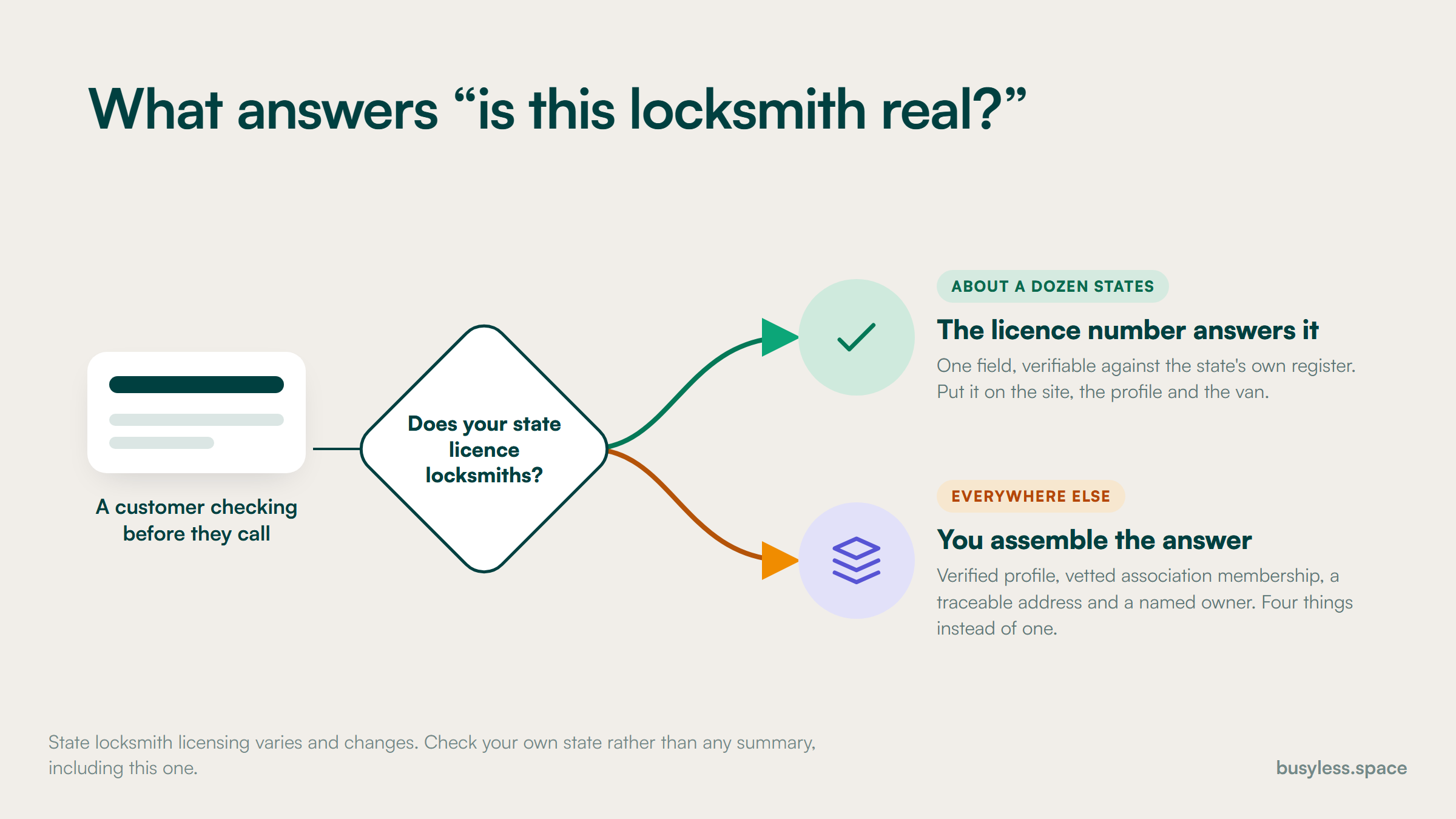
A decision fork showing what proves a locksmith is real in a state that licences the trade against a state that does not
In roughly a dozen states the licence number answers the credential question. In the rest it has to be assembled, which is why the verified profile carries so much weight.

Proving expertise

Experience and trust do almost all the work in this trade, and the usual proxies are unusually weak because the impostors carry them too. What separates a real business from a listing is anything that costs something to fake.

  • A street address a customer could drive to, or an honest statement that you travel to them
  • A named owner with a photograph, not a stock image of a hand holding keys
  • The state licence number where one exists, and a plain explanation where one does not
  • Association membership that required vetting, such as ALOA, named and linked
  • Vehicle photographs with plates and signage visible, taken on local streets
  • A published callout fee and the conditions that change it
  • Insurance and bonding named with the insurer, not asserted as a badge
  • Reviews that mention the technician by name, which an impostor cannot manufacture at scale

How to build a locksmith SEO strategy

The sequence below is deliberately front-loaded with things that are not writing. A locksmith SEO strategy that starts with content sits idle for a month waiting on a verification it should have applied for on day one, and the verification is the thing that unlocks everything else.

  1. 1

    Week 1

    Start the clock on verification

    • Apply for advanced verification and assemble the document pack in one go
    • Claim or reclaim the Google Business Profile, and confirm the category is exact
    • Audit the profile for the service-area setting, hours and phone number
    • Search your main terms and screenshot every result you cannot trace to premises
    • Claim Yelp, Bing Places, Apple Business Connect and the BBB profile

    You end up with
    A submitted verification application and a dated screenshot record of the current map results

  2. 2

    Weeks 2-4

    Prove you exist

    • Publish the credentials page naming licence, association, insurer and owner
    • Publish the pricing page with a callout fee you will honour
    • Fix name, address and phone consistency across every profile you claimed
    • Report the impostor listings you logged, one at a time, with evidence
    • Photograph the vans, the premises and the team, and replace every stock image

    You end up with
    A site a suspicious customer can verify in under a minute

  3. 3

    Weeks 5-9

    Build the pages that carry the money

    • Write the emergency lockout page with the price and the number above the fold
    • Write the automotive key pages, split by make, stating programming capability
    • Write the rekey page for new owners and landlords
    • Write the commercial access control page with a project enquiry form
    • Set up call tracking so each page's calls can be counted separately

    You end up with
    Four service pages that answer the query rather than restating the category

  4. 4

    Weeks 10-13

    Compound it

    • Start the review request habit, asking customers to name the technician
    • Add the safe servicing and repair-or-replace pages
    • Build referral relationships with estate agents and property managers
    • Re-run the impostor search monthly and keep the log going
    • Review which marketplace spend is still earning its margin

    You end up with
    A monthly rhythm of reviews, reports and impostor removals that survives a busy week

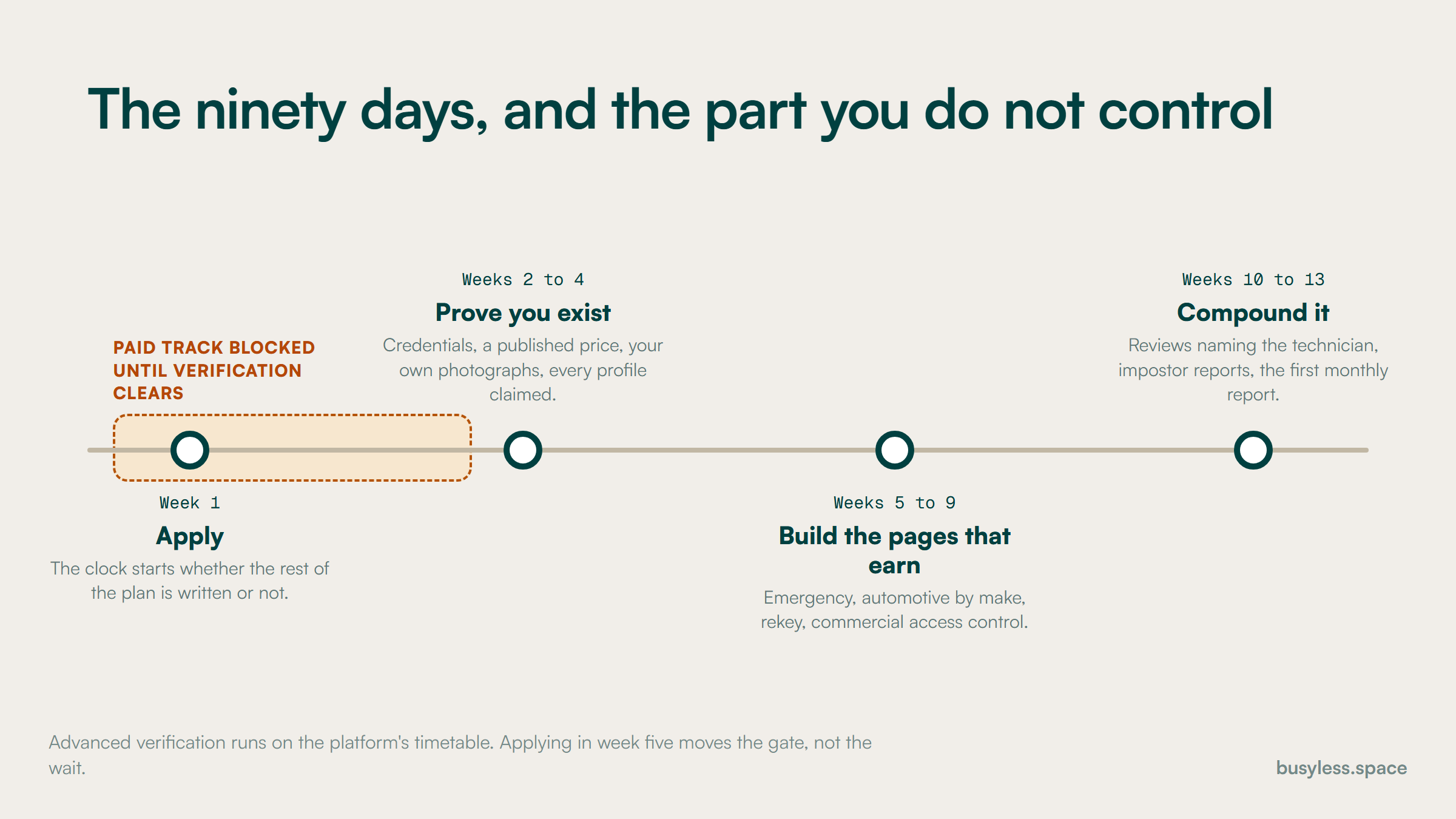
A ninety day plan timeline with the advanced verification wait drawn as a gate that blocks the paid track from week one
The wait is not a task you can shorten, so it belongs at the start. Everything on the paid track sits behind it whether you applied in week one or week five.

Technical fixes with the best payoff

Locksmith websites are overwhelmingly built from the same handful of trade templates, so the defects recur across the whole market. Three of the five below are direct consequences of a template designed to be resold to a hundred locksmiths in a hundred towns.

  • The phone number is an image or sits inside a script

    An hour

    Trade templates render the number in a graphic to stop scraping, which also stops a phone from dialling it and a crawler from associating it with the business.

    Make it a tel: link in the markup, in the header, on every page. Then check it on a real handset rather than in a desktop browser.

  • Forty towns, one page, find and replace

    A day, then a page a week

    The template ships with a location page generator, and a trade with a wide service radius is exactly the customer for it. The result is thirty near-identical pages that rank for nothing and dilute the ones that could.

    Keep a page only where you can write two paragraphs nobody else could: response times, a landmark, a lock type common in that housing stock. Delete the rest and redirect them.

  • The 24-hour claim is decorative

    An hour

    Almost every locksmith site says 24/7 in the banner, and almost none of them state it in the opening hours markup, so the profile and the page disagree about when you answer.

    Set the opening hours specification to reflect what actually happens, including on the profile. If nights go to an answering service, say so. The customer at 2am is measuring honesty, not availability.

  • No page carries a price

    Half a day

    The industry learned to hide pricing because the scam operators advertise fake ones, which is precisely backwards: the hiding is what makes the fake number credible.

    Publish a callout fee, the common job prices, and the conditions that change them. Mark the callout up as an Offer so it can surface in the profile.

  • Automotive capability is one line in a service list

    A week, then one a fortnight

    Key programming is capital equipment and training, so it is the hardest thing in the trade to fake and the easiest to prove. The templates treat it as a bullet.

    One page per make you genuinely cover, naming the years and the fob types, with the equipment you use. This is the highest-return page set in the trade.

  • The service area is set to the whole state

    Ten minutes

    The trade template asks for a service area and an anxious owner types something enormous, which tells the platform the business is everywhere and therefore near nobody.

    Set it to the area you would genuinely drive to at 2am. A tighter honest radius outranks a wide dishonest one, because proximity is computed from what you claimed.

  • Every image is stock

    An afternoon with a phone

    The template ships with a photo library, and the impostor listings use the same library, so the two are visually indistinguishable to a customer trying to tell them apart.

    Replace all of it with photographs of your vans, premises, team and finished work. Keep the location metadata. This is the cheapest trust signal available and almost nobody does it.

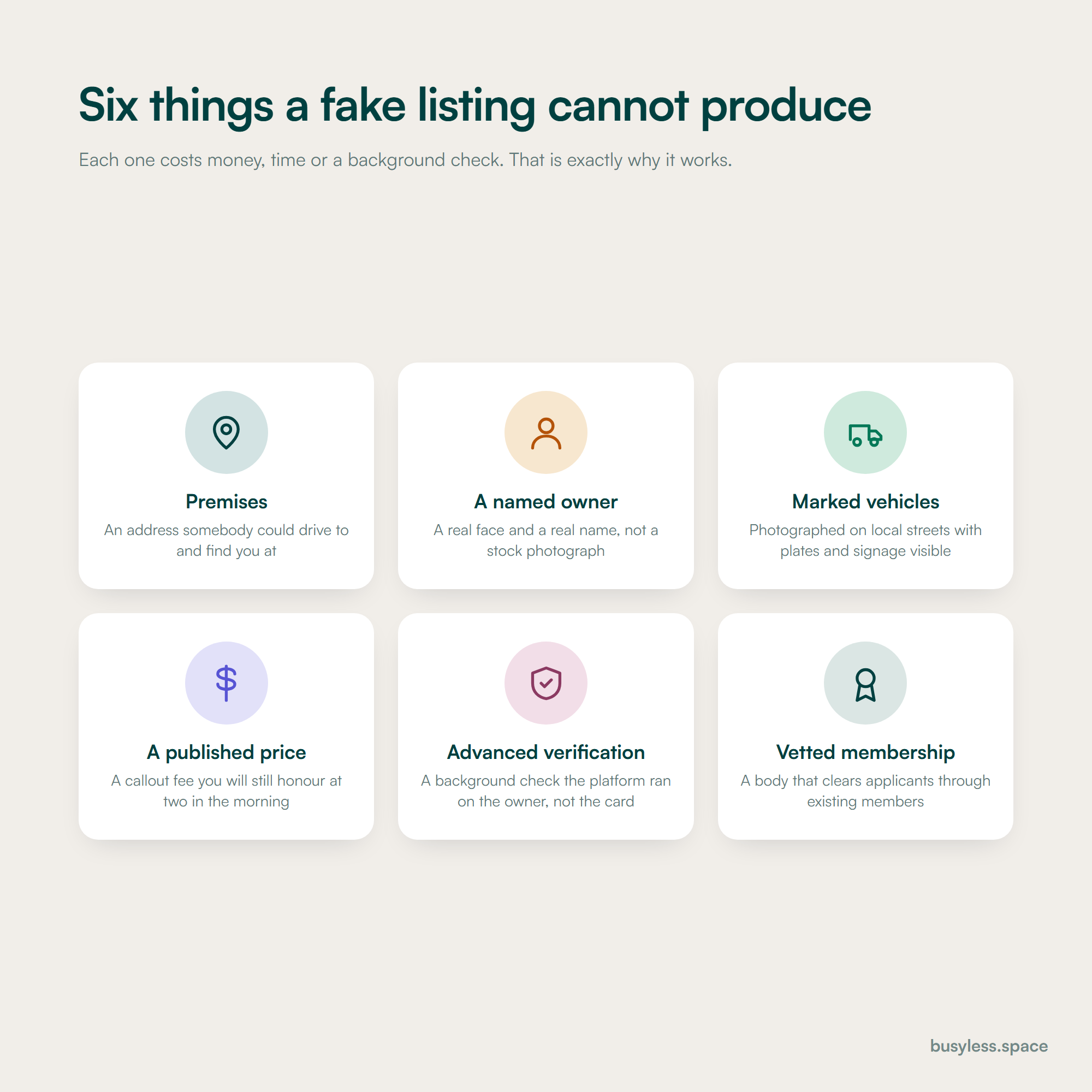
Six trust signals a fake listing cannot produce, including a traceable address, a named owner, marked vehicles and a published callout fee
Each of these costs something to produce, which is exactly why they work. Anything free to fake has already been faked.

Structured data that applies here

The types below fit this industry specifically. Most of them earn no rich result on their own, which is worth knowing before anyone sells the work on that basis. What they do is describe the entity precisely, which matters for how search engines and answer engines resolve who you are.

  • Locksmith

    Home page and the contact page

    schema.org has a dedicated Locksmith type under HomeAndConstructionBusiness, which is more specific than the LocalBusiness most trade templates emit. Use it, and fill the properties an impostor would leave empty.

    Locksmith.jsonld
    {
      "@context": "https://schema.org",
      "@type": "Locksmith",
      "name": "[BUSINESS NAME]",
      "url": "https://[YOUR-DOMAIN]/",
      "telephone": "[+1-555-000-0000]",
      "email": "[EMAIL]",
      "image": "https://[YOUR-DOMAIN]/[PHOTO-OF-YOUR-PREMISES-OR-VAN].jpg",
      "priceRange": "[$$]",
      "address": {
        "@type": "PostalAddress",
        "streetAddress": "[STREET]",
        "addressLocality": "[CITY]",
        "addressRegion": "[STATE]",
        "postalCode": "[ZIP]",
        "addressCountry": "US"
      },
      "geo": {
        "@type": "GeoCoordinates",
        "latitude": "[LATITUDE]",
        "longitude": "[LONGITUDE]"
      },
      "founder": {
        "@type": "Person",
        "name": "[OWNER NAME]"
      },
      "foundingDate": "[YYYY-MM-DD]",
      "areaServed": {
        "@type": "GeoCircle",
        "geoMidpoint": {
          "@type": "GeoCoordinates",
          "latitude": "[LATITUDE]",
          "longitude": "[LONGITUDE]"
        },
        "geoRadius": "[RADIUS IN METRES]"
      }
    }
  • OpeningHoursSpecification

    Wherever the 24-hour claim appears

    The one piece of markup in this trade that is a trust statement rather than a formatting one. If the banner says 24/7 and the markup says nine to five, one of them is wrong and the customer at 2am is the one who finds out.

    OpeningHoursSpecification.jsonld
    {
      "@context": "https://schema.org",
      "@type": "Locksmith",
      "name": "[BUSINESS NAME]",
      "url": "https://[YOUR-DOMAIN]/",
      "openingHoursSpecification": [
        {
          "@type": "OpeningHoursSpecification",
          "dayOfWeek": [
            "Monday", "Tuesday", "Wednesday", "Thursday",
            "Friday", "Saturday", "Sunday"
          ],
          "opens": "00:00",
          "closes": "23:59"
        }
      ],
      "specialOpeningHoursSpecification": {
        "@type": "OpeningHoursSpecification",
        "validFrom": "[YYYY-MM-DD]",
        "validThrough": "[YYYY-MM-DD]",
        "opens": "[HH:MM]",
        "closes": "[HH:MM]"
      }
    }
  • Service with Offer

    The pricing page and each service page

    Publishing the callout fee as structured data is an anti-scam move before it is an SEO one. It puts a number the platform can read against a business the platform has verified.

    Service with Offer.jsonld
    {
      "@context": "https://schema.org",
      "@type": "Service",
      "serviceType": "[Emergency lockout]",
      "provider": {
        "@type": "Locksmith",
        "name": "[BUSINESS NAME]",
        "url": "https://[YOUR-DOMAIN]/"
      },
      "areaServed": {
        "@type": "City",
        "name": "[CITY]"
      },
      "offers": {
        "@type": "Offer",
        "priceSpecification": {
          "@type": "PriceSpecification",
          "price": "[CALLOUT FEE]",
          "priceCurrency": "USD",
          "valueAddedTaxIncluded": false,
          "description": "[Callout fee. Labour and parts quoted before work begins.]"
        },
        "availability": "https://schema.org/InStock"
      }
    }
  • Person with hasCredential

    The credentials page and the about page

    Worth more here than almost anywhere else, because in the states with no licensing a vetted association membership is one of the few credentials that exists. Mark up the person, not the company, because that is who was vetted.

    Person with hasCredential.jsonld
    {
      "@context": "https://schema.org",
      "@type": "Person",
      "name": "[OWNER OR TECHNICIAN NAME]",
      "jobTitle": "[Locksmith]",
      "worksFor": {
        "@type": "Locksmith",
        "name": "[BUSINESS NAME]",
        "url": "https://[YOUR-DOMAIN]/"
      },
      "hasCredential": [
        {
          "@type": "EducationalOccupationalCredential",
          "credentialCategory": "[State licence]",
          "recognizedBy": {
            "@type": "Organization",
            "name": "[ISSUING STATE AGENCY]"
          },
          "identifier": "[LICENCE NUMBER]"
        },
        {
          "@type": "EducationalOccupationalCredential",
          "credentialCategory": "[Association membership]",
          "recognizedBy": {
            "@type": "Organization",
            "name": "ALOA Security Professionals Association",
            "url": "https://www.aloa.org/"
          }
        }
      ]
    }
  • Product for key and fob coverage

    Each automotive key replacement page

    The automotive pages are the trade's most defensible asset and the least marked up. Describing what you can actually cut and program, by make and year, is a capability claim a fake listing cannot match.

    Product for key and fob coverage.jsonld
    {
      "@context": "https://schema.org",
      "@type": "Product",
      "name": "[MAKE] [MODEL] key fob replacement",
      "description": "[Cut, programmed and tested on site for MAKE MODEL, YEARS.]",
      "brand": {
        "@type": "Brand",
        "name": "[MAKE]"
      },
      "offers": {
        "@type": "Offer",
        "priceCurrency": "USD",
        "price": "[PRICE]",
        "availability": "https://schema.org/InStock",
        "seller": {
          "@type": "Locksmith",
          "name": "[BUSINESS NAME]",
          "url": "https://[YOUR-DOMAIN]/"
        }
      }
    }
  • FAQPage

    The pricing page and the emergency page

    The questions worth marking up here are the suspicious ones. What does the callout actually cost, how do I know you are real, what happens if the price changes. Answer those and the markup is doing the same job as the page.

    FAQPage.jsonld
    {
      "@context": "https://schema.org",
      "@type": "FAQPage",
      "mainEntity": [
        {
          "@type": "Question",
          "name": "[How much does a callout cost?]",
          "acceptedAnswer": {
            "@type": "Answer",
            "text": "[The callout fee is $X. Labour and parts are quoted before any work starts, and the quote is what you pay.]"
          }
        },
        {
          "@type": "Question",
          "name": "[How do I know you are a real local business?]",
          "acceptedAnswer": {
            "@type": "Answer",
            "text": "[Our address is X, our licence number is Y, and the technician will arrive in a marked van. Ask for identification before you let anyone work on your locks.]"
          }
        }
      ]
    }

What it costs

These bands are editorial estimates based on what this work actually takes, not a price list and not survey data. What makes locksmith budgets different from the other trades is that the first month buys almost no content: it buys verification, photography and profile work, and that is the money best spent in this trade.

Do it yourself

$0 to $300
  • Advanced verification, claimed profiles and consistent details everywhere
  • Your own photographs replacing every stock image
  • A published pricing page and a credentials page
  • A monthly impostor search and report log
  • Reviews requested by hand after every job

Who it suits

A one-van operator in a single town who has time on the quiet days and would rather spend it than borrow against it.

Where it stops

You will not build the automotive page set this way, and that is the half of the trade with the best margin and the least competition.

Lean

$700 to $1,500
  • Everything above, plus a writer for the service and make pages
  • Call tracking split by page so you can see what earns
  • Local rank tracking by map point rather than by city
  • Quarterly technical review of the trade template's defects

Who it suits

Two to four vans with a real service radius, where the owner still answers the phone but no longer has an afternoon to write.

Where it stops

Commercial access control needs a different kind of writing and a longer sales cycle than this tier funds.

Funded

$1,500 to $3,500
  • The automotive page set built out by make and year
  • The commercial access control track, written for facilities managers
  • Paid search running behind a completed verification
  • Reporting that separates emergency, automotive and commercial

Who it suits

A multi-van business with a commercial arm, or one covering a metro wide enough that the map points genuinely differ.

Where it stops

Beyond this the limit is technicians and equipment rather than demand, which is a hiring problem wearing a marketing costume.

How to do it with no budget

More of this playbook is free than in any other trade in this directory, because the highest-value work is verification and photography rather than production. A weekend spent on the five steps below moves a locksmith further than a month of blog posts.

  1. 1

    Apply for advanced verification

    2 hours, then a wait of weeks

    Google Ads

    The single highest-leverage free action available. Do it first because the waiting happens whether you started or not, and nothing paid can run until it clears.

  2. 2

    Log every impostor in your map results

    2 hours, then 30 minutes a month

    Google Maps and a spreadsheet

    Search your terms from your actual service area, and record every profile you cannot trace to premises: name, address, phone, screenshot, date. The log is what makes a report credible, and one report rarely works alone.

  3. 3

    Photograph everything you own

    An afternoon

    A phone

    Vans with plates visible, the premises, the team, finished work, the key cutting machine. Every one of these is something a listing operating from another country cannot produce.

  4. 4

    Publish a callout fee you will honour

    2 hours

    Your website editor

    State the number, then state what changes it. This is the highest-converting free change available in this trade, and it directly answers the suspicion the whole category has earned.

  5. 5

    Ask every customer to name the technician

    5 minutes a job

    A text message after the job

    A review that names a person and describes the lock is the one signal the fraud cannot generate at volume. Ask for it in the message rather than hoping for it.

  6. 6

    Write the how to check a locksmith is real guide

    3 hours

    Your website editor

    Explains the scam, the callout switch and what to ask at the door. It ranks on the suspicion queries, earns links from local news and consumer groups, and is the rare page that is a public service and a positioning asset at once.

  7. 7

    Set the service area to what you would actually drive

    10 minutes

    Google Business Profile

    Most locksmiths type something enormous, which tells the platform they are everywhere and therefore near nobody. A tighter honest radius outranks a wide dishonest one, because proximity is computed from what you claimed.

The tool stack

A small stack, because the money in this trade goes on verification and photography rather than software. Two of the five below are things most locksmiths already pay for and do not read.

  • Track position by map point, not by city

    NozzleSEO APIRead the review

    A city-level rank is meaningless in a trade where the customer is a mile from the van. What matters is whether you appear at the edges of the radius you claim to cover, and the free version of this check takes fifteen minutes.

    Free routeSearch from three addresses at the edges of your radius, monthly

  • Measure what the pricing page actually changes

    SEO Conversion Rate CalculatorFree toolOpen the tool

    Publishing a callout fee feels like a concession and behaves like a conversion asset. Run the numbers before and after so the decision is settled by data rather than by nerve.

    Free routeFree

  • Run a site with many service and make pages cheaply

    StatamicHeadless CMSRead the review

    The automotive page set is the one place this trade needs real content infrastructure: a make, a model, a year range and a fob type, rendered as a page. Modelling that once beats maintaining forty hand-built pages.

    Free routeFlat file, no database to run

  • Split calls by page

    A tracking number per service page

    Without this you cannot tell whether the automotive pages earn, and the automotive pages are the argument for the whole budget. One number for the whole site answers no question worth asking.

    Free routeOne extra number, split by page

  • Watch the impostors

    Google Business Profile and your own log

    Set a monthly recurring task rather than reacting when a customer mentions being overcharged by somebody using your name. Removal takes repetition, and the log is what turns repetition into evidence.

    Free routeFree

  • See what your terms cost before you bid

    Google Keyword Planner

    Emergency locksmith clicks are among the most expensive in local services precisely because the fraud can afford them. Knowing the number before you commit stops a paid plan built on a guess.

    Free routeFree with an Ads account

Take it from here

Everything below is written to be filled in and used rather than read. Bodies are plain text, so what lands on your clipboard is exactly what you see, brackets and all.

Checklist

The document set to assemble before you apply, so a request for more does not restart the wait.

ADVANCED VERIFICATION PACK
Business: [BUSINESS NAME]
Applied on: [DATE]
Status: [SUBMITTED / MORE INFO REQUESTED / APPROVED]

BEFORE YOU APPLY, GATHER
[ ] Legal entity name exactly as registered
[ ] State registration or incorporation document
[ ] Employer identification number
[ ] Business address, matching the profile exactly
[ ] Evidence the address is yours (lease, utility bill, tax document)
[ ] Owner government identification
[ ] Owner date of birth and home address for the background check
[ ] State locksmith licence number, where the state issues one
[ ] Proof of liability insurance, in the business name
[ ] Business phone number, matching the profile exactly

CONSISTENCY CHECK, DO THIS BEFORE SUBMITTING
[ ] Name identical on: website, profile, licence, insurance, registration
[ ] Address identical on all five
[ ] Phone identical on all five
[ ] No abbreviations on one and not another (St vs Street)

AFTER SUBMITTING
[ ] Diary a check every 7 days
[ ] Record any request for more information and the date you answered it
[ ] Do not change the profile name, address or phone while it is in review

NOTES
[WHAT WAS ASKED FOR AND WHEN]

What to publish

The content that works here is proof rather than persuasion, which inverts the usual advice. The best-performing pages in this trade are the ones a suspicious person reads to decide whether to call, not the ones a search engine reads to decide whether to rank.

  • The pricing page

    Once, reviewed quarterly

    The single highest-value page in the trade. It answers the question the category has taught people to ask, and it is the one page an impostor will not copy because their model depends on the number being wrong.

  • The credentials page

    Once, reviewed twice a year

    Licence where one exists, association where it does not, insurer, owner, premises. It exists to be checked rather than read, which is why it should be linked from every service page.

  • Automotive key pages by make

    One a fortnight until the common makes are covered

    The most defensible asset available. Programming capability is equipment and training, so a page that names makes, years and fob types states something the competition cannot copy in an afternoon.

  • The access control page

    Once, then a case study a quarter

    Written for a facilities manager rather than a homeowner, and therefore competing in a much quieter market with a much larger ticket. Of everything in this list, it is the one that can win without touching the map pack.

  • Repair-or-replace diagnostics

    One a month

    The one informational format that converts, because it tells a worried person their lock may be fixable. Being the business that says the cheaper thing is a positioning asset in a trade defined by overcharging.

  • A how to check a locksmith is real guide

    Once, updated annually

    Ranks on the suspicion queries, earns links from local news and consumer groups, and positions you as the one operator willing to explain the scam. It is the rare content asset that is also a public service.

And what not to

  • History of locks articles, which rank for nothing and signal a content mill
  • Thirty near-identical town pages generated from one template, which is the defect the trade software encourages
  • Security tips listicles that never mention a service you sell
  • Stock photography of hands holding keys, which is the visual signature of the listings you are competing with
  • Countdown timers and "only 2 slots left" urgency, which reads as the scam it resembles

The expensive mistakes

Treating verification as paperwork to do later

Costs you The whole paid half of the plan sits blocked for a month while the content half runs without it, and the map results stay as they were.

Apply in week one, before the strategy is written. It runs on somebody else's clock and nothing else in the plan can start it earlier.

Hiding prices because the scammers advertise fake ones

Costs you The customer cannot distinguish you from the fake, so they call whoever is nearest in the map, which is often the fake.

Publish a real callout fee and what changes it. The hiding is what makes the fake number credible in the first place.

Buying leads without asking where they came from

Costs you You end up paying for calls generated by a listing you would never have created, and the conduct at the top of that chain becomes your reputation problem.

Ask every supplier which listing produced the call, and stop buying from the ones that will not say.

Publishing a page per town for forty towns

Costs you Thirty pages that rank for nothing, dilute the four that could, and look to a quality rater exactly like the doorway pages they are.

Keep a town page only where you can write something true about that town's housing stock or your response time there.

Chasing house lockouts and ignoring car keys

Costs you You compete hardest in the cluster with the lowest ticket and the most fraud, and cede the one with the highest margin to dealerships.

Build the automotive pages first if you have the equipment. Less competition, better margin, and a capability claim nobody can fake.

Reporting an impostor once and giving up

Costs you The listing stays, and the operator learns your reports do not persist. Removal in this category is usually a sequence, not an event.

Keep the dated log with screenshots and report on a schedule. Evidence accumulated over months is what actually moves it.

What to measure

Two of the leading indicators below exist on no other playbook in this directory, because they measure whether you have displaced an impostor rather than whether you have outranked a competitor. Attribution in emergency trades is never clean: people call from the map without ever reaching the site.

Leading indicators

Move first. They predict, they do not prove.

  • Verification status and time in the queue

    Google Ads account

    The first thing to report and the only one with a hard dependency behind it. Until it clears, a chunk of the plan is on hold and the report should say so rather than filling the gap with something else.

  • Impostor listings logged and removed

    Your own monthly log

    Count both, and keep the ratio. It is the clearest measure of whether the map results are getting cleaner, and it is the number that explains a ranking change no keyword report can account for.

  • Map pack presence at the edges of the radius

    Rank tracking by map point

    Checked from three or four addresses at the boundary rather than from the office. A business can hold the centre and be invisible eight miles out, which is where the growth is.

  • Calls by service page

    Call tracking numbers

    The only way to see whether the automotive pages are earning their build. Report emergency, automotive, rekey and commercial separately or the largest cluster hides the most profitable one.

  • Reviews naming a technician

    Profile review text

    A proxy for the trust signal the fraud cannot manufacture. Count them separately from the overall review total, which is a number the impostors also have.

Business indicators

The ones a manager acts on.

  • Jobs won, by cluster

    Your job management system

    Calls are not jobs in a trade where a third of them are price shopping. Splitting won work by cluster is what shows the automotive argument was right or wrong.

  • Average job value

    Invoicing

    The number that decides whether a strategy aimed at higher-ticket clusters is working. A flat call count with a rising average value is a success the leading indicators will not show.

  • Commercial contracts opened

    Your own pipeline

    Slow, lumpy and worth tracking separately, because one access control contract can outweigh a quarter of emergency work and it will never show up in a call-volume chart.

The verdict

Most locksmith SEO services sell the same package they sell a plumber: location pages, a blog, a review widget. It is not wrong so much as out of order, because it assumes the competition is other locksmiths.

It often is not. When the results contain listings that are not businesses, the first job is establishing that you are one, in the places a customer and a platform can both check. Verification, premises, a named owner, a published price.

That is the honest version of what SEO services for locksmiths should do first, and it is unglamorous work that produces no content to show. It is also the part that makes everything after it worth doing.

Then build the automotive pages. They carry the better margin, the calmer customer and the capability claim nobody can copy, and almost every locksmith site in the country gives them a single line.

FAQ

Locksmiths SEO questions

  • Why do I need advanced verification to advertise as a locksmith?
    Because the category was abused heavily enough that Google restricted it. Ads for locksmith services in the United States require advanced verification, which checks the business and its owner rather than the payment method. Apply early: it runs on the platform's timetable and blocks every paid element until it clears.
  • How do I get a fake locksmith listing removed?
    Report it through the profile's own redress flow with evidence: a screenshot, the date, and what you found when you checked the address and phone number. Expect it to take repetition rather than one submission. A dated log of the same listing over several months is far more persuasive than a single report.
  • Should I publish my prices when competitors hide theirs?
    Yes, and the fact that competitors hide theirs is the argument for it. The scam works by advertising a price it does not honour, so a business that states a callout fee and what changes it is answering the exact suspicion the category has created.
  • Do I need a locksmith licence?
    It depends on the state, and roughly a dozen require one. Check your own rather than any list. Where a licence exists, publish the number. Where none does, say so plainly and point at what can be checked instead, because silence on this question reads badly.
  • Is a page for every town I cover a good idea?
    Only where you can write something true about that town specifically. Thirty pages generated from one template with the name swapped rank for nothing and look to a quality rater like the doorway pages they are. Four genuine ones beat forty generated ones.
  • What is the most underrated opportunity in this trade?
    Car key and fob replacement. The ticket is higher, the customer has hours rather than minutes, the fraud largely ignores it because it needs real equipment, and the competition is dealerships quoting more. Most locksmith sites give it one line in a service list.
  • How long before a locksmith website starts producing work?
    Three to six months for the local pack and the service pages, assuming verification and profile work happen first. Automotive and commercial pages take longer because they build authority rather than proximity. Anyone promising faster is describing paid search, not organic.
  • Are lead marketplaces worth it?
    As a bridge, often yes. As a destination, rarely. They rank on terms you cannot outrank quickly and will fund the period before your own pages mature. Measure them on cost per won job rather than per lead, and set a date to review whether they still earn their margin.

Run it yourself, or have someone own it

Everything above is written to be run without us, and the free path is genuinely most of the value for a single-location business. Where these plans stall is almost never the plan. It is that nobody owns it after the first month. That is the job we do, with search as one distribution layer inside a wider system rather than the whole engagement.