
Skip to content

Franchise SEO strategy

YMYL and regulated

Your site sells franchises too, and that half is federally regulated

Written by Eugene SuslovLast reviewed 18 September 2026No affiliate links
Sector
Business services
Model
Multi-location, National service
Competition
High
Time to results
4 to 12 months, locations first
Typical monthly
$4,000 to $30,000

Key takeaways

  1. 1Your website runs two sales at once. Customers buy the service from a location and prospective owners buy the business, and only the second is governed by the FTC Franchise Rule and by state franchise laws.
  2. 2The development question a prospective owner most wants answered, what an owner earns, may be answered on your own site only from Item 19 of the current disclosure document, with its dates, its counts and its admonition.
  3. 3A profit calculator, an owner quoting income in a video and a chatbot answering the earnings question are all earnings claims in the rule's own terms. Take them down before building anything new.
  4. 4A location page is a joint document between a brand and an owner. Whether franchisees may write their own, target the next town or run a site of their own is already disclosed in Items 11 and 12.
  5. 5Unit turnover is a search event. A transfer, a termination or a closure strands a page, a profile, a phone number and a review history unless somebody wrote the runbook before it happened.

SEO for franchises is usually sold as local search with more addresses. That describes half of the job. A franchisor's domain also sells the franchise itself, to people deciding whether to put their savings into a unit of their own.

That second sale has a rulebook of its own. The FTC Franchise Rule decides what a franchise seller may say about money. Several states add registration and advertising rules, often administered by their securities regulators, and the FTC's compliance guide names a franchisor's website as general media.

So a franchise SEO strategy has two customers and two sets of rules. The consumer half is judged on whether a searcher finds the right unit in the right town. The development half is judged on whether a prospective owner gets a true answer, and a true answer about earnings has one permitted source.

The consumer half is harder than it looks, because the franchisor owns the domain and somebody else owns each location. Who may write a location page, whether it may target the next town and what happens to it when the unit is sold are contract questions first, and the disclosure document already answers most of them.

One location under your own name is a local businesses problem; this page is for the brand that owns the domain but not the units. A roll-up running company-owned branches across several trades belongs to the home services playbook, and a single-trade franchise system belongs here. The franchisee's reading of the same agreement is argued in the fitness gyms playbook.

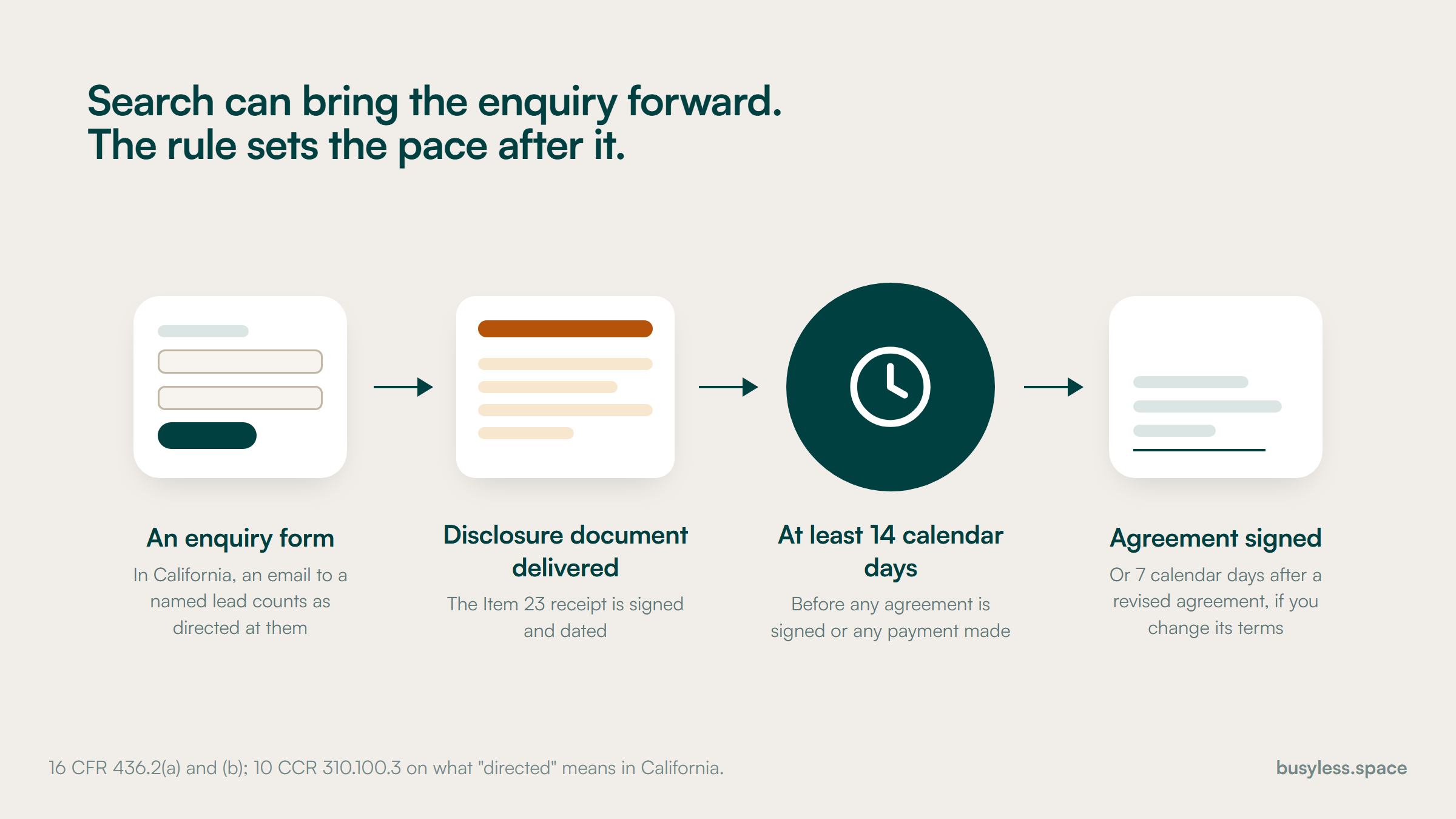
The return arrives oddly too. A franchisor does not bank the revenue a location page produces, it collects a royalty on it. On the development half the pace is set by regulation rather than by search, because the rule keeps at least fourteen calendar days between delivering the disclosure document and any signature or payment.

Who already ranks in franchises

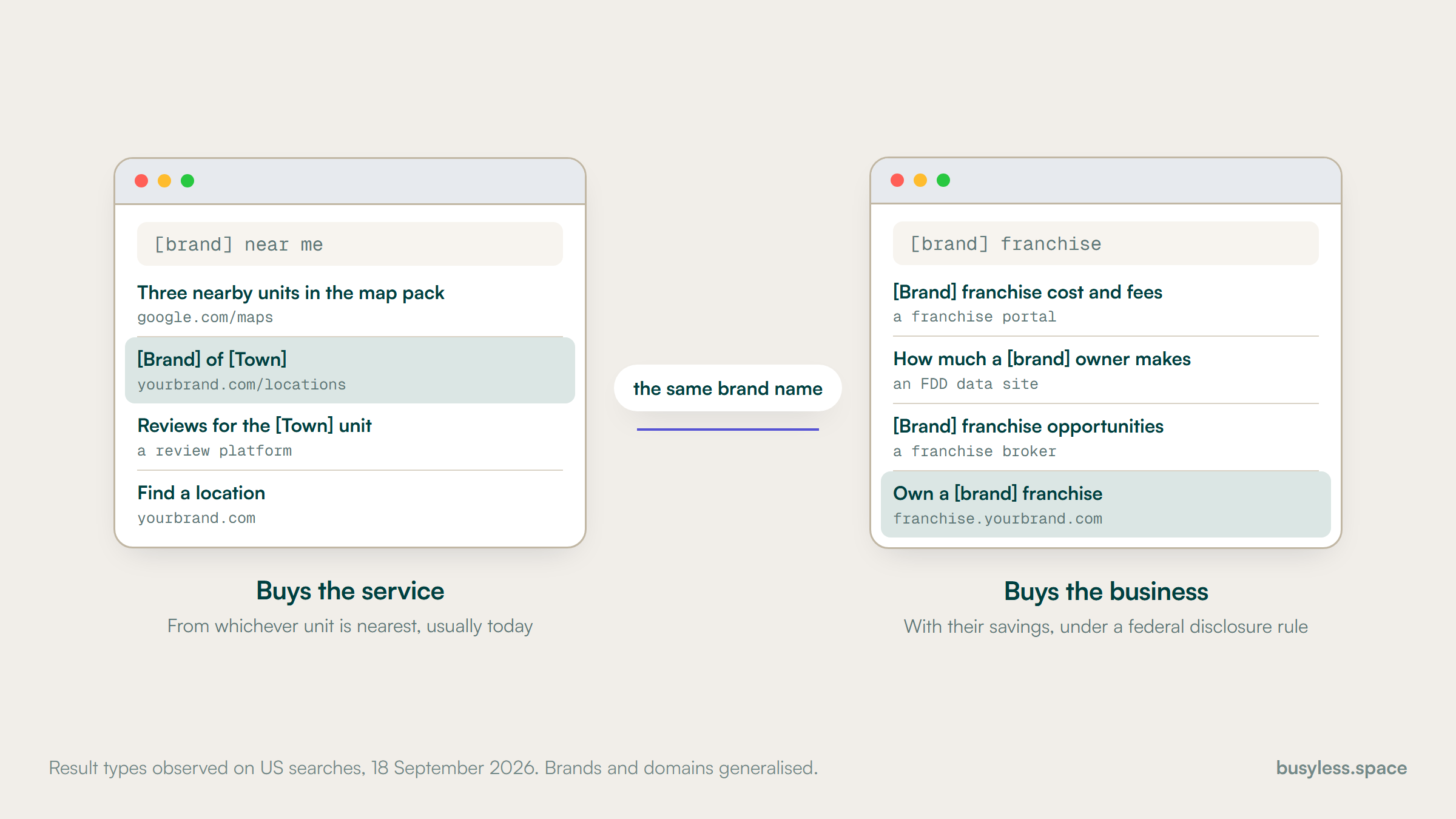
Type your brand name into a search box twice, once as a customer and once as somebody thinking of buying in. The two results pages share almost nothing, and most franchise SEO work only ever looks at the first. The second belongs to portals, brokers and sites publishing profit estimates you may not publish yourself.

What is on the results page

  • A local pack and the brand's own locator on brand plus near me searches
  • Franchisor location pages, sometimes in two URL patterns for one territory
  • A same-named town in another state surfacing the wrong unit first
  • Franchise portals on brand franchise and franchise opportunity queries
  • FDD data sites answering what an owner of the brand earns
  • Broker sites ranking on the brand's own franchise terms
  • Ranking lists and owner survey badges on best franchise queries
  • A resale marketplace holding the brand franchise for sale query
  • Franchise portals

    franchisedirect.com, franchisegator.com, franchising.com, franchiseopportunities.com

    They rank on your brand plus the word franchise and sell the enquiry back to you. Listings are paid placements, so make your own development page the better answer. The FTC's guide counts a third party's website as general media too, so the earnings rule follows your copy onto theirs.

  • FDD data sites and commentators

    franchisechatter.com, vettedbiz.com, franzy.com, franchisepayback.com

    They hold how much a [brand] owner makes, with profit estimates the franchisor itself could not publish; one read on 18 September 2026 computed profit from an assumed margin. They are not franchise sellers, so the earnings rule does not bind them. You cannot out-answer them. You can publish Item 19 faithfully and be the primary source they cite.

  • Franchise brokers

    frannet.com, ifpg.org

    They rank on your brand terms and, unlike the data sites, they are franchise sellers under the rule's definition, which names third-party brokers. An earnings figure a broker invents is a problem you share. Give them approved wording and a link to your Item 19 page, and check the status of California's 2024 broker registration law before relying on it.

  • The resale marketplace

    bizbuysell.com

    It owns the brand plus franchise for sale. A franchisee selling its own unit sits outside the rule's definition of a franchise seller, so that listing is the owner's own business. A resale listing the franchisor writes is held to the same standard as the development page, money included.

  • The IFA member directory

    franchise.orgClaim it

    The International Franchise Association's directory ranks on franchise opportunity queries. Membership is a business decision rather than a search one, but a member's profile is worth completing, because it can point straight at your development page.

  • Ranking lists and owner surveys

    franchisebusinessreview.com, entrepreneur.com

    They own the best franchises queries. Franchise Business Review says no brand can pay to be on its list and ranks on owner surveys. Show any badge with its source and year, and never present a paid listing as an independent report, which the rule forbids misrepresenting.

  • The SBA Franchise Directory

    sba.govClaim it

    The authority on whether a brand is eligible for SBA-backed lending, and its own page says placement is not an endorsement or approval of the brand. Get listed if you qualify, link to the entry from the financing page, and never write SBA approved in a title tag.

  • Each unit's Google Business Profile

    google.comClaim it

    The consumer half is decided here, and the franchise twist is whose account holds it. A profile created under a franchisee's own login leaves with that franchisee, reviews and all. Decide in the operations manual who holds primary ownership of every profile, before the first transfer rather than during it.

Two browser windows searching the same brand name two ways. Near me returns a map pack and the brand's location page; the word franchise returns a portal, a data site, a broker and the brand's own development page last.
The same words in the search box, two purchases behind them. Only the one on the right is regulated, and its results page is held mostly by businesses that are not you.

What people actually search

Six of these eight clusters belong to the development half and never meet a consumer page. They are also the half the pages ranking for franchise search advice leave out, which is why a franchisor's own site so often loses them to portals and data sites.

Owner earnings

Commercial investigation, with savings at stake

how much does a [brand] franchise owner make

The page that wins it: An Item 19 page, reproduced with its dates, counts and admonition

The question a prospective owner most wants answered, and the one you are least free to answer. Only Item 19 may answer it, and a franchisor with no Item 19 may publish no figure at all. The data sites ranking here are estimating, which is exactly why a faithful Item 19 page is worth citing.

The investment to open

Commercial, comparison led

[brand] franchise cost

The page that wins it: An investment page built from Items 5, 6 and 7, with no sales figure on it

The one money query you can answer in full, because cost data alone is not an earnings claim under the FTC's guide. It becomes one the moment a sales figure sits beside it that a reader can subtract from.

Validation and reputation

Commercial investigation, sceptical

is [brand] a good franchise

The page that wins it: A validation page pointing to Item 20's list of current and former owners

Prospective owners are told to call existing ones, and Item 20 lists them, former owners included. Pointing to the whole list reads as confidence. A hand-picked shortlist reads as the opposite, and it invites the income anecdote you cannot publish.

Territory and state

Commercial, local to the buyer

[brand] franchise [state]

The page that wins it: State pages carrying the registration statement and the open territories

Where the state rules land. A page for a state where you are not registered needs a statement that the franchise is not offered there. In California, an email sent from that page to a named lead can count as directed at that person.

Financing

Informational, blocking

is [brand] SBA approved

The page that wins it: A financing page stating the directory listing, never an approval

The query uses the wrong word and the page must not repeat it. The SBA's own directory says listing is not an endorsement or approval, so the honest answer is that the brand is listed, what that means, and where the entry is.

Category discovery

Commercial investigation, broad

best franchises for veterans

The page that wins it: Category guides, reviewed as the franchise advertisements they are

Portals and ranking lists own these, and some franchisors publish best-franchises posts of their own that include competitors. Your own list is still franchise advertising, so the earnings rule and any state filing duty travel with it.

Brand plus place

Local, navigational

[brand] [city]

The page that wins it: One location page per unit, reachable from the locator in plain HTML

The consumer cluster, and the one shape shared with any multi-location business. What is particular to franchising is two URL patterns competing for one territory, and a same-named town in another state answering first.

Resale

Transactional, high value

[brand] franchise for sale

The page that wins it: A resale page, if you run one, reviewed like any development page

BizBuySell holds this query, and a franchisee selling its own unit may list there freely. A resale page the franchisor runs is franchise advertising, which surprises teams who think of it as a service to existing owners.

A four-step line from an enquiry form to a delivered disclosure document, a wait of at least fourteen calendar days and a signed agreement, with California's rule on directed email noted under the form.
Every development query on this page feeds the first box. Nothing a page does can shorten the third.

What the rules change

Every rule below applies to the development half of the site and none of it to the consumer half. This is my reading of the federal text and the state texts named, as read on 18 September 2026, rather than legal advice. State franchise law varies, so have franchise counsel read the development pages before they go live.

1

Earnings claims may come only from Item 19, and your website is general media

16 CFR 436.9(c), 436.1(e) and 436.5(s); FTC Franchise Rule Compliance Guide, May 2008, printed pp. 96 and 131-133. Read 18 September 2026

What it means

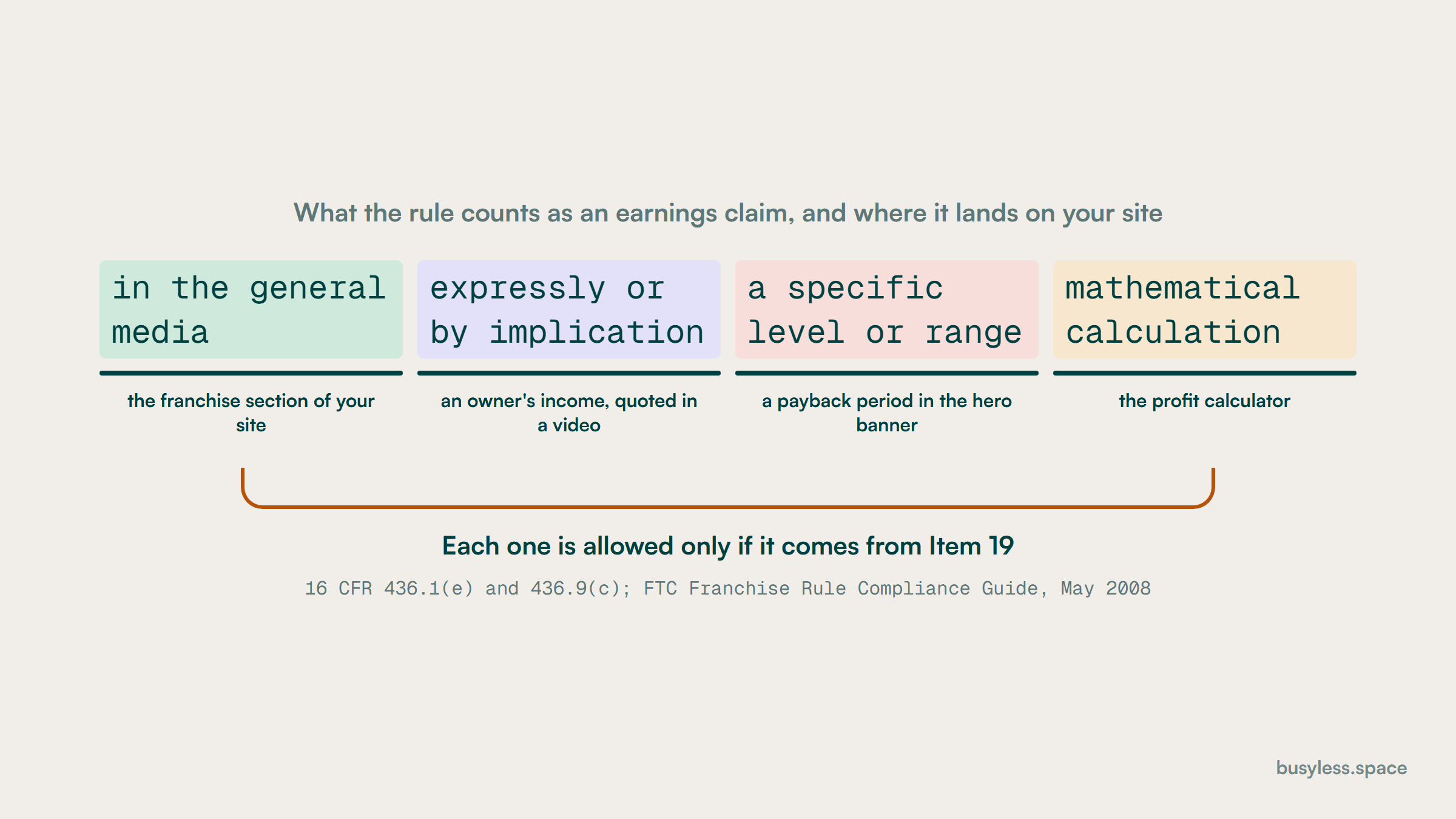
An earnings claim is any statement, including one in the general media, that states expressly or by implication a level or range of sales, income or profit, including a chart, table or mathematical calculation. It may be made only from Item 19, with the dates, the number and percent of outlets that reached it, and an admonition that results may differ. The guide names a franchisor's website as general media.

So do this

Answer what an owner earns only by reproducing Item 19, footnoted as the rule requires. Before any search work, remove the profit calculator, income figures in franchisee videos and any chatbot allowed to answer the question.

2

A cost page beside a sales figure is a profit claim, and so is the wrong link

FTC Franchise Rule Compliance Guide, May 2008, printed pp. 131-133; NASAA Financial Performance Representation Commentary, adopted 8 May 2017

What it means

Cost or expense data alone is not an earnings claim, but cost data coupled with sales figures from which a reader could calculate profit is one. Figures in a press release or an investors section ordinarily are not general media, until the franchisor uses them in franchise promotion, for example in the franchisee section of a website or by referring to them there.

So do this

Keep the investment page to Items 5, 6 and 7, with no average sales on it. Never link the franchise section to investor relations, from the navigation, the footer or the chatbot's sources. NASAA adds that even a blank pro forma may count as franchise advertising under state law.

3

Several states want franchise advertising filed before you publish it

13 NYCRR 200.9-200.13 and N.Y. GBL 683; Cal. Corp. Code 31156 and 10 CCR 310.156.3, 310.100.3; RCW 19.100.100 and WAC 460-80-500 to 540; COMAR 02.02.08.09; Minn. Stat. 80C.09. Read 18 September 2026

What it means

New York, California, Washington, Maryland and Minnesota each expect franchise advertising filed before first use, between three business days and seven days ahead. Several exempt a website not directed at their residents, on conditions such as disclosing its address to the regulator and carrying a legend. California counts an email to a specifically named person as directed.

So do this

Put the approved legends and a dated list of registration states in the footer, and a not-offered statement on every state page. Stop automated nurture emails to leads in states where you are not registered. Some published lists of filing states are out of date, so read each statute with counsel.

4

Items 11 and 12 already disclose your SEO architecture

16 CFR 436.5(k)(4) and (l)(6); FTC staff guidance on undisclosed fees, 12 July 2024. Read 18 September 2026

What it means

Item 11 must say when franchisees may use their own advertising material and what share of the advertising fund pays for selling franchises. Item 12 must say whether the franchisor may sell inside a territory over the Internet, and whether franchisees may take orders from outside it. The FTC's 2024 staff guidance treats fees not disclosed in the document as likely unlawful.

So do this

Read both items before writing the plan. Franchisee pages, location pages aimed at the next town and national orders taken inside a territory are disclosure questions first. A new local search or website fee introduced mid-term needs counsel before anybody invoices it.

5

Controlling local copy is a trademark duty, not a style preference

15 U.S.C. 1055 and 1127, read 18 September 2026; Eva's Bridal Ltd. v. Halanick Enterprises, 639 F.3d 788 (7th Cir. 2011)

What it means

A licensee's use of a mark counts for the owner only where the owner controls the nature and quality of the goods or services. Conduct that lets a mark lose its significance as a mark can amount to abandonment. In Eva's Bridal the Seventh Circuit affirmed that licensing a mark without control had abandoned it.

So do this

Give franchisees fields to fill and a review step, rather than either a free hand or a ban. Franchisee-written location copy is the most useful local material a system has, and it needs an approver with the authority to reject it.

6

An opening timeline or an approval badge is a representation

FTC v. Xponential Fitness, proposed stipulated order, C.D. Cal., 18 March 2026; SBA Franchise Directory, read 18 September 2026; 16 CFR 436.9(b)(2)

What it means

The FTC alleged that Xponential made false claims about how quickly studios would open; the March 2026 order is a proposed settlement, not a ruling. The SBA's directory states that placement is not an endorsement or approval. And the rule forbids misrepresenting that any person can give an independent and reliable report about the franchise.

So do this

Remove opening-time promises you cannot substantiate. Write listed in the SBA Franchise Directory, never SBA approved. Show awards and survey badges with their source and year, and never describe a paid listing as independent.

The federal definition of an earnings claim in four quoted fragments, each labelled with the web element it catches: a franchise section, an owner's income in a video, a payback period in a banner and a profit calculator.
Read one clause at a time, the definition describes the parts of a development page most likely to be added by a marketer rather than by counsel.

Proving expertise

A prospective owner is checking two things at once: whether the business works, and whether the people selling it will tell the truth about money. The signals that answer the second are mostly dates and sources.

  • The issue date of the disclosure document on every development page that quotes it
  • Item 19 reproduced with its own footnotes, never paraphrased into a headline
  • A system size on the development page that agrees with the current Item 20
  • Each unit's owner named on its location page, with the entity that trades there
  • Registration states listed in the footer, with the date the list was last checked
  • Validation calls offered against the full Item 20 list rather than a shortlist
  • Photographs and staff on each location page that genuinely belong to that unit
  • A named franchise development lead, reachable directly from the development pages

How to build a franchise SEO strategy

Audit the development pages before touching a single location page. A franchise SEO strategy that grows traffic into a profit calculator grows the exposure faster than the pipeline, and taking that calculator down costs an afternoon.

  1. 1

    Weeks 1-2

    Take the money claims down

    • Inventory every number, calculator, testimonial and chatbot answer on the development pages
    • Replace any earnings answer with the current Item 19, footnoted
    • Remove every link between the franchise section and investor relations
    • Put the legends and the registration states in the footer, dated
    • Show the disclosure document's issue date on every page that quotes it

    You end up with
    A development section with no earnings claim outside Item 19

  2. 2

    Weeks 3-5

    Map who may publish what

    • Read Items 11 and 12 against every page type in the plan
    • Choose one URL pattern per territory, city or territory but not both
    • Decide between a subfolder and the vendor's subdomain deliberately
    • Record who holds primary ownership of every business profile
    • Agree the fields franchisees fill on a location page, and the approver

    You end up with
    A rights map for every page type, checked against the disclosure document

  3. 3

    Weeks 6-9

    Rebuild the location layer

    • Render state, city and unit directory links in plain HTML
    • Put the state in every location title, heading and slug
    • Launch the location template with franchisee-supplied fields
    • Show each unit's own reviews, never the system total
    • Write the unit turnover runbook and test it on the next event

    You end up with
    A crawlable location layer that survives a unit changing hands

  4. 4

    Weeks 10-13

    Earn the development queries

    • Publish the investment page from Items 5, 6 and 7
    • Publish the validation page pointing to the Item 20 list
    • Build state pages with the not-offered statement where it applies
    • Publish the financing page and a discovery day event page
    • Split reporting into the consumer half and the development half

    You end up with
    Development pages accurate enough to be cited, and a report in two halves

Technical fixes with the best payoff

Two habits cause most of the damage. Location tooling is priced per unit, so its defaults spread across every page at once, and the franchisor's pages outlive the owners they describe. Neither shows until a crawler meets the locator or a unit changes hands.

  • Location pages sit on the vendor's subdomain

    A project with your locations vendor

    Location platforms are bought per unit, and their hosted pages default to an address such as locations.brand.com. Yext's own documentation calls the subdomain the straightforward option and a subfolder a reverse-proxy job at your origin, so nobody actually decides.

    Decide it. A reverse proxy puts the pages under /locations on the main domain; if the subdomain stays, link it from the main navigation and the footer so it is not an island.

  • The locator is JavaScript with nothing in the HTML

    A sprint

    Units load from an API after the page renders, so the directory a crawler receives contains a search box and a map and no links to any location at all.

    Publish state, city and unit directory pages as plain links, and let the interactive locator sit on top of them rather than replace them.

  • Two URL patterns compete for one territory

    A week, then a rule

    Service-area systems often publish a city page and a separate page for the franchisee trading as the brand of a named territory. One service brand observed on 18 September 2026 ranked both for the same query, so the two pages were splitting each other's signals.

    Pick one pattern per territory, tie it to the territory as Item 12 defines it, and consolidate or redirect the other.

  • A unit changes hands and everything attached breaks

    A runbook, then minutes per event

    A transfer, a termination or a closure removes the page, while the profile, the phone number and the reviews often sit in the departing franchisee's accounts. The unit's search history leaves with the person rather than staying with the territory.

    Treat it as a territory decision in a runbook. A transfer keeps the page and changes the owner, a replacement franchisee inherits the URL, and a closure keeps the page live and points to the nearest open unit.

  • Mandated copy is the only text on every location page

    A template, then per unit

    Brand standards supply one approved block and the template repeats it everywhere. The only unique words left on the page are the address, which gives a search engine nothing to rank one unit on.

    Keep the mandated block short and add fields only the unit can fill: the team, the services this unit offers, the streets it covers, its own photographs and its parking.

  • Towns share names across states

    A day, plus redirects

    A national system has units in towns that share a name, and a slug built from the city alone or from an ID number cannot tell them apart. A search for one unit observed on 18 September 2026 returned a same-named town in another state first.

    Put the state in every slug, title and heading, and replace ID-number slugs with readable ones behind redirects.

  • The brand's rating appears on every unit page

    An afternoon

    A system-wide review widget shows the brand's overall rating on a location page, which describes other businesses. Marking it up as the unit's own rating repeats the error in structured data.

    Show and mark up only the unit's own reviews, or none at all.

  • The profile name drifts from unit to unit

    A sweep across every profile

    Franchisees add their town or their company name to the profile. Google's guidelines require every location of a chain in one country to carry the same name, with exceptions for sub-brands and consistent real-world variations.

    One name everywhere. The franchisee's legal entity belongs on the page and in the legalName property of the markup, never in the profile's name field.

Structured data that applies here

The types below fit this industry specifically. Most of them earn no rich result on their own, which is worth knowing before anyone sells the work on that basis. What they do is describe the entity precisely, which matters for how search engines and answer engines resolve who you are.

  • Organization for the franchisor

    The home page

    Describes the franchisor as a company, with its logo and profiles. Google supports Organization markup for logo and knowledge panel details, and it is the node the development pages refer back to by its id.

    Organization for the franchisor.jsonld
    {
      "@context": "https://schema.org",
      "@type": "Organization",
      "@id": "https://[YOUR-DOMAIN]/#organization",
      "name": "[FRANCHISOR TRADING NAME]",
      "legalName": "[FRANCHISOR LEGAL ENTITY]",
      "url": "https://[YOUR-DOMAIN]/",
      "logo": "https://[YOUR-DOMAIN]/[LOGO].png",
      "brand": { "@id": "https://[YOUR-DOMAIN]/#brand" },
      "sameAs": [
        "https://www.linkedin.com/company/[SLUG]",
        "https://[FRANCHISE-DEVELOPMENT-DOMAIN]/"
      ]
    }
  • Brand, referenced by every unit

    Declared once, referenced from every location page

    No rich result. It is the join: every unit points at one Brand node, which is how a machine learns that many independently owned businesses trade under a single mark.

    Brand, referenced by every unit.jsonld
    {
      "@context": "https://schema.org",
      "@type": "Brand",
      "@id": "https://[YOUR-DOMAIN]/#brand",
      "name": "[BRAND NAME]",
      "logo": "https://[YOUR-DOMAIN]/[LOGO].png",
      "url": "https://[YOUR-DOMAIN]/",
      "slogan": "[APPROVED BRAND LINE]"
    }
  • LocalBusiness for a franchised unit

    Each location page

    Written franchise-honestly. The name is the brand, as the chain naming rule requires; legalName is the franchisee entity; brand points at the Brand node. Leave out parentOrganization, and branchOf, which schema.org marks as superseded by it: both assert an ownership the franchisor does not have. Google supports local business markup.

    LocalBusiness for a franchised unit.jsonld
    {
      "@context": "https://schema.org",
      "@type": "[LocalBusiness, or a more specific subtype]",
      "@id": "https://[YOUR-DOMAIN]/locations/[ST]/[TOWN]#unit",
      "name": "[BRAND NAME]",
      "legalName": "[FRANCHISEE LEGAL ENTITY]",
      "brand": { "@id": "https://[YOUR-DOMAIN]/#brand" },
      "url": "https://[YOUR-DOMAIN]/locations/[ST]/[TOWN]",
      "telephone": "[+1-555-000-0000]",
      "address": {
        "@type": "PostalAddress",
        "streetAddress": "[STREET]",
        "addressLocality": "[TOWN]",
        "addressRegion": "[ST]",
        "postalCode": "[00000]",
        "addressCountry": "US"
      },
      "geo": {
        "@type": "GeoCoordinates",
        "latitude": "[LAT]",
        "longitude": "[LON]"
      },
      "openingHoursSpecification": [
        {
          "@type": "OpeningHoursSpecification",
          "dayOfWeek": ["Monday", "Tuesday", "Wednesday", "Thursday", "Friday"],
          "opens": "[08:00]",
          "closes": "[18:00]"
        }
      ],
      "areaServed": "[TOWNS INSIDE THIS UNIT'S TERRITORY]",
      "description": "Independently owned and operated by [FRANCHISEE LEGAL ENTITY] under licence from [FRANCHISOR LEGAL ENTITY]."
    }
  • BreadcrumbList for the directory

    State, city and unit directory pages

    Supported by Google, and it spells out the directory a script-driven locator hides. Put the state in the trail, which is also where towns that share a name stop colliding.

    BreadcrumbList for the directory.jsonld
    {
      "@context": "https://schema.org",
      "@type": "BreadcrumbList",
      "itemListElement": [
        {
          "@type": "ListItem",
          "position": 1,
          "name": "Locations",
          "item": "https://[YOUR-DOMAIN]/locations"
        },
        {
          "@type": "ListItem",
          "position": 2,
          "name": "[STATE]",
          "item": "https://[YOUR-DOMAIN]/locations/[ST]"
        },
        {
          "@type": "ListItem",
          "position": 3,
          "name": "[TOWN], [ST]",
          "item": "https://[YOUR-DOMAIN]/locations/[ST]/[TOWN]"
        }
      ]
    }
  • JobPosting with the franchisee as employer

    Unit job pages

    Supported by Google. The employer is the franchisee entity rather than the brand, and hiringOrganization should say so. Getting it wrong names the franchisor as the employer of people it does not employ.

    JobPosting with the franchisee as employer.jsonld
    {
      "@context": "https://schema.org",
      "@type": "JobPosting",
      "title": "[JOB TITLE]",
      "description": "[DUTIES, HOURS AND PAY]",
      "datePosted": "[YYYY-MM-DD]",
      "validThrough": "[YYYY-MM-DD]",
      "employmentType": "[FULL_TIME]",
      "hiringOrganization": {
        "@type": "Organization",
        "name": "[FRANCHISEE LEGAL ENTITY]",
        "sameAs": "https://[YOUR-DOMAIN]/locations/[ST]/[TOWN]"
      },
      "jobLocation": {
        "@type": "Place",
        "address": {
          "@type": "PostalAddress",
          "streetAddress": "[STREET]",
          "addressLocality": "[TOWN]",
          "addressRegion": "[ST]",
          "postalCode": "[00000]",
          "addressCountry": "US"
        }
      },
      "baseSalary": {
        "@type": "MonetaryAmount",
        "currency": "USD",
        "value": {
          "@type": "QuantitativeValue",
          "minValue": "[MIN]",
          "maxValue": "[MAX]",
          "unitText": "HOUR"
        }
      }
    }
  • Event for a discovery day or webinar

    Each discovery day or franchise webinar page

    Google supports event markup. The event page is still a franchise advertisement, so its description carries no earnings figure, and its registration form is where the state rules on directed contact begin.

    Event for a discovery day or webinar.jsonld
    {
      "@context": "https://schema.org",
      "@type": "Event",
      "name": "[BRAND] discovery day",
      "startDate": "[YYYY-MM-DDTHH:MM:SS-05:00]",
      "endDate": "[YYYY-MM-DDTHH:MM:SS-05:00]",
      "eventStatus": "https://schema.org/EventScheduled",
      "eventAttendanceMode": "https://schema.org/OnlineEventAttendanceMode",
      "location": {
        "@type": "VirtualLocation",
        "url": "https://[FRANCHISE-DEVELOPMENT-DOMAIN]/discovery-day/[SLUG]"
      },
      "description": "[WHAT THE SESSION COVERS. NO EARNINGS FIGURE OUTSIDE ITEM 19.]",
      "organizer": {
        "@type": "Organization",
        "name": "[FRANCHISOR LEGAL ENTITY]",
        "url": "https://[FRANCHISE-DEVELOPMENT-DOMAIN]/"
      },
      "offers": {
        "@type": "Offer",
        "price": "0",
        "priceCurrency": "USD",
        "url": "https://[FRANCHISE-DEVELOPMENT-DOMAIN]/discovery-day/[SLUG]#register",
        "availability": "https://schema.org/InStock",
        "validFrom": "[YYYY-MM-DD]"
      }
    }

What it costs

These bands are editorial estimates for the work on this page rather than quoted prices. Two things move a system between them: the number of units, because location tooling and rank tracking are priced per location, and the hours franchise counsel spends reading development pages before they publish.

Emerging system

$4,000 to $9,000
  • Money claims audited and removed from the development pages
  • An Item 19 page and an investment page built from Items 5 to 7
  • A crawlable location directory and one template for every unit
  • Profile ownership recorded for every unit

Who it suits

A young system where the founder still signs every franchise agreement and the units are few enough to review by hand.

Where it stops

It cannot keep per-unit pages fresh once units open faster than one person can approve what they submit.

Growing system

$9,000 to $18,000
  • Franchisee-supplied location content through an approval workflow
  • The unit turnover runbook, run on every transfer and closure
  • State development pages carrying the registration statements
  • Rank tracking on a sample of units rather than on all of them

Who it suits

A system opening units steadily across several states, with a development team and franchise counsel already retained.

Where it stops

Tooling and tracking costs rise with every unit, so reporting has to sample locations rather than cover each one.

Established system

$18,000 to $30,000
  • A location platform, with the reverse proxy that keeps its pages on the main domain
  • Development content produced as a programme and read by counsel before each publish
  • Reporting split into consumer and development halves, by state
  • An audit of every page against each newly issued disclosure document

Who it suits

A mature system, or a franchisor with several brands, where many pages quote the disclosure document and all of them must follow it when it is reissued.

Where it stops

Nothing here changes what Item 19 says. At this size the development half is limited by the facts the system can disclose, not by the number of pages.

How to do it with no budget

Most of this costs attention rather than money, because the risk sits in pages you already have. The first three steps take material off the site rather than adding it.

  1. 1

    Inventory every number on the development pages

    Half a day

    A crawl of the franchise section and a spreadsheet

    Every figure, calculator, testimonial, badge and chatbot answer, with its page and its source. The risky ones are rarely in the body copy, so look at videos, sliders, downloadable decks and whatever the chatbot says when asked about income.

  2. 2

    Replace the earnings answer with Item 19

    Two hours

    Your current disclosure document and your CMS

    Reproduce the table, its dates, the number and percent that reached each figure, and the admonition, exactly. Date the page with the document's issue date and set a reminder for the day the next one takes effect.

  3. 3

    Cut the link to investor relations

    An hour

    Your navigation, your footer and a site search

    If the franchise section links to financial results anywhere, including the footer, those figures can become an earnings claim. Keep the two sections apart, and check the chatbot's source list for the same route.

  4. 4

    Put the legends and registration states in the footer

    An hour, plus counsel's time

    Your franchise counsel's approved wording

    The wording is counsel's and the placement is yours. Date the list, because registrations lapse and renew on their own schedule and nobody remembers to update a footer.

  5. 5

    Check the locator's links are in the HTML

    20 minutes

    View source, or URL Inspection in Search Console

    Search the raw source of the locations page for a link to one unit. If it is not there, a crawler that does not run the script finds a search box and nothing behind it.

  6. 6

    Record who owns every business profile

    Half a day

    The user list in each Google Business Profile

    For each unit, the primary owner, the managers and whose phone number is on it. This is the table a transfer or a closure will need, and it is far easier to build before one happens.

  7. 7

    Put the state in every location title

    An afternoon

    Your location page template

    One template change ends the same-named-town problem in titles and headings. The slugs can follow later, behind redirects, once the titles have settled.

The tool stack

A short list, because most of what a franchisor buys here is priced per location and should earn its place against that. One entry is a person rather than software, and it is the one that matters most.

  • Run every location page from one instance, with approval built in

    dotCMSHeadless CMSRead the review

    One instance serves many sites and languages with shared content types, permissions and workflows, which suits a system with a development site and more than one brand. Its licence is free only while your total finances stay at or below $5 million, so check your own figures before planning around the free grant.

    Free routeYour existing CMS with one strict location template

  • Track rankings per unit, in each unit's own town

    Advanced Web RankingSEO APIRead the review

    It tracks local packs as well as organic results. Each added location adds a full set of tracking units, so price a sample of units by region before promising a rank report for every one of them.

    Free routeSearch Console, filtered to each location page's URL

  • Keep listings and profiles consistent across units

    A location platform such as Yext, SOCi, Uberall or Rio SEO

    Bought per location, which is why their defaults spread across a system unchanged. Ask where the hosted pages will live and who will own the profiles before signing, because both decide what happens at the first transfer.

    Free routeGoogle Business Profile's own tools for managing a chain

  • Tie disclosure receipts and signed agreements to where each lead came from

    Your franchise development CRM

    The signed and dated Item 23 receipt is the leading indicator the development half actually has. Record the source of every lead that reaches one, and the date, because fourteen calendar days must pass before any signature.

    Free routeA spreadsheet with a receipt date column

  • Read every development page for money claims before it publishes

    Franchise counsel, with the audit template below

    A marketer can find the numbers; deciding whether a sentence makes an earnings claim by implication is counsel's call.

    Free routeThe earnings claim audit on this page

  • Watch what the data sites say about your owners' earnings

    A monthly manual search of the owner-earnings queries

    Record which sites rank, what figure each states and whether any of them cites your Item 19 page. The last column tells you whether the primary source is doing its job.

    Free routeFree

Take it from here

Everything below is meant to be filled in and used rather than read. Bodies are plain text, so what lands on your clipboard is exactly what you see, brackets and all.

Checklist

Finds every figure, calculator and chatbot answer on the development site and checks each against Item 19 before counsel sees it.

EARNINGS CLAIM AUDIT - FRANCHISE DEVELOPMENT SITE
System: [BRAND]     Audited by: [NAME]     Date: [DATE]
Disclosure document in force, issued: [DATE]

Working tool, not legal advice. Every finding goes to franchise
counsel before anything is changed or published.

WHAT COUNTS
A financial performance representation is any statement, including
one in the general media, that states expressly or by implication a
level or range of actual or potential sales, income, gross profits
or net profits. It includes a chart, a table or a mathematical
calculation showing possible results from a combination of
variables.
  Source: 16 CFR 436.1(e). Read on: [DATE]

It may appear only if it is in Item 19, and only with:
  [ ] the dates the result was achieved
  [ ] the number and percent of outlets that reached or beat it
  [ ] the admonition that a new franchisee's results may differ
  Source: 16 CFR 436.9(c) and 436.5(s). Read on: [DATE]

STEP 1 - EVERY PAGE IN THE FRANCHISE SECTION
Page URL                     Figure or claim found        In Item 19?
[ ........................ ] [ ........................ ] [ ] Y [ ] N
[ ........................ ] [ ........................ ] [ ] Y [ ] N
[ ........................ ] [ ........................ ] [ ] Y [ ] N

STEP 2 - WHERE NUMBERS HIDE
  [ ] Hero banners and sliders: payback, average sales, return
  [ ] Profit, return or break-even calculators
  [ ] Franchisee videos and quotes that mention income or sales
  [ ] Downloadable decks, brochures and one-pagers
  [ ] Chatbot answers to "how much will I make"
  [ ] Discovery day and webinar slides
  [ ] Portal and broker listings that reuse your copy
  Found: [ ...................................................... ]

STEP 3 - THE INVESTMENT PAGE
  [ ] Cost data from Items 5, 6 and 7 only
  [ ] No average sales, revenue or margin on the same page
  [ ] No link from it to any sales figure
  [ ] Any pro forma or worksheet put past counsel

STEP 4 - LINKS THAT CHANGE WHAT A PAGE IS
  [ ] No link from the franchise section to investor relations
  [ ] Footer checked for the same link
  [ ] Chatbot source list checked for investor documents
  [ ] Press releases with sales figures kept out of the section

STEP 5 - DATES
  [ ] Every page quoting Item 19 shows the document's issue date
  [ ] Reminder set for the day the next document takes effect
  [ ] Superseded figures removed everywhere, PDFs included

FINDINGS FOR COUNSEL
1. [ ........................................................... ]
2. [ ........................................................... ]
3. [ ........................................................... ]

SIGN OFF
Reviewed by counsel: [NAME]     Date: [DATE]
Next audit: [DATE, OR THE DAY A NEW DOCUMENT ISSUES]

What to publish

Everything below is either something the disclosure document already contains or something only a unit can supply. The most tempting asset in the category, the profit calculator, sits on the second list rather than this one.

  • The Item 19 page

    Once per disclosure document, replaced the day the next takes effect

    The only page on the site allowed to answer the owner-earnings question. The data sites estimating owner income need a primary source, and a faithful, dated reproduction is what they end up citing.

  • The investment page

    Once per disclosure document

    Built from Items 5, 6 and 7, it answers a money query you are free to answer in full, as long as nothing on it lets a reader subtract costs from sales.

  • Location pages with franchisee-supplied fields

    One per unit, reviewed quarterly

    The team, the services this unit offers, the streets it covers and its own photographs are material no template can produce, and the franchisee is the only person who has it.

  • State development pages

    One per state you sell in, checked when registrations change

    Where the registration statements, the open territories and the not-offered notice belong, and where a prospective owner searching their own state arrives.

  • The validation page

    Once, refreshed with each disclosure document

    Explains how to call existing and former owners from Item 20, which every prospective owner is told to do anyway. Pointing to the whole list is the confident move.

  • Discovery day and webinar pages

    One per event

    Real events with dates and registration, marked up as events, and the step between reading and applying. The description is franchise advertising and carries no earnings figure.

And what not to

  • A profit or return calculator, which the rule's definition covers as a mathematical calculation
  • Franchisee videos in which an owner mentions income or sales
  • Headlines promising payback within a stated period, or an opening within a stated number of months
  • City pages for towns inside another franchisee's territory
  • Location pages that repeat the mandated block with only the address changed
  • A best-franchises list on your own development site presented as though it were independent
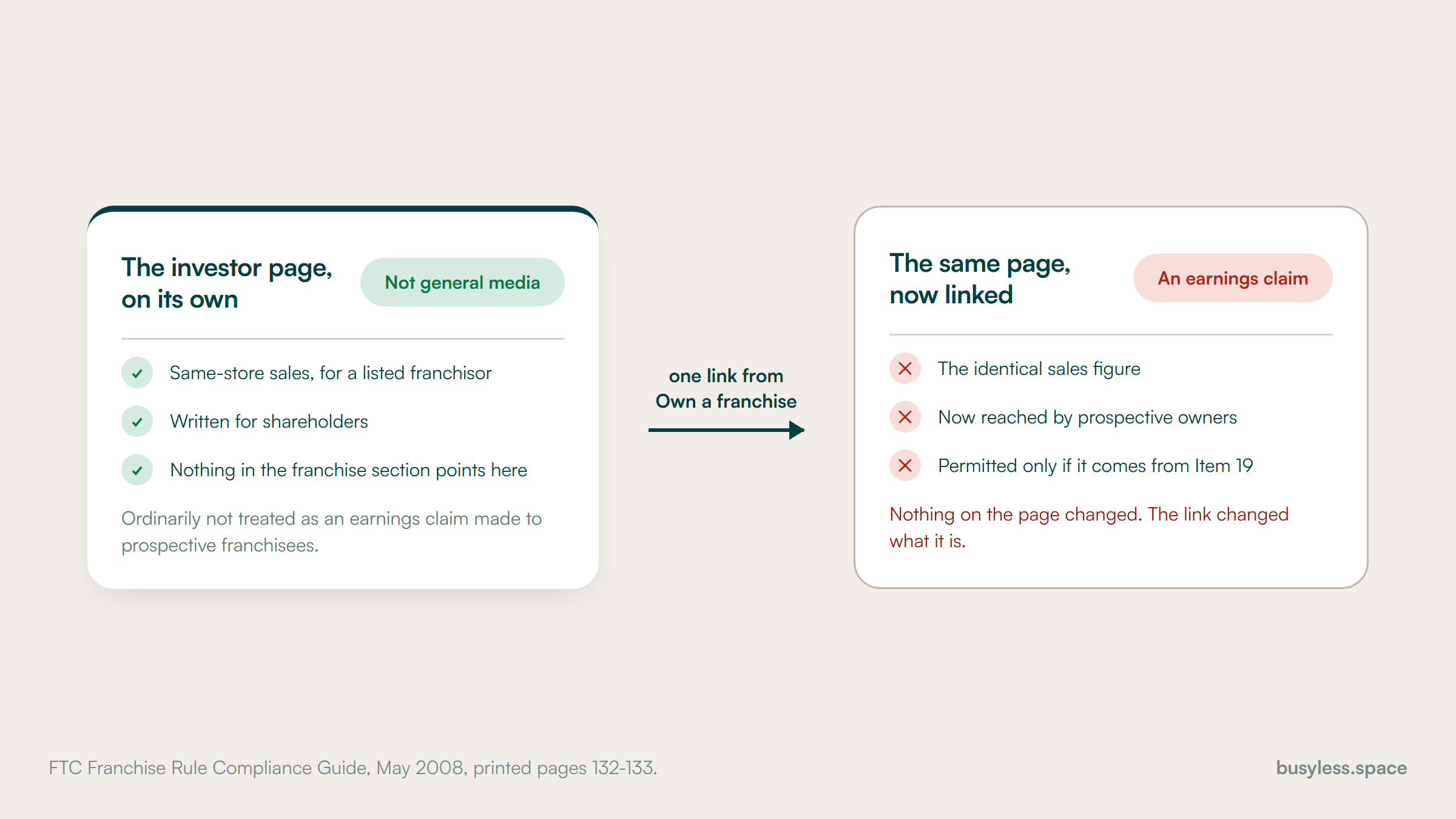
Two panels showing the same investor page. On its own it is not treated as general media; after one link from the franchise section it becomes an earnings claim, with nothing on the page itself changed.
Worth checking in the navigation, the footer and the chatbot's source list, because each of those can create the link without anybody deciding to.

The expensive mistakes

Building a profit calculator for the development site

Costs you An earnings claim outside Item 19, on the page built to rank for the earnings question, working every hour it is live.

Publish Item 19 as it stands, footnoted, and link to it from every place a calculator would have gone.

Leaving last year's Item 19 up after a new document issues

Costs you The rule ties the claim to the current Item 19, so a superseded figure is a claim the document in force no longer supports.

Replace the page the day the new document takes effect, and date every page that quotes it.

Linking Own a franchise to the investor relations page

Costs you Figures that were ordinarily not general media become an earnings claim through a single internal link.

Keep the two sections apart everywhere, including the footer and the chatbot's source list.

Treating a closed unit as a redirect question

Costs you The profile, the phone number and the reviews stay with the departing owner while the URL is being argued about.

Decide by event type in the runbook, before the first transfer, and hold primary ownership of the profiles centrally.

Adding a local search fee in the middle of the term

Costs you A fee not disclosed in the document is what the FTC's 2024 staff guidance treats as likely unlawful, and it lands on every franchisee at once.

Fund it from fees already disclosed, or introduce it at renewal, and put it past counsel first.

Publishing pages for towns in someone else's territory

Costs you A dispute with a franchisee, and a page that contradicts what Item 12 told them about their territory.

Map every location page to exactly one territory before a word of it is written.

What to measure

The two halves run on different clocks and pay the franchisor in different ways. The consumer half pays as a royalty on somebody else's revenue, and the development half cannot close faster than the rule allows, so neither number should be averaged into the other.

Leading indicators

Move first. They predict, they do not prove.

  • Location pages indexed, against units open

    Search Console and your unit list

    A gap between the two is the first sign of a locator hiding units or a template failing. Read it after every opening and every closure.

  • Profile actions, by unit

    Google Business Profile insights

    Calls, direction requests and website clicks per unit, read against each unit's own history rather than against the system average.

  • Impressions on owner-earnings and investment queries

    Search Console, filtered by query

    Whether your own Item 19 and investment pages appear at all beside the portals and data sites. Brand-only reporting hides this completely.

  • Development enquiries, by state

    Your franchise development CRM

    Split by registration status, because an enquiry from a state where you are not registered is a lead you may not be able to pursue.

  • Disclosure document receipts, signed and dated

    Item 23 receipts, logged in your CRM

    The first point in the sale that the rule itself records. Count them by lead source, remembering that fourteen calendar days separate each receipt from any signature.

Business indicators

The ones a manager acts on.

  • Franchise agreements signed, by source

    Your franchise development CRM

    The number the development half exists for. Attribution across a portal, a broker and a discovery day is never clean, so report first and last touch side by side.

  • Gross sales at units, the royalty base

    Franchisee sales reports

    The consumer half's return reaches the franchisor as royalty on this line. Compare units with complete location pages against those without, and say plainly that the comparison is not controlled.

  • Cost per signed agreement, by channel

    Portal and broker invoices, against agreements signed

    Portals and brokers charge for leads, and your own pages do not. This is where the development content earns its budget or fails to.

The verdict

Most franchise SEO services sell the locator, the listings and a page per town. That work is real, and it is half the site. The other half sells the franchise itself, and on the day I read the ten top-ranking pages on the subject, not one mentioned Item 19.

A local SEO strategy for franchises starts with the contract rather than the keyword list. Items 11 and 12 already say who may publish, where and under whose name, and the location pages should be built to what they say rather than to what a vendor's template assumes.

Take the money claims down before anything new is built. Local SEO strategies for franchises that ignore the development half end up sending more prospective owners towards a calculator the rule treats as an earnings claim.

So buy SEO services for franchises from somebody who reads Item 19 before writing a headline, asks where Items 11 and 12 draw the lines, and reports disclosure receipts separately from store visits. Then decide whether you run it yourself or have somebody own it.

FAQ

Franchises SEO questions

  • Can our franchise development page say what an owner earns?
    Only by reproducing Item 19. The rule allows an earnings claim only where it is in Item 19 with a reasonable basis. It also requires the dates, the number and percent of outlets that reached the figure, and a warning that results may differ. With no Item 19, the FTC's guide says no figure may appear on a website at all.
  • Is a franchise ROI calculator allowed on the development site?
    Not as an earnings tool. The definition of a financial performance representation includes a mathematical calculation showing possible results from a combination of variables, which describes a calculator exactly. A worksheet showing only the costs from Items 5 to 7 is a different thing, and still worth putting past counsel under state advertising rules.
  • Can we publish the investment needed to open a unit?
    Yes, and in full. The FTC's guide says cost or expense data alone is not an earnings claim, so Items 5, 6 and 7 can go on the page. What turns it into one is a sales figure beside it that lets a reader work out profit.
  • Do we have to file the franchise website with each state?
    Possibly, state by state. New York, California, Washington, Maryland and Minnesota expect franchise advertising filed before use, and several exempt a website not directed at their residents if conditions are met. California treats an email to a named lead as directed. Take the list to franchise counsel rather than trusting a published summary.
  • Should franchisees be allowed websites of their own?
    Decide it in Item 11, which must say when franchisees may use their own advertising material. A franchisor also has a trademark reason to review what they publish under the mark. The franchisee's side of the same question is covered in the fitness gyms playbook, from the operator's chair.
  • What happens to a location page when a franchise unit is sold?
    It should stay, because the territory is still served. A transfer changes the owner's name on the page, the legalName in the markup and the profile's managers, and keeps the URL, the reviews and ideally the phone number. A closure is different: the page says so and points to the nearest open unit.
  • Can we say our brand is SBA approved?
    No. The SBA Franchise Directory states that placement is not an endorsement or approval of the brand. Say the brand is listed in the directory, link to the entry, and let the financing page explain what the listing does and does not mean.
  • What does franchise SEO cost?
    The tiers above are editorial estimates, from $4,000 to $30,000 a month to run it yourself or with help, and they move with the number of units and with counsel's time. The development half never scales the way the consumer half does, because every page it adds needs a legal read.
  • Does a franchise system need outside help with local search?
    Not at the start. Local SEO for franchises is mostly profiles, locator links and one location template, and a marketing team can run it once Items 11 and 12 are mapped. Local SEO services for franchises earn their fee later, when turnover, approvals and per-unit tracking outgrow a spreadsheet.
  • How should a franchisor judge SEO agencies for franchises?
    By what they propose for the development pages. A provider suggesting a profit calculator or an earnings-potential page has not read the rule, and one that cannot say who keeps the profiles when a unit changes hands has not run a system. Do not hire until Item 19 is on the page.
  • What should local SEO marketing for franchises actually include?
    The consumer half: location pages, profiles, each unit's own reviews and the turnover runbook. It should stop at the development pages, which need franchise counsel as well as a marketer. If a proposal treats both halves as one campaign, ask for them to be split before you sign anything.

Run it yourself, or have someone own it

Everything above is written to be run without us, and the free path is genuinely most of the value for a single-location business. Where these plans stall is almost never the plan. It is that nobody owns it after the first month. That is the job we do, with search as one distribution layer inside a wider system rather than the whole engagement.