
Skip to content

Flooring SEO strategy

Regulated marketing

The sample and the estimate are the conversions, not the sale

Written by Eugene SuslovLast reviewed 29 August 2026No affiliate links
Sector
Retail and ecommerce
Model
Local service, Ecommerce
Competition
High
Time to results
5 to 9 months
Typical monthly
$1,500 to $6,000

Key takeaways

  1. 1Nothing on your website is the sale. A free sample and a measurement appointment are the conversions, so a page that ranks and does not produce one of those two things has done nothing.
  2. 2Your product pages are already published by everybody else. Manufacturers supply the copy and the buying co-ops supply the site, so several thousand dealers describe the same SKU in the same words. Rewriting one range beats adding fifty.
  3. 3Cost per square foot is the query that decides the market. It is the highest-intent research phrase in the category and almost every dealer answers it with a form.
  4. 4Photograph installed floors, not swatches. Manufacturer renders are the visual signature of a dealer with nothing of its own, and installed photography is the only image asset a competitor cannot download.
  5. 5Low-VOC is a claim with paperwork. TSCA Title VI puts you inside the compliance chain as a retailer, so the phrase on your product page has a document behind it or it should not be there.

SEO for flooring companies has to be built around a website that never takes the money. Somebody researches for weeks, orders a sample, books a measurement, and signs in a showroom or at a kitchen table long after the last session ended.

That single fact rearranges everything. The conversion worth optimising is a sample request or an appointment, the attribution window is measured in weeks rather than days, and a page that ranks beautifully and produces neither is decoration.

It also explains why so much flooring SEO strategy work goes into the wrong half of the site. The product catalogue feels like the shop, so it gets the attention, but the catalogue is the one part of the site that is not yours.

Manufacturers supply product descriptions and buying co-operatives supply the website. CCA Global alone covers roughly 2,700 outlets across Carpet One and Flooring America, all running the same platform. Several thousand dealers therefore publish the same sentences about the same plank.

The way out is not more pages. It is the material the manufacturer cannot give you: your installed prices, your photographs of finished rooms in local housing stock, your subfloor problems, your fitters, and an honest answer to what a job actually costs.

There is a compliance layer underneath that most dealers have never thought about as marketing. Formaldehyde standards, country-of-origin claims and warranty availability all land on the product page, and they turn three common marketing words into claims with documents behind them.

Who already ranks in flooring companies

Search a material term and then the same term with your town attached, and notice that they are two different markets. Almost every flooring SEO audit finds the national half occupied by big-box retailers and manufacturers, and the local half occupied by lead marketplaces sitting above every showroom in the area.

What is on the results page

  • Big-box retailers owning the material and product head terms
  • Manufacturer sites ranking for their own product names, above their dealers
  • Local pack on store and installer queries
  • Lead marketplaces above independent showrooms on installation terms
  • Image packs on style, colour and room queries, unusually prominent
  • People Also Ask, dominated by cost and by which material suits which room
  • Shopping results on product terms, which a showroom cannot enter without a feed
  • The Home Depot

    homedepot.com

    Owns the material head terms outright and is not worth attacking there. What it is bad at is the specific: a subfloor problem in a 1940s house, what a job costs installed in your county, whether a product suits a basement. Concede the category term and win the qualified one.

  • Lowe's

    lowes.com

    The same shape, plus a room visualiser and an installation programme that make it a genuine competitor for the job rather than only for the product. Read its installation pages to see what a homeowner has already been told before they reach you.

  • Floor & Decor

    flooranddecor.com

    A specialist with national authority and physical stores, so it competes on both halves at once. Where a big-box page is generic, its pages are not, which makes it the more useful competitor to study for structure and the harder one to outrank.

  • Houzz

    houzz.comClaim it

    Unusually strong in this category because flooring is chosen visually and Houzz is where people collect pictures. A properly built profile with real project photography ranks and refers, and it is the one directory here where the photographs matter more than the description.

  • Angi

    angi.comClaim it

    Sits above independent showrooms on installation queries and sells the introduction back. Treat it as a bridge while your own pages mature, and measure it on cost per won job rather than cost per lead.

  • Google Business Profile

    google.comClaim it

    Different from a pure service trade because you have a showroom people actually visit, so the photographs, the product categories and the hours all do real work. Add the materials you stock as services, and keep the photographs of the showroom current.

  • Manufacturer dealer locators

    shawfloors.comClaim it

    Every brand you carry has one, and most dealers fill them in once and never look again. They rank for brand plus location, which is the highest-intent query in the category, and the listing is free. Check what each one currently says about you.

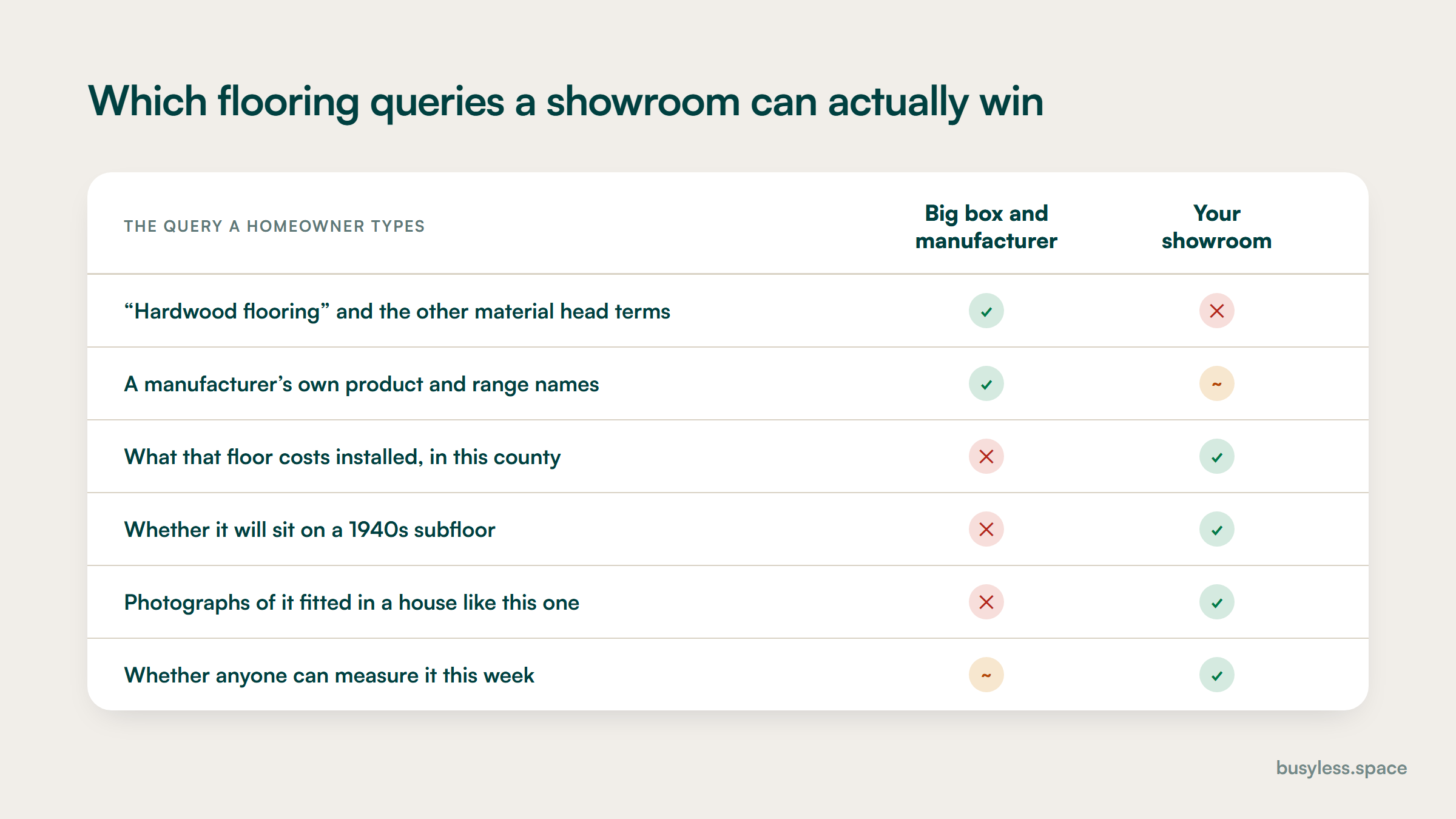
Six flooring queries scored in two columns, big box and manufacturer against your showroom, with a tick, a cross or a partial mark in each
Neither column sweeps, and that is the point. The head terms are genuinely theirs; everything a homeowner asks next is genuinely yours.

What people actually search

The cluster that decides this market is cost, and it is the one most dealers refuse to answer. The second is the room question, which is really a durability question wearing a decorating costume, and it is where a showroom can beat a national retailer on judgement.

Cost per square foot

Informational, immediately pre-commercial

how much does vinyl plank flooring cost installed

The page that wins it: Cost page with your own installed ranges and what moves them

The highest-intent research query in the category and the one almost every dealer answers with a contact form. The dealer who publishes real installed ranges wins the visit, because the alternative is a homeowner guessing from a national average that does not apply to them.

Material comparison

Commercial investigation

luxury vinyl plank vs laminate

The page that wins it: Comparison page written from fitting experience, not from spec sheets

Every manufacturer has written this page and all of them are conflicted. A retailer that fits both can say which one actually fails, in which rooms, and how the complaint arrives two years later. That is the version nobody else can write.

Room and use case

Informational, constraint-led

best flooring for a basement

The page that wins it: Room guide organised by the constraint, not by the product

A durability question in decorating language. Moisture, subfloor, movement and traffic decide it, and the honest answer often rules out the material the customer arrived wanting. Ruling something out is what makes the page trustworthy.

Look and style

Informational, visual

wide plank light oak living room

The page that wins it: Photographed galleries of finished rooms, filterable by material

The only cluster where image results matter more than text, and the one where manufacturer renders lose to real photographs of real houses. Local housing stock is a genuine advantage: a room that looks like the reader's own room converts.

Local retail

Local commercial

flooring stores near me

The page that wins it: Showroom page stating what is physically on display

Almost every showroom page describes the business rather than the showroom. What is actually on the floor, how many samples, whether you can take them home and whether anyone can measure this week are what the query is really asking.

Installation and subfloor

Informational, with a job attached

can you lay lvp over ceramic tile

The page that wins it: Subfloor and preparation guide, honest about when the answer is no

The cluster where a fitter's knowledge shows. It also protects margin: most disputes in this trade start with subfloor preparation that was skipped, and a page explaining why it is on the quote defuses that before it happens.

Durability for pets and children

Commercial, anxiety-led

scratch resistant flooring for dogs

The page that wins it: Durability page comparing wear layers and finishes in plain terms

A high-converting cluster because the customer has a specific fear and a deadline, usually a new puppy or a toddler. It rewards specifics: wear layer thickness in mils, finish type, and what you have seen come back.

Brand and product research

Commercial, brand-led

shaw floorte reviews

The page that wins it: Range page written by you, not the copy the manufacturer supplied

Where the duplicate-copy problem bites hardest, because you are competing with the manufacturer and with every other dealer using identical text. A short, genuinely independent read on a range you fit regularly is a page nobody else has.

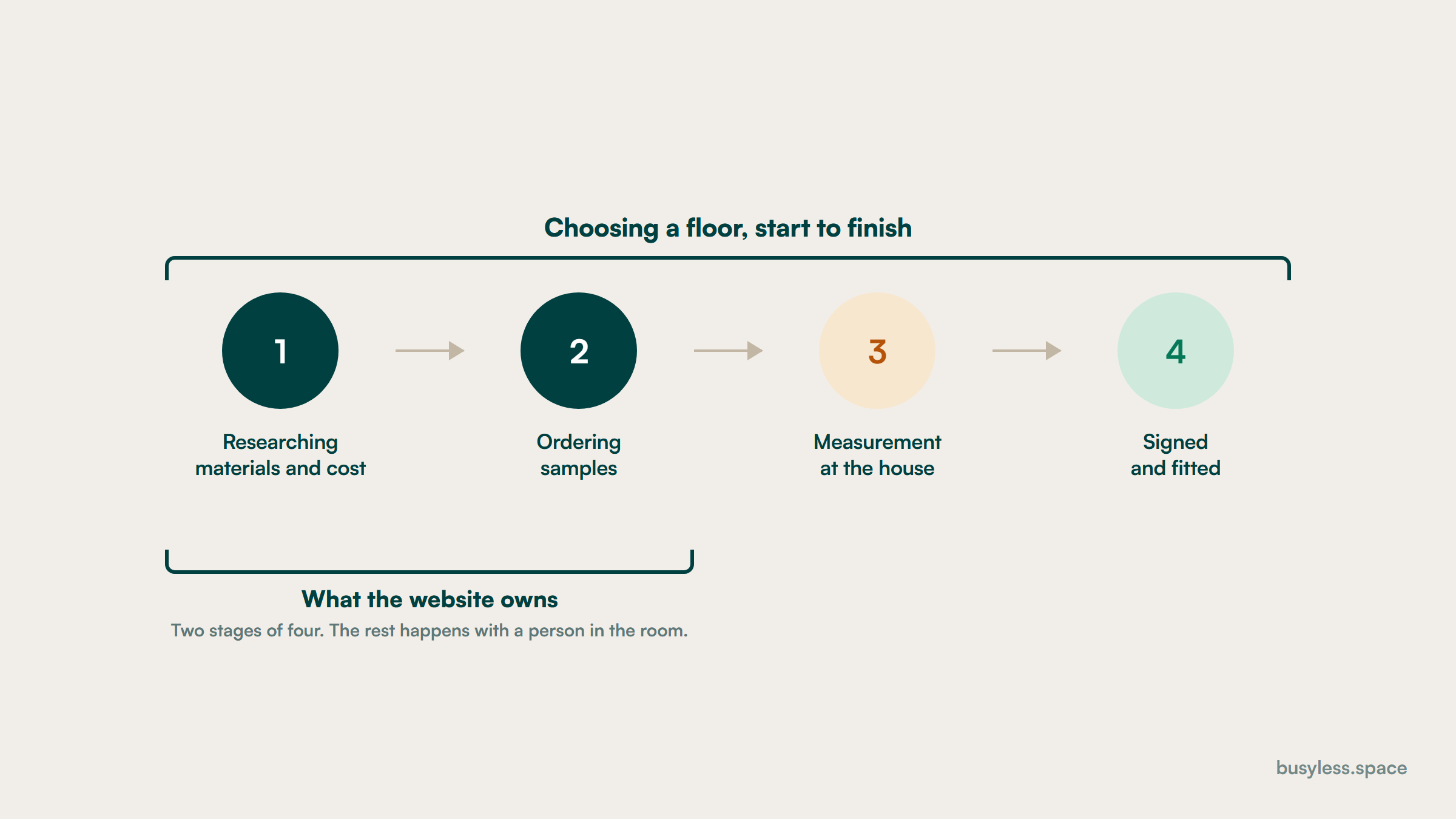
The four stages of a flooring purchase with a bracket marking the two the website is responsible for and the two that happen in person
Judging the site on the fourth stage is what makes flooring marketing look broken. It was never asked to reach that far.

What the rules change

Three rules turn ordinary flooring marketing words into claims with documents behind them, and all three land on a product page rather than in a contract. This is my reading rather than legal advice, and a compliance officer should see the wording before it ships.

1

Composite wood must be labelled and documented as TSCA Title VI compliant

EPA, formaldehyde emission standards for composite wood products, 40 CFR part 770

What it means

Since 22 March 2019 composite wood panels made in or imported into the United States must carry a TSCA Title VI compliance label, and fabricators, importers, distributors and retailers must hold invoices or bills of lading stating compliance.

So do this

Treat "low-VOC" and "formaldehyde-free" as claims you have to be able to evidence, and keep the supplier documents for the ranges you make them about. Then say it properly on the page, naming the standard rather than gesturing at healthiness.

2

An unqualified Made in USA claim has a high bar

FTC Made in USA Labeling Rule, 16 CFR 323, in force since August 2021

What it means

An unqualified Made in USA claim requires that all or virtually all of the product be made domestically. The rule is enforceable with civil penalties, which the policy statement that preceded it was not.

So do this

Audit the badge on every range page. Where a product is assembled here from imported components, qualify the claim precisely rather than dropping a flag on the template and hoping.

3

Warranty terms must be available before the sale, not after it

FTC Rule on Pre-Sale Availability of Written Warranty Terms, 16 CFR 702

What it means

Sellers of consumer products carrying a written warranty must make the warranty text available to the shopper before purchase. Flooring is sold heavily on warranty length, which makes this a rule about your product pages.

So do this

Link the actual warranty document from every range that advertises one, and summarise what voids it. This also removes the most common source of post-installation dispute, which is a customer discovering the exclusions afterwards.

4

Advertising finance terms triggers required disclosures

Regulation Z, 12 CFR 1026.24, Truth in Lending

What it means

Stating a triggering term in an advertisement, such as a monthly payment, a down payment, a repayment period or a finance charge, obliges the advertiser to include the further disclosures the rule specifies.

So do this

Decide deliberately whether a promotional finance banner is worth carrying the disclosure. Many dealers run "nothing to pay for twelve months" across every page without it, which is the most common advertising breach in the category.

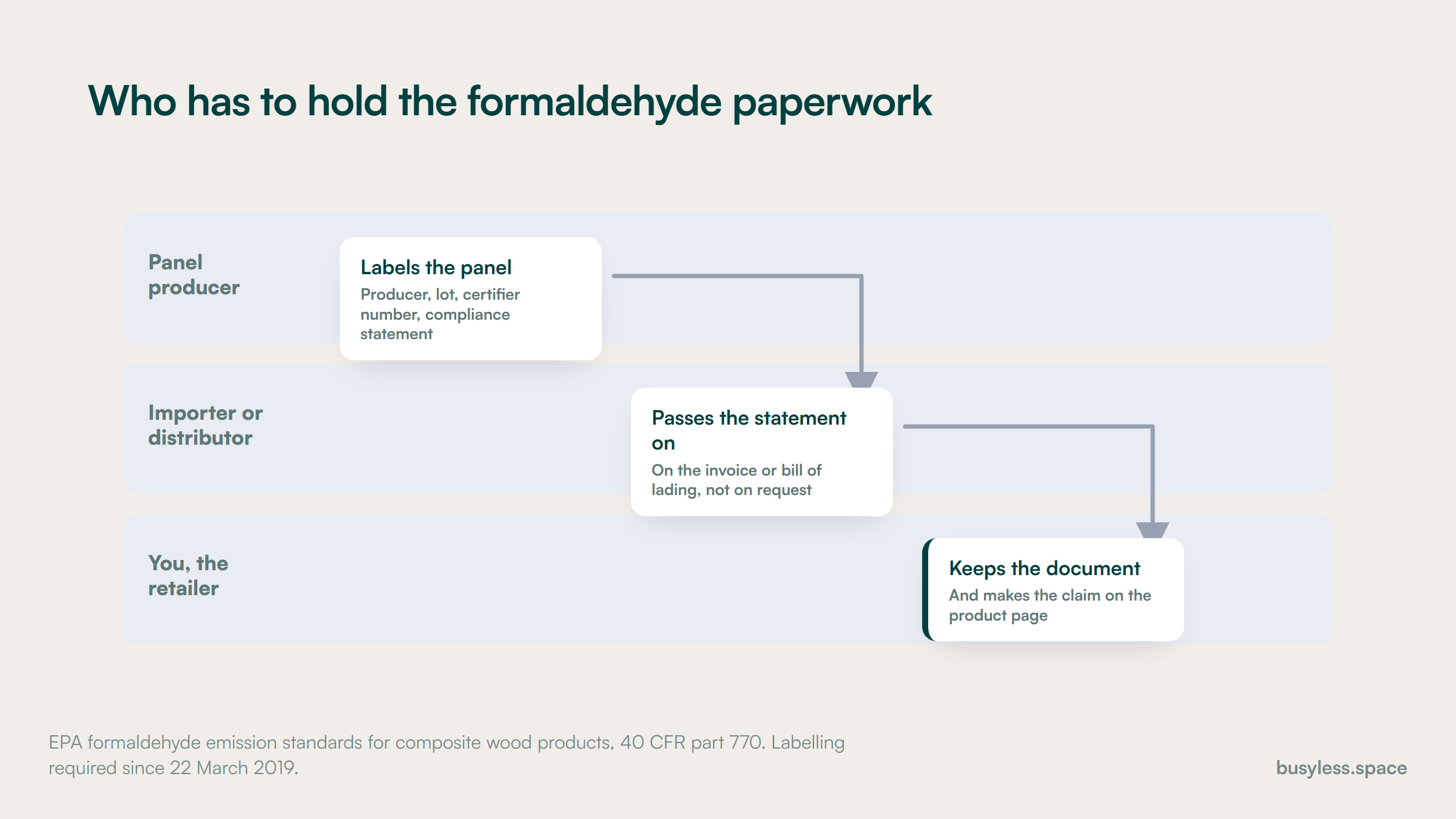
Three parties in the composite wood supply chain and the compliance document each must hold, showing the retailer inside the chain rather than beside it
The reason a marketing word on a product page becomes a claim: the retailer is a link in the chain, not an observer of it.

Proving expertise

Expertise in this trade is demonstrated by what you have fitted and what has come back, and neither of those things can be sourced from a supplier. Almost every signal below is a photograph or a number the dealer already owns and has never published.

  • Photographs of finished rooms in local housing, with the material and the year named
  • Installed price ranges you will stand behind, updated and dated
  • Named fitters with their certifications and years in the trade
  • A written subfloor preparation standard, published rather than described
  • Manufacturer certifications and dealer status, linked to the brand's own locator
  • The warranty documents themselves, not a summary of them
  • An honest page on what you will not fit, and why
  • Reviews that name the fitter and the material

How to build a flooring SEO strategy

The order below fixes the site you already have before it adds anything, because in this trade the biggest available gain is usually rewriting the pages the manufacturer wrote for you. A flooring SEO strategy that opens by publishing more product pages makes the problem it is trying to solve slightly worse.

  1. 1

    Weeks 1-3

    Find out what is actually yours

    • Audit the product catalogue for copy supplied by manufacturers or the co-op
    • Check what your template lets you edit, and what it does not
    • Claim every manufacturer dealer locator and correct the details
    • Set up conversion tracking for sample requests and appointment bookings
    • Photograph six finished rooms with the material and location recorded

    You end up with
    A list of what you control, and a working count of the two conversions that matter

  2. 2

    Weeks 4-7

    Answer the cost question properly

    • Publish installed price ranges by material, with what moves them
    • Write the two or three material comparisons you can speak to from fitting
    • Rewrite the ranges you sell most, in your own words
    • Publish the subfloor preparation standard
    • Add the warranty documents to every range that advertises one

    You end up with
    A cost page and three comparison pages that no other dealer could have written

  3. 3

    Weeks 8-11

    Make the visual half yours

    • Build the finished-room gallery, filterable by material and room
    • Replace manufacturer renders on the pages that matter most
    • Write the room-by-room guides organised around the constraint
    • Rewrite the showroom page to describe the showroom
    • Compress and caption every image properly

    You end up with
    An image library nobody else has, doing work on the queries that are decided visually

  4. 4

    Weeks 12-16

    Close the loop the analytics cannot see

    • Connect sample and appointment requests to signed jobs in your own records
    • Start the review habit, asking customers to name the fitter and the material
    • Add the durability and pet pages
    • Review which marketplace spend is still earning its margin
    • Report leading and business indicators separately for the first time

    You end up with
    A monthly report that survives the weeks-long gap between the click and the contract

Technical fixes with the best payoff

The defects here recur across the whole market rather than one site at a time, and the reason is structural: the buying co-operatives supply the platform and the manufacturers supply the copy, so a dealer inherits the same problems as every other dealer on the same programme.

  • Product copy identical to several thousand other dealers

    A range a day, ongoing

    Manufacturers distribute product descriptions and the co-op platforms ingest them, so the same paragraph about the same plank is published by every member store in the country. Canonicalisation cannot help: none of the copies is the original.

    Rewrite the ranges you actually sell, starting with the top twenty by revenue. Two paragraphs of genuine fitting experience per range beats a catalogue of five hundred untouched ones.

  • The room visualiser is an iframe with nothing crawlable in it

    A day

    Visualisers are third-party embeds, so the most engaging thing on the site contributes no text, no headings and often no measurable interaction.

    Keep the tool, but wrap it in a real page with real copy about choosing that material, and fire an event when somebody uses it. Then it is a conversion step rather than a decoration.

  • Sample requests are not counted as conversions

    Half a day

    The template treats the sample form as a contact form, so the single best predictor of a sale in this trade is recorded in the same bucket as somebody asking about opening hours.

    Separate the events: sample request, appointment booking, quote request, general enquiry. Nothing else in this list changes decision-making as much.

  • Every image is a manufacturer swatch

    An afternoon per month

    The catalogue feed ships images and the template uses them, so a dealer's site looks exactly like the manufacturer's and exactly like its competitors'.

    Photograph finished installations and use those on the range pages. This is the single largest differentiator available and it costs a phone and a habit.

  • Nothing on the site says where you will travel to

    An hour

    A showroom serves a driving radius for retail and a wider one for installation, and the template has one address field for both.

    State both explicitly, and mean it. A page that says which counties you fit in prevents the enquiries you cannot serve and helps the ones you can.

  • The showroom page describes the company, not the showroom

    Half a day

    Co-op templates ship an About page and most dealers never replace it, so the highest-intent local query lands on corporate history.

    Say what is on display, how many samples can go home, whether measuring is available this week, and where to park. Photograph the inside.

Structured data that applies here

The types below fit this industry specifically. Most of them earn no rich result on their own, which is worth knowing before anyone sells the work on that basis. What they do is describe the entity precisely, which matters for how search engines and answer engines resolve who you are.

  • HomeGoodsStore

    Home page and each showroom page

    More specific than the generic LocalBusiness the co-op template usually emits, and it carries the properties a showroom actually needs: opening hours, department, payment methods and the brands carried.

    HomeGoodsStore.jsonld
    {
      "@context": "https://schema.org",
      "@type": "HomeGoodsStore",
      "name": "[BUSINESS NAME]",
      "url": "https://[YOUR-DOMAIN]/",
      "telephone": "[+1-555-000-0000]",
      "image": "https://[YOUR-DOMAIN]/[PHOTO-OF-YOUR-SHOWROOM].jpg",
      "priceRange": "[$$]",
      "address": {
        "@type": "PostalAddress",
        "streetAddress": "[STREET]",
        "addressLocality": "[CITY]",
        "addressRegion": "[STATE]",
        "postalCode": "[ZIP]",
        "addressCountry": "US"
      },
      "openingHoursSpecification": [
        {
          "@type": "OpeningHoursSpecification",
          "dayOfWeek": ["Monday","Tuesday","Wednesday","Thursday","Friday"],
          "opens": "[09:00]",
          "closes": "[17:30]"
        }
      ],
      "brand": [
        { "@type": "Brand", "name": "[BRAND YOU CARRY]" },
        { "@type": "Brand", "name": "[BRAND YOU CARRY]" }
      ],
      "areaServed": [
        { "@type": "AdministrativeArea", "name": "[COUNTY]" },
        { "@type": "AdministrativeArea", "name": "[COUNTY]" }
      ]
    }
  • Product with UnitPriceSpecification

    Each range or product page that carries a price

    Several trades here quote per square foot, but flooring is the only one where that price sits on a product page rather than inside a quote, which is why the unit belongs in the markup. Without it a price of 4.99 is ambiguous between a plank, a box and a square foot.

    Product with UnitPriceSpecification.jsonld
    {
      "@context": "https://schema.org",
      "@type": "Product",
      "name": "[RANGE NAME]",
      "description": "[YOUR OWN DESCRIPTION, NOT THE MANUFACTURER'S]",
      "brand": { "@type": "Brand", "name": "[MANUFACTURER]" },
      "image": "https://[YOUR-DOMAIN]/[PHOTO-OF-IT-INSTALLED].jpg",
      "offers": {
        "@type": "Offer",
        "availability": "https://schema.org/InStock",
        "priceSpecification": {
          "@type": "UnitPriceSpecification",
          "price": "[PRICE]",
          "priceCurrency": "USD",
          "unitCode": "FTK",
          "unitText": "square foot"
        },
        "seller": {
          "@type": "HomeGoodsStore",
          "name": "[BUSINESS NAME]",
          "url": "https://[YOUR-DOMAIN]/"
        }
      }
    }
  • WarrantyPromise

    Any range page advertising a warranty

    A real schema.org type that almost nobody uses, and it pairs directly with the pre-sale availability rule: if you are advertising the warranty as a reason to buy, describe it in the markup and link the document on the page.

    WarrantyPromise.jsonld
    {
      "@context": "https://schema.org",
      "@type": "Product",
      "name": "[RANGE NAME]",
      "offers": {
        "@type": "Offer",
        "priceCurrency": "USD",
        "price": "[PRICE]",
        "warranty": {
          "@type": "WarrantyPromise",
          "durationOfWarranty": {
            "@type": "QuantitativeValue",
            "value": "[25]",
            "unitCode": "ANN"
          },
          "warrantyScope": {
            "@type": "WarrantyScope",
            "name": "[Residential wear, manufacturer limited warranty]"
          }
        },
        "seller": {
          "@type": "HomeGoodsStore",
          "name": "[BUSINESS NAME]"
        }
      }
    }
  • Service for installation

    The installation page and each material's fitting page

    The retail half and the fitting half are different offerings to the same customer, and separating them in the markup is what lets the installation pages compete on installer queries rather than on product ones.

    Service for installation.jsonld
    {
      "@context": "https://schema.org",
      "@type": "Service",
      "serviceType": "[Luxury vinyl plank installation]",
      "provider": {
        "@type": "HomeGoodsStore",
        "name": "[BUSINESS NAME]",
        "url": "https://[YOUR-DOMAIN]/"
      },
      "areaServed": [
        { "@type": "AdministrativeArea", "name": "[COUNTY]" }
      ],
      "hasOfferCatalog": {
        "@type": "OfferCatalog",
        "name": "[Installation services]",
        "itemListElement": [
          {
            "@type": "Offer",
            "itemOffered": { "@type": "Service", "name": "[Subfloor preparation]" }
          },
          {
            "@type": "Offer",
            "itemOffered": { "@type": "Service", "name": "[Old floor removal and disposal]" }
          }
        ]
      }
    }
  • ImageObject on the finished-room gallery

    The gallery, and each range page carrying installed photography

    Worth doing here specifically because the style and colour clusters are decided in image results, and because your photographs are the only images on the site that are not also on five thousand other dealer sites.

    ImageObject on the finished-room gallery.jsonld
    {
      "@context": "https://schema.org",
      "@type": "ImageObject",
      "contentUrl": "https://[YOUR-DOMAIN]/[PHOTO].jpg",
      "name": "[MATERIAL] in a [ROOM TYPE] in [TOWN]",
      "description": "[RANGE NAME] fitted in [MONTH YYYY]. [ONE DETAIL ABOUT THE SUBFLOOR OR THE ROOM.]",
      "creator": {
        "@type": "HomeGoodsStore",
        "name": "[BUSINESS NAME]",
        "url": "https://[YOUR-DOMAIN]/"
      },
      "contentLocation": {
        "@type": "Place",
        "address": {
          "@type": "PostalAddress",
          "addressLocality": "[TOWN]",
          "addressRegion": "[STATE]"
        }
      }
    }
  • FAQPage

    The cost page and the subfloor guide

    The questions worth marking up are the ones that decide the visit: what a job costs installed, what is included, and when the honest answer to a customer's plan is no.

    FAQPage.jsonld
    {
      "@context": "https://schema.org",
      "@type": "FAQPage",
      "mainEntity": [
        {
          "@type": "Question",
          "name": "[What does LVP cost installed?]",
          "acceptedAnswer": {
            "@type": "Answer",
            "text": "[In our area, $X to $Y per square foot installed. Subfloor preparation, removal of the old floor and stairs are the three things that move it most.]"
          }
        },
        {
          "@type": "Question",
          "name": "[Is the old floor removal included?]",
          "acceptedAnswer": {
            "@type": "Answer",
            "text": "[Yes or no, and what it costs if not. Say it plainly here rather than in the quote.]"
          }
        }
      ]
    }

What it costs

These are editorial estimates of what the work takes, not a price list and not survey data. Flooring sits above the trades in this directory for one specific reason: photography is a recurring line rather than a one-off, and it is the part of the budget that produces the differentiation.

Do it yourself

$0 to $400
  • Rewritten copy on your top ten ranges
  • A published installed-cost page
  • Finished-room photographs taken on a phone
  • Every manufacturer dealer locator claimed and corrected
  • Sample and appointment requests separated in analytics

Who it suits

A single showroom where the owner or a manager knows the products well enough to write about them and has an hour a week.

Where it stops

The material comparison and room guide set is a lot of writing, and it is the part that produces the top-of-funnel traffic.

Lean

$1,500 to $3,000
  • Everything above, plus a writer working from your fitters' knowledge
  • The comparison and room guide set built out properly
  • Monthly installed photography
  • Technical work inside whatever the co-op template allows

Who it suits

One or two showrooms with a fitting team, where the knowledge exists in the business but nobody has time to write it down.

Where it stops

Connecting a sample request to a signed job months later needs process work in the business, not more marketing.

Funded

$3,000 to $6,000
  • The full range catalogue rewritten rather than the top twenty
  • A properly built gallery with structured data and filtering
  • Paid search on cost and installation terms
  • Reporting that bridges the weeks between the enquiry and the contract

Who it suits

Multi-showroom retailers, or a single large one with a commercial arm and enough volume that a percentage point of close rate is worth real money.

Where it stops

Beyond this the constraint is fitting capacity, and marketing that outruns the fitting diary damages the reviews it depends on.

How to do it with no budget

Unusually productive in this trade, because the two highest-value assets are a price you already know and photographs of work you have already done. Neither costs anything except the decision to publish them.

  1. 1

    Publish installed price ranges

    A morning

    Your own quoting history

    Pull the last thirty jobs by material and state the range honestly, with the three things that move it. This is the highest-value free page available and most competitors will not copy it.

  2. 2

    Photograph finished rooms before you leave

    5 minutes a job

    A phone

    Make it the last step of every installation. Record the material, the room and the town. Within a year you have an image library no competitor can assemble retrospectively.

  3. 3

    Rewrite your ten best-selling ranges

    An hour a range

    Your own website editor

    Two paragraphs each on who it suits, where it fails and what fitting it is actually like. You are replacing text that several thousand other dealers are also publishing.

  4. 4

    Claim every manufacturer dealer locator

    2 hours

    Each brand's dealer portal

    Brand plus location is the highest-intent query in the category and these listings rank for it. Most dealers filled them in once, years ago, and the details are wrong.

  5. 5

    Separate your conversions

    2 hours

    Google Analytics and Search Console

    Sample request, appointment, quote and general enquiry as four distinct events. Until this exists, no other decision in this playbook can be judged.

  6. 6

    Write the subfloor standard down

    2 hours

    Your website editor

    What you check, what you charge to correct, and why you will not fit over certain substrates. It ranks, it converts, and it prevents the dispute that costs a review.

  7. 7

    Get the compliance statements from your three biggest suppliers

    An hour, then filing

    Email, and your existing invoices

    TSCA Title VI puts you inside the documentation chain as a retailer, so this is the paperwork behind every low-VOC claim on the site. Ask once, file it, and the claim becomes something you can stand behind rather than something you inherited.

The tool stack

Small, and weighted toward the two things this trade is short of: knowing which material terms are worth writing for, and running a product catalogue you actually control.

  • Find the material and room queries worth a page

    Keyword ToolSEO APIRead the review

    The useful demand here is long and specific rather than broad: a room, a constraint and a material together. Broad material terms belong to the big-box retailers and chasing them wastes the budget.

    Free routeSearch Console's query report, filtered to questions

  • Run a product catalogue you own rather than inherit

    CrystallizeHeadless CMSRead the review

    Relevant only if you can leave the co-op platform, which many dealers cannot. Where you can, modelling ranges, finishes, wear layers and installed prices as real records is what makes rewriting the catalogue a one-time job rather than a permanent one.

    Free routeWhatever your co-op template allows, documented honestly

  • Work out what a piece of content actually costs you

    Content Marketing Cost CalculatorFree toolOpen the tool

    Worth running before committing to rewriting a catalogue. The answer usually justifies doing the top twenty ranges properly instead of all five hundred badly, which is the decision this whole page turns on.

    Free routeFree

  • Measure the two conversions that matter

    Google Analytics, with four distinct events

    Sample, appointment, quote, enquiry. Anything that reports them as one number will tell you the site is working when only the least valuable of the four is moving.

    Free routeFree

  • Store and caption the photography

    Whatever your team will actually use

    The library fails on organisation rather than on capture. Material, room, town and date in the filename at the point of shooting, or the photographs are unusable in two years.

    Free routeA shared drive with a naming convention

  • Keep the visualiser measurable

    Your visualiser vendor's event hooks

    Most dealers cannot say whether the visualiser produces anything. At minimum, count who opens it and whether those sessions request samples more often than sessions that do not.

    Free routeA click event on the launch button

Take it from here

Everything below is meant to be filled in and used rather than read. Bodies are plain text, so what lands on your clipboard is exactly what you see, brackets and all.

Checklist

Finds out how much of your catalogue is text every other dealer is also publishing, before you decide what to rewrite.

DUPLICATE COPY AUDIT
Site: [YOUR DOMAIN]
Platform: [CO-OP NAME / OWN BUILD]
Date: [DATE]

STEP 1 - PICK THE SAMPLE
List your top 20 ranges by revenue over the last 12 months.
1. [RANGE]          Revenue rank: [1]
2. [RANGE]          Revenue rank: [2]
...

STEP 2 - TEST EACH ONE
For each range, copy one distinctive sentence from your product page.
Search it in quotation marks.

Range: [RANGE NAME]
Sentence tested: "[SENTENCE]"
Number of other sites publishing it: [N]
Is the manufacturer one of them? [Y/N]
Verdict: [OURS / SUPPLIED / MIXED]

STEP 3 - RECORD WHAT YOU CONTROL
[ ] Can you edit product page body copy?          [Y/N]
[ ] Can you replace product images?               [Y/N]
[ ] Can you edit title tags and meta descriptions? [Y/N]
[ ] Can you add schema markup?                    [Y/N]
[ ] Can you change URL structure?                 [Y/N]
[ ] Can you add new page templates?               [Y/N]

STEP 4 - THE DECISION
Ranges to rewrite this quarter: [N]
Order them by revenue, not by how bad the copy is.
Leave the tail alone. A smaller catalogue of genuine pages
outperforms a large one of supplied text.

REWRITE QUEUE
[ ] [RANGE] - [OWNER] - [DATE]
[ ] [RANGE] - [OWNER] - [DATE]
[ ] [RANGE] - [OWNER] - [DATE]

What to publish

Almost everything worth publishing here already exists inside the business as knowledge or as photographs. The job is extraction rather than invention, which is why the production bottleneck is the fitters' time rather than a writer's.

  • The installed cost page

    Once, reviewed quarterly

    Answers the highest-intent research query in the category with something a national retailer cannot: your prices, in your area, with the three things that change them.

  • Material comparisons written from fitting experience

    One a month until the main pairs are covered

    Every manufacturer has written this page and every one of them is conflicted. A retailer who fits both can say which fails, where, and how the complaint arrives.

  • Room guides organised by constraint

    One a month

    Moisture, subfloor and traffic decide the answer, not decor. Organising around the constraint produces advice, and often the useful answer is that the customer's plan will not work.

  • The finished-room gallery

    Continuous, five minutes a job

    The style cluster is decided in image results and this is the only image asset a competitor cannot download. Local housing makes it convert as well as rank.

  • Rewritten range pages

    A range a day until the top twenty are done

    Replaces text several thousand dealers publish identically. Start with the twenty ranges that carry the revenue rather than the whole catalogue.

  • The subfloor preparation standard

    Once, reviewed annually

    Ranks on a genuinely searched question, demonstrates expertise better than any About page, and defuses the single most common dispute in the trade.

And what not to

  • Manufacturer product copy published verbatim, which is the default state and the core problem
  • History of hardwood flooring articles, which rank for nothing and read as filler
  • A page per town with the name swapped, on a business with one showroom
  • Manufacturer renders presented as your own work
  • Trend round-ups that name colours without saying what they cost to fit

Three levels of dealer website, from wholly supplied copy and renders up to your own installed prices and photography
Almost every dealer site in the country sits on the bottom rung. Moving one rung takes twenty ranges, not five hundred.

The expensive mistakes

Treating the website as a shop

Costs you Effort goes into a catalogue you do not control while the two pages that actually produce appointments stay unwritten.

Optimise for the sample request and the measurement booking. Those are your conversions; the sale happens elsewhere and always will.

Hiding prices behind a form

Costs you The highest-intent query in the category sends the visitor to a competitor who answered it, or to a national average that does not apply here.

Publish installed ranges and what moves them. You will lose some tyre-kickers and gain the people who were ready.

Adding hundreds of untouched product pages

Costs you A larger catalogue of text that several thousand other dealers already publish, which dilutes the pages that are genuinely yours.

Rewrite the top twenty by revenue and leave the tail alone. Depth on what you sell beats breadth on what you list.

Using manufacturer photography everywhere

Costs you Your site looks like every other dealer's, and you have nothing to compete with in image results, where the style queries are decided.

Photograph finished installations. Five minutes at the end of every job compounds into the only visual asset that is yours.

Running a finance banner without the disclosures

Costs you A Regulation Z problem on every page of the site, for a promotion nobody has measured.

Decide whether the promotion earns its disclosure. If it does, carry it properly; if not, take the banner down.

Measuring the marketing on enquiries

Costs you The number that moves is the least valuable of the four, and the sample requests that predict revenue are invisible inside it.

Split the four events, then connect samples and appointments to signed jobs in your own records over a quarter.

What to measure

The specific difficulty here is time. Weeks pass between the research and the contract, and the sale is closed by a person in a showroom, so the analytics can show you the front half and never the back half. Report both and be explicit about the join.

Leading indicators

Move first. They predict, they do not prove.

  • Sample requests

    Analytics, as its own event

    The best single predictor of a sale in this trade and the one most commonly buried inside a general contact-form count. Track it by material as well as in total.

  • Measurement appointments booked

    Analytics and your diary

    The conversion the site actually exists to produce. Compare the analytics count against the diary monthly, because the two will disagree and the diary is right.

  • Rankings on cost and comparison queries

    Search Console

    Track these separately from material head terms, which belong to the big-box retailers. Movement here is the honest measure of whether the strategy is working.

  • Range pages rewritten

    Your own count

    A production metric rather than a performance one, and worth reporting because the work is slow and invisible. Twenty rewritten ranges is a milestone that predicts the rest.

  • Installed photographs added

    Your image library

    The habit either exists or it does not, and counting it monthly is what keeps it alive. It also predicts image-result visibility roughly two quarters out.

Business indicators

The ones a manager acts on.

  • Sample to appointment rate

    Your own records

    Where the funnel actually leaks in this trade. A high sample count with a low appointment rate means the samples are going to people who were never going to buy this year.

  • Appointment to signed job rate

    Your sales records

    A showroom metric rather than a marketing one, and it belongs in the same report. Marketing that raises appointments while this falls has changed the mix, not the outcome.

  • Average job value by source

    Invoicing

    Marketplace leads and organic enquiries rarely produce the same job size. Until this is split, the cheaper lead source looks better than it is.

The verdict

Most flooring SEO services arrive proposing more product pages, because the catalogue looks like the obvious asset. It is the least valuable part of the site, because none of it is yours and all of it is already published elsewhere.

The work that moves this trade is unglamorous. Publish what a job costs installed. Photograph the floors you fit. Rewrite the twenty ranges that carry the revenue. Write down the subfloor standard.

Honest SEO services for flooring companies should start by telling you which parts of your website you are not allowed to change, because on a co-op platform that list is longer than anyone expects and it decides the plan.

Then measure the right thing. Nothing on the site is the sale, so the sample and the appointment are what you optimise, and the join to signed revenue happens in your records rather than in the analytics.

FAQ

Flooring companies SEO questions

  • Why does my product catalogue not rank?
    Because the copy is not yours. Manufacturers distribute product descriptions and the buying co-ops ingest them, so thousands of dealers publish identical text about the same plank. Rewriting the twenty ranges that carry your revenue does more than adding another five hundred untouched pages.
  • Should I publish my prices?
    Yes, as installed ranges with the three things that move them. Cost per square foot is the highest-intent research query in the category, and a dealer who answers it wins the visit from the ones who send everybody to a contact form.
  • Can I compete with Home Depot and Lowe's?
    Not on the material head terms, and you should not try. Compete where they are weak: what a job costs in your county, whether a product suits a 1940s subfloor, and photographs of that floor in a house that looks like the reader's.
  • My website is supplied by my buying group. What can I actually change?
    Find out before planning anything, because the answer decides the strategy. Most co-op platforms allow page copy and images but restrict templates, URL structure and schema. Document the boundary first and build the plan inside it.
  • Is a room visualiser worth having?
    As a conversion tool, usually yes. As an SEO asset, no, because it is a third-party embed that contributes nothing crawlable. Keep it, wrap it in a real page with real copy, and fire an event so you can tell whether it does anything.
  • How long before this produces work?
    Five to nine months for the cost and comparison pages to rank, and longer for the gallery to build up. The photography habit pays back slowest and compounds most, which is why it should start in week one rather than when there is budget for it.
  • What does low-VOC actually commit me to?
    More than most dealers realise. Composite wood sold in the United States must be TSCA Title VI compliant and labelled, and retailers sit inside the documentation chain. Make the claim only for ranges where you hold the supplier paperwork.
  • How do I measure something that closes in a showroom weeks later?
    Split the site conversions into sample, appointment, quote and enquiry, then join them to signed jobs in your own records over a quarter rather than a month. The analytics will show the front half honestly and cannot show the back half at all.

Run it yourself, or have someone own it

Everything above is written to be run without us, and the free path is genuinely most of the value for a single-location business. Where these plans stall is almost never the plan. It is that nobody owns it after the first month. That is the job we do, with search as one distribution layer inside a wider system rather than the whole engagement.