
Skip to content

Family law SEO strategy

YMYL and regulated

The other party may be watching the search, or making it

Written by Eugene SuslovLast reviewed 18 September 2026No affiliate links
Sector
Legal and financial
Model
Local service
Competition
High
Time to results
6 to 12 months
Typical monthly
$2,000 to $10,000

Key takeaways

  1. 1Your consultation form decides who you may represent later. Ask for names and the county first, run the conflict check, and take the story in a conversation afterwards, which is the order ABA Opinion 510 describes.
  2. 2The person filling in the form may be the other spouse. Bar opinions in three states name consulting local lawyers to disqualify them in divorce, and no form can tell that enquiry from a genuine one.
  3. 3Every automatic message is a disclosure to whoever shares the device. Ask for a safe channel before any confirmation, reminder, calendar invite or missed-call text goes out, and never mail the submission back.
  4. 4Take remarketing tags off divorce, custody and protective order pages. Google's own policy already bars remarketing audiences for divorce services, and the cookie trail stays on the household device.
  5. 5Win the ground the court and the state agency leave open. They own the forms and the calculator; you own what counts as income, when the form route stops working, and what happens after the decree.

SEO for family law is written for a reader who may not be safe reading it. The person searching for a divorce lawyer late at night is often on a phone, a laptop or an account that somebody else in the house can see, and that somebody is usually the other party to the matter.

The same adversary can sit on the other side of your enquiry form. In divorce, a spouse can consult several local family lawyers in order to disqualify them, and bar opinions in North Carolina, New Jersey and Montana describe exactly that. A consultation form built for ordinary lead capture serves both of those people badly.

A family law SEO strategy therefore starts with the path from the search result to the first conversation. It designs that path against one person twice: as somebody who can see the client's device, and as somebody typing into your form.

The advertising rules every firm works under, from specialist claims to results disclaimers, are in the law firms playbook; this page starts where they stop, with the person on the other side of the enquiry.

The search itself is intensely local. Procedure differs by county, support follows a state guideline, and property is divided under community property in some states and equitable distribution in others. The court publishes the forms and the state publishes the calculator, which leaves the explanation around them for a firm to own.

None of the search work is exotic: a complete profile, county pages written by somebody who files there, and measurement that counts consultations rather than clicks. The family law part is that each of those pieces also has to be safe for the person using it.

Who already ranks in family law

Search a family law question and public bodies fill the page before a single firm appears. A large share of family law SEO work is deciding which of them to link to rather than compete with. A court's self-help guide and a state's calculator are what the reader came for; the firm's opening is the part around them.

What is on the results page

  • Court self-help pages holding the filing and custody queries, often several results from one court
  • The state's own child support calculator above every firm on calculator queries
  • A local pack on divorce and custody lawyer queries that carry a city
  • Q&A threads and firm posts on whether you can see a lawyer without your spouse knowing
  • Insurers ranking on legal separation, because the question is often really about health cover
  • Online divorce services on every without-a-lawyer query
  • Firms' own best-divorce-lawyer lists that rank their rivals
  • State child support agencies

    childsupport.ca.gov, csapps.oag.texas.gov and each state's equivalent

    The state publishes the guideline calculator, and in Texas the attorney general runs it. Do not try to outrank the official number. Link it from every support page, then write what it cannot: which income counts and when a court departs from the guideline.

  • Court self-help centres

    selfhelp.courts.ca.gov, sll.texas.gov and your state court's equivalent

    They own the forms and the filing steps, often with several URLs on one results page. Concede the forms. Win the page that says when the form route stops working: a house with equity, a pension, a business, a move with children, or a spouse who will not sign.

  • The LawHelp network

    texaslawhelp.org, lawhelpny.org, wislawhelp.org

    Statewide legal aid sites rank on property and custody questions for readers who cannot pay. They are referral partners rather than targets, and a resource page linking your state's is a trust signal a frightened reader notices.

  • WomensLaw

    womenslaw.org

    A project of the National Network to End Domestic Violence, with protective order and statute pages by state. Link it from your protective order page. Outranking it is the wrong goal; being the local firm that points to it is the right one.

  • Online divorce services

    divorce.com, hellodivorce.com

    They own the without-a-lawyer queries and they are good at them. Concede the head term and publish the honest line where an uncontested divorce stops being uncontested, which a form-filling service is not built to say.

  • Co-parenting and schedule tools

    custodyxchange.com

    Interactive calendars and calculators that own the schedule queries. Your page wins by naming the state's default schedule and how it gets varied in your county, which a national tool cannot know.

  • Mediators

    equitablemediation.com and local mediation practices

    A different profession competing on the choice of process. If the firm mediates or refers to mediators, say so plainly; a reader choosing a process trusts the page that admits the cheaper route exists.

  • American Academy of Matrimonial Lawyers

    aaml.orgClaim it

    The Fellow directory is claimable only if a lawyer at the firm is a Fellow. Fellowship is a membership with entry criteria rather than a board certification, and the attorney page should say which it is.

What people actually search

Eight clusters, and the two that decide the most sit at either end of the matter: one before anybody has filed, when the search itself is a secret, and one years after the decree, when the same opponent comes back. The middle is where the court and the state agency hold the answers.

Covert preparation

Informational, private, before anything is filed

can i talk to a divorce lawyer without my spouse knowing

The page that wins it: A plain page on confidential first consultations, with a safe way to make contact

The same secrecy serves a person planning to leave safely and a spouse planning to move money first. Write for the first. Model Rule 1.2(d) bars assisting conduct a lawyer knows is fraudulent, so the page says the firm will not help anybody hide assets or income.

Protection and emergency orders

Urgent, safety-critical

how to get a protective order in [county]

The page that wins it: A protective order page with an exit control, no advertising tags and a safe contact route

The reader may be searching on the device the other person checks. Link WomensLaw and the court's forms, then explain the local hearing. The page itself is evidence on the device, so it carries no remarketing and says what the exit control cannot do.

Guideline calculation

Informational, with a number wanted

child support calculator california

The page that wins it: An inputs explainer that links the official calculator

The state publishes the answer, so the firm explains what goes into it: which income counts, how parenting time enters the formula where it does, and when a court may depart from the guideline.

Default parenting schedules

Informational, then local

standard possession order texas

The page that wins it: A schedule explainer naming the state's default and how local courts vary it

Texas sets a standard possession order in its Family Code, chapter 153, subchapter F; other states use named schedules or none. A national tool can draw the calendar. Only a local practice can say how the default gets varied.

Property regime

Commercial investigation, state-bound

who gets the house in a divorce texas

The page that wins it: A property division page written for your state's regime

Community property and equitable distribution answer the same question differently, so a page with no state is wrong for many readers. A firm wins on the details that move the answer, such as property brought into the marriage.

Separation or divorce

Commercial investigation

legal separation vs divorce

The page that wins it: A state-specific page on separation, including what it does to health cover

Insurers rank here because the real question is often whether a spouse stays on a health plan. Answer it for your state, and say where the reader needs the plan's own terms.

The form route and its limits

Commercial investigation, price-sensitive

how to file for divorce in florida without a lawyer

The page that wins it: An honest page on where the do-it-yourself route stops working

The competitor is the court's own paperwork. Concede the uncontested case and say which facts end it. Limited-scope help belongs here, and the rule varies: the ABA text of Model Rule 1.2(c) requires informed consent, North Carolina's only that the limit be reasonable.

After the decree

Transactional, returning

how to modify child support in [state]

The page that wins it: Modification and enforcement pages by state and county

The same opponent returns years later, and so does the conflicts question, because the enquirer may be a former client's ex. Run the same two-stage intake and check Model Rule 1.9 before anybody takes the story.

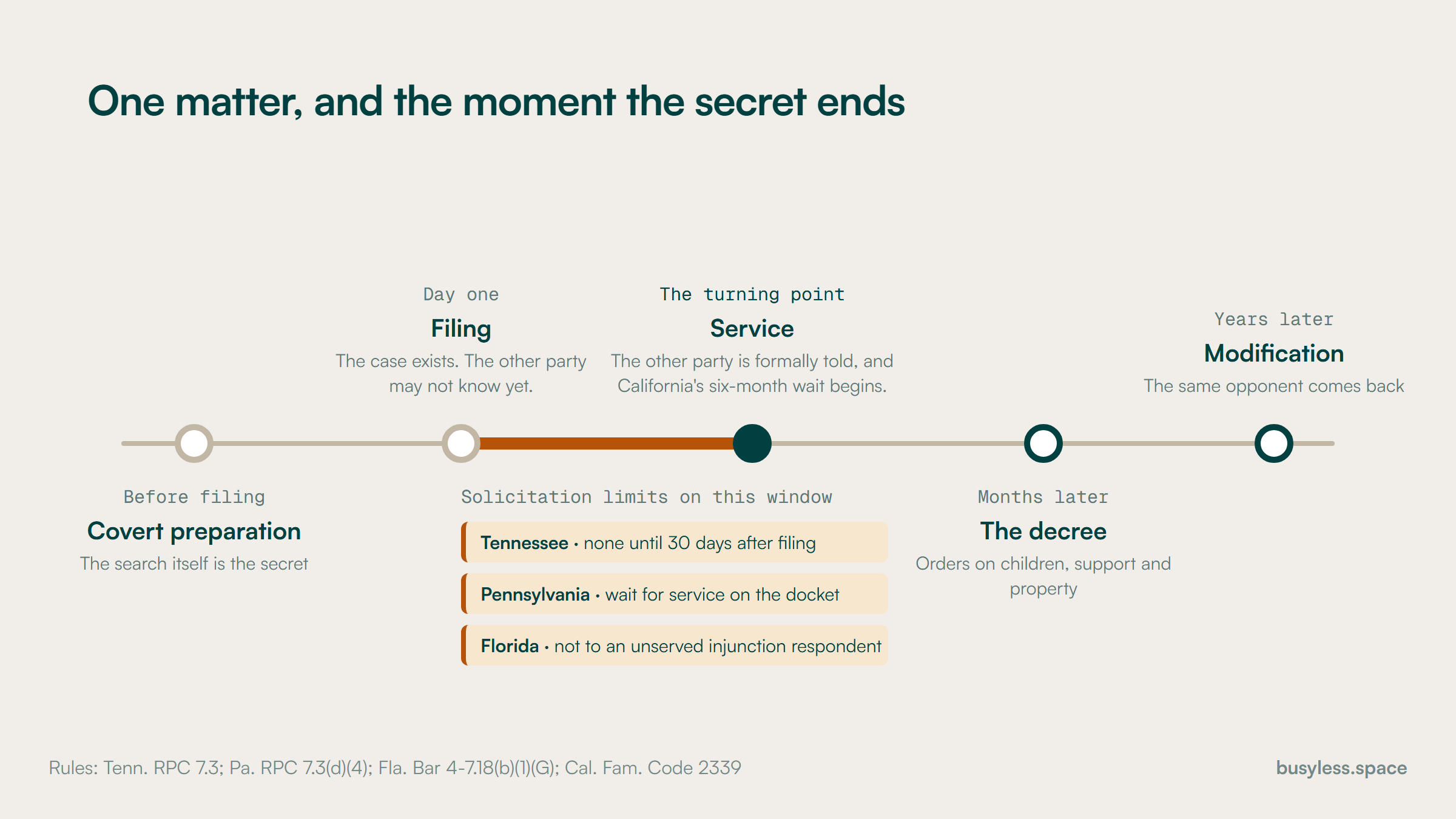
A timeline of one family law matter running from covert preparation through filing, service, the decree and a modification years later. Service is marked as the moment the other party learns of the case, and three state limits on solicitation sit between filing and service.
Three states wrote the gap between filing and service into their solicitation rules. A website's own messages cross the same gap without any rule noticing.

What the rules change

Everything below is about who sits on the other side of your website, a different question from what your advertising may claim. These are ABA Model Rules and state opinions as read on 18 September 2026; your own state's version is the authority, and none of it is legal advice. The privacy-law case against pixels is made on the mental health playbook; here the reason is simpler, and it lives in the same house.

1

The consultation form decides who you may later represent

ABA Model Rule 1.18(c)-(d) and comment [2]; ABA Formal Opinions 492 (9 June 2020) and 510 (20 March 2024); North Carolina 2011 Formal Ethics Opinion 8 (15 July 2011) on chat

What it means

A lawyer given information that could significantly harm a prospective client may not act against that person in the same matter, and the conflict spreads to the firm unless it took reasonable measures to limit what it received. Opinion 510 says to ordinarily seek the identities of the other parties, witnesses and counsel, and to caution the person at the outset not to volunteer the facts.

So do this

Split intake into two stages: names, the other party, any lawyer involved and the county under a short caution, then the facts in a conversation after the conflict check. Script the chat vendor the same way; North Carolina permits nonlawyer operators but flags what they collect.

2

The enquirer may be the other spouse, and a form cannot tell

North Carolina RPC 181 (21 July 1994); New Jersey ACPE Opinion 703 (April 2006); Montana Ethics Opinion 010830; Texas Rule 1.18(a), effective 1 July 2021

What it means

All three opinions describe consulting local lawyers to disqualify them in matrimonial matters, and New Jersey calls advising it conduct prejudicial to the administration of justice. Comment [2] to Model Rule 1.18 and Texas's good-faith wording both deny protection to a person who consults for that purpose. Montana's committee, shown a husband's anonymous letter mentioning custody, found it could not tell whether he was doing it.

So do this

Build the form for the ambiguous case, because you will never know which enquiry is which. Asking for less protects the firm from a deliberate taint and a genuine client from a firm that has heard too much.

3

Regulators treat the other spouse finding out early as a safety event

Pennsylvania RPC 7.3(d)(4) and comment [8]; Tennessee RPC 7.3 and comment [6]; Florida Bar Rule 4-7.18(b)(1)(G); all read 18 September 2026

What it means

Pennsylvania makes a lawyer wait until proof of service is on the docket before soliciting a domestic relations respondent, citing the risk of violent confrontation. Tennessee bars divorce solicitation until the filing is more than thirty days old, because the statutory injunctions take effect on service. Florida bars written solicitation of an injunction respondent who has not yet been served.

So do this

These rules govern targeted outreach rather than search, but they state the threat in the regulator's own words. Do not buy lists of new filings, and treat nurture emails, text reminders and retargeted ads as the same risk: each reaches a household rather than a person.

4

Divorce is already off-limits for remarketing on Google

Google Ads policy, Relationship hardships in personalized advertising (page undated, read 18 September 2026)

What it means

Google lists divorce services among the relationship hardships advertisers may not target with personalised advertising. Advertiser-curated audiences, customer match, remarketing lists (which Google calls your data segments), audience expansion and lookalikes are all excluded. Meta's policy was not checked for this page, and nothing here is a statement about it.

So do this

Remove remarketing and social pixels from divorce, custody and protective order pages rather than parking them behind a consent banner. A tag there builds an audience you may not use for this and leaves a trail on the visitor's device. Measure with Search Console and first-party analytics.

5

A scheduling email can be the disclosure

ABA Formal Opinions 11-459 and 11-460 (both 4 August 2011)

What it means

Opinion 11-459 says a lawyer must consider whether third parties may have access before emailing a client, and that even messages about scheduling can have substantive consequences. Its companion, 11-460, found the Model Rules impose no separate duty to notify when a party's retrieved emails reach the other side's lawyer. The example in both is an employer's computer; applying them to a spouse's device is my reading.

So do this

Ask for a safe channel and a safe time before any confirmation, reminder, invite or text is sent. Never mail the submission back, and use a neutral sender name. Prefer the form to a mailto link, because a form leaves no copy in a sent folder.

6

An exit button does not clear history, and the page should say so

National Domestic Violence Hotline and NNEDV Safety Net guidance; GOV.UK Design System, Exit this page; all read 18 September 2026. Guidance, not law

What it means

The Hotline says browsing history can never be completely erased from a device, even in private mode. NNEDV says an escape button will not stop another person reading the browser history. GOV.UK's exit component leaves the page on a button or three presses of Shift, sends the visitor somewhere neutral, and states plainly that it does not clear history, cache or autocomplete.

So do this

Add an exit control to protective order, divorce and custody pages, point it at a neutral site, and publish a short note beside it saying what it does not do. Never claim the button hides the visit.

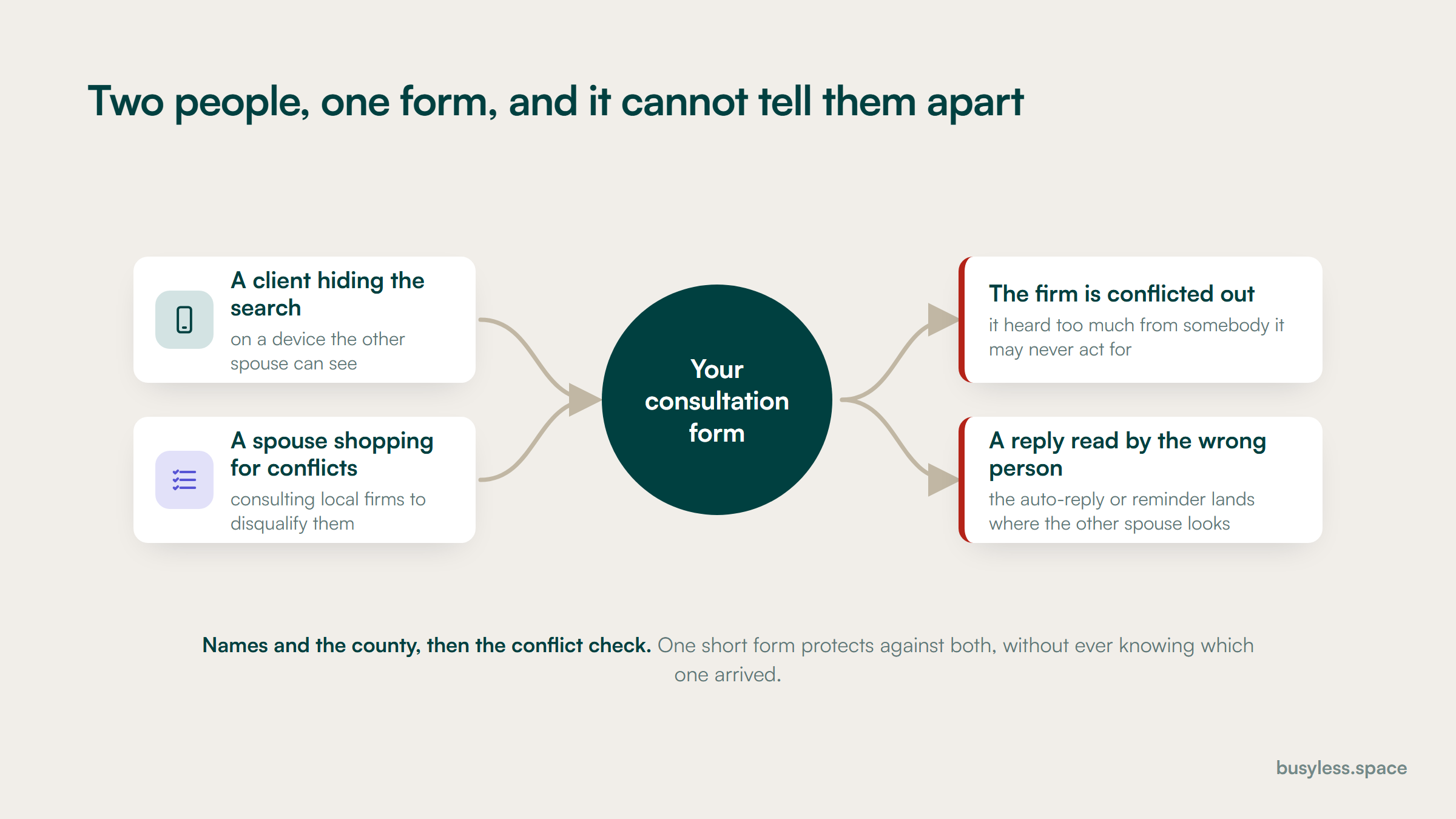
Two enquirers converge on one consultation form: a client hiding the search from a spouse, and a spouse consulting local firms to disqualify them. Two harms leave the form: the firm conflicted out, and a reply read by the wrong person.
The form cannot tell these two people apart, and neither could Montana's ethics committee when shown a real letter. Build it for both at once.

Proving expertise

Credibility in family law can be checked, and most firms never show the evidence. Certification has a named issuing body in the states that offer it, and a procedure page can cite the local rule and the form number. Even a site's safety practices can be written down where a reader can see them.

  • Board certification named by the body that grants it, such as the State Bar of California, the Texas Board of Legal Specialization or the Florida Bar in marital and family law, and never implied where none is held
  • Fellowship of the American Academy of Matrimonial Lawyers described as a membership with entry criteria, not as a certification
  • The county and the court named on every procedure page, with local form numbers and a review date
  • The guideline statute cited on every child support page, beside a link to the state's official calculator
  • A published intake note explaining what the firm asks before a conflict check, and why it asks for so little
  • A safety note beside the exit control that states plainly what the control does not do
  • A resource page linking the state's legal aid site, WomensLaw and the court's self-help pages
  • A plain statement that the firm will not help anybody conceal assets or income

How to build a family law SEO strategy

Begin with what can hurt a client this week, because a family law SEO strategy that sends more people into an unsafe form is only making the problem larger. The first phase audits the intake and every automatic message, and new content waits until that is done.

  1. 1

    Weeks 1-3

    Make the site safe to visit and safe to contact

    • Check the form, chat script and booking questions for any field that invites the story
    • List every automatic message: confirmation, reminder, calendar invite, missed-call text and nurture email
    • Remove remarketing and social pixels from divorce, custody and protective order pages
    • Turn off every auto-reply that copies the submission back to the sender
    • Add an exit control and a safety note that does not overpromise
    • Replace mailto links on sensitive pages with the form

    You end up with
    An intake path that asks for identities first and sends nothing until a safe channel is recorded

  2. 2

    Weeks 3-8

    Rebuild intake and take the local ground

    • Ship the two-stage form, with the caution above the first field
    • Send the chat vendor a script that takes names first and then hands to a person
    • Add a safe-contact question and make every CRM automation depend on it
    • Complete the business profile, with real photographs of the office
    • Publish the resource page linking legal aid, WomensLaw and the court's self-help pages
    • Name board certification by its issuing body on each attorney page, where it is held

    You end up with
    A consultation path that can be found locally and cannot disqualify the firm by accident

  3. 3

    Weeks 6-16

    Write what the court and the agency cannot

    • A procedure page for each county the firm actually files in
    • A child support inputs explainer that links the official calculator
    • A page on the state's default parenting schedule
    • A property division page written for the state's regime
    • A page on where the form route stops working, including limited-scope help
    • A protective order page with the exit control, no tags and a safe contact route

    You end up with
    County and state pages that neither a court nor a national tool can write

  4. 4

    Weeks 12-26

    Count consultations, and serve the return visit

    • Write the modification and enforcement pages for every state and county the firm serves
    • The same two-stage intake for returning clients, with a former-client check under Model Rule 1.9
    • Leading and business indicators reported separately
    • Conflicts caught at stage one logged as a result rather than an embarrassment
    • Every procedure page checked against the court's current forms

    You end up with
    A monthly report that counts consultations and matters, with the attribution gap stated

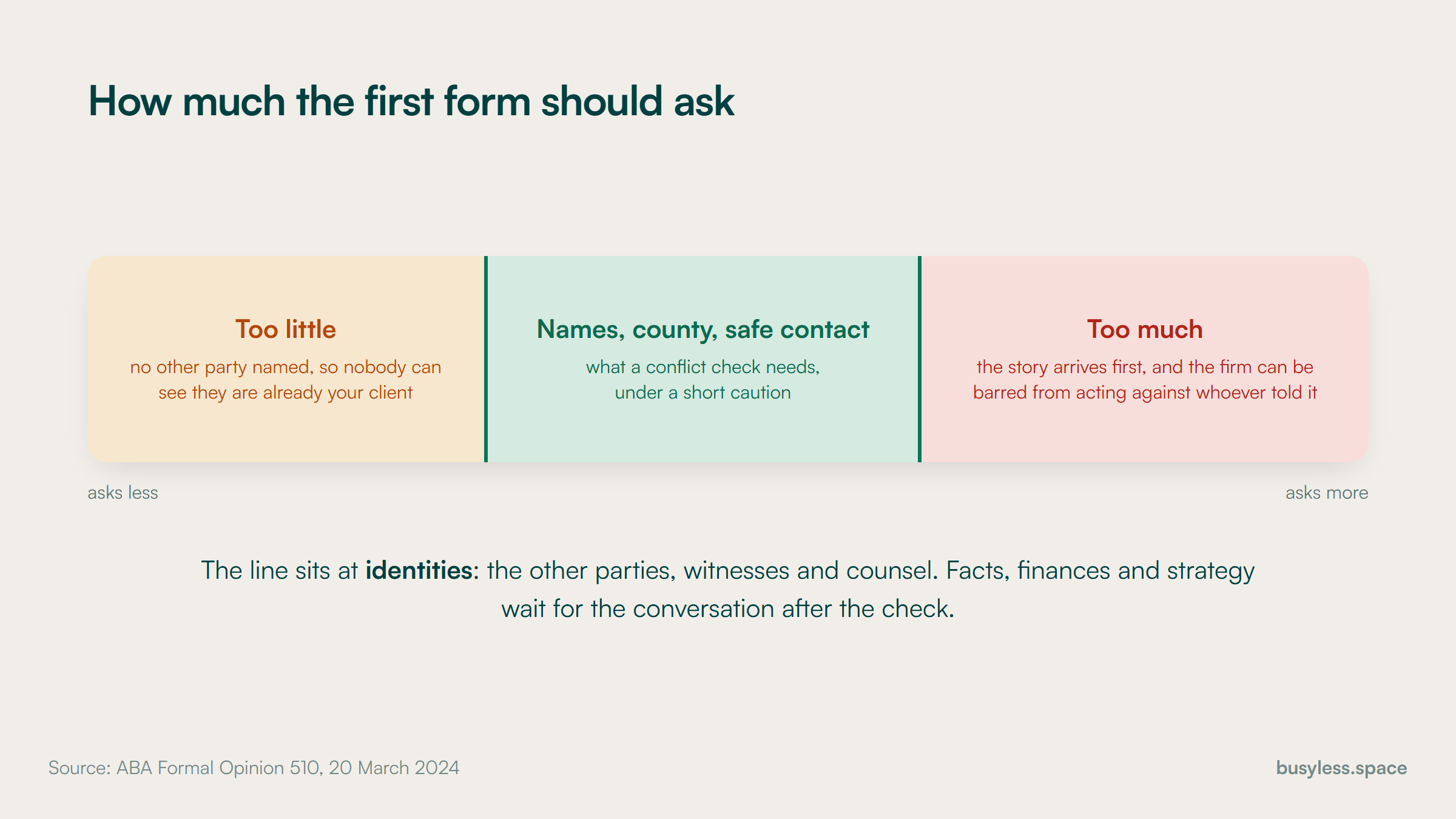
A band showing how much a consultation form should ask. Too little and no conflict check can run. Too much and the firm receives disqualifying information. The safe zone in the middle is names, the county and a safe way to make contact.
Detail gathered to persuade somebody to hire you is allowed, and it is not reasonably necessary, so it does not protect the firm when the conflict arrives.

Technical fixes with the best payoff

Family practices buy websites, chat services and intake software from the same legal vendors as every other practice area, which is why the defects repeat. Most of them are an annoyance on a personal injury site and a hazard here, because the person who reads the automatic reply may be the other party.

  • The chat widget is scripted to take the story

    An afternoon, plus the vendor's lead time

    Legal chat services staff the widget around the clock from a script the firm supplies, and email the transcript on. A script that asks what happened before who is involved collects exactly what Opinion 510 tells lawyers to avoid, through somebody who is not a lawyer.

    Rewrite it to take both parties' names, any lawyer involved, the county and a safe time to call back, then hand off. Say at the start that the operator is not a lawyer and that details come later.

  • The form's only real field is a narrative box

    An hour in the form builder

    Consultation forms commonly require an email address and a box asking the visitor to describe the case. It is the field most likely to deliver disqualifying information from somebody the firm may never represent.

    Replace it with the stage-one fields: the visitor's name, the other party's name, any lawyer involved, the county and a safe way to make contact. Add one line explaining why the form asks for so little.

  • The auto-reply mails the submission back

    Twenty minutes

    Form plugins offer to send visitors a copy of what they submitted. Here that copy carries the other party's name and the whole account into an inbox the other party may read, from a sender that announces a divorce firm.

    Turn the copy off. If a receipt is needed at all, send it only to the channel the visitor chose as safe, from a neutral sender name, saying nothing about the matter.

  • The CRM sends reminders nobody chose

    A day in the CRM

    Legal intake systems run drip emails, text reminders, calendar invites that sync to a shared family calendar, and missed-call texts from call tracking. Each one is a message about scheduling, sent to a device the firm knows nothing about.

    Add one required field, the safe-contact answer, and make every automation depend on it. No answer, or an answer of not sure, means no automated message of any kind until a person has spoken to the client.

  • Remarketing tags fire on divorce pages

    Half a day in the tag manager

    Site-wide tag managers load the same advertising and social pixels everywhere, so the protective order page carries the home page's tags. Google already bars remarketing audiences for divorce services.

    Scope those tags off divorce, custody, protective order and consultation pages entirely. A consent banner does not help, because the problem is who else uses the device.

  • The visit stays in the browser

    A day, including the safety note

    History, autocomplete and open tabs keep the title and address of every page, so a slug about leaving a marriage is visible to the next person who types into the browser. No button removes that after the fact.

    Keep titles accurate, since blurring them costs the ranking and hides nothing. Add an exit control that swaps the page for a neutral site, with a note saying history, autocomplete and open tabs still record the visit.

  • The support calculator is an iframe

    A day per state

    Vendors sell child support calculators that load in an iframe or as a script, so the page carries no crawlable text, often cites no guideline statute, and duplicates a calculator the state already runs.

    Replace it with an HTML explainer of the inputs, and link the state's official calculator for the number itself.

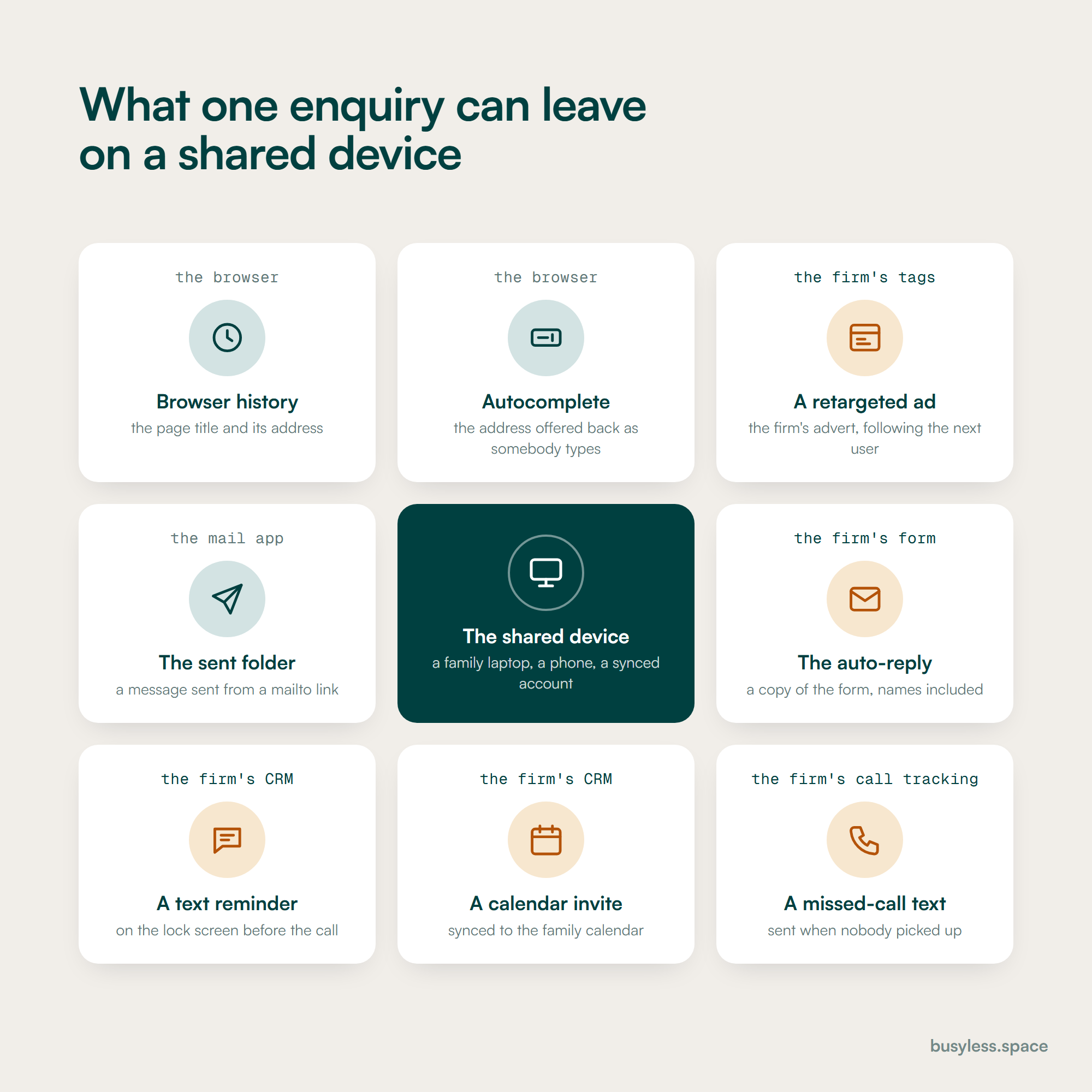
A shared household device at the centre of a grid of eight traces one enquiry can leave on it. They are browser history, autocomplete, a retargeted ad, a copy in the sent folder, an auto-reply, a text reminder, a calendar invite and a missed-call text.
Most of these traces are created after the visit, by systems the firm switched on. The exit button can reach none of them.

Structured data that applies here

The types below fit this industry specifically. Most of them earn no rich result on their own, which is worth knowing before anyone sells the work on that basis. What they do is describe the entity precisely, which matters for how search engines and answer engines resolve who you are.

  • Courthouse

    County procedure pages, through the page's about property

    Used as the thing the page is about, not as the firm. It tells a machine which court a procedure page describes: entity clarity rather than a rich result, and a claim no national publisher can make.

    Courthouse.jsonld
    {
      "@context": "https://schema.org",
      "@type": "WebPage",
      "@id": "https://[YOUR-DOMAIN]/[county]-county-divorce#page",
      "name": "[How divorce works in COUNTY County]",
      "url": "https://[YOUR-DOMAIN]/[county]-county-divorce",
      "lastReviewed": "[YYYY-MM-DD]",
      "reviewedBy": {
        "@type": "Person",
        "name": "[ATTORNEY WHO FILES IN THIS COURT]"
      },
      "about": {
        "@type": "Courthouse",
        "name": "[COUNTY] County [Superior / District / Circuit] Court",
        "url": "[https://COURT-WEBSITE]",
        "telephone": "[+1-555-000-0000]",
        "address": {
          "@type": "PostalAddress",
          "streetAddress": "[STREET]",
          "addressLocality": "[CITY]",
          "addressRegion": "[ST]",
          "postalCode": "[00000]",
          "addressCountry": "US"
        }
      },
      "mentions": {
        "@type": "AdministrativeArea",
        "name": "[COUNTY] County, [STATE]"
      }
    }
  • Legislation

    Child support and parenting schedule explainers

    Names the statute an explainer explains, by citation and jurisdiction. No rich result. Use it on the schedule page too, citing the chapter that sets the state's default.

    Legislation.jsonld
    {
      "@context": "https://schema.org",
      "@type": "Legislation",
      "@id": "https://[YOUR-DOMAIN]/child-support-[state]#guideline",
      "name": "[STATE] child support guideline",
      "legislationIdentifier": "[STATUTE CITATION]",
      "legislationJurisdiction": "[STATE]",
      "legislationType": "Statute",
      "legislationDate": "[YYYY-MM-DD OF THE LAST AMENDMENT]",
      "sameAs": "[https://OFFICIAL-TEXT-OF-THE-STATUTE]",
      "subjectOf": {
        "@type": "WebPage",
        "url": "https://[YOUR-DOMAIN]/child-support-[state]",
        "lastReviewed": "[YYYY-MM-DD]"
      }
    }
  • WebApplication

    A firm's own inputs worksheet, only if one is built

    Most practices should not build one, because the state already publishes the calculator. If you do, mark what it is based on. There is no rich result without a rating, and none may be invented.

    WebApplication.jsonld
    {
      "@context": "https://schema.org",
      "@type": "WebApplication",
      "name": "[STATE] child support inputs worksheet",
      "url": "https://[YOUR-DOMAIN]/child-support-[state]/worksheet",
      "applicationCategory": "[FinanceApplication]",
      "operatingSystem": "Any",
      "browserRequirements": "Requires JavaScript",
      "isAccessibleForFree": true,
      "isBasedOn": {
        "@id": "https://[YOUR-DOMAIN]/child-support-[state]#guideline"
      },
      "publisher": {
        "@id": "https://[YOUR-DOMAIN]/#firm"
      },
      "description": "[What it helps you gather, and a plain statement that the state's official calculator decides the figure]"
    }
  • Offer with PriceSpecification

    The firm node, on flat-fee and limited-scope pages

    States a flat fee as data where one genuinely exists, usually uncontested divorce and limited-scope help. No rich result. Check your state's rules on advertising fees first, and keep the facts that end a flat fee on the same page.

    Offer with PriceSpecification.jsonld
    {
      "@context": "https://schema.org",
      "@type": "LegalService",
      "@id": "https://[YOUR-DOMAIN]/#firm",
      "name": "[FIRM NAME]",
      "url": "https://[YOUR-DOMAIN]",
      "makesOffer": [
        {
          "@type": "Offer",
          "name": "[Uncontested divorce, flat fee]",
          "description": "[What is included, what is not, and the facts that end the flat fee]",
          "url": "https://[YOUR-DOMAIN]/uncontested-divorce",
          "eligibleRegion": {
            "@type": "AdministrativeArea",
            "name": "[COUNTY] County, [STATE]"
          },
          "priceSpecification": {
            "@type": "PriceSpecification",
            "price": "[0000]",
            "priceCurrency": "USD"
          }
        },
        {
          "@type": "Offer",
          "name": "[Limited-scope document review]",
          "description": "[Exactly which task is covered, and what the client keeps doing themselves]",
          "url": "https://[YOUR-DOMAIN]/limited-scope-help",
          "priceSpecification": {
            "@type": "PriceSpecification",
            "price": "[000]",
            "priceCurrency": "USD"
          }
        }
      ]
    }
  • Event

    Divorce-options workshops and free clinics

    The one type in this set with a Google rich result behind it, subject to its current guidelines, so check Search Central before relying on it. Keep registration to a first name and a safe contact, because a confirmation for a divorce workshop leaves the same trace as a consultation reminder.

    Event.jsonld
    {
      "@context": "https://schema.org",
      "@type": "Event",
      "name": "[Divorce options in STATE: the process, mediation and court]",
      "url": "https://[YOUR-DOMAIN]/workshops/[slug]",
      "startDate": "[YYYY-MM-DDTHH:MM:SS-05:00]",
      "endDate": "[YYYY-MM-DDTHH:MM:SS-05:00]",
      "eventStatus": "https://schema.org/EventScheduled",
      "eventAttendanceMode": "https://schema.org/OnlineEventAttendanceMode",
      "location": {
        "@type": "VirtualLocation",
        "url": "https://[YOUR-DOMAIN]/workshops/[slug]"
      },
      "isAccessibleForFree": true,
      "organizer": {
        "@type": "LegalService",
        "@id": "https://[YOUR-DOMAIN]/#firm",
        "name": "[FIRM NAME]",
        "url": "https://[YOUR-DOMAIN]"
      },
      "offers": {
        "@type": "Offer",
        "price": "0",
        "priceCurrency": "USD",
        "availability": "https://schema.org/InStock",
        "url": "https://[YOUR-DOMAIN]/workshops/[slug]",
        "validFrom": "[YYYY-MM-DD]"
      }
    }
  • DefinedTermSet

    A glossary of the words your court uses

    Petitioner, respondent, service and your state's property regime, each defined as your court uses them. No rich result, but answer engines get a clean definition to quote. Service belongs in it: it is the moment the other party is told.

    DefinedTermSet.jsonld
    {
      "@context": "https://schema.org",
      "@type": "DefinedTermSet",
      "@id": "https://[YOUR-DOMAIN]/glossary#terms",
      "name": "[STATE] family law glossary",
      "url": "https://[YOUR-DOMAIN]/glossary",
      "hasDefinedTerm": [
        {
          "@type": "DefinedTerm",
          "name": "Petitioner",
          "description": "[Plain definition, as the word is used in STATE courts]",
          "url": "https://[YOUR-DOMAIN]/glossary#petitioner"
        },
        {
          "@type": "DefinedTerm",
          "name": "Respondent",
          "description": "[Plain definition, as the word is used in STATE courts]",
          "url": "https://[YOUR-DOMAIN]/glossary#respondent"
        },
        {
          "@type": "DefinedTerm",
          "name": "Service",
          "description": "[How the other party is formally told of the case in STATE, and what starts once they are]",
          "url": "https://[YOUR-DOMAIN]/glossary#service"
        },
        {
          "@type": "DefinedTerm",
          "name": "[Community property / Equitable distribution]",
          "description": "[What your state's regime means for a house, a pension and debts]",
          "url": "https://[YOUR-DOMAIN]/glossary#property"
        }
      ]
    }

What it costs

These bands are editorial estimates for running the work yourself or with help, not quotes, at US rates in 2026. The intake rebuild is a one-off cost in the first quarter. After that the budget is mostly county content, which is cheap to write and slow to publish, because a lawyer who files in that court has to read it.

Do it yourself

$0 to $400
  • The consultation form rebuilt in two stages
  • The copy-to-sender reply switched off and remarketing tags removed
  • An exit control with an honest safety note
  • One county procedure page and the support inputs page
  • The business profile completed and kept current

Who it suits

A solo or two-lawyer family practice in one county, with somebody who can give it two hours a week and a lawyer willing to read what they write.

Where it stops

Every piece of safety work is reachable at this tier. County content beyond the first page or two usually is not, because attorney review is the pace and no budget buys it.

Lean

$2,000 to $4,500
  • Everything above, done properly rather than in spare evenings
  • The chat script and CRM automations rebuilt around the safe-contact answer
  • Procedure pages for every county the firm files in
  • Schedule and property pages for the state
  • Monthly reporting split into leading and business indicators

Who it suits

A practice of three to eight lawyers across one or two counties, where search already brings some consultations and nobody owns the work.

Where it stops

Two counties done well outrank six done thinly, and at this tier that choice has to be made. Review by the lawyers who appear in each court sets the pace, not the writing.

Funded

$5,000 to $10,000
  • County pages for every office and every court the firm uses
  • After-the-decree pages by state and county
  • Protective order pages built with the safety pattern throughout
  • Intake wired to the practice management system so consultations and matters can be attributed
  • A quarterly check of every procedure page against the court's forms

Who it suits

Multi-office family practices, or firms in contested metros where the local pack is expensive and procedure content is the asset that lasts.

Where it stops

Spend cannot buy review time or make a new county page trusted faster. Past this band the extra money usually goes into paid search, which is a separate decision with its own policy limits.

How to do it with no budget

Seven things, all free, in this order. The first four remove a risk rather than add traffic, and for a small practice they matter more than everything after them.

  1. 1

    Fill in your own consultation form as the other spouse would

    An hour

    Your website, in a private window

    Read every field as somebody hoping to say too much. A free-text box before a conflict check is the usual finding, and replacing it costs nothing.

  2. 2

    Turn off the copy-to-sender setting

    Twenty minutes

    Your form plugin's notification settings

    The setting that emails visitors a copy of their submission sends the other party's name and the story to an inbox you know nothing about. Switch it off, and use a neutral sender name for anything that remains.

  3. 3

    Find every tag on your divorce and protective order pages

    Two hours

    Google Tag Assistant, or the network tab in your browser

    List what fires, then remove the remarketing and social pixels from those pages. Google already bars remarketing audiences for divorce services, so nothing you were allowed to use is lost.

  4. 4

    Add an exit control and an honest safety note

    Half a day

    Your site editor, with the GOV.UK exit pattern as the model

    Send it somewhere neutral with no personalised content, and say beside it that history, autocomplete and open tabs still record the visit. The note is the part most firms leave out.

  5. 5

    Write one county procedure page

    A day, plus a lawyer's read

    Your court's self-help pages and local rules

    Start with the county you file in most. Link the court's own forms, then write what they leave out: where to file, how service happens locally, and when the form route stops working.

  6. 6

    Write the child support inputs page

    A day

    Your state's official guideline calculator

    Link the official calculator for the number and explain what goes into it: which income counts, and when a court may depart from the guideline. Cite the statute and put a review date on the page.

  7. 7

    Split Search Console queries by stage of the matter

    Thirty minutes a week

    Google Search Console

    Tag queries as before filing, during the case and after the decree. The last set is the one practices rarely look at on its own, and it answers whether the modification pages deserve more work.

The tool stack

Short, and chosen as much for what each tool leaves out as for what it does. The measurement side needs no pixel on a sensitive page, and the publishing side is safer with fewer third-party scripts rather than more.

  • Measure search without a tag on the page

    Google Search ConsoleSEO APIRead the review

    Which queries reach the divorce and protective order pages comes from Google's side of the search, with nothing running in the visitor's browser. It is the measurement a sensitive page can carry without adding a trace.

    Free routeFree

  • Publish county and statute pages with no server and no third-party scripts

    PubliiHeadless CMSRead the review

    A static site ships only what you put on it, so proving a protective order page loads no tracking is easy. It is a desktop tool for one editor, so attorney review happens outside it.

    Free routeFree, GPL-3.0, and the output is plain files you can host anywhere

  • Count visits to sensitive pages without cookies

    Cookieless first-party analytics

    Pick a tool that sets no cookie and shares nothing with an ad network, and load it only where the practice genuinely needs page counts. Search Console already covers most of the questions worth asking.

    Free routeServer logs, read monthly

  • Audit what fires on each sensitive page

    Google Tag AssistantExternalVisit site

    Run it on the protective order page, not the home page. The finding that matters is the pixel a tag manager loads everywhere, which nobody added to that page on purpose.

    Free routeFree

  • Build the exit control

    GOV.UK Design System, Exit this pageExternalVisit site

    A public-sector pattern with its limits written into its own documentation, which is the honesty the safety note on your page needs. Change the destination if you must; keep the warning.

    Free routeFree and documented

  • Run the conflict check before the facts

    Your practice management system's conflict search

    Stage one of the intake exists to feed this search. If the names on the form cannot be checked quickly, stage two starts before the check does, which defeats the design.

    Free routeA searchable list of every party the firm has acted for or against

  • Hold every automated message until a safe channel is recorded

    Your intake CRM's workflow conditions

    One required field, one condition on every workflow. Check calendar invites and missed-call texts as well as email, because those usually belong to a different vendor and escape the first audit.

    Free routeAutomations off, confirmations sent by hand

Take it from here

Everything below is meant to be filled in and used. Bodies are plain text, so what lands on your clipboard is exactly what you see, brackets and all. The first three are compliance tools and say so; start with the intake form, because it is the one that changes what the firm receives.

Spec

Specifies the stage-one fields, the cautionary note and the safe-contact question, and lists what must never be asked before the conflict check.

TWO-STAGE CONSULTATION INTAKE - FORM SPECIFICATION
Firm: [FIRM NAME]     Prepared by: [NAME]     Date: [DATE]
Approved by: [ATTORNEY NAME]

Working tool, not legal advice. Built on ABA Model Rule 1.18 and
Formal Opinion 510 (20 March 2024). Check your own state's version
of Rule 1.18 before using it.

WHY TWO STAGES
Stage one asks only what a conflict check needs. Stage two happens
after the check, in a conversation.

STAGE 1 - ON THE WEBSITE (these fields and no others)
  [ ] Your first name                          required
  [ ] Your last name                           required
  [ ] The other party's full name              required
  [ ] Other names they have used               optional
  [ ] Their lawyer, if they have one           optional
  [ ] County where the case is or will be      required
  [ ] Type of matter (pick one)                required
        divorce / custody / support / protective order /
        changing an existing order / not sure
  [ ] A safe way to reach you                  required
        (the safe-contact question below)
  [ ] "I have read the note above"             required

MUST NOT APPEAR AT STAGE 1
  [ ] "Tell us what happened" or "Describe your case"
  [ ] Income, assets, property or debts
  [ ] Reasons for the separation
  [ ] Anything about the other party's conduct or health
  [ ] Children's details beyond whether there are children

THE CAUTIONARY NOTE (above the first field)
  "Please give us names and your county only, and do not tell us
   about your situation yet. We need to check that we are free to
   help you before you share details. We will ask about the rest
   when we speak. Sending this form does not make us your lawyer."
  Wording checked against our state's rules by: [ATTORNEY]
  Date: [DATE]

THE SAFE-CONTACT QUESTION
  How should we contact you?  [ ] Call only  [ ] Text  [ ] Email
  Number or address we may use:  [____________________]
  When is it safe to call?       [____________________]
  May we leave a message?        [ ] Yes  [ ] No
  Can anyone else see this phone or inbox?
                                 [ ] Yes  [ ] No  [ ] Not sure
  -> "Yes" or "Not sure": no automated message of any kind.

AFTER SUBMISSION
  [ ] Confirmation shown on screen only. No copy emailed.
  [ ] The firm's notification carries the stage-one fields only.
  [ ] Conflict search run on BOTH names within [HOURS] by [ROLE].
  [ ] Result logged: clear / conflict / possible taint pattern.

STAGE 2 - AFTER THE CHECK CLEARS
  [ ] First call made on the safe channel, at the safe time
  [ ] Facts, finances and goals taken in conversation by [ROLE]
  [ ] If the check did NOT clear: decline without asking anything
      further, and without saying whose conflict it is

SIGN-OFF
  Form built: [DATE]    Tested in a private window: [DATE]
  Attorney sign-off: [NAME / BAR NO / DATE]

What to publish

What to publish, in the order it pays. Each asset below either answers a question the court and the state agency leave open, or is a page a frightened reader has to be able to use safely.

  • County procedure pages

    One per county the firm files in, reviewed each year

    Where to file, how service happens locally, and where the court's forms stop. Checkably local, and the court's own pages never explain around their forms.

  • A child support inputs explainer for each state

    Once per state, reviewed whenever the guideline changes

    The state owns the number and the firm owns the explanation. People reach for it right after the calculator.

  • After-the-decree pages

    One per matter type, then per county

    Modification and enforcement by state and county. The reader already knows the process exists and has one specific need, and most practices publish nothing for them.

  • A protective order page built for a shared device

    Once, checked against the court's forms every quarter

    Exit control, safety note, no advertising tags, a safe contact route, and links to WomensLaw and the court's forms. This is the page where the safety design is the content.

  • Where the form route stops working

    Once per state

    An honest page on uncontested divorce, the facts that end it, and what limited-scope help covers. It keeps the reader the online services attract and cannot hold once a pension or a house turns up.

  • Parenting schedule and property explainers

    One of each per state

    The state's default schedule and its property regime, with how local courts apply them. Both answers flip at the state border, which is why a national page gets them wrong for many readers.

And what not to

  • Free-text boxes inviting the story, anywhere on the site, before a conflict check
  • Gated divorce guides sent by email, which put the firm's name in an inbox the other party may read
  • Advice on concealing assets or income from a spouse, which Model Rule 1.2(d) forbids a lawyer to assist and the page should decline in writing
  • Pages on monitoring a spouse's phone, messages or location, which coach the very conduct protective orders exist to stop
  • Iframed support calculators that duplicate the state's own and cite no statute
  • Celebrity divorce commentary, which draws readers who will never file in your county

The expensive mistakes

Asking for the story on the first form

Costs you Disqualifying information from somebody the firm may never represent, possibly the other spouse on purpose

Two stages: identities and the county, then the conflict check, then the facts in a conversation

Emailing visitors a copy of their submission

Costs you The other party's name and the whole account in an inbox that may be shared

No copy, a neutral sender, and nothing sent before a safe channel is recorded

Running remarketing across the whole site

Costs you An audience Google bars divorce services from using, built by leaving a cookie trail on household devices

Tags scoped off every sensitive page, with measurement through Search Console and cookieless analytics

Sending calendar invites and text reminders by default

Costs you A consultation appearing on a family calendar or a lock screen before the client has told anybody

A safe-contact question that gates every automation, answered before anything is scheduled

Promising that the exit button hides the visit

Costs you False safety on the page where safety matters most, contradicted by the published guidance on exit controls

An exit control plus a note that says plainly what it does not clear

Buying lists of new divorce filings for outreach

Costs you Contact that can reach a respondent before service, which Pennsylvania and Tennessee restrict in their own rules on safety grounds

Let search and referrals do the work, and read your state's timing rule before any outreach at all

What to measure

Report what the search did and what the practice did, separately, and say where the line between them cannot be drawn. Some of the work here is less visible in analytics by design: a page carrying no advertising tags reports less about its visitors, and that is the trade the page is making.

Leading indicators

Move first. They predict, they do not prove.

  • Queries split by stage of the matter

    Search Console, tagged before filing, during the case and after the decree

    An average position hides the two ends that matter most. Read the covert and after-the-decree sets on their own.

  • County page impressions, by county

    Search Console, filtered by page

    Each county moves on its own clock. A county page with impressions and no clicks usually has a title that does not name the court.

  • Local pack position for divorce and custody queries

    Rank checks from the neighbourhoods clients live in

    Checked from where clients search at home rather than from the office.

  • Enquiries with a safe channel recorded

    Intake log

    A process measure, and the one that shows the safety design is being used rather than bypassed by whoever answers the phone.

Business indicators

The ones a manager acts on.

  • Consultations held from search

    Practice management system, source captured at stage one

    The first number a partner acts on. Capture the source in stage one, because asking later means asking a client in distress where they found you.

  • Matters opened, by type

    Practice management system

    Report divorce, custody, protective orders and modification apart, or the returning modification matters vanish inside the divorce total.

  • Conflicts caught at stage one

    Conflict search log

    Each one is a disqualification that did not happen. It belongs in the report as a result, and a sudden cluster of them is worth reading as a possible taint pattern.

  • Former clients returning after a decree

    Practice management system

    Modification and enforcement from former clients, checked under Model Rule 1.9 like any other enquiry. The after-the-decree pages exist for this line.

The verdict

The decisive part of this work sits between the search result and the first conversation. A form that asks for the story, a reminder that lands on a shared calendar and a remarketing tag on a divorce page each undo more than a ranking can earn.

After that the search side is local and patient. Concede the forms to the court and the number to the state agency, then write the county procedure, the support inputs and the after-the-decree pages that only a practice filing in those courts can write.

Ask anyone offering family law SEO services two questions before anything else. What should your consultation form collect before a conflict check, and what does your site send to somebody who has not yet given you a safe way to reach them? An answer about keywords to either one is the wrong answer.

Good SEO services for family law start with an intake audit, not a content calendar. I would not publish a single new page into a form that could disqualify the firm or endanger the person filling it in, because the page would only send more people into it.

FAQ

Family law SEO questions

  • Why can a family law consultation form get a firm disqualified?
    Under Model Rule 1.18, information from a prospective client that could significantly harm them in the matter can stop you acting against them, and the conflict can spread to the whole firm. ABA Opinion 510 says to limit what you ask and start with identities. A narrative box before a conflict check does the opposite. Check your own state's version.
  • What is taint shopping in a divorce?
    A spouse consulting several local family lawyers in order to disqualify them. Opinions from North Carolina, New Jersey and Montana describe it in matrimonial matters, and comment [2] to Model Rule 1.18 denies such a person prospective-client status. Proving it is the hard part, which is why the form should simply ask for less.
  • Should a divorce practice run remarketing ads?
    Not from its divorce, custody or protective order pages. Google's relationship hardships policy, read on 18 September 2026, lists divorce services among the categories advertisers may not target with remarketing lists, customer match or lookalike audiences. Removing the tags also removes the cookie trail on a device the other party may use. Meta's policy was not checked for this page.
  • Does an exit button make a family law site safe to browse?
    It helps, and it is not enough. The National Domestic Violence Hotline, NNEDV and the GOV.UK design system all say an exit control does not clear history, cache or autocomplete. Add one, and publish a note beside it saying what it does not do.
  • What should a family law practice send after someone books a consultation?
    Nothing, until you know where it is safe to send it. ABA Opinion 11-459 treats even scheduling messages as capable of substantive consequences where third parties may have access; applying its employer's-computer example to a family device is my reading. Ask for a safe channel first, never mail the submission back, and use a neutral sender name.
  • Should a family law site write for people planning a divorce in secret?
    Yes for the reader who needs to leave safely, and no for the reader who wants to move money first. Model Rule 1.2(d) bars a lawyer from assisting conduct they know is fraudulent, so the covert-preparation page should say in plain words that the firm will not help conceal assets or income. That sentence also tells the right reader they are in the right place.
  • Can a family law firm outrank the state's child support calculator?
    It should not try. The state publishes the calculator, and in Texas the attorney general runs it. Link the official one and write the page it cannot: which income counts, and when a court may depart from the guideline.
  • What does it cost to run search for a family law practice?
    The tiers above are editorial estimates rather than quotes. For a practice that wants the work run properly, yourself or with help, the realistic range is roughly $2,000 to $10,000 a month, driven mostly by how many counties the firm files in. The first quarter carries a one-off intake rebuild, and attorney review sets the pace after that.

Run it yourself, or have someone own it

Everything above is written to be run without us, and the free path is genuinely most of the value for a single-location business. Where these plans stall is almost never the plan. It is that nobody owns it after the first month. That is the job we do, with search as one distribution layer inside a wider system rather than the whole engagement.