
Skip to content

Auto repair SEO strategy

Regulated marketing

The highest-volume queries come from people trying not to pay you

Written by Eugene SuslovLast reviewed 29 August 2026No affiliate links
Sector
Business services
Model
Local service, Multi-location
Competition
High
Time to results
4 to 9 months
Typical monthly
$800 to $4,500

Key takeaways

  1. 1The queries with the most volume are typed by people who intend to fix it themselves. Chasing them with how-to articles funds an audience that will never book a bay.
  2. 2Cost queries are where the money is. Somebody asking what a repair should cost has already decided to pay somebody, and they are choosing who.
  3. 3The vehicle is a variable, so one service is really a hundred pages. This is the rare market where a structured, vehicle-by-vehicle page set is the correct answer rather than the trap.
  4. 4A federal statute says a manufacturer generally cannot void a warranty because you used an independent shop. That is a content asset, and almost no shop has written the page.
  5. 5Your visitor is often standing in a car park beside a car that will not start. If the phone number is an image, or the page takes six seconds, you have already lost the job.

SEO for auto repair shops has an awkward starting point. Run the keyword research and the biggest clusters by a wide margin are symptoms, warning lights and how-to queries, and a large share of the people typing them are trying to avoid paying a mechanic.

Those results are already spoken for. YouTube, the model-specific forums and the parts retailers answer them, and every one of those parties benefits when the searcher decides to buy a part rather than book a bay.

So an auto repair SEO strategy has to be built on the clusters where the searcher has already decided to pay. What a repair should cost, what a service interval includes on their specific vehicle, and who nearby can be trusted with it.

The vehicle is what makes those clusters unusually large. A timing belt is one job and a hundred different pages, because the interval, the parts, the labour time and the price are different on every engine, and the searcher always includes the car.

Underneath the content sits a trust problem this trade has carried for decades. The searcher expects to be overcharged, so the shop that publishes prices, methods and named technicians wins against one that publishes a stock photograph and a form.

And one competitor is beatable with a citation. The dealership's implication that independent service risks the warranty is not what federal law says, and the page explaining that is one almost nobody has written.

Who already ranks in auto repair

Look at who occupies each result before deciding what to write, because auto repair SEO fails most often by picking a fight with YouTube. A symptom query returns videos, forum threads and a parts retailer; a cost query returns a national estimator and, if anybody has bothered, a local shop.

What is on the results page

  • Video carousels sitting on top of every symptom and how-to query
  • National repair cost estimators ranking for the price questions
  • Forum threads answering year, make and model faults better than anyone
  • Parts retailer pages with fitment selectors on part-name searches
  • A local pack sorted by reviews and proximity on anything with near me
  • People also ask stacks expanding a symptom into six related faults
  • Dealer service department pages on brand and scheduled service queries
  • AI answers offering a probable diagnosis and a cost range, naming no shop
  • Google Business Profile

    google.comClaim it

    Where the decision actually happens for anything local, and where reviews, hours, photographs and the service list do more work than the whole website. For a single-location shop this is the highest-return asset you own.

  • YouTube

    youtube.comClaim it

    The default answer to any how-to or symptom query and effectively unbeatable on them. Worth using rather than fighting: a short honest video on a fault you actually fix builds the trust that the written page then converts.

  • RepairPal

    repairpal.comClaim it

    Owns much of the cost cluster nationally with an estimator and a certified shop network. You will not outrank it on the generic price query, but you can beat it on the same question with your town and a real price attached.

  • Parts retailers

    autozone.com, oreillyauto.com, rockauto.com

    Enormous domains with a page for every part and every vehicle, publishing how-to content to sell components. They are the commercial reason the how-to cluster is unwinnable and unprofitable at the same time.

  • Model-specific forums and Reddit

    reddit.com, and the forum for every marque

    Where a genuine diagnosis often comes from, and increasingly where AI answers source theirs. Not optimisable and not to be astroturfed. A technician who answers honestly under their own name is the only version of this that works.

  • Kelley Blue Book and Edmunds

    kbb.com, edmunds.com

    Publisher authority on maintenance schedules and repair guidance, ranking on vehicle-specific service queries. They cover the generic interval; they cannot tell somebody what it costs at a shop eight minutes away.

  • Yelp

    yelp.comClaim it

    Persistent on local service queries and heavily used for exactly this trade, because people ask other people whether a mechanic is honest. Claim it, keep the hours right, and answer the bad reviews properly.

  • Dealership service departments

    Each manufacturer's dealer network

    Well-funded local competitors ranking on brand plus service terms, and the source of the warranty implication this page exists to correct. They are beatable on price transparency and on being a named human.

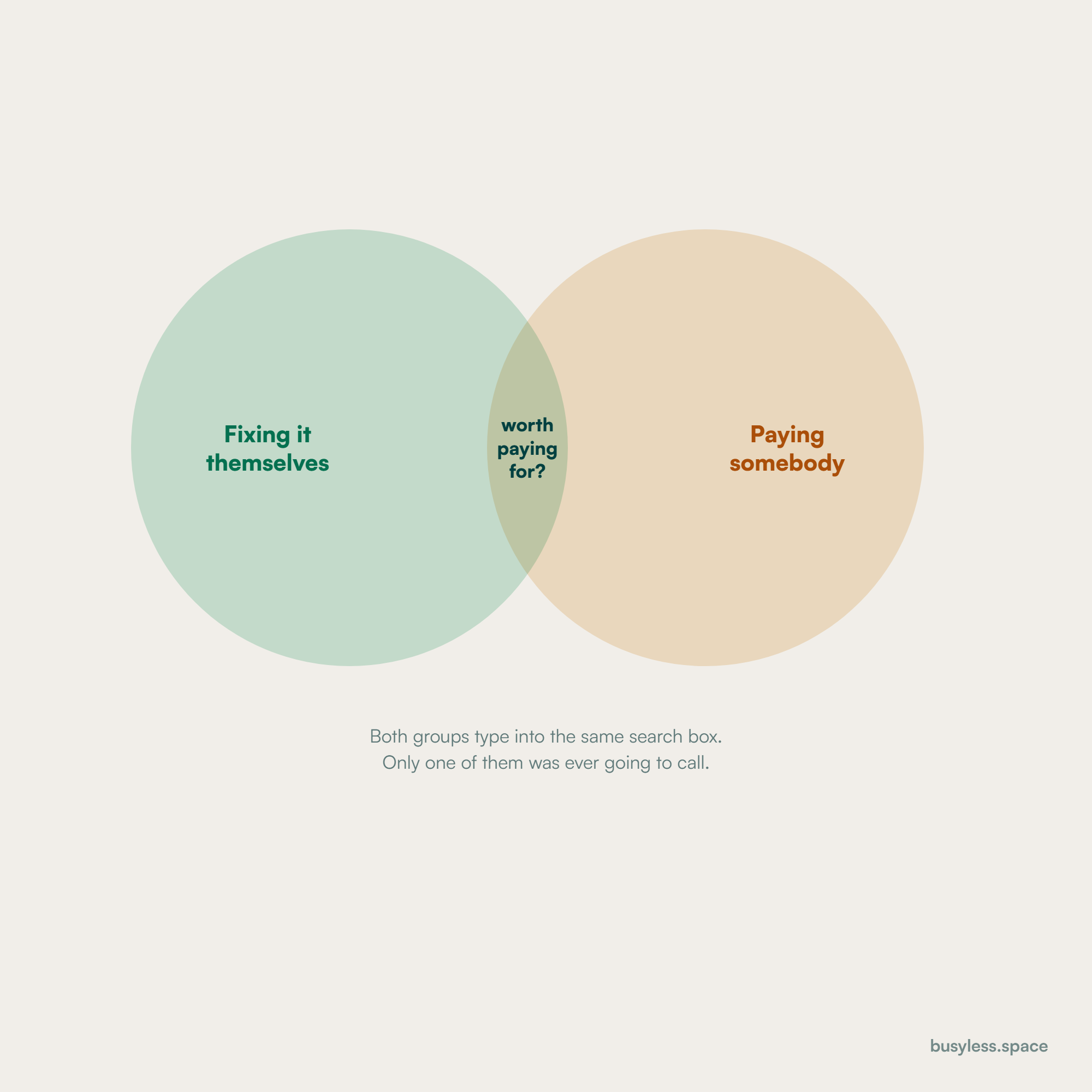
Two overlapping groups, people who will fix it themselves and people who will pay somebody, with the shared region marked as the one question both of them ask
The left-hand circle holds most of the search volume in this trade. The right-hand one holds the bookings, and it is a much quieter place.

What people actually search

These clusters are sorted by how close the searcher is to paying somebody, which in this market runs almost exactly opposite to search volume. The first two are small and lucrative; the ones at the bottom are enormous and mostly worthless.

Repair cost

Commercial investigation, ready to pay

how much to replace a timing belt on a [make model]

The page that wins it: A cost page with real bands, by vehicle, for your labour rate

The single most valuable cluster here. The person has accepted the bill exists and is deciding who sends it, and a real local price beats a national estimate every time.

Scheduled service by vehicle

Commercial, planned

[make model] 60,000 mile service

The page that wins it: A page per make and interval, listing what is genuinely included

Predictable, high margin and the cluster that justifies a structured page set. The interval is published by the manufacturer, so the page can be exact about what it covers and what it does not.

Warranty and the dealership

Informational, decision blocking

does independent servicing void my warranty

The page that wins it: A page citing the Magnuson-Moss tie-in prohibition

The only cluster where a federal statute answers the objection for you. It removes the specific fear keeping a car at a main dealer, and almost no independent shop has published it.

Specialisation and marque

Commercial, qualified

[european marque] specialist [town]

The page that wins it: A page per marque you genuinely specialise in, with tooling named

Small volume, excellent customers. Owners of particular marques search this way deliberately because they have been let down by a generalist, and a chain cannot credibly claim it.

Nearby and urgent

Local, immediate

mechanic near me open saturday

The page that wins it: Accurate profile hours, services and a phone number that dials

Settled on the profile rather than on the site, and often typed on a phone beside a stationary car. Everything about this cluster rewards speed and correctness over persuasion.

Warning light and fault code

Informational, anxious

[fault code] on a [make model]

The page that wins it: A code page saying what it usually means on which engines

The code is a standard string, so the page can be precise in a way generic advice cannot. It is also exactly the shape an AI answer resolves, which makes it worth being the source it uses.

Fleet and commercial accounts

Commercial, recurring, business to business

fleet maintenance [town]

The page that wins it: A fleet page with response times, account terms and a named contact

Recurring work that fills the quiet weeks, decided by somebody comparing three shops on a spreadsheet. Almost nobody writes the page, so it ranks on very little.

Symptom and how-to

Informational, frequently do-it-yourself

grinding noise when braking

The page that wins it: Rarely worth a page, and never a step-by-step guide

The largest cluster in the market and the least profitable. It belongs to video and to the parts retailers, and a shop that wins it attracts an audience whose whole intention is not to visit.

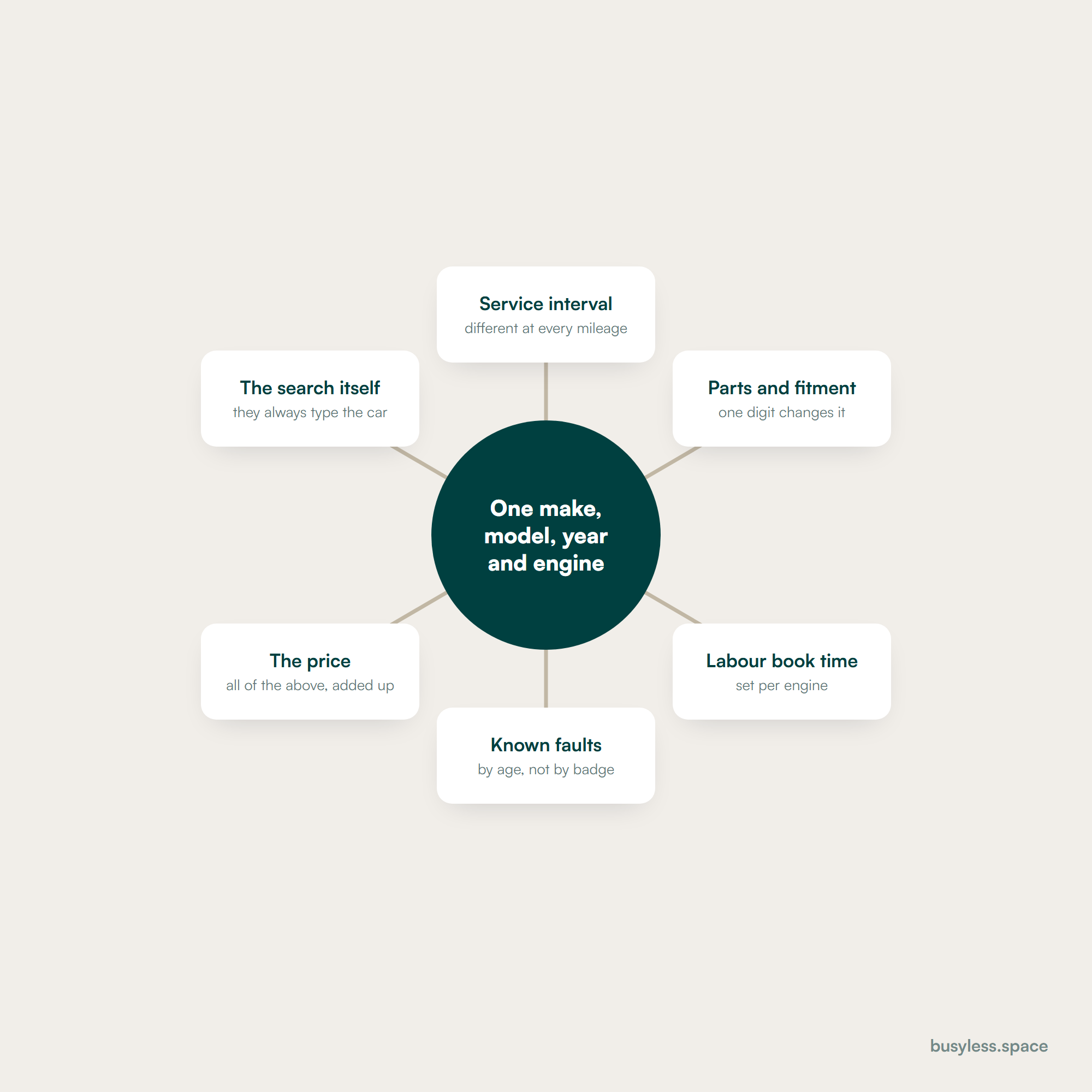
A vehicle at the centre with spokes out to the services, intervals and faults that only apply to that specific make, model and engine
One service becomes a hundred pages because the middle of this diagram changes. That is a page-set problem, not a keyword problem.

What the rules change

One of the rules below is the reason a section of this page exists at all, and it is unusual in this directory for being a rule you can use rather than one you have to work around. The rest are ordinary trade regulation, and they vary by state more than most. This is my reading rather than legal advice.

1

A manufacturer generally cannot void a warranty because you used an independent shop

Magnuson-Moss Warranty Act, 15 U.S.C. 2302(c); FTC staff warning letters, April 2018; FTC report to Congress, May 2021; final consent orders, October 2022

What it means

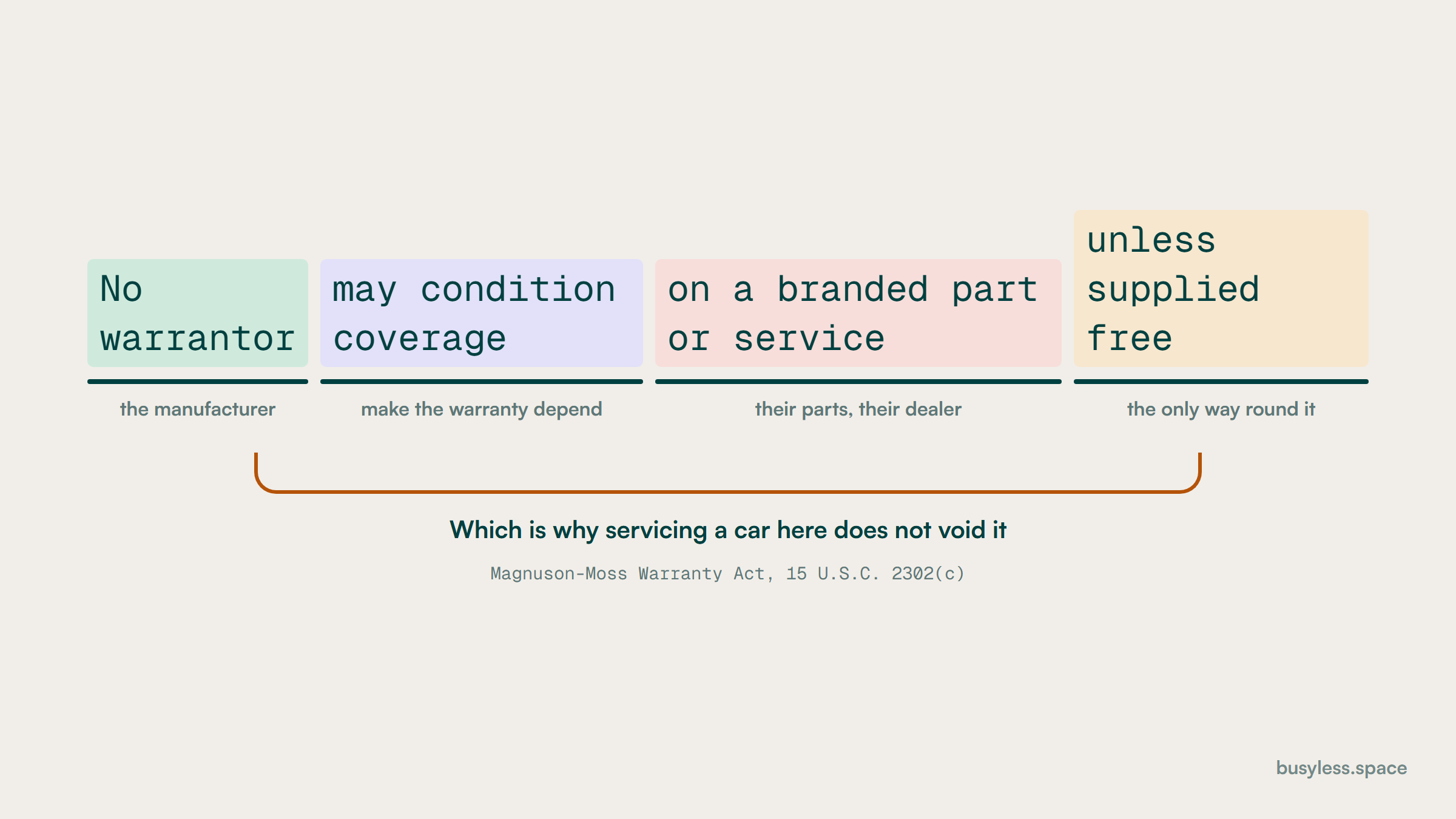
The tie-in sales prohibition stops a warrantor conditioning coverage on the use of a branded part or an authorised service provider, unless it supplies that part or service free of charge. FTC staff wrote to six companies about warranty language in April 2018, published its repair restrictions report to Congress in May 2021, and approved consent orders in October 2022 requiring three companies to state that independent repair does not void coverage.

So do this

Write the page. State what the Act says, name the FTC actions and their dates, and be careful about the real limit: if a repair you performed caused the failure, that specific claim can still be denied. An honest page beats an overstated one and stands up when a dealer disputes it.

2

Your registration number belongs in your internet advertising

California Bureau of Automotive Repair, read 2026-08-29; B&P Code 9880 to 9889.68 and 16 CCR 3351 to 3394

What it means

In California an automotive repair dealer's internet advertising must display the firm name exactly as it appears on the state registration certificate, along with the registration number issued by the Bureau. Repair dealer registration schemes exist in many states and differ in what they require.

So do this

Put the registered name and number in the site footer and the business profile, and make sure the trading name you market under matches the certificate. Then check what your own state requires rather than assuming California is the strictest version of it.

3

The estimate comes before the work, and so does the authorisation for more

State automotive repair statutes, California's among the most detailed

What it means

A written estimate is generally required before work begins unless the customer waives it, and additional work beyond the estimate needs fresh authorisation. This is a shop-floor rule with a marketing consequence: it is also the thing customers most fear you will not do.

So do this

Describe your estimate and authorisation process on the website in plain words. It is a compliance obligation you already meet, and publishing it answers the trade's oldest objection before anybody has to ask.

4

An advertised service price has to be available on ordinary terms

FTC Act section 5 deception principles and state advertising statutes

What it means

A headline oil change price that excludes most vehicles, most oil types and most filters is the classic bait complaint in this trade. The price is a representation, and the qualifications have to be as visible as the number.

So do this

Publish price bands rather than a single hero number, and say which vehicles fall outside them. A band that is honest converts better than a number that has to be walked back at the desk.

5

The certifications in your footer are claims about people

Certification body trademark and usage terms, including ASE and manufacturer programmes

What it means

Technician certifications are held by individuals and expire. A badge on a website asserts a current credential, and a shop that keeps the logo after the technician left, or after the certification lapsed, is making a false one.

So do this

Name the technician who holds each certification, with the year, and review it annually. It is more convincing than a badge row and it makes the claim verifiable, which is the point of publishing it at all.

The Magnuson-Moss tie-in sentence broken into parts, showing what a warrantor may not require and the exception where it supplies the part free
Read left to right this is a prohibition on somebody else. Read as a shop owner, it is the only rule in this playbook that hands you an argument.

Proving expertise

This trade's trust problem is specific: the customer cannot verify the work, cannot judge the price and has usually heard a story about somebody being overcharged. Every signal below is a way of being checkable.

  • Named technicians with their certifications and how long they have been in the trade
  • Price bands published for the jobs people search for most
  • The estimate and authorisation process described in plain words
  • Photographs of your own bays and your own team, not stock images
  • The marques and systems you genuinely specialise in, with the tooling named
  • Warranty terms on your own work, stated in months and miles
  • Reviews answered, including the unhappy ones, without arguing
  • The registered business name and repair dealer number, where your state requires it

How to build a auto repair SEO strategy

The order below is deliberate, because an auto repair SEO strategy that opens with content usually opens in the wrong cluster. Get the profile and the money pages right first, then build the vehicle matrix, and leave the symptom material alone entirely.

  1. 1

    Weeks 1-3

    Win the decision that is already being made

    • Complete the business profile services list, hours and photographs
    • Publish price bands for your ten most requested jobs
    • Make the phone number real text and tappable on every page
    • Describe the estimate and authorisation process on the site
    • Fix hours so they match when somebody actually answers the phone

    You end up with
    A profile and a set of pages that answer the price and trust questions

  2. 2

    Weeks 4-10

    Build the pages that map to real jobs

    • One page per service you actually sell, replacing the single services list
    • Add AutoRepair markup with a service catalogue
    • Write the warranty page citing the Magnuson-Moss tie-in prohibition
    • Build a page per marque you specialise in, naming the tooling
    • Write the fleet page with response times and account terms

    You end up with
    A service structure a search engine can read, and three pages nobody local has

  3. 3

    Weeks 11-20

    Add the vehicle dimension

    • Pick the ten vehicles you see most often in the bays
    • Build service interval pages for each, with what is genuinely included
    • Add cost pages for your top jobs on those specific vehicles
    • Write fault code pages only for codes you diagnose regularly
    • Interlink the vehicle pages to the service pages both ways

    You end up with
    A vehicle-by-service page set built on the work you really do

  4. 4

    Weeks 21-26

    Make the trust visible and repeatable

    • Add named technician profiles with dated certifications
    • Set a review request into the invoice or the collection message
    • Publish your own warranty terms in months and miles
    • Track calls from the profile separately from calls from the site
    • Review which cost and vehicle pages produced booked jobs

    You end up with
    A shop that is checkable online and a report that shows which pages fill bays

Technical fixes with the best payoff

Most of what breaks here comes from two directions: website vendors that specialise in this trade and ship the same structure to every shop, and a visitor who is frequently outdoors, on a phone, next to a car that will not move.

  • There is one services page listing thirty services

    A fortnight

    Vendor templates model services as a bullet list because that is how a shop describes itself on a wall. Thirty jobs share one URL, so none of them can rank for anything, and the highest-intent queries land on a page about everything.

    A page per service you genuinely sell, with your price band and the vehicles it applies to. Ten good ones beat thirty stubs.

  • The vehicles you actually work on appear nowhere

    A week

    A shop that has specialised in one group of marques for twenty years describes itself as a general repair shop online, because that is what the template's home page asked for.

    Say it plainly, once on the home page and once per marque, and name the diagnostic tooling. It is the fastest way to change who books.

  • The phone number is inside an image

    Fifteen minutes

    It was set in the header graphic when the site was designed, so it cannot be tapped, cannot be copied and does not exist as text for anything that reads the page.

    Real text, wrapped in a telephone link, in the header and at the end of every page. This is the highest-value fifteen minutes on the whole site.

  • The booking form is a third-party iframe

    A sprint with your vendor

    Scheduling is bought as a separate product and embedded, so the conversion step happens on somebody else's domain and appears in your analytics as an exit rather than as a booking.

    Use the vendor's inline or API option where one exists, and instrument the submission so a booked job is countable. If neither is possible, at least measure the click.

  • The blog is syndicated from the website vendor

    An afternoon to switch off, then ongoing

    Many shop platforms include a content feed, so several hundred shops publish the same article about winter tyres on the same week, under different logos.

    Turn it off. Two pages a month about the jobs you actually do are worth more than fifty articles that exist on four hundred other domains.

  • The page is too slow for a car park

    Two days

    The site is judged on a desk connection, and the real visitor is on mobile data, outdoors, with a stationary vehicle and no patience, which is the least forgiving context a website faces.

    Cut the hero video and the slider, compress the images and get the number, the address and the hours into the first screen.

Structured data that applies here

The types below fit this industry specifically. Most of them earn no rich result on their own, which is worth knowing before anyone sells the work on that basis. What they do is describe the entity precisely, which matters for how search engines and answer engines resolve who you are.

  • AutoRepair

    The home page and every location page

    Schema.org models this trade specifically, under AutomotiveBusiness, and most shop sites still use the generic local business type. Using the exact one carries the address, the hours and the service catalogue in a form built for the trade.

    AutoRepair.jsonld
    {
      "@context": "https://schema.org",
      "@type": "AutoRepair",
      "name": "[REGISTERED BUSINESS NAME]",
      "url": "https://[YOUR-DOMAIN]/",
      "image": "https://[YOUR-DOMAIN]/[YOUR-OWN-SHOP-PHOTO].jpg",
      "telephone": "[+00 000 000 0000]",
      "priceRange": "[$$]",
      "address": {
        "@type": "PostalAddress",
        "streetAddress": "[STREET]",
        "addressLocality": "[TOWN]",
        "addressRegion": "[STATE]",
        "postalCode": "[POSTCODE]",
        "addressCountry": "[ISO COUNTRY CODE]"
      },
      "geo": {
        "@type": "GeoCoordinates",
        "latitude": "[LAT]",
        "longitude": "[LON]"
      },
      "openingHoursSpecification": [
        {
          "@type": "OpeningHoursSpecification",
          "dayOfWeek": ["Monday", "Tuesday", "Wednesday", "Thursday", "Friday"],
          "opens": "[07:30]",
          "closes": "[17:30]"
        }
      ],
      "identifier": {
        "@type": "PropertyValue",
        "name": "[Automotive repair dealer registration]",
        "value": "[NUMBER]"
      }
    }
  • hasOfferCatalog on the shop

    The home page, listing every service that has its own page

    This is the machine-readable answer to the single services page problem. It says which jobs the shop does and where each one is described, which is exactly what a thirty-item bullet list fails to communicate.

    hasOfferCatalog on the shop.jsonld
    {
      "@context": "https://schema.org",
      "@type": "AutoRepair",
      "name": "[REGISTERED BUSINESS NAME]",
      "url": "https://[YOUR-DOMAIN]/",
      "hasOfferCatalog": {
        "@type": "OfferCatalog",
        "name": "Repair and maintenance services",
        "itemListElement": [
          {
            "@type": "Offer",
            "itemOffered": {
              "@type": "Service",
              "name": "[Timing belt replacement]",
              "url": "https://[YOUR-DOMAIN]/services/[SLUG]"
            }
          },
          {
            "@type": "Offer",
            "itemOffered": {
              "@type": "Service",
              "name": "[Brake replacement]",
              "url": "https://[YOUR-DOMAIN]/services/[SLUG]"
            }
          }
        ]
      }
    }
  • Service with a published price band

    Every individual repair or service page

    Price is the objection in this trade and a band is the honest way to answer it. Marking it up says the range is a real quoted range rather than a headline number that changes at the desk.

    Service with a published price band.jsonld
    {
      "@context": "https://schema.org",
      "@type": "Service",
      "serviceType": "[Timing belt replacement]",
      "name": "[Timing belt replacement in TOWN]",
      "url": "https://[YOUR-DOMAIN]/services/[SLUG]",
      "provider": {
        "@type": "AutoRepair",
        "name": "[REGISTERED BUSINESS NAME]",
        "url": "https://[YOUR-DOMAIN]/"
      },
      "areaServed": [
        { "@type": "City", "name": "[TOWN]" },
        { "@type": "City", "name": "[NEIGHBOURING TOWN]" }
      ],
      "offers": {
        "@type": "Offer",
        "priceSpecification": {
          "@type": "PriceSpecification",
          "minPrice": "[LOW END]",
          "maxPrice": "[HIGH END]",
          "priceCurrency": "[CURRENCY CODE]",
          "valueAddedTaxIncluded": true
        },
        "description": "[What the band covers, and which vehicles fall outside it.]"
      }
    }
  • Person with a technician credential

    Technician profile pages

    Certifications belong to people and expire, so marking them on a Person node rather than as a badge in the footer makes the claim specific and datable. That is both more honest and more persuasive.

    Person with a technician credential.jsonld
    {
      "@context": "https://schema.org",
      "@type": "Person",
      "name": "[TECHNICIAN NAME]",
      "url": "https://[YOUR-DOMAIN]/team/[SLUG]",
      "jobTitle": "[Master technician]",
      "worksFor": {
        "@type": "AutoRepair",
        "name": "[REGISTERED BUSINESS NAME]",
        "url": "https://[YOUR-DOMAIN]/"
      },
      "hasCredential": {
        "@type": "EducationalOccupationalCredential",
        "credentialCategory": "certification",
        "name": "[CERTIFICATION NAME AND SERIES]",
        "recognizedBy": {
          "@type": "Organization",
          "name": "[CERTIFYING BODY]"
        },
        "validIn": { "@type": "Country", "name": "[COUNTRY]" },
        "dateCreated": "[YYYY]"
      },
      "knowsAbout": ["[MARQUE]", "[SYSTEM YOU SPECIALISE IN]"]
    }
  • FAQPage

    The warranty page, cost pages and service pages

    The warranty question is the one worth marking up above all others, because it is short, factual and blocking a decision. Only mark up questions the page actually shows.

    FAQPage.jsonld
    {
      "@context": "https://schema.org",
      "@type": "FAQPage",
      "mainEntity": [
        {
          "@type": "Question",
          "name": "[Will servicing here void my manufacturer warranty?]",
          "acceptedAnswer": {
            "@type": "Answer",
            "text": "[The plain answer, the statute named, and the honest limit.]"
          }
        },
        {
          "@type": "Question",
          "name": "[Why is this a price range rather than a price?]",
          "acceptedAnswer": {
            "@type": "Answer",
            "text": "[What changes the number, and when you confirm it.]"
          }
        }
      ]
    }
  • AggregateRating on the shop

    The home page, only where the reviews are genuinely displayed

    Reviews carry more weight in this trade than in almost any other, which makes the temptation to inflate them correspondingly strong. Mark up only what is on the page and only what was collected without incentive.

    AggregateRating on the shop.jsonld
    {
      "@context": "https://schema.org",
      "@type": "AutoRepair",
      "name": "[REGISTERED BUSINESS NAME]",
      "url": "https://[YOUR-DOMAIN]/",
      "aggregateRating": {
        "@type": "AggregateRating",
        "ratingValue": "[YOUR REAL AVERAGE]",
        "reviewCount": "[HOW MANY ARE SHOWN ON THE PAGE]",
        "bestRating": "5",
        "worstRating": "1"
      },
      "review": [
        {
          "@type": "Review",
          "author": { "@type": "Person", "name": "[REVIEWER FIRST NAME]" },
          "datePublished": "[YYYY-MM-DD]",
          "reviewRating": {
            "@type": "Rating", "ratingValue": "[N]", "bestRating": "5"
          },
          "reviewBody": "[THEIR WORDS, UNEDITED]"
        }
      ]
    }

What it costs

The bands below are editorial estimates for the work described here rather than quotes. What moves a shop up a tier is the size of the vehicle matrix it wants to cover, since every extra marque multiplies the page count rather than adding to it.

Do it yourself

$0 to $300
  • Profile services, hours and photographs completed properly
  • Price bands published for your ten most requested jobs
  • A tappable phone number and a page that loads outdoors
  • The warranty page, written once
  • Reviews requested on every invoice

Who it suits

A single-location shop where the owner or service manager can give this two hours a month. Most of the return in this playbook is available at this tier.

Where it stops

The vehicle matrix is the wall. Building interval and cost pages for ten vehicles by hand is a job nobody running a shop finishes in evenings.

Lean

$900 to $2,500
  • A page per service, written and priced
  • Vehicle-specific interval and cost pages for your top ten vehicles
  • Marque specialisation pages with tooling named
  • Technician profiles and the fleet page

Who it suits

An established independent with a clear specialism and enough bays that filling the diary is a real commercial goal rather than a nice idea.

Where it stops

None of this changes how many cars fit in the bays. Once the diary is full, further search work moves the mix rather than the volume.

Funded

$2,500 to $4,500
  • A structured vehicle-by-service page set at real scale
  • Multi-location coverage with distinct pages and profiles
  • Fleet and commercial acquisition run as its own funnel
  • Call tracking that separates profile calls from website calls

Who it suits

A multi-site group, or a specialist workshop where a particular marque or system is the whole business and the catchment is regional.

Where it stops

Technician capacity, every time. In this trade the constraint on growth is who you can hire, and no amount of demand generation recruits anybody.

How to do it with no budget

The two things that matter most here cost nothing and take an afternoon between them: publishing what jobs cost, and making the phone number work. Almost every shop has neither.

  1. 1

    Turn the phone number into tappable text

    15 minutes

    Your website editor

    If it lives inside the header image it cannot be tapped by somebody standing beside a car that will not start. This is the shortest task on this page and probably the most valuable.

  2. 2

    Put a real number on the ten jobs people ask about

    An afternoon

    Your website editor

    A range with an honest explanation of what moves it. The cost cluster is where people who have already decided to pay are choosing, and most shops refuse to answer them.

  3. 3

    Fill in the services list on your business profile

    An hour

    Google Business Profile

    It is a structured field that feeds directly into which local searches you appear for, and most shops leave it at whatever the category default was.

  4. 4

    Write the warranty page

    Two hours

    Your website editor

    What the Magnuson-Moss tie-in prohibition says, the FTC actions with their dates, and the honest limit. It answers the objection keeping cars at the dealership and nearly nobody has written it.

  5. 5

    Say which marques you actually specialise in

    An hour

    Your website editor

    Twenty years of specialism usually appears online as general repairs, because that is the field the template asked for. Naming it changes who books rather than how many.

  6. 6

    Switch off the syndicated blog

    20 minutes

    Your website vendor's settings

    Several hundred shops publish the same seasonal article in the same week. Removing it costs nothing and stops your domain carrying content that exists everywhere else.

  7. 7

    Ask for a review at collection, every time

    20 minutes to set up

    Your invoice or your collection message

    Reviews decide the local pack in this trade more than anything you publish. Asking at the moment the car is handed back, with no incentive attached, is the whole mechanism.

The tool stack

Short, and one entry is here for a reason peculiar to this trade: the useful keyword research is not a list of phrases, it is a list of questions attached to specific vehicles.

  • Find the questions people ask about specific vehicles

    SerpstatSEO APIRead the review

    Generic keyword volume hides this market, because the real queries carry a make, a model and a year. Question data grouped by vehicle is what tells you which ten pages to build first.

    Free routeRead the People also ask boxes and your own service advisers' notes

  • Run a vehicle by service page set without hand-building it

    Umbraco HeartcoreHeadless CMSRead the review

    A service, a vehicle, an interval and a price band are structured records that combine. Modelling them once is what makes a hundred pages maintainable rather than a hundred pages abandoned.

    Free routeA spreadsheet and your existing CMS, for the first ten vehicles

  • Work out what a filled bay is worth over a year

    SEO Revenue Growth CalculatorFree toolOpen the tool

    A repair customer who returns for servicing is worth several times the first job, and shops routinely value them at the invoice. Modelling the repeat is what justifies the work above.

    Free routeFree

  • Know which calls came from the profile and which from the site

    A call tracking number on the website only

    Most bookings in this trade arrive by phone, so an analytics report that counts form submissions is measuring the smallest part of the funnel. Separate the two sources or the profile takes all the credit.

    Free routeAsk every caller where they found you, and write it down

  • Keep the profile accurate and photographed

    Google Business Profile

    Hours, services, and photographs of your own bays and team. For a single-location shop this outperforms anything on the website and takes an hour a quarter.

    Free routeFree

  • Watch which vehicle pages produce booked jobs

    Analytics plus your shop management system

    The vehicle matrix is a large investment and it needs a verdict. Match the page to the job in the diary rather than to the session count, or the wrong ten pages get built next.

    Free routeFree, if somebody asks at booking

Take it from here

Everything below is meant to be filled in and used rather than read. Bodies are plain text, so what lands on your clipboard is exactly what you see, brackets and all.

Brief

Answers the price question with a real band, which is the cluster national estimators own by default.

REPAIR COST PAGE
Job: [SERVICE NAME]     Vehicle: [MAKE MODEL, YEARS, ENGINE]
URL: /cost/[SERVICE-SLUG]-[VEHICLE-SLUG]
Written by: [NAME]     Date: [DATE]

TITLE TAG
[SERVICE] cost for a [MAKE MODEL] in [TOWN] | [SHOP NAME]

H1
What a [SERVICE] costs on a [MAKE MODEL]

THE ANSWER, FIRST
"At our shop a [SERVICE] on a [MAKE MODEL] is usually between
[LOW] and [HIGH], including parts and labour."

  - the number goes in the first 40 words, not at the bottom
  - a range, never a single figure
  - inclusive of tax and parts, or say clearly what it excludes

WHAT MOVES THE NUMBER
Factor                       Effect on the price
[Engine variant]             [ ............................ ]
[Whether X is replaced too]  [ ............................ ]
[Parts choice]               [ ............................ ]
[Condition found on strip]   [ ............................ ]

WHY IT IS A RANGE AND NOT A PRICE
[ Two sentences. Honest, not defensive. This is the paragraph
  that separates you from a shop that will not answer at all. ]

WHAT THE JOB INVOLVES
[ 120 words. What actually happens in the bay, in plain words.
  Not a how-to. The reader is deciding whether the price is
  reasonable, not whether to attempt it. ]

LABOUR TIME
Book time:     [ ......... ]
Our rate:      [ ......... ]
  - publishing the rate is unusual and unusually persuasive

HOW LONG WE KEEP THE CAR
[ ....................................................... ]

WHAT HAPPENS IF WE FIND SOMETHING ELSE
[ Describe the authorisation step. This is a legal obligation
  in many states and the single most reassuring paragraph on
  the page. ]

WARRANTY ON THIS WORK
Parts:  [ ......... ]     Labour: [ ......... ]

CALL TO ACTION
Phone number as tappable text, above and below the fold.
"Ring and we will give you a firm figure for your registration."

MARKUP
  [ ] Service with priceSpecification minPrice and maxPrice
  [ ] FAQPage if the page carries questions
  [ ] AutoRepair as the provider

REVIEW
Price band checked against the last [N] invoices for this job.
Checked on: [DATE]     Next check: [DATE, 6 MONTHS]

What to publish

Everything below serves a searcher who has accepted they will pay somebody. That is the filter for this trade, and applying it removes about eighty per cent of what a keyword tool will suggest.

  • Cost pages with real bands

    Ten jobs first, then as questions arrive at the desk

    The most valuable non-branded cluster here, and the one national estimators own only because local shops refuse to publish a number. A band with your labour rate behind it beats a national average.

  • Vehicle service interval pages

    Your ten most common vehicles, then two a month

    The manufacturer publishes the interval, so your page can be exact about what it includes and what it leaves out, which is precisely where dealership quotes differ from yours.

  • The warranty page

    Once, reviewed annually

    A federal statute answers the fear that keeps cars at the main dealer, and almost no independent has written the page. It converts a specific, common objection.

  • Marque specialisation pages

    One per marque you genuinely specialise in

    Owners of particular marques search that way on purpose, usually after a generalist has let them down. Naming your tooling is what makes the claim credible.

  • Technician profiles

    One per technician, updated as certifications renew

    The trust problem in this trade is about people, not premises. A named technician with a dated certification is more persuasive than any amount of copy about quality.

  • The fleet page

    Once, reviewed each year

    Recurring work chosen by somebody comparing shops on response time and account terms. It is a business page on a consumer site and it competes with almost nothing.

And what not to

  • Step-by-step repair guides, which serve an audience whose whole intention is not to visit
  • Symptom articles competing with video, forums and parts retailers at once
  • The syndicated seasonal blog your website vendor publishes on hundreds of shop sites
  • A single headline oil change price that most vehicles do not qualify for
  • Certification badges with no named technician or date behind them
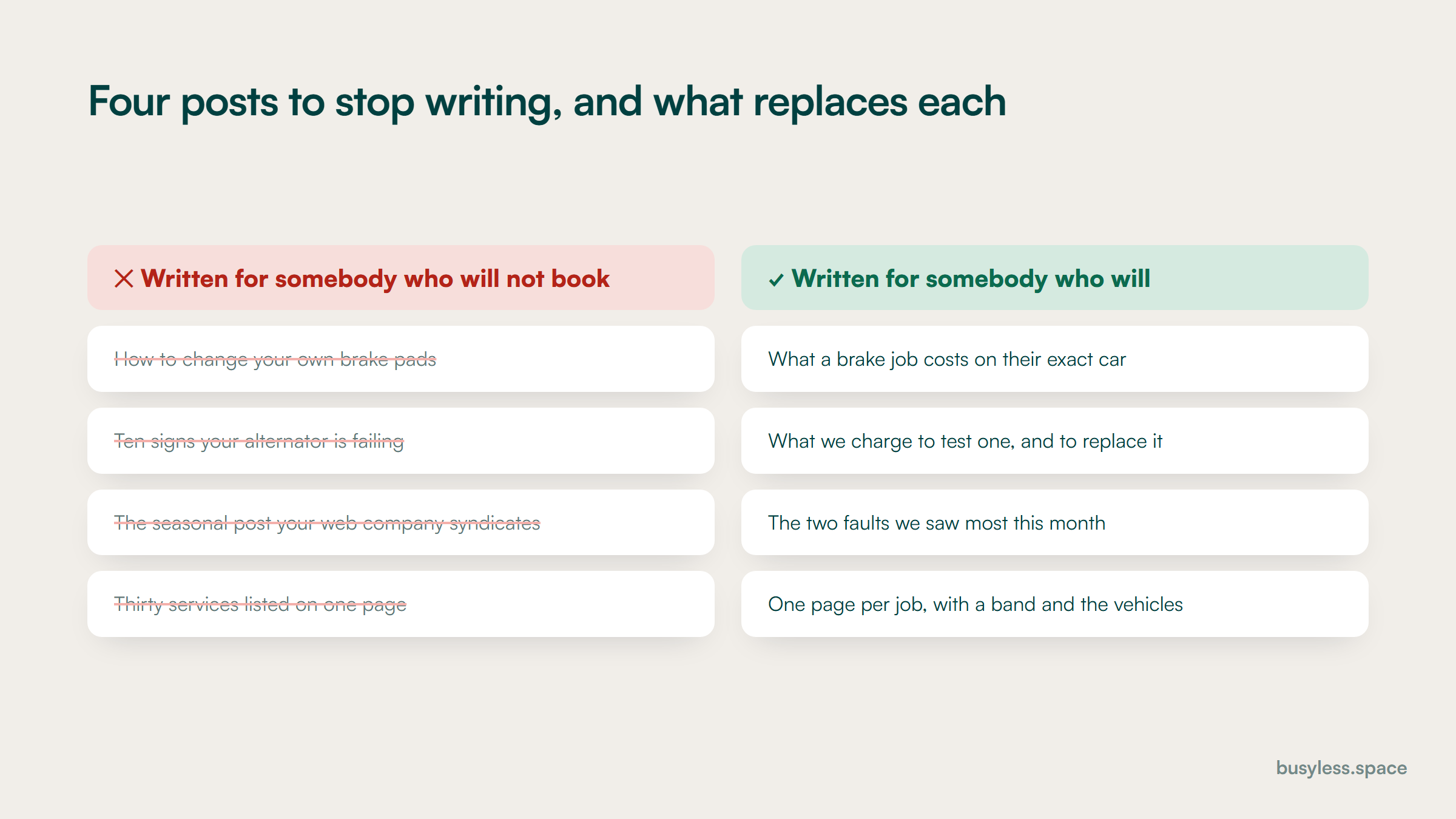
Four content types to stop producing beside the four that replace them, pairing how-to guides with cost pages and syndicated posts with vehicle pages
Each pair takes about the same effort to produce. Only the right-hand column is read by somebody who has already decided to pay.

The expensive mistakes

Chasing the how-to cluster because it has the volume

Costs you Months of writing that attracts people who are researching how to avoid you, and a traffic chart that looks healthy while the diary does not.

Filter every content idea by whether the searcher has already accepted they will pay somebody. Most of the volume fails that test.

Refusing to publish prices

Costs you The cost cluster goes to a national estimator, and the shop that will answer the question gets the call that was going to become a booking.

Publish honest bands with what moves them. The customers who leave over a published range were going to leave at the desk anyway.

Leaving thirty services on one page

Costs you Every high-intent service query lands on a page about everything, so none of them rank and none of them convert.

A page per service you genuinely sell, with a band and the vehicles it applies to. Ten real ones beat thirty stubs.

Hiding the specialism

Costs you A shop with twenty years of experience on one group of marques markets itself as a general garage, and competes on price with everybody instead of on skill with a few.

Say it on the home page and build a page per marque, naming the diagnostic tooling you own.

Publishing the vendor's blog feed

Costs you Your domain carries articles that exist on hundreds of other shop sites, which builds nothing and occupies the space real pages would.

Turn it off and write two pages a month about jobs that came through your own bays.

Counting form submissions as the funnel

Costs you Most bookings arrive by phone, so the reporting shows a handful of conversions and the work looks ineffective for a year.

Track calls, and separate the ones from your profile from the ones from the website. They are two channels with different fixes.

What to measure

Two measurement problems dominate this trade and both make good work look bad. Bookings arrive by phone rather than by form, and the value of a customer is spread over years of servicing rather than concentrated in the first invoice.

Leading indicators

Move first. They predict, they do not prove.

  • Local pack position for service and near me queries

    A rank tracker with location settings

    Track it from a handful of points across your catchment rather than one. A shop can be first at its own postcode and invisible four miles away, which is where the growth is.

  • Profile calls and direction requests

    Google Business Profile insights

    The clearest early signal in this trade, because the profile is where local decisions resolve. Watch calls specifically; direction requests tend to follow rather than lead.

  • Impressions on cost and vehicle pages

    Search Console, filtered to those URL patterns

    Segment them from the site total or the vehicle matrix cannot be judged. These pages index quickly and accumulate slowly, so read the trend rather than the month.

  • Website calls, tracked separately

    A call tracking number used only on the site

    Without this the profile takes credit for everything and the website looks like it does nothing. It is the single most useful piece of instrumentation in this playbook.

  • Review volume and response rate

    Your profiles

    Volume drives the pack and responses drive the reading. Answering an unhappy review calmly is read by every future customer, which makes the response rate a real metric rather than a courtesy.

Business indicators

The ones a manager acts on.

  • Booked jobs attributed to a page or a call source

    Your shop management system, with the source recorded at booking

    Requires somebody to ask at booking and write it down. It is a small habit that turns the whole report from an argument into evidence.

  • Average repair order value

    Your shop management system

    Worth watching alongside volume, because a specialism strategy should raise it while doing little to the count. If both are flat, the marque pages are not doing their job.

  • Returning customers and fleet accounts

    Your shop management system

    The number that says whether the work built a business rather than a month. First-visit customers who return for servicing are worth several times the job that brought them in.

The verdict

Plenty of auto repair SEO services arrive with a content plan full of symptom articles, because that is where the keyword tool points. It points at an audience that is deliberately trying not to become a customer.

The clusters that pay are smaller and duller. What a job costs on a specific vehicle, what a service interval actually includes, whether the warranty survives, and who nearby can be trusted with a car worth more than most people's savings.

That last question is the whole trade. A shop that publishes prices, names its technicians and explains its estimate process is answering the objection this industry has carried for fifty years, and doing it in public.

So the useful scope for SEO services for auto repair shops is narrow and deep: fix the profile, publish the numbers, build the vehicle pages, and leave the how-to library to the people selling parts.

FAQ

Auto repair SEO questions

  • Should I write repair how-to guides?
    Generally no. Those queries belong to video, forums and parts retailers, and the audience is explicitly trying to avoid paying a shop. Your effort is better spent on cost pages and vehicle-specific service pages, where the searcher has already decided to pay somebody.
  • Will publishing prices lose me customers?
    It loses the ones who were going to walk at the desk, and wins the ones currently calling a shop that will answer the question. Publish bands rather than single numbers, and say plainly what moves the figure.
  • Does using an independent shop void a manufacturer warranty?
    Generally not. The Magnuson-Moss Warranty Act's tie-in prohibition stops a warrantor requiring branded parts or authorised service unless it provides them free. The real limit is narrower: if a repair you performed caused the failure, that specific claim can still be refused.
  • How do I compete with RepairPal on cost queries?
    Not on the national question. Answer the same question with your town in the title and your own labour rate behind the number. A local price from a real shop is a different and better answer than an average.
  • Is it worth building pages for individual vehicles?
    Yes, and it is the one place in this directory where a structured page set is the right answer. Start with the ten vehicles that come through your bays most often, and only build pages you can genuinely make specific.
  • Should I keep the blog my website company publishes for me?
    No. That feed usually appears on hundreds of shop sites in the same week, so it builds nothing for your domain. Two pages a month about jobs from your own bays will outperform all of it.
  • Why does my website show so few conversions?
    Because most of your bookings are phone calls that the website never records. Put a tracked number on the site, keep the profile number separate, and the two channels stop competing for the same credit.
  • Do I need to put my repair dealer registration on the site?
    In some states, yes. California requires internet advertising to show the firm name exactly as registered along with the Bureau's registration number. Check your own state's rules, and make sure your trading name matches the certificate either way.

Run it yourself, or have someone own it

Everything above is written to be run without us, and the free path is genuinely most of the value for a single-location business. Where these plans stall is almost never the plan. It is that nobody owns it after the first month. That is the job we do, with search as one distribution layer inside a wider system rather than the whole engagement.