
Statamic review
Best for Laravel teams
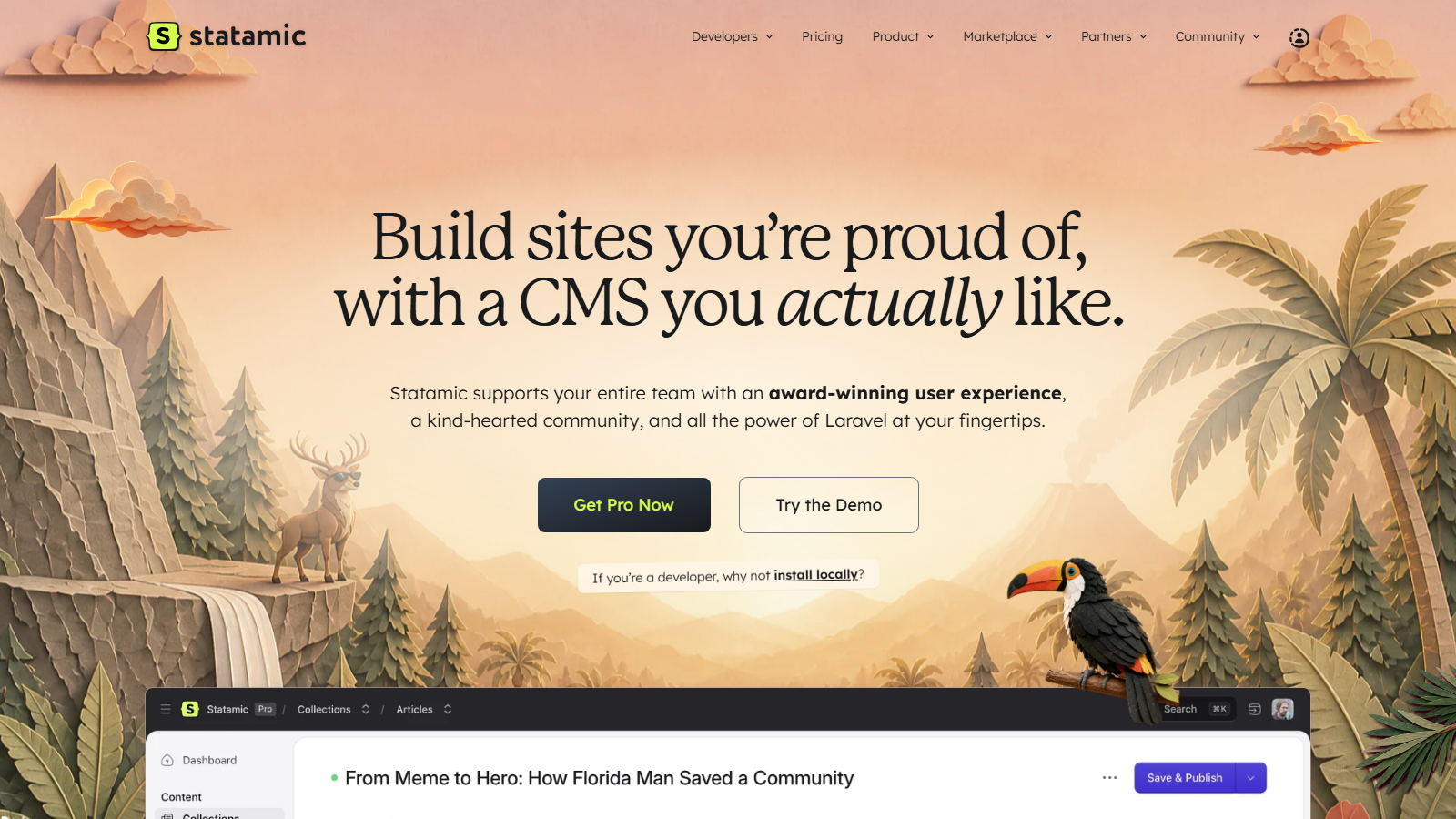
Statamic is a CMS built on Laravel, which means a PHP team gets a content platform that speaks the framework they already use: Eloquent, Blade, the service container, the queue, and the rest of the ecosystem including tools like Filament. Content can live in flat files under version control or in a database, and the modelling layer is genuinely good, with Blueprints and more than forty fieldtypes.
For this directory the crucial detail is what the free edition is not. Core is free forever and includes content modelling, unlimited collections and taxonomies, asset management and live preview, but it gives you one super admin account and no API at all.
Statamic's own pricing page lists "Headless, REST API, and GraphQL" among the Pro features. If you want to consume Statamic from a separate front end, the free tier is not an option you are choosing between.
The commercial model is the other thing that sets it apart, and it is the most buyer-friendly here. Pro is $349 once per site, not per month, including a year of updates, with $99 a year afterwards if you want to keep receiving them. It is free while you are still in development, so you pay at launch. Over three years that is $547 against roughly $5,400 for a mid-tier hosted competitor.
Our scorecard
Our editorial read across six dimensions, scored 1 to 5. This is our own assessment, not an aggregate of user reviews, and it is deliberately kept out of the page's structured data.
- Content modelling5/5
Blueprints and 40+ fieldtypes, in flat files you can version-control or a database if you prefer.
- Developer experience5/5
If you already write Laravel, this is the most comfortable CMS in the directory by a distance.
- Editor experience4/5
A polished control panel with live preview, though Core's single admin account makes it a solo tool until you pay.
- Pricing5/5
A perpetual $349 per site: stop paying and it keeps running. Craft's paid editions work the same way.
- Governance3/5
Roles, revisions and multi-site are all Pro. SSO, 2FA and audit logging are Enterprise.
- Ecosystem4/5
A real addon marketplace and the entire Laravel ecosystem behind it, which is the actual advantage.
An editorial read, not an aggregate of user reviews, and deliberately kept out of this page's structured data.
What you can query
REST API
PRO ONLY, and disabled by default
Read access to entries, collections, taxonomies, terms, globals, assets and users, filtered and paginated.
GraphQL API
PRO ONLY
The same content through a typed GraphQL schema, for teams that would rather shape the response.
Content repositories
Available in Core
The PHP query builder used inside your own Laravel code. This is the real API when Statamic is not headless.
Live Preview
In Core, and the reason Core is usable
Renders your front end inside the control panel as an editor types, including against a decoupled front end.
Git integration
Pro feature, automated in the panel
Commits content changes made in the control panel back to your repository, so flat-file content stays versioned.
Addons and Laravel
The genuine differentiator
The full Laravel application underneath: Eloquent, queues, events, middleware and any package you already use.
Who Statamic is for
Laravel teams, and agencies that build and hand over client sites. If your developers already write Laravel, Statamic removes the impedance between the CMS and the application entirely, and the perpetual licence means a client site does not carry a subscription anyone has to keep justifying. Licences can be transferred to the client, which is exactly how agency work should be billed.
It is a poor fit for a team with no PHP, and for very large datasets, where the flat-file architecture and its reliance on caching is the documented failure mode.
Strengths and limits
What it does well
- A perpetual licence at $349 per site, so you can stop paying and keep running the software you bought. Craft's paid editions work the same way; most others here are subscriptions.
- Free while the site is in development, so cost begins at launch rather than at kickoff.
- It is a Laravel application, so queues, events, Eloquent, middleware and the whole package ecosystem are available rather than approximated.
- Content can live in flat files under Git, and the Pro control panel commits editor changes back to the repository automatically.
- Blueprints and more than forty fieldtypes make the modelling layer genuinely strong, and all of it is in the free edition.
- Licences transfer to clients, which fits agency delivery better than a subscription in the agency's name.
- A 20% discount for verified non-profits, schools and universities, including on renewals.
Where it falls short
- THE FREE EDITION HAS NO API. Headless mode, REST and GraphQL are all Pro features, so Core cannot be evaluated for headless use at all.
- Core allows one super admin account, so any second editor means buying Pro.
- The REST API ships disabled and is enabled per resource in config, with no built-in per-request token, so exposing it safely is your job.
- Flat-file architecture leans heavily on caching, and one team reported a large migrated dataset taking 8 or more seconds a call against 200ms on the previous CMS.
- The licence is source-available and restrictive: one production environment per copy, and a no-reuse clause covering designs, components, classes and patterns. Breach terminates permission automatically.
- Per-site licensing gets expensive across many small sites, where a subscription with unlimited projects would not.
- No MCP server, and no hosted option from the vendor, so you own the infrastructure.
- PHP is a hard prerequisite. If your team is JavaScript-only, none of the ecosystem advantage applies.
Statamic pricing
Core is free forever and is a real CMS: Blueprints, more than forty fieldtypes, unlimited collections and taxonomies, asset management, live preview and the whole front-end layer. It gives you one super admin account and no API of any kind.
Pro is $349 once per site. That includes a year of updates, after which updates are $99 a year if you want them, and the software keeps working if you do not. It is free to use while the site is in development, so the licence is bought at launch. Pro is what unlocks headless mode, the REST API, GraphQL, unlimited users and roles, revisions and history, multi-site and multilingual, white labelling and Git automation.
Run the three-year arithmetic, because it is the strongest argument on this page. Pro plus two years of updates is $547 for a site you own outright. A mid-tier hosted competitor at $149 a month is roughly $5,364 over the same period, and you stop having a CMS when you stop paying.
The model inverts for a portfolio. Ten client sites is ten licences, $3,490 up front plus $990 a year, where a subscription platform with unlimited projects might be cheaper. Per-site pricing rewards a few important sites and punishes many small ones.
Enterprise is quote-only and adds an SLA, SSO, 2FA, audit logging, priority bug resolution and offline licence validation.
Core
Free
Forever, one production site
- One super admin user account, one content form
- Blueprints, 40+ fieldtypes, unlimited collections and taxonomies
- Asset management, Live Preview, all frontend features
- NO headless mode, NO REST API, NO GraphQL
Pro
$349 per site
One-off, plus $99/yr for updates
- Headless, REST API and GraphQL
- Unlimited users and roles, revisions, drafts and history
- Multi-site, multilingual, multi-user editing, white label
- Free while in development, so you pay at launch
Enterprise
Custom
For SLAs and procurement
- Dedicated premium support with an SLA
- SSO, 2FA and audit logging
- Priority bug resolution and roadmap influence
- Offline and private licence validation
Query example
A minimal fetch against the live API, with credentials read from the environment rather than pasted inline.
curl -s -G "https://your-site.test/api/collections/articles/entries" \
  --data-urlencode "filter[status:is]=published" \
  --data-urlencode "sort=-date" \
  --data-urlencode "limit=10" \
  --data-urlencode "fields=title,slug,date,author"

# Two things to know before this works:
#   1. This endpoint requires a PRO licence. Core has no API.
#   2. The REST API ships DISABLED. Enable it and choose which
#      resources are exposed in config/statamic/api.php, because
#      there is no per-request auth token in front of it.
Limits and quotas
- Core: one super admin user account and one content form.
- Core has no headless mode, no REST API and no GraphQL.
- Pro: $349 per site, one-off, including one year of updates.
- Updates after the first year: $99 per year, per site.
- The licence permits one active production environment per licensed copy.
- The REST API is disabled by default and enabled per resource in configuration.
- SSO, 2FA and audit logging are Enterprise only.
- Non-profits, schools and universities get 20% off, renewals included.
What developers say on Reddit
Inside the PHP and Laravel community Statamic is recommended warmly and specifically. It appears in nearly every thread asking for a Laravel-based CMS, usually alongside Craft and Winter, and the people recommending it tend to have shipped several sites on it rather than tried it once.
The recurring argument for it is not the CMS in isolation but what sits underneath. Practitioners describe starting with a marketing site and then reaching into Laravel proper when requirements grow, which is the thing a hosted headless CMS cannot offer at any price.
The one substantive criticism is about scale, and it is worth taking seriously because it is specific. A team that migrated a large dataset from another CMS reported response times of 8 or more seconds a call against 200ms previously, and traced it to how heavily the platform depends on caching. If your content set is large, prototype with realistic volume before committing.
“If you're after purely a marketing site with blogging/posting content Statamic provides good flexibility, an eco system of plugins (similar to (gasp) WordPress) and like you said technical support. The best thing about Statamic is should you need more Statamic plugs right into the Laravel framework”
r/PHP on Reddit“One for the first customers had a really big dataset and after migrating this from the old CMS, the site became horribly slow. I'm talking 8+ seconds per call, where the old CMS did 200ms max (without caching). So we started to profile the CMS to find the problem. It became clear that it relies heavily on caching”
r/cms on Reddit“comparing Statamic to any other CMS I've worked with, Statamic will always take first place in my book.”
r/PHP on Reddit“If you looking only for Laravel based solution then it's Statamic, Craft CMS or WinterCMS. If not only laravel based then WordPress or Drupal.”
r/PHP on Reddit“I regret WordPress. Only time in my life I've woke up to my web server mining bitcoin. My current favorite is Astro or Statamic.”
r/cms on Reddit
Verdict
If your team writes Laravel, stop comparing and try it. Statamic is the Laravel-native choice here, an application in your own framework rather than a service you integrate with, and its $349 perpetual licence per site is one of the most buyer-friendly commercial models in this directory. For an agency handing sites to clients, the transferable licence fits the delivery model better than any subscription does.
Understand what the free edition is, though. Core is a traditional CMS with one admin and no API, so within this directory it is effectively a demo. The moment headless is the requirement, the price is $349 and there is no free path to evaluate it.
Two things to test before committing. Load the real content volume, because the reliance on caching is a documented failure at scale. And read LICENSE.md rather than the word source-available: one production environment per licence and a broad no-reuse clause covering patterns and components are stricter terms than most developers assume they are agreeing to.
Statamic FAQ
Can I use Statamic headlessly for free?
No. The pricing page lists headless mode, the REST API and GraphQL together as Pro features. The free Core edition is a traditional CMS with a templating layer and no API at all, so for headless use the entry price is $349 per site.How much does Statamic cost?
Core is free. Pro is $349 once per site, including a year of updates, then $99 a year afterwards if you want to keep receiving them. It is free while the site is in development, so you buy the licence at launch. Enterprise is quote-only.Is the Statamic licence a subscription?
No. It is a perpetual licence, like Craft's paid editions and unlike most platforms in this directory. You buy the site once and it keeps working whether or not you renew updates. Over three years Pro plus renewals is $547, against roughly $5,400 for a mid-tier hosted competitor over the same period.Is Statamic open source?
No, it is source-available. LICENSE.md sets five conditions, of which two bite: each licensed copy may be actively installed in no more than one production environment, and the code, designs, components, classes and patterns may not be reused in other projects without written consent. Breach terminates the permission automatically.Does Statamic scale to large content sets?
It is the main documented weakness. One team migrating a large dataset reported 8 or more seconds per call against 200ms on their previous CMS, and traced it to how heavily the platform leans on caching. Prototype with realistic content volume rather than a sample before committing.How do I turn on the Statamic REST API?
It ships disabled. You enable it and choose which resources are exposed in config/statamic/api.php, and there is no built-in per-request token in front of it, so authentication and exposure are your responsibility. That is a reasonable default for a self-hosted CMS and a surprise if you expect a hosted platform's key management.Can I transfer a Statamic licence to a client?
Yes, and Statamic actively supports it: you can initiate a transfer request from your account and the recipient approves it. That fits agency delivery much better than a subscription held in the agency's name, because the client ends up owning the licence for their own site.Statamic or a hosted headless CMS?
Statamic if you write PHP, want the content in Git, and would rather own a licence than rent a service. A hosted platform if your team is JavaScript-only, you want somebody else running the infrastructure and applying security patches, or you need many small sites where per-site licensing works against you.
Other platforms worth a look
This is an independent review. We have no affiliate relationship with Statamic, earn nothing if you sign up, and no vendor pays for placement in the directory. Prices were read from the vendor's own pages in September 2026 and change without notice.