
Skip to content

Landscaping SEO strategy

Regulated marketing

Route density decides the margin, so geography beats volume

Written by Eugene SuslovLast reviewed 28 August 2026No affiliate links
Sector
Home and trades
Model
Local service
Competition
High
Time to results
3 to 7 months
Typical monthly
$800 to $3,500

Key takeaways

  1. 1More leads is the wrong goal. Crews are paid while they drive, so a customer six miles from your route is worth less than one next door to an existing job.
  2. 2The maintenance contract is the business. Design and build work funds the year, but recurring routes are what make the company worth something and what survive a bad spring.
  3. 3Watering restrictions and turf rebate programmes are municipal, they change, and in a drought year they are the highest-intent content you can publish.
  4. 4"Eco-friendly", "organic" and "pet-safe" are regulated environmental claims. The FTC Green Guides govern exactly the copy every landscaper wants to write.
  5. 5A plant recommendation is a regulated statement in some states. Check your own invasive and noxious species list before publishing a planting guide.

SEO for landscapers usually starts with the wrong goal, and it is worth naming that before anything else. More enquiries is not the objective. Enquiries in the right places is.

The reason is the cost structure. Crews are paid while they drive, equipment is trailered between jobs, and a route with eight properties on one street is a completely different business from a route with eight properties spread across a county.

That gives a landscaping SEO strategy an unusual shape. Instead of casting the widest possible net, you are trying to deepen density where you already work, which changes what a service-area page is for and how you judge whether it is working.

What actually holds value here is the second thing to get straight. Design and build work pays well and it is one-off, portfolio-led and lumpy. Recurring maintenance is what smooths the year, what a buyer values if you ever sell, and what survives a wet spring.

Then there is the seasonality, which in cold markets goes to a hard zero. Snow work is the counter-seasonal answer and it is contracted in autumn, months before anybody thinks about it, which means the content has to exist long before the demand does.

And there is one live regulatory theme that most landscapers walk into. The greenest, most appealing copy in this industry is also the most regulated, because environmental marketing claims have their own rulebook.

Who already ranks in landscaping

A maintenance query and a project query split the results page in half, and landscaping SEO has to work with both halves: national franchises and lead marketplaces on the recurring work, and design inspiration platforms on the project work, with local companies appearing mainly in the map pack.

What is on the results page

  • Local pack on nearly everything carrying a place name or a service word
  • National lawn care franchises on recurring service queries in most metros
  • Lead marketplaces on service-plus-city terms
  • Image results on project, material and design queries
  • Pinterest and design platforms on inspiration terms
  • People Also Ask, dense on cost, plant selection and timing questions
  • Municipal and utility pages on watering restriction and rebate queries, which is exactly where you want to be second
  • Water utility rebate programmes

    epa.govClaim it

    The gatekeeper that pays your customer to hire you. Water utilities in drought-affected regions run turf replacement and irrigation efficiency rebates, publish approved or participating contractor lists, and those pages rank for programme-name queries searched by homeowners who have already decided to spend. Free, paperwork rather than marketing, and almost nobody in the trade has checked whether they qualify.

  • Hardscape and irrigation manufacturer programmes

    belgard.comClaim it

    Paver, wall and irrigation manufacturers run certified or authorised contractor programmes with locators that rank for brand-plus-city queries. Certification is a real credential, the listing is usually half filled in, and many of these programmes carry co-operative marketing funds that expire unclaimed. Ask your distributor what yours is.

  • National lawn care franchises

    trugreen.com

    Not claimable and not beatable on generic recurring-service head terms. Their advantage is national authority and spend; yours is that they cannot answer a question about your soil, your watering ordinance or the tree that keeps dying on that street. Concede the head terms and compete where local knowledge is the answer.

  • Angi, Thumbtack and Yelp

    angi.comClaim it

    Rank on service-plus-city queries and sell the same enquiry to several companies. Claim the free profiles for consistency. Price any paid tier carefully in this trade specifically, because a marketplace has no idea where your routes are and will happily send you the least profitable geography in your market.

  • Nextdoor

    nextdoor.comClaim it

    Unusually strong here and structurally aligned with the economics. Recommendations happen within a neighbourhood, which is exactly the route density you are trying to build, and the work is visible from the street in a way that plumbing never is. A claimed page and genuine recommendations outperform most paid effort.

  • Design and inspiration platforms

    houzz.comClaim it

    Relevant to the design and build half of the business rather than the maintenance half. Project photography with full descriptions performs there, and the platform ranks for design and material queries. Treat it as a second portfolio rather than a directory listing.

  • Trade association directories

    landscapeprofessionals.orgClaim it

    National and state associations publish member and certified-professional directories. Modest traffic, genuine credibility with commercial and HOA buyers specifically, and worth naming on your own site as a membership rather than a certification.

What people actually search

Landscaping search divides by what the money looks like: recurring, project, seasonal and counter-seasonal. The clusters behave differently enough that treating them as one keyword list is the most common planning mistake in the trade.

Recurring maintenance

Local commercial

lawn care service [suburb]

The page that wins it: A service-area page shaped by your routes, not by the county line

The prize, and the cluster where geography matters more than volume. A page for a suburb you cannot service profitably is worse than no page.

Design and build project

Commercial investigation

paver patio cost [city]

The page that wins it: A cost page with real ranges plus a project gallery behind it

Researched for weeks, high ticket, and answered almost everywhere by national cost aggregators because contractors will not publish numbers.

Seasonal one-off

Local transactional

fall cleanup near me

The page that wins it: A seasonal page that exists before the season starts

Short, intense demand windows. The content has to be live and indexed weeks ahead, which means writing it out of season or missing it.

Counter-seasonal

Commercial investigation

snow removal contract [city]

The page that wins it: A contract page published in late summer, not in December

In cold markets this is what stops revenue going to zero, and it is contracted in autumn. By the first snowfall the decision is already made.

Diagnostic

Informational

brown patches in lawn [region]

The page that wins it: A regional diagnosis guide with what it actually is here

The patient cluster. It is searched before anybody calls, the answer depends on local grass type, soil and climate, and national content gets it wrong constantly.

Plant selection

Informational

best shade trees for [city or zone]

The page that wins it: A planting guide for your zone, checked against the state list

Genuinely local, evergreen, and a regulated statement in some states. Check your invasive and noxious species list before recommending anything.

Water restrictions and rebates

Informational to commercial

[city] watering schedule this year

The page that wins it: A page tracking the current local restrictions and rebate programmes

Municipal, changes year to year, and in a drought year it is the highest-intent content in the trade. Also the route into turf replacement work.

Commercial and HOA

Commercial investigation

commercial grounds maintenance [city]

The page that wins it: A separate section written for a property manager or a board

Different buyer with contracts, insurance requirements and a bidding cycle. It is also the best route to route density, since one contract can be twenty properties on one site.

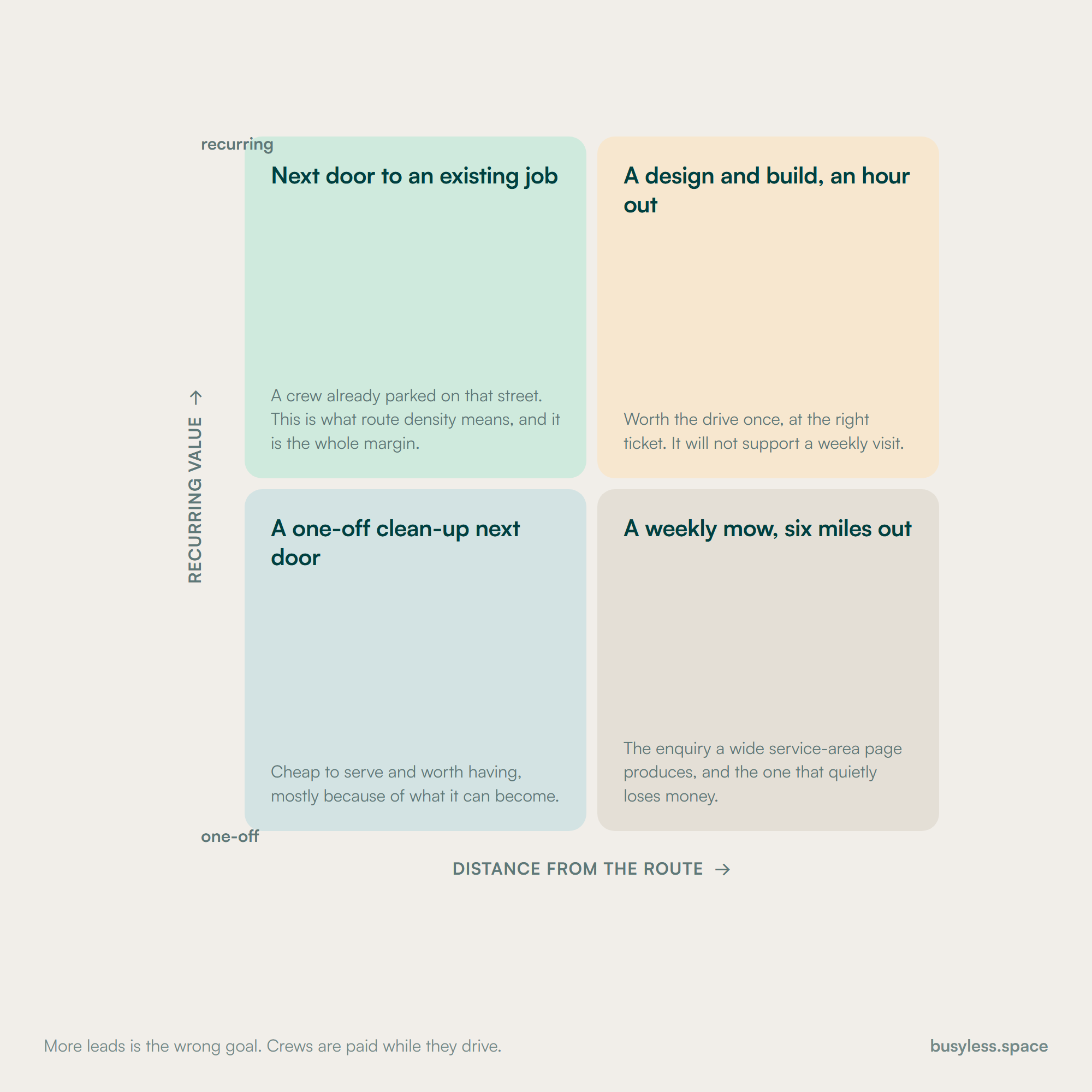
A quadrant with distance from the route on one axis and recurring value on the other. Next door to an existing job sits top left. A design and build an hour out sits top right. A one-off clean-up next door sits bottom left. A weekly mow six miles out sits bottom right as the enquiry a wide service area produces.
An editorial read of a business the reader knows better than we do. The point is that distance is a cost, because crews are paid while they drive.

What the rules change

Lighter than the regulated professions, and with one theme that catches almost every landscaper: the most appealing copy in this industry is also the most governed. Licensing for chemical application is a state matter, so check your own department of agriculture. Nothing here is legal advice.

1

"Eco-friendly", "organic" and "chemical-free" are regulated claims

Federal Trade Commission Guides for the Use of Environmental Marketing Claims, 16 CFR Part 260

What it means

The Green Guides govern how environmental benefit claims may be made in advertising. General claims like eco-friendly or green are treated as broad and hard to substantiate, and the guidance is that claims should be specific and qualified. "Chemical-free" is almost never literally true. "Organic" carries its own meanings depending on the product and the programme. This is precisely the copy landscapers most want to write.

So do this

Replace the general claim with the specific one. "We use slow-release organic fertiliser on maintenance accounts and spot-treat weeds rather than blanket-spraying" is substantiable, more persuasive and more useful than "eco-friendly lawn care". If you make a claim, keep the evidence for it with the page.

2

Applying pesticides commercially requires a licence

Federal Insecticide, Fungicide and Rodenticide Act, administered by the EPA with certification and licensing programmes run by each state's department of agriculture

What it means

Commercial application of pesticides and herbicides requires certification or licensing, categories differ by state, and some states require a business licence in addition to individual applicator certification. Advertising weed control or pest treatment you are not licensed to perform is a licensing problem, and in several states there are also recordkeeping and customer notification requirements attached.

So do this

State the licence number and the categories you hold, in text, on the site. Do not advertise applications your team is not certified for. If you subcontract application, say so, because a customer discovering it after a complaint is a different conversation.

3

A plant recommendation can be a regulated statement

State noxious weed and invasive species lists, maintained by state agriculture departments

What it means

States maintain lists of species whose sale, transport or planting is prohibited or restricted, and the lists differ across state lines and get updated. Planting guides are one of the most durable content assets in this industry, and a national one will confidently recommend something your state prohibits.

So do this

Check every species in a planting guide against your own state's current list before publishing, note the date you checked, and re-check annually. Where a plant is restricted, say so and suggest an alternative; that sentence is more useful than the recommendation would have been.

4

Watering restrictions and rebates change, and stale pages become wrong advice

Municipal and water district ordinances and rebate programme terms, which are set locally and revised seasonally

What it means

Watering schedules, restriction stages and turf replacement rebates are set by local authorities and change with conditions, sometimes several times in a season. A page published in a drought year and left alone becomes actively misleading, and rebate terms in particular have qualification rules that a contractor can inadvertently misrepresent.

So do this

Date every restriction and rebate figure on the page, name the authority, link to their own page, and put a seasonal reminder on the review. Never imply the utility endorses you because you appear on a participating contractor list; describe it as participation.

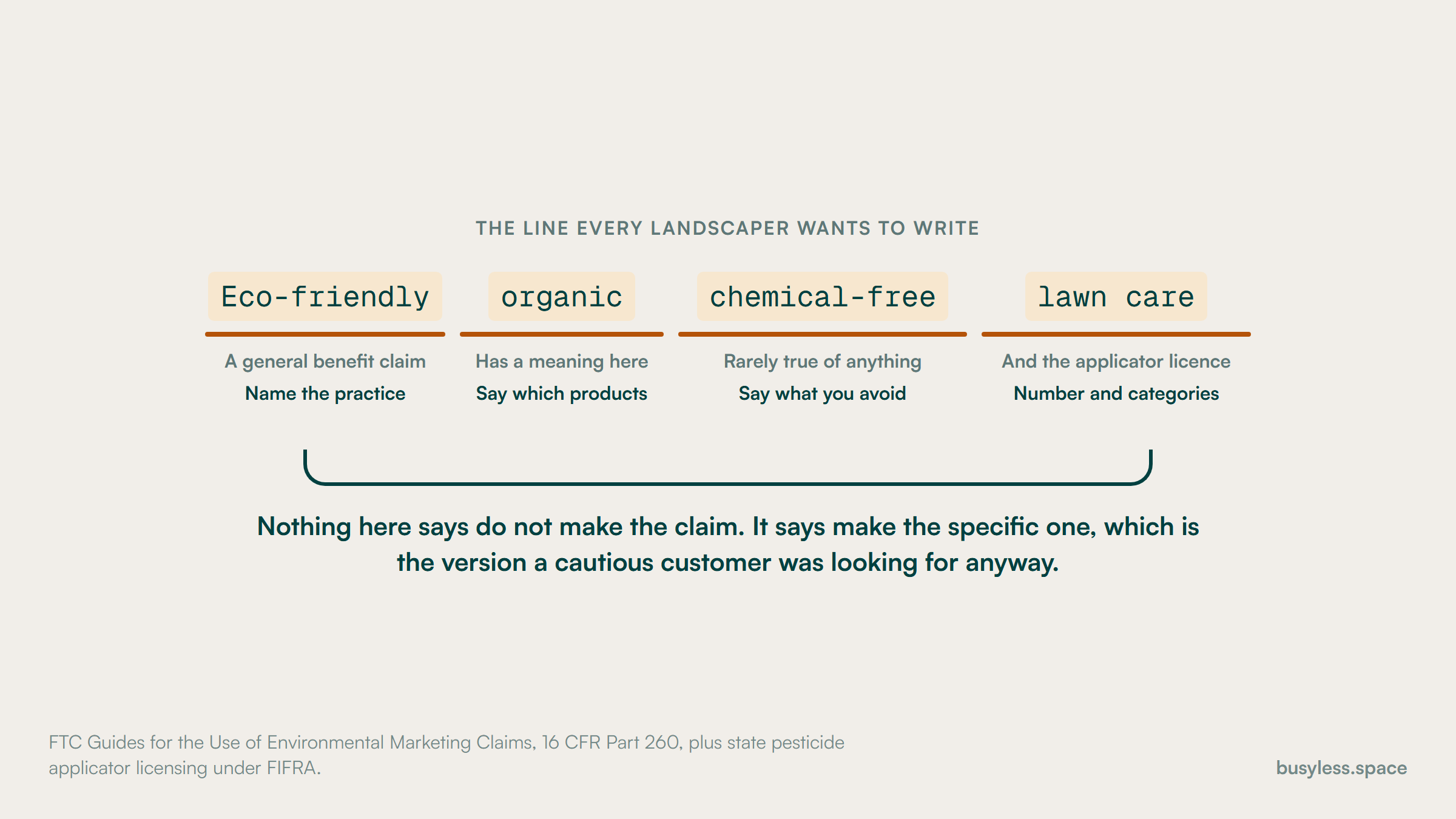
The phrase eco-friendly organic chemical-free lawn care broken into four highlighted terms, each with the specific claim that should replace it: name the practice, say which products, say what you avoid, and give the applicator licence number and categories.
Nothing here says do not make the claim. It says make the specific one, which is what a cautious customer was looking for anyway.

Proving expertise

Trust here is built on evidence of work in conditions the reader recognises. A homeowner wants to know you understand this soil, this grass, this watering ordinance and this street, and almost none of that appears on a typical landscaping website.

  • Applicator licence numbers and categories in text, with the issuing state department named
  • Insurance limits stated, which HOAs and property managers ask for and homeowners rarely think to
  • Manufacturer certifications named with the programme and the year rather than shown as a badge
  • Photographs of your own completed projects, with the plants and materials named
  • Projects shown after two or three seasons, not only on the day of installation
  • The grass types, soils and hardiness zone you actually work in, stated
  • Crew size, equipment and how many properties you service, which tells a commercial buyer whether you can take their contract
  • Association memberships stated as memberships, with any certified professional credentials named separately

How to build a landscaping SEO strategy

A realistic first six months, sequenced against the season. A landscaping SEO strategy written in April is already late for spring and, if it is any good, will be aimed at the following one, which is the honest way to set the expectation.

  1. 1

    Weeks 1 to 3

    Map the routes and claim what is free

    • Map where your existing customers actually are, and where the profitable density is
    • Rewrite the service area to match the routes rather than the county
    • Check whether you qualify for the water utility rebate contractor list
    • Claim every manufacturer certified contractor locator you hold
    • Complete the Google Business Profile with services, real photographs and hours
    • Put applicator licence numbers and categories into text on the site

    You end up with
    A service area defined by economics rather than ambition, and every free listing claimed

  2. 2

    Weeks 3 to 8

    Publish the numbers and the local knowledge

    • Publish maintenance pricing, at least as a starting figure per property size
    • Publish project cost ranges for the hardscape work you do most
    • Write the current watering restriction and rebate page, dated
    • Write the diagnostic guides for the problems in your region
    • Add structured data with the service area expressed properly
    • Audit all environmental claims against the Green Guides and rewrite them

    You end up with
    Real numbers on the site and the local knowledge a national franchise cannot publish

  3. 3

    Weeks 6 to 16

    Build the project proof and the counter-seasonal work

    • Turn completed projects into pages with materials, plants and cost bands named
    • Photograph past projects again after a season or two, which nobody does
    • Write the planting guides for your zone, checked against the state list
    • Build the commercial and HOA section for property managers
    • Publish the snow or counter-seasonal contract page before the season
    • Set the seasonal content calendar with dates and owners

    You end up with
    Project proof, a commercial pipeline, and content live before the seasons that need it

  4. 4

    Weeks 12 to 26

    Measure contracts and route density, not leads

    • Track enquiries by postal code, not just by count
    • Report recurring contracts signed and route density separately from project work
    • Track revenue per route hour, which is the number the whole strategy serves
    • Compare marketplace leads on geography as well as on cost
    • Review restriction and rebate pages seasonally
    • Report churn on maintenance accounts, because retention is cheaper than acquisition here

    You end up with
    A report about profitability by geography rather than about lead volume

Technical fixes with the best payoff

The technical work here is mostly about geography and about seasons, which is unusual. The largest single improvement available to most landscaping companies is not on the site at all: it is deciding which areas the site should be trying to attract at all.

  • The service area is drawn round ambition rather than routes

    A day with a map, then a sprint

    Most landscaping sites claim a radius or a county. That attracts enquiries from geographies where a crew spends an hour driving to a two-hour job, and those accounts quietly lose money for years without anybody noticing which ones they are.

    Plot your existing customers on a map. Draw the areas where density is real or achievable, and shape the service area pages to those. Fewer, tighter areas with genuine local content beat a page per town every time, and here they also protect the margin.

  • Seasonal pages appear after the season starts

    A day to plan, an hour per update

    Fall cleanup content published in October and snow contracts published in December have both missed. Demand windows in this trade are short and indexing is not instant, so a page written on time is already late.

    Write and publish each seasonal page six to eight weeks ahead, and leave it up year-round with a dated update rather than deleting it. Put six dates in a calendar with a named owner and the problem is solved permanently.

  • Environmental claims are unsubstantiated

    An afternoon

    "Eco-friendly", "green", "chemical-free" and "pet-safe" appear on most landscaping sites and are governed by the FTC Green Guides. They are also weak copy, because they say nothing a competitor cannot also say.

    Replace each general claim with the specific practice behind it. What you actually apply, how you apply it, what you avoid, and what a customer should do afterwards. It is substantiable and it converts better.

  • The portfolio has no plants, no materials and no prices

    An hour per project

    Project photographs with no information cannot match a query. Somebody searching a material, a plant or a style is describing exactly what is in the picture, and the page does not contain the words.

    Name the materials, the plant species, the size of the space, the timeline and the cost band on every project page. It is the difference between a gallery and a set of pages that rank.

  • Every project photograph was taken on installation day

    An afternoon a year

    A garden on the day it is planted looks sparse, and a patio on the day it is laid has no context. The most persuasive image in this industry is the same project two seasons later, and almost nobody goes back for it.

    Photograph a handful of projects again after one and two growing seasons, with the owner's permission, and publish them as a then-and-now. It costs an afternoon a year and it is proof nobody else has.

  • Maintenance cannot be priced or bought

    A sprint

    The recurring contract is the asset, and on most sites it is a paragraph and a form. The customer most likely to sign is one who just watched your crew do a good job across the street and is looking at their phone.

    Publish a starting price per property size band, state exactly what is included and how often, and let somebody request a quote with their address so you can check it against the route before replying.

  • Licences and certifications are logos

    An afternoon

    Applicator licence categories and manufacturer certifications are the two things a cautious homeowner and a commercial buyer both check, and rendering them as badges puts none of it in text.

    Write them out: licence number, categories, issuing state, certification programme, year, and what it required. Link to the manufacturer's own locator entry, which you should also complete.

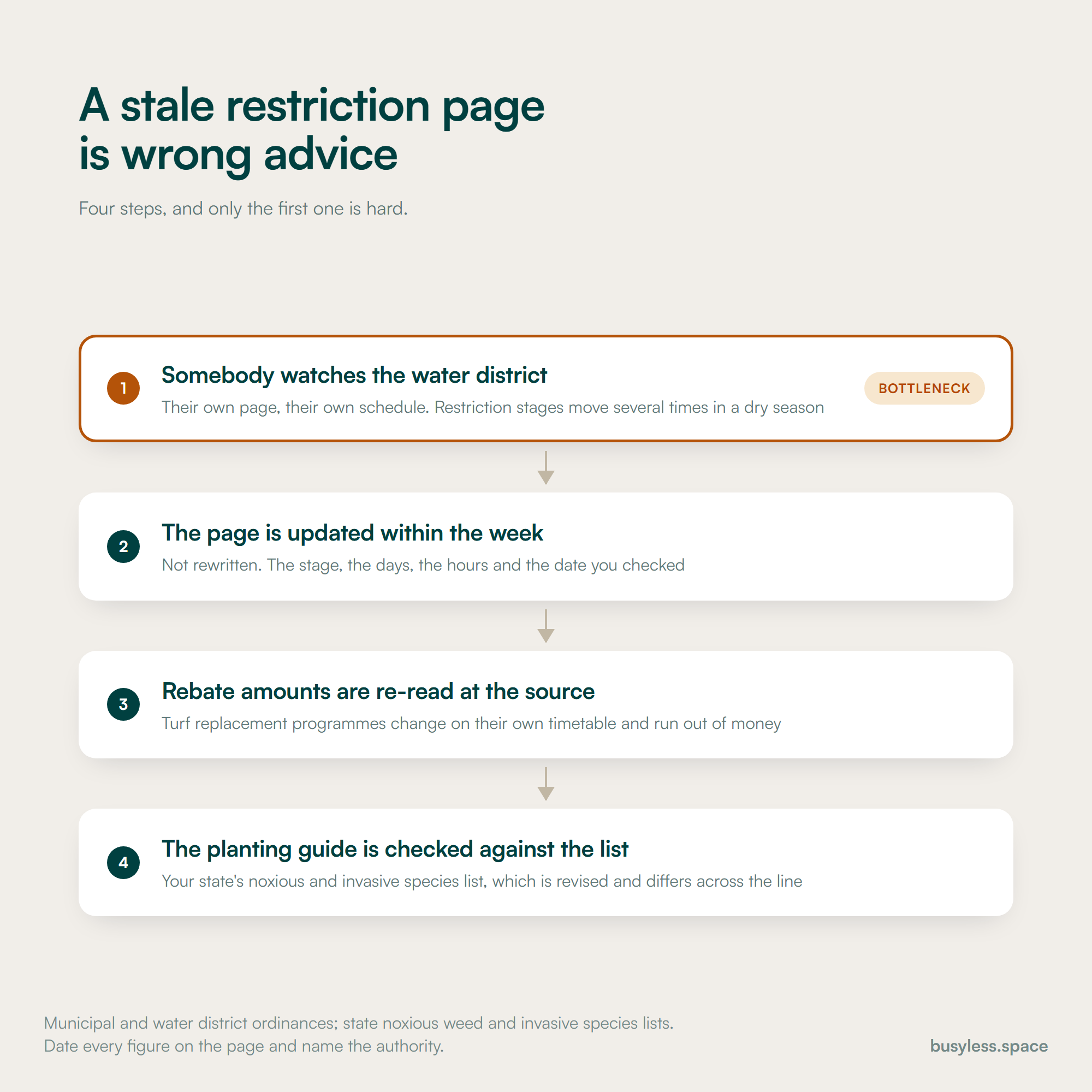
A four-stage vertical routine. Somebody watches the water district, flagged as the bottleneck. The page is updated within the week. Rebate amounts are re-read at the source. The planting guide is checked against the state's noxious and invasive species list.
Only the first step is hard, and it is the one nobody owns. Everything below it takes an hour.

Structured data that applies here

The types below fit this industry specifically. Most of them earn no rich result on their own, which is worth knowing before anyone sells the work on that basis. What they do is describe the entity precisely, which matters for how search engines and answer engines resolve who you are.

  • HomeAndConstructionBusiness

    Home page

    Schema.org has no landscaping type, so use the parent with a clear description. The important field here is areaServed, and it should reflect the routes you can actually service profitably rather than the region you would like to.

    HomeAndConstructionBusiness.jsonld
    {
      "@context": "https://schema.org",
      "@type": "HomeAndConstructionBusiness",
      "@id": "https://[YOUR-DOMAIN]/#business",
      "name": "[BUSINESS NAME]",
      "url": "https://[YOUR-DOMAIN]",
      "telephone": "[+1-555-000-0000]",
      "priceRange": "[$$]",
      "image": "https://[YOUR-DOMAIN]/crew.jpg",
      "description": "[What you do, where, and for whom. One plain sentence.]",
      "address": {
        "@type": "PostalAddress",
        "streetAddress": "[123 Example St]",
        "addressLocality": "[CITY]",
        "addressRegion": "[ST]",
        "postalCode": "[00000]",
        "addressCountry": "US"
      },
      "areaServed": { "@id": "https://[YOUR-DOMAIN]/service-area#area" },
      "makesOffer": [
        { "@type": "Offer", "itemOffered": { "@type": "Service", "name": "[Lawn maintenance]" } },
        { "@type": "Offer", "itemOffered": { "@type": "Service", "name": "[Hardscape installation]" } }
      ]
    }
  • Service area as a GeoShape

    The service area page

    The one place in this directory where the SHAPE of a service area is the commercial point rather than its size. Express it as the postal codes you actually run routes in, so the markup states the same thing your dispatch board does.

    Service area as a GeoShape.jsonld
    {
      "@context": "https://schema.org",
      "@type": "Place",
      "@id": "https://[YOUR-DOMAIN]/service-area#area",
      "name": "[BUSINESS NAME] service area",
      "description": "[The postcodes we run routes in. We take work outside these only where it joins an existing route.]",
      "geo": {
        "@type": "GeoShape",
        "postalCode": [
          "[00000]", "[00000]", "[00000]", "[00000]"
        ]
      },
      "containedInPlace": {
        "@type": "AdministrativeArea",
        "name": "[COUNTY]"
      }
    }
  • Service with a starting price

    Maintenance and project pages

    Publish a starting figure per property size band rather than a single number, and make sure the same band appears in the visible copy. A quote request that captures an address is worth more here than one that does not, because you can check it against the route.

    Service with a starting price.jsonld
    {
      "@context": "https://schema.org",
      "@type": "Service",
      "name": "[Lawn and garden maintenance]",
      "serviceType": "[Recurring grounds maintenance]",
      "provider": { "@id": "https://[YOUR-DOMAIN]/#business" },
      "areaServed": { "@id": "https://[YOUR-DOMAIN]/service-area#area" },
      "offers": {
        "@type": "Offer",
        "priceSpecification": {
          "@type": "UnitPriceSpecification",
          "price": "[000]",
          "priceCurrency": "USD",
          "unitText": "per visit",
          "referenceQuantity": {
            "@type": "QuantitativeValue",
            "value": "[0000]",
            "unitCode": "FTK",
            "name": "lot size up to"
          }
        },
        "description": "[What each visit includes, how often, and what changes the price.]"
      }
    }
  • Organization with licences and certifications

    The about or credentials page

    Applicator licence categories and manufacturer certifications are what a cautious homeowner and a commercial buyer both check. Publish the categories, because a licence in one category says nothing about another.

    Organization with licences and certifications.jsonld
    {
      "@context": "https://schema.org",
      "@type": "Organization",
      "@id": "https://[YOUR-DOMAIN]/#business",
      "name": "[BUSINESS NAME]",
      "hasCredential": [
        {
          "@type": "EducationalOccupationalCredential",
          "credentialCategory": "Commercial pesticide applicator licence",
          "identifier": "[NUMBER]",
          "name": "[CATEGORIES HELD]",
          "recognizedBy": {
            "@type": "GovernmentOrganization",
            "name": "[STATE] Department of Agriculture"
          }
        },
        {
          "@type": "EducationalOccupationalCredential",
          "credentialCategory": "[MANUFACTURER] certified contractor",
          "recognizedBy": { "@type": "Organization", "name": "[MANUFACTURER]" },
          "dateCreated": "[YYYY]"
        }
      ],
      "memberOf": [
        { "@type": "Organization", "name": "[ASSOCIATION]" }
      ]
    }
  • FAQPage

    Pricing, restriction and plant selection pages

    Cover the watering restriction and cost questions. Keep the answers dated where they describe a rule that changes, and match the visible text exactly.

    FAQPage.jsonld
    {
      "@context": "https://schema.org",
      "@type": "FAQPage",
      "mainEntity": [
        {
          "@type": "Question",
          "name": "[Question exactly as it appears on the page]",
          "acceptedAnswer": {
            "@type": "Answer",
            "text": "[Answer exactly as it appears. Where it describes a local rule, name the authority and the date checked.]"
          }
        }
      ]
    }
  • BreadcrumbList

    Service, project and area pages

    Worth it once services, projects and areas form a real hierarchy. It also surfaces service-area pages for places you do not actually want work in, and deleting those is worth more than the breadcrumb.

    BreadcrumbList.jsonld
    {
      "@context": "https://schema.org",
      "@type": "BreadcrumbList",
      "itemListElement": [
        { "@type": "ListItem", "position": 1, "name": "Home",
          "item": "https://[YOUR-DOMAIN]/" },
        { "@type": "ListItem", "position": 2, "name": "[Services]",
          "item": "https://[YOUR-DOMAIN]/services" },
        { "@type": "ListItem", "position": 3, "name": "[SERVICE]",
          "item": "https://[YOUR-DOMAIN]/services/[SLUG]" }
      ]
    }

What it costs

Editorial estimates rather than quotes, and lower than most trades in this directory for two reasons: the ticket sizes are smaller on the recurring side, and a large share of the value is geographic discipline rather than published pages.

Do it yourself

$0 to $300
  • Customer map plotted and the service area redrawn to match the routes
  • Google Business Profile completed and maintained
  • Applicator licence details and certifications put into text
  • Water utility and manufacturer contractor listings claimed
  • A starting price published for maintenance

Who it suits

A one or two crew company with an owner willing to spend two hours a week

Where it stops

It will hold a local position and improve route economics, which is genuinely the largest available gain. It will not build the project cost and planting content, which takes sustained writing.

Lean

$900 to $2,000
  • Route-shaped service area pages with real local content
  • Project cost pages and maintenance pricing published properly
  • Watering restriction and rebate pages maintained seasonally
  • Diagnostic and planting guides for your region
  • Seasonal content calendar executed rather than intended

Who it suits

A three to eight crew company that wants denser routes and more contract work

Where it stops

It cannot outrank a national franchise on generic recurring-service head terms. It works by taking the local questions the franchise cannot answer.

Funded

$2,000 to $3,500
  • A project page programme, with re-photography after a season or two
  • A commercial and HOA section built for property managers and boards
  • Counter-seasonal contract content produced ahead of each season
  • Attribution by postal code, so geography is visible in the reporting
  • Content produced at a cadence rather than in bursts

Who it suits

Companies with a real design and build arm, or anyone chasing commercial contracts

Where it stops

Above this the constraint is usually crews and equipment rather than demand, and the right report will say so rather than recommending more spend.

How to do it with no budget

The highest-value item on this list involves no website work at all, which is unusual and is the point of this page. Start at the top; the first item decides what everything below it is aimed at.

  1. 1

    Plot your customers on a map

    2 hours

    A spreadsheet of addresses and any free mapping tool

    First, and it will change what you do next. Where the density is, where it is not, and which accounts are costing you an hour of driving. This single afternoon usually reshapes the whole plan.

  2. 2

    Redraw the service area to match the routes

    2 hours

    Your website editor and your business profile

    Cut the areas you cannot service profitably. Fewer, tighter areas attract better work, and this is the rare case where deleting pages improves both rankings and margin.

  3. 3

    Check the water utility rebate contractor list

    1 hour

    Your water utility's conservation programme pages

    Free, high authority, and it puts you in front of homeowners the utility is actively paying to do work. Most landscapers have never checked whether they qualify.

  4. 4

    Fix the environmental claims

    2 hours

    Your website editor

    Replace every eco-friendly and chemical-free with the specific practice behind it. It is a compliance fix and a copy improvement in the same edit.

  5. 5

    Publish a starting price for maintenance

    1 hour

    Your website editor

    A starting figure per property size band plus what is included. It filters the enquiries you did not want and it is the first question every homeowner asks.

  6. 6

    Write the watering restriction page

    2 hours

    Your website editor and your municipality's own page

    Current stage, schedule, what is exempt, what the fines are, linked to the authority and dated. In a drought year it is the highest-intent page in the trade and the route into turf replacement work.

  7. 7

    Name the plants and materials on your best projects

    1 hour per project

    Your website editor

    Somebody searching a material or a plant is describing what is in your photograph. Right now the words are not on the page, so the picture cannot be found.

The tool stack

Jobs first, tools second, and the most important tool in this trade is a map. Everything below is in service of one number: revenue per route hour.

  • Understand where your profitable work actually is

    Your customer list and any mapping tool

    Plot every active account, colour it by revenue and by drive time. The clusters and the outliers are the whole strategy, and no SEO tool will tell you this.

    Free routeFree, and the highest-value analysis on this page

  • Track local pack position from the areas you actually want

    DataForSEOSEO APIRead the review

    Track from the centre of your route clusters, not from the yard. Ranking well where you do not want work is not a result, and an average across a county hides both.

    Free routeManual checks from two or three postcodes

  • Find the diagnostic and plant queries worth writing for

    Google Search Console plus your crews

    Ask what customers point at and ask about. The regional problems, the plant that always fails on a certain soil. That is the content plan and it is local by construction.

    Free routeBoth free, and the crews are the better source

  • Model what a maintenance contract is worth over its life

    SEO Revenue Growth CalculatorFree toolOpen the tool

    Use contract lifetime rather than first invoice, and run project work separately. A recurring account retained for six years and a one-off patio are not the same lead and should never be averaged.

    Free routeFree

  • Set a budget against route economics

    SEO Budget CalculatorFree toolOpen the tool

    Set the target as contracts in your dense postcodes rather than total leads. That framing usually reduces the budget and improves the outcome.

    Free routeFree

  • Generate the service area and credential markup

    Schema Markup GeneratorFree toolOpen the tool

    The GeoShape postal code list is the part worth getting right, because it makes the markup say the same thing as your dispatch board.

    Free routeFree

  • Run seasonal and area pages without a rebuild each time

    PayloadHeadless CMSRead the review

    Services, seasons, areas and projects intersect, and seasonal rotation is the thing that never happens if it needs a developer. Being able to swap the featured service on a schedule is what turns the calendar into a habit.

    Free routeFree and self-hosted

  • See what assistants recommend for local plant and lawn questions

    LLM visibility trackerOur toolSee the tool

    Homeowners increasingly describe a lawn problem to an assistant before searching. The answers lean on regional diagnostic content, which is exactly the cluster a national franchise cannot write and you can.

Take it from here

Everything below is yours to take. Fill the [BRACKETS] and it is ready to use. Start with the route density map: it decides what every other item on this page should be aimed at.

Checklist

The analysis that reshapes the whole plan. It takes an afternoon, needs no SEO tool, and usually shows that a third of the service area is costing money.

ROUTE DENSITY MAP - [COMPANY] - [DATE]

WHY THIS COMES BEFORE ANY WEBSITE WORK
Crews are paid while they drive. A customer six miles off the
route is a different business from a customer next door to one
you already service. Until you know where the profitable density
is, every marketing decision is a guess.

1. EXPORT YOUR ACTIVE CUSTOMERS
   [ ] Address
   [ ] Postal code
   [ ] Annual revenue
   [ ] Service type (maintenance / project / both)
   [ ] Which route or crew
   [ ] Years as a customer

2. PLOT THEM
   Any free mapping tool will take a spreadsheet of addresses.
   Colour by revenue. Size by years retained.

3. WHAT TO LOOK FOR
   | Postal code | Accounts | Annual revenue | Drive time | Verdict |
   |-------------|----------|----------------|------------|---------|
   | [_________] | [______] | $[___________] | [________] | [_____] |
   | [_________] | [______] | $[___________] | [________] | [_____] |
   | [_________] | [______] | $[___________] | [________] | [_____] |
   | [_________] | [______] | $[___________] | [________] | [_____] |

   Verdict is one of:
     CORE      - real density, this is where marketing points
     GROW      - some accounts, worth deepening
     THIN      - a few outliers, take work only if it joins a route
     DROP      - costs more to reach than it earns

4. THE OUTLIER LIST
   Accounts more than [__] minutes from any cluster:
   | Customer | Postcode | Revenue | Drive | Keep? |
   |----------|----------|---------|-------|-------|
   | [______] | [______] | $[____] | [___] | [___] |
   | [______] | [______] | $[____] | [___] | [___] |

   Nobody is suggesting you fire them. But they should not be
   what your marketing is trying to produce more of.

5. WHAT THIS CHANGES ON THE WEBSITE
   [ ] Service area pages: keep [__], cut [__]
   [ ] Business profile service areas updated
   [ ] Structured data areaServed rewritten to the CORE and GROW
       postcodes
   [ ] Marketplace targeting narrowed to the same list
   [ ] Enquiry form now captures the property address

6. THE NUMBER TO WATCH FROM NOW ON
   Revenue per route hour: $[____] (baseline, [DATE])
   Stops per route hour:   [____]
   Re-measure in [6] months. If enquiries rise and this falls,
   the service area is still drawn wrong.

What to publish

Ordered by how directly it produces profitable work rather than any work. Writing for the widest possible area is the reflex here. What pays is local enough that a national competitor structurally cannot write it.

  • Route-shaped service area pages

    One per real route cluster, revisited yearly

    The page type that decides whether the enquiries you get are worth having. Fewer, tighter areas with real local detail beat a page per town on both rankings and margin.

  • The watering restriction and rebate page

    Once, then updated every time the stage changes

    Municipal, changing, high intent in a drought year, and it is the natural route into turf replacement and irrigation work.

  • Regional diagnostic guides

    One a month through the season

    The patient cluster, searched before anybody calls, and the answers depend on local grass, soil and climate that national content gets wrong.

  • Project pages with plants, materials and cost bands named

    One per completed project worth showing

    Turns a gallery into pages that can match a query. Somebody searching a material is describing what is already in your photograph.

  • Then-and-now project photography

    An afternoon once a year

    The most persuasive image in this industry is the same garden two seasons later, and almost nobody goes back to take it.

  • A commercial and HOA section

    Once, properly, then quarterly additions

    Different buyer, contract cycle, and the best available route to route density, since one site can be twenty properties in one place.

And what not to

  • "Eco-friendly", "green" and "chemical-free" as general claims with nothing behind them
  • Service area pages for places you cannot service profitably, which attract the accounts that lose money
  • A page per town in the county, which is a doorway pattern and a margin problem at once
  • Planting guides copied from national sources without checking your state's invasive list
  • Watering restriction pages with no date and no named authority
  • Project galleries with no plants, materials, sizes or costs named
  • Advertising chemical applications your team is not licensed to perform
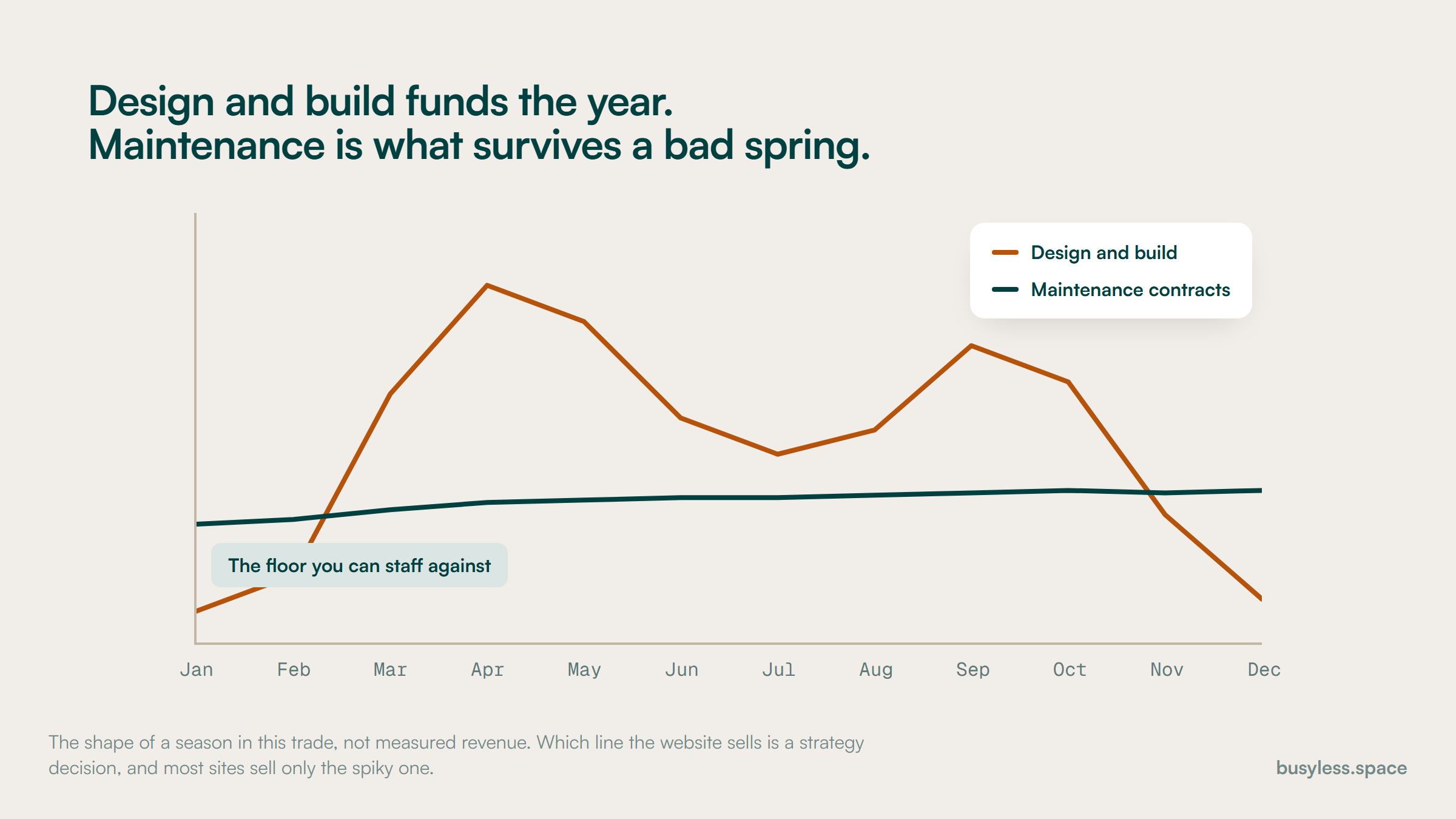
Two lines across a year. Design and build work spikes in spring and again in autumn and collapses in winter. Maintenance contracts run almost flat underneath, labelled as the floor you can staff against.
Which of these two lines the website sells is a strategy decision, and most landscaping sites sell only the spiky one.

The expensive mistakes

Optimising for lead volume

Costs you Accounts scattered across a county, crews paid to drive, and a business that looks busy and earns nothing

Optimise for enquiries in the postcodes where you already have density, and report leads by geography

Claiming a county-wide service area

Costs you The least profitable geography in the market, delivered to you by every marketplace and every service-area page

Draw the area from the customer map, cut what does not work, and say so plainly on the site

Publishing seasonal content in season

Costs you A missed window every year, in a trade where the windows are weeks long

Six calendar dates, each six to eight weeks ahead of its season, with a named owner

Leading with eco-friendly claims

Costs you Copy that is both regulated and weak, since every competitor says the same words

Name the specific practice: what you apply, how, what you avoid and what the customer should do after

Treating maintenance as the boring half

Costs you A business with no recurring base, no smoothing through a bad spring and very little value if it is ever sold

Price it publicly, make it easy to buy, and report contract growth and churn as the headline numbers

Reporting leads to the owner

Costs you A programme judged on a number that can rise while profitability falls, which in this trade happens routinely

Contracts signed by postcode, and revenue per route hour, with churn reported alongside

What to measure

Lead volume can rise here while the business gets worse, because a lead in the wrong place costs money to serve. Every number below is therefore reported with geography attached.

Leading indicators

Move first. They predict, they do not prove.

  • Enquiries by postal code

    Enquiry form capturing an address, plus call tracking

    The most important leading indicator here and the one almost nobody captures. Ask for the property address on the form; it is a reasonable question and it makes the whole report possible.

  • Local pack position from route centres

    Geo-specific rank tracking

    Measured from the middle of the areas you actually want work in, not from the yard. Ranking well outside your routes is not progress.

  • Profile actions: calls, direction requests, website clicks

    Google Business Profile insights

    Fast moving and seasonally distorted. Useful for spotting a profile problem, and only meaningful as a trend against the same period last year.

  • Impressions on diagnostic and restriction clusters

    Search Console, filtered by cluster

    The content that compounds, and the only early evidence that the local knowledge programme is doing anything. Expect restriction pages to spike with the weather.

Business indicators

The ones a manager acts on.

  • Recurring contracts signed, by postal code

    Your own contract records

    The headline business number. Report it by geography rather than as a total, because a contract that deepens an existing route is worth substantially more than one that does not.

  • Route density

    Your scheduling or route data

    Properties per route hour, or stops per mile. It is the number the whole strategy exists to move, and almost no marketing report contains it.

  • Revenue per route hour

    Invoicing plus route data

    The number that tells you whether more leads made the business better or busier. If it falls while enquiries rise, the service area is drawn wrong.

  • Maintenance account churn

    Your contract records

    Retention is far cheaper than acquisition here, and a company losing accounts as fast as it wins them is paying for marketing to stand still. Report it beside contracts signed, never separately.

The verdict

Landscaping is the industry in this directory where more visibility can make the business worse. Crews are paid while they drive, so an enquiry in the wrong place is a cost, and the first job is deciding where you actually want to be found.

After that the content is unusually easy, because it is all local by construction. Watering rules, soil, grass types, the plants that fail here, the projects you built two seasons ago and what they look like now. None of it can be written by a national franchise.

Before you sign for landscaping SEO services, put these three to whoever is selling them. Will they look at your customer map before writing anything? Will they recommend cutting service areas rather than adding them? Will they report contracts by postcode rather than total leads?

Deleting pages is a strange thing to charge for, so the second question is rarely answered well by anybody selling SEO services for landscapers. It is also, in this trade specifically, frequently the most profitable thing you can do.

FAQ

Landscaping SEO questions

  • Why is more leads the wrong goal?
    Because crews are paid while they drive. A property six miles from your route absorbs an hour of paid travel for a two-hour job. Route density decides the margin in this trade, so the objective is enquiries in the postcodes where you already work or where you could realistically build density. Plot your customers on a map before you change anything on the website; that afternoon usually reshapes the whole plan.
  • Should we have a page for every town we cover?
    No, and it is worse than the usual doorway problem here because it also damages the business. Pages for towns you cannot service profitably attract exactly the accounts that cost you money, on top of being near-identical content. Build a page per real route cluster instead, with the soil, the grass types, the common problems and the day your crew is in the area.
  • Can we say our lawn care is eco-friendly?
    Be careful, because it is a regulated claim. The FTC Green Guides govern environmental marketing claims and treat general ones like eco-friendly or green as broad and hard to substantiate. Chemical-free is almost never literally true. Replace the general claim with the specific practice: which products, applied how, what you avoid, and what the customer should do afterwards. That version is substantiable, and it is also better copy because no competitor can copy it.
  • What is the highest-value page we could publish?
    In a drought-affected market, the current watering restriction and rebate page. It is municipal, it changes, it is searched urgently when conditions tighten, and the municipality's own version is usually a PDF. It also connects directly to turf replacement and irrigation efficiency work, and there is often money from the utility on the table. Date it, name the authority, link to their page, and review it at every stage change.
  • When should we publish seasonal content?
    Six to eight weeks before the season. Demand windows in this trade are weeks long and indexing is not instant, so a fall cleanup page published in October has missed and a snow contract page published in December has missed by months. Put six dates in a calendar with a named owner, prepare the updates in the quiet months, and never delete a seasonal page: date it and update it.
  • Do we really need to publish prices?
    A starting figure by lot size band, yes. It is the first question every homeowner asks, it filters out enquiries you did not want, and it saves quoting time on properties that were never going to work. Pair it with a quote request that captures the property address, so you can check the location against your routes before you reply. That address field is worth more than any other change on the enquiry form.
  • What does landscaping SEO cost?
    The tiers above are editorial estimates rather than quotes, and they are lower than most trades here because ticket sizes on the recurring side are smaller and a large share of the value is geographic discipline rather than published pages. A company running a real programme is realistically at $900 to $3,500 a month. The single highest-value piece of work, mapping your customers and redrawing the service area, costs an afternoon.
  • Can AI write our planting guides?
    For a first draft, with a hard check afterwards. A model will confidently recommend a species your state prohibits, because invasive and noxious lists are state-specific and change. Check every species against your own state's current list before publishing, note the date you checked, and re-check annually. The local knowledge that makes these guides worth reading, which soil, which grass, what fails here and why, is also the part a model cannot supply.

Run it yourself, or have someone own it

Everything above is written to be run without us, and the free path is genuinely most of the value for a single-location business. Where these plans stall is almost never the plan. It is that nobody owns it after the first month. That is the job we do, with search as one distribution layer inside a wider system rather than the whole engagement.