
Hygraph review
Best for content federation
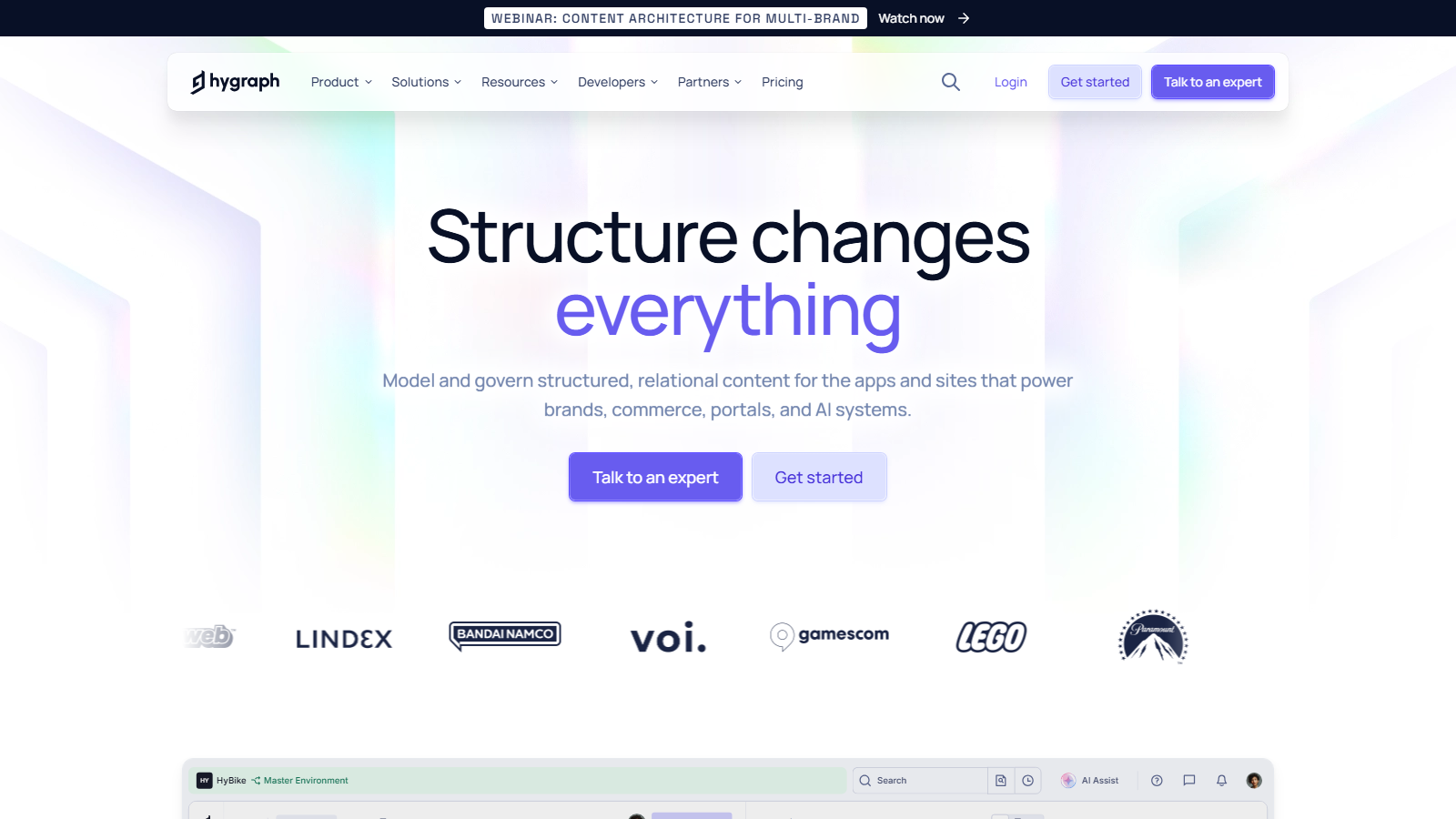
Hygraph, formerly GraphCMS, was GraphQL-native before that was a common choice, and it still shows in the best way: the Schema Builder generates a typed API as you model, and querying is the same thing your front end already does. If your team thinks in GraphQL, there is no impedance here at all.
The genuine differentiator is content federation. Remote sources let you register an external service, a commerce backend, a PIM, an internal API, and query it through the same GraphQL endpoint as your editorial content, joined at the field level. Nothing else in this directory offers that as a first-class feature rather than something you build in a BFF layer. It is the reason Hygraph shows up in architecture conversations rather than CMS ones.
The pricing needs reading carefully, because the monthly figure is not the constraint. Growth is $199 a month and caps you at 10,000 entries. Hobby allows 1,000. Enterprise starts at a million and up. There is no middle tier, so a content archive of any real size takes you straight from $199 to a sales conversation, and that jump is the single most important thing to model before choosing.
Our scorecard
Our editorial read across six dimensions, scored 1 to 5. This is our own assessment, not an aggregate of user reviews, and it is deliberately kept out of the page's structured data.
- Content modelling5/5
Schema Builder plus components and federation. The most sophisticated modelling layer in this directory.
- Developer experience5/5
GraphQL-native throughout, typed end to end, with no REST layer bolted alongside it.
- Editor experience3/5
Competent: live preview, commenting and assignment. Not in Storyblok's class for non-technical editors.
- Pricing2/5
10,000 entries on a $199 plan, and then nothing until Enterprise. The gap is the problem, not the price.
- Governance4/5
Fine-grained permissions, audit logs, SSO and multitenancy, all on Enterprise.
- Ecosystem3/5
Solid framework support. Smaller community than Contentful or Strapi, and no MCP server yet.
An editorial read, not an aggregate of user reviews, and deliberately kept out of this page's structured data.
What you can query
Content API (GraphQL)
25 req/s Growth, up to 500 Enterprise
A typed, generated GraphQL schema over your content model, which is the only read API. There is no separate REST surface.
Remote sources (federation)
One on Growth, custom on Enterprise
External REST or GraphQL services registered into your schema and queryable in the same request as your content, joined at field level.
Management API
How you version a model
Programmatic schema and environment management, so the content model can be defined in code and migrated.
Mutations
Token-scoped permissions
Create, update, publish and unpublish content through the same GraphQL endpoint rather than a separate write API.
Assets
50MB Hobby, 200MB Growth per file
Upload and transformation with unlimited storage on every plan, capped by per-file upload size rather than total volume.
Components and Taxonomies
10 components on Hobby
Reusable content structures, with taxonomies as a distinct Enterprise feature for classifying at scale.
Who Hygraph is for
Teams with content in more than one system, and a GraphQL-first front end. If you are already writing a backend-for-frontend to stitch a commerce API together with editorial content, federation replaces that layer with configuration, and that is a genuinely different value proposition from every other CMS here.
A large content archive on a mid-sized budget is the case it handles worst. The 10,000-entry ceiling on Growth is the binding constraint, and the absence of anything between Growth and Enterprise means outgrowing it is a renegotiation rather than an upgrade.
Strengths and limits
What it does well
- Content federation through remote sources is unique in this directory as a first-class feature: query external services and your own content in one GraphQL request, joined at field level.
- GraphQL-native throughout rather than a GraphQL layer added over REST, so the schema, the types and the tooling are all consistent.
- The Schema Builder produces a typed API as you model, which shortens the distance between a content change and a working query.
- Unlimited asset storage on every plan including the free one, with limits on per-file size rather than total volume.
- The free Hobby tier includes 3 seats, live preview and assignment workflows, which is a real collaborative tier rather than a single-user demo.
- Published rate limits, 25 requests a second on Growth and up to 500 on Enterprise, so you can design against a stated ceiling.
- A 30-day Enterprise trial with no credit card, which is unusually generous for evaluating features that normally sit behind a sales call.
Where it falls short
- 10,000 entries on the $199 Growth plan is the tightest content ceiling at that price in this directory, and it is easy to miss when comparing monthly figures.
- There is nothing between Growth and Enterprise. Outgrowing 10,000 entries means a quote, not an upgrade button.
- Growth includes ONE remote source, so the feature that makes Hygraph distinctive is mostly an Enterprise feature.
- API calls are easy to run away with. One user with no traffic recorded 400,000 calls, then 700,000 an hour later, from an unintended loop in their own code.
- Version retention is 14 days on Growth against a full year on Enterprise, which is short if you need an editorial audit trail.
- Taxonomies, scheduled publishing, SSO, audit logs and custom workflows are all Enterprise-only.
- Hygraph ships no MCP server; Contentful, Sanity, Storyblok, DatoCMS and Strapi each offer one.
- Practitioner discussion is thin and much of the archive predates the GraphCMS rebrand, so there is less peer evidence to draw on than for its competitors.
Hygraph pricing
Hobby is free forever and unusually usable: 3 seats, 2 locales, 10 components, 1,000 entries, 500,000 API calls a month and unlimited asset storage, plus live preview and assignment workflows. As a free tier for a small real project it is one of the better ones here.
Growth starts at $199 a month for 10 seats, 3 locales, 10,000 entries and a million API calls, with 14-day version retention and one remote source. Enterprise is quote-only and starts at a million entries and fifty million API calls, adding custom remote sources, taxonomies, scheduled publishing, SSO, audit logs, multitenancy, a custom SLA and a year of version retention.
Model the entry count, not the monthly price. Ten thousand entries sounds ample until you count locales as separate entries, or import a blog archive, or model components as records. It is the tightest ceiling at this price point in the directory, and the leap to Enterprise is from 10,000 to a million with nothing in between, so there is no gentle upgrade path.
Watch the API meter too. A million calls a month is roughly 33,000 a day, and a single page render can fire several queries. One user reported 400,000 calls with no traffic at all, rising to 700,000 an hour later, caused by a loop in their own code. Metered platforms punish that kind of mistake quickly, so instrument early.
Hobby
$0
Free forever, no card
- 3 seats, 2 locales, 2 standard roles, 10 components
- 1,000 entries and 500,000 API calls a month
- Unlimited asset storage, 50MB per file
- Live preview, commenting and assignment workflow
Growth
From $199 / mo
10,000 entries, 1M API calls
- 10 seats, 3 locales, 4 standard roles
- ONE remote source for federation
- 14-day version retention, 200MB per asset
- 25 requests a second, email support desk
Enterprise
Custom
1,000,000+ entries, 50M+ API calls
- Custom remote sources, taxonomies and workflows
- SSO, audit logs, multitenancy, fine-grained permissions
- Up to 500 requests a second and a custom uptime SLA
- One-year version retention and one-click backup recovery
Query example
A minimal fetch against the live API, with credentials read from the environment rather than pasted inline.
curl -s -X POST "https://api-eu-central-1.hygraph.com/v2/$PROJECT_ID/master" \
  -H "Authorization: Bearer $HYGRAPH_TOKEN" \
  -H "Content-Type: application/json" \
  -d '{"query":"{
        products(first: 10) {
          name slug
          inventory { stockLevel warehouse }   # remote source
        }
      }"}'

# "inventory" is not stored in Hygraph. It is a registered remote
# source resolved at query time and joined onto the content, which
# is the thing nothing else in this directory does natively.
#
# Watch the meter: Growth includes 1M API calls, and one page can
# fire several. See the runaway-calls thread in the Reddit section.
Limits and quotas
- Hobby: 1,000 entries, 500,000 API calls a month, 3 seats, 2 locales, 2 roles, 10 components.
- Growth: 10,000 entries, 1,000,000 API calls a month, 10 seats, 3 locales, 4 roles.
- Enterprise: 1,000,000+ entries and 50,000,000+ API calls.
- Rate limits: 25 requests per second on Growth, up to 500 per second on Enterprise.
- Asset upload size: 50MB per file on Hobby, 200MB on Growth. Storage itself is unlimited.
- Remote sources: one on Growth, a custom number on Enterprise.
- Version retention: 14 days on Growth, one year on Enterprise.
- SLAs are Enterprise only. A 30-day Enterprise trial is available without a card.
What developers say on Reddit
There is not enough current practitioner discussion to call a sentiment. Hygraph rebranded from GraphCMS in 2022 and most of the archive sits before that, describing a product with a different name, a different pricing model and a different feature set. Quoting 2017 enthusiasm as though it were a 2026 verdict would be misleading, so it is left out.
What recent discussion exists is sparse and neutral. One developer with prior Contentful and DatoCMS experience reports using Hygraph a little with no substantial complaints, which is honest and not much to go on.
The one genuinely instructive recent thread is about billing rather than opinion, and it is quoted below because it illustrates a real risk on any metered platform: a project with no traffic recorded 400,000 API calls and then 700,000 an hour later. Hygraph support diagnosed an unintended loop in the developer's own code. On a plan including a million calls a month, that is most of the allowance gone in an afternoon.
“I am using hygraph for a website im building that currently has 0 traffic aside from me testing it, and somehow I have 400k api calls this month, and then I refreshed it an hour later and im at 700k api calls, though I haven't changed anything.”
r/webdev on Reddit“Thank you this is very helpful! I contacted hygraph support and they suggested it was an unintended loop in my code”
r/webdev on Reddit“I've used it a tiny amount and have no substantial complaints. I've got deep history with and expertise in Contentful, and I've used Hygraph a bit similar to the usage I have with Dato CMS.”
r/cms on Reddit
Verdict
Choose Hygraph for federation, and be honest with yourself about whether you need it. Querying a commerce backend, a PIM and your editorial content in one typed GraphQL request is a real architectural advantage that nothing else in this directory offers natively, and for a team already maintaining a backend-for-frontend to do exactly that, it replaces code with configuration.
If you are not federating, the case is much weaker. As a straightforward GraphQL CMS it is good rather than exceptional, DatoCMS gives you a better asset pipeline and finer-grained pricing, and Storyblok gives editors a better time.
The entry ceiling is what to check first, before the price. Ten thousand entries on Growth, a million on Enterprise, and nothing between them, so the question is not whether $199 fits your budget but whether 10,000 fits your content. If it does not, you are buying Enterprise, and you should find out what that costs before you build.
Hygraph FAQ
How much does Hygraph cost?
Hobby is free forever with 1,000 entries, 3 seats and 500,000 API calls a month. Growth starts at $199 a month for 10,000 entries, 10 seats and a million API calls. Enterprise is quote-only and begins at a million entries and fifty million calls.What is the entry limit and why does it matter?
10,000 on Growth, which is the tightest content ceiling at that price in this directory. It matters because there is no tier between Growth and Enterprise: outgrowing 10,000 entries means a sales conversation rather than an upgrade, so model your content volume before you commit rather than after.What is content federation?
Registering an external service, such as a commerce backend or a PIM, as a remote source so it can be queried through the same GraphQL endpoint as your editorial content and joined at field level. It is Hygraph's genuine differentiator, and nothing else in this directory offers it as a first-class feature.How many remote sources do I get?
One on Growth, and a custom number on Enterprise. That is worth knowing early, because federation is the main reason to choose Hygraph and a single source only covers the simplest case. A real federation architecture is an Enterprise purchase.What are Hygraph's rate limits?
25 requests a second on Growth and up to 500 on Enterprise, published in the pricing FAQ. That is a stated ceiling you can design against, which is more than several competitors offer, though 25 a second is modest for a high-traffic site without aggressive caching.How easily can API calls run away?
Very. One developer with no traffic at all recorded 400,000 calls and then 700,000 an hour later, which Hygraph support traced to an unintended loop in their own code. With a million included on Growth, that is most of a month's allowance in an afternoon. Instrument your call volume from day one.Is Hygraph the same as GraphCMS?
Yes, renamed in 2022. That matters when researching it: much of the archived discussion and many tutorials describe GraphCMS, with different pricing and a different feature set, so treat older material as historical rather than current.Hygraph or DatoCMS?
Hygraph if federation is the requirement and content lives in several systems. DatoCMS if it does not: it has a better asset pipeline, far more granular pricing, real-time updates and an MCP server, and it will not stop you at 10,000 entries. Federation is the question that decides this one.
Other platforms worth a look
This is an independent review. We have no affiliate relationship with Hygraph, earn nothing if you sign up, and no vendor pays for placement in the directory. Prices were read from the vendor's own pages in September 2026 and change without notice.