
Skip to content

Florist SEO strategy

The product is a delivery date, worthless one day late

Written by Eugene SuslovLast reviewed 29 August 2026No affiliate links
Sector
Retail and ecommerce
Model
Local service, Ecommerce
Competition
High
Time to results
3 to 8 months
Typical monthly
$700 to $4,000

Key takeaways

  1. 1You are not selling flowers, you are selling a date. Everything on the site that does not help somebody trust the date will arrive is decoration, including most of the photography.
  2. 2Your cutoff time is the single most important fact on the website and it usually appears for the first time in the checkout. Put it above the fold on every delivery page.
  3. 3Your product pages are probably identical to four hundred other shops'. The wire services supply the catalogue, the descriptions and the photographs, and every member publishes the same ones.
  4. 4The occasion page has to exist weeks before the occasion. Publishing to an empty room in early January is what makes the page rank in the seventy-two hours that matter in February.
  5. 5Funeral homes are a keyword. A page for each one you deliver to answers a search made by somebody grieving and in a hurry, and almost no shop has written them.

SEO for florists is unusual because the product barely matters. What the customer is buying is a delivery that lands on a specific day, at a specific address, before a specific moment, and the arrangement is the part they can be flexible about.

That inverts most retail advice. A late parcel is an annoyance; a sympathy arrangement that arrives an hour after the service has failed completely, and there is no version of a refund that recovers the occasion.

So a florist SEO strategy is really about making a promise credible. Cutoff times, delivery areas, what happens on a bank holiday and how substitutions work are not small print here, they are the reasons somebody chooses you over a national brand.

The competitive picture is unlike anything else on this site. The businesses ranking above you for your own town's flower queries are frequently not shops at all, but order gatherers who take the payment and pass the work to a local florist at a discount.

Which means your largest search competitor may also be a wholesale customer. That is uncomfortable and it is a commercial reality rather than a compliance question, so the page treats it as one.

Underneath both of those sits a calendar. A handful of dates carry a disproportionate share of the year's revenue, and the work that makes those dates go well happens weeks before anybody searches.

Who already ranks in florists

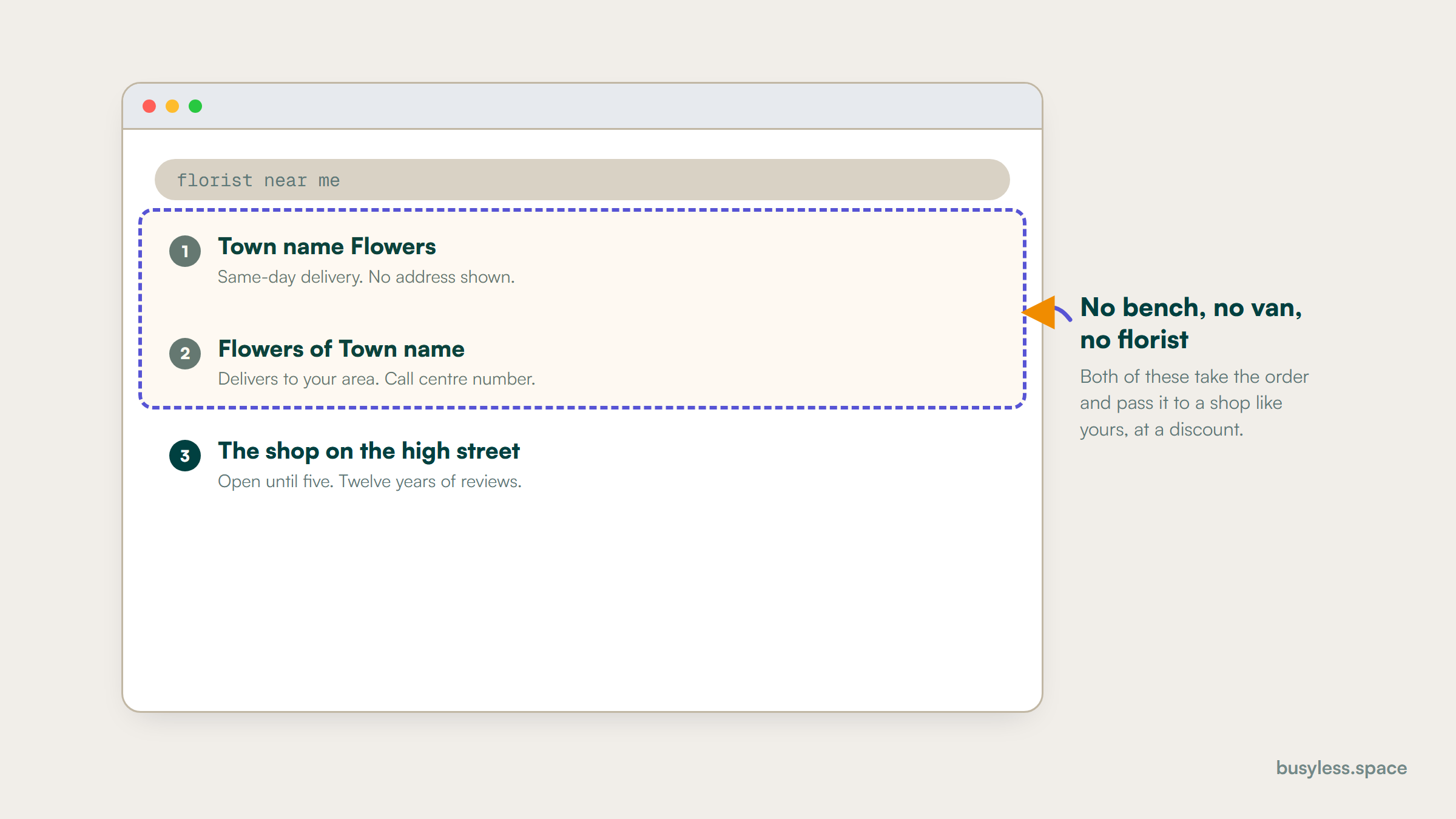
Search your own town's flower delivery query and read the results carefully rather than quickly. A good deal of florist SEO consists of noticing that several of the businesses above you have no shop, no van and no florist, and deciding what you are going to do about that.

What is on the results page

  • A local pack sorted largely by review volume and proximity to the searcher
  • Shopping results and product listings on every delivery query
  • Order gatherer pages carrying your town's name in the title tag
  • Open now and delivery attributes surfacing directly in the map results
  • Wedding directories occupying the whole first page of the wedding queries
  • Price and delivery fee annotations pulled from merchant feeds
  • Demand that appears and disappears inside seventy-two hours around a date
  • Care and how-long questions answered in featured snippets by publishers
  • 1-800-Flowers

    1800flowers.com

    A national brand and an order gatherer at once. It ranks nationally on brand strength and locally on city landing pages, and when it wins your town's query the order may still reach a local shop, at a wholesale rate, with the customer relationship kept elsewhere.

  • FTD

    ftd.comClaim it

    Wire service and consumer brand together, which is the awkward part. Membership brings orders and a shared product catalogue; the catalogue is also why your product pages look like everybody else's. Both halves are worth deciding on deliberately.

  • Teleflora

    teleflora.comClaim it

    The other major wire service, with the same dual role and the same catalogue problem. Its member sites are frequently built on a shared platform too, which extends the duplication from the products to the templates.

  • From You Flowers

    fromyouflowers.com

    A pure order gatherer with no shops. It competes for local queries at national scale and fulfils by brokering to florists. There is nothing to claim here and nothing to negotiate; it is simply a competitor for the query and a customer for the work.

  • Google Business Profile

    google.comClaim it

    Where the local pack is decided, and where hours, delivery attributes and review volume do more work than anything on your website. For a shop with one address it is the highest-leverage asset you own and the cheapest to neglect.

  • The Knot and WeddingWire

    theknot.com, weddingwire.comClaim it

    They own the wedding florist queries almost completely, and wedding work is the highest revenue per customer in the business. A paid listing is a distribution decision; the SEO decision is to build a portfolio page good enough that the couple who finds you there books directly.

  • Yelp

    yelp.comClaim it

    Persistent on local retail queries and disproportionately visible on mobile. Worth claiming and keeping accurate, particularly the hours, because an incorrect closing time on a date that matters generates the exact review you cannot afford.

  • Funeral home websites

    Varies locally

    Many list a preferred florist or link one, and that link is both a referral and a ranking signal. It is the single most valuable local relationship in this business and it is won in person rather than online.

A local results panel with one region highlighted, showing that several of the listings belong to national order gatherers rather than to shops in the town
Everything in the highlighted band looks local to the person searching. Two of the entries have no bench, no van and no florist.

What people actually search

The clusters below are ordered by how quickly they convert rather than by volume. This is a category where a small query with a two hour decision window is worth more than a large one with a two week window.

Urgent and same day

Transactional, immediate

flower delivery today near me

The page that wins it: A delivery page with the cutoff time above the fold

The cutoff is the whole answer and it is usually buried in the checkout. A page that says what time you stop taking today's orders converts better than one that says you deliver quickly.

Occasion

Transactional, calendar bound

mothers day flowers [town]

The page that wins it: An occasion page published six weeks early and kept live

The page has to exist before the demand does, which means publishing to nobody in January. Shops that build the page during the week it matters are competing with pages that have been indexed for a month.

Sympathy and funeral

Transactional, urgent and sensitive

funeral flowers delivered to [funeral home]

The page that wins it: A page per funeral home you deliver to, with times and etiquette

The buyer is grieving, unfamiliar with the conventions and working to a service time. Naming the building, the delivery window and what is appropriate removes three separate anxieties at once.

Wedding and event

Commercial, high value, long lead

wedding florist [town]

The page that wins it: A portfolio page with real weddings, venues and honest budget bands

The largest order a florist takes and the one decided furthest ahead. The directories own the query, so the winnable version is the venue name, which nobody optimises for.

Flower and variety

Commercial, product led

peony bouquet delivery

The page that wins it: A product page that states the season honestly

Availability is agricultural. A page that implies peonies all year is manufacturing the substitution complaint it will receive in November, and the honest version outperforms it over a year.

Corporate and recurring

Commercial, business to business

weekly office flowers [town]

The page that wins it: A contract page with a real starting price and a named contact

The revenue that smooths the calendar, which in a business built on two spikes is worth more than its margin suggests. It is a business page sitting on a consumer site and it usually reads like an afterthought.

Nearby and open now

Local, immediate

florist near me open now

The page that wins it: Accurate profile hours, attributes and delivery radius

Answered on the profile rather than on the website, which is why the hours field matters more than the home page. Wrong hours on a date that matters produce the review that costs you the following year.

Care and longevity

Informational, retention led

how long do roses last

The page that wins it: A care guide, written once, kept accurate

No immediate sale and a real long-term one, because the person searching already has flowers. It is also the natural home for the substitution explanation, where it reads as expertise rather than as a disclaimer.

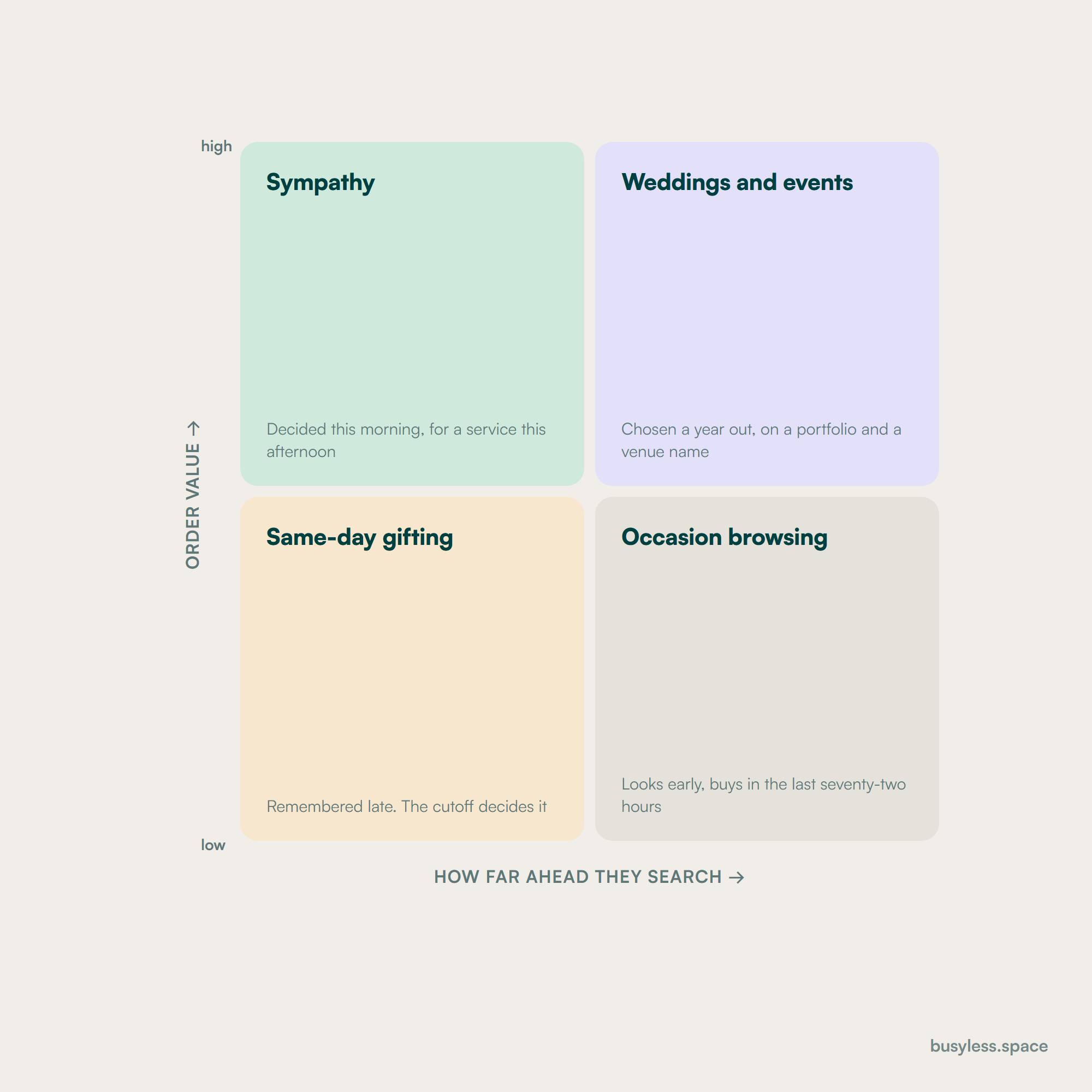
Query types plotted by how far ahead people search against how much the order is worth, putting weddings and corporate high and same-day delivery close to the axis
The queries closest to the axis are decided in minutes. The ones furthest along it are decided in months, and both need a page that already exists.

What the rules change

Nothing here comes from a sector regulator; a flower shop is bound by ordinary advertising and mail order law like any other retailer. What makes the list worth reading is that this category triggers those ordinary rules more often than almost any other, because it sells a date and shows a photograph it cannot exactly reproduce. This is my reading rather than legal advice.

1

The delivery date you advertise is a promise the rule can measure

FTC Mail, Internet, or Telephone Order Merchandise Rule, 16 CFR Part 435

What it means

A seller must ship within the time it stated in its advertising, or within thirty days if it stated none. If it cannot, it has to notify the buyer and offer the option to cancel with a full and prompt refund. Every same day, next day and guaranteed by badge on a category page is that stated time.

So do this

Say what you actually do rather than what converts best. If the cutoff is two in the afternoon, publish two in the afternoon, and build the notify-and-refund path into the order system rather than into an apology email somebody writes by hand at seven at night.

2

The photograph is a representation and the substitution has to be disclosed before the sale

FTC Act section 5 deception principles; the wire services' own published substitution standards

What it means

Flowers are a living crop, so every florist reserves the right to substitute, and the trade standard is that a substitute should be as close as possible in style and value. A customer who discovers that only after their order arrives has been told something different from what they were shown.

So do this

Put the substitution policy on the product page, not just in the terms, and make it specific: what you swap, what you never swap, and what you do if the whole look is unavailable. Handled well it reads as craft rather than as a get-out.

3

Locally grown and eco-friendly are claims with an evidence standard

FTC Green Guides, 16 CFR Part 260

What it means

Environmental marketing claims must be substantiated and qualified so an ordinary reader is not misled. Locally grown, sustainable and eco-friendly are three of the most frequently used words in this category and three of the least frequently supported.

So do this

Name the farm, the county and the months. A specific claim you can evidence is both compliant and better copy than a vague one, and in a market full of imported stems it is a genuine differentiator.

4

Reviews cannot be incentivised without disclosure or written in-house at all

FTC Guides Concerning the Use of Endorsements and Testimonials, effective 26 July 2023

What it means

The local pack rewards review volume heavily, which makes the temptation unusually strong in a business with hundreds of transactions a week. Reviews written by anyone connected to the shop, or bought, are deceptive regardless of sentiment, and undisclosed incentives are a separate problem.

So do this

Ask on the delivery confirmation message, every time, with no incentive attached. In a business with this transaction volume, simply asking consistently produces more reviews than any scheme worth the risk.

5

Your published hours are a representation too

Google Business Profile guidelines, read 2026-08-29, and ordinary consumer law

What it means

Hours, delivery attributes and service areas in a business profile are shown to customers as facts about you. A profile saying you close at six when the last delivery run leaves at two is not a settings mistake, it is a claim about when somebody can still order.

So do this

Keep special hours updated for every bank holiday and every peak date, and set the delivery attributes to match the actual cutoff rather than the shop's opening times. Do this in December for the whole following year.

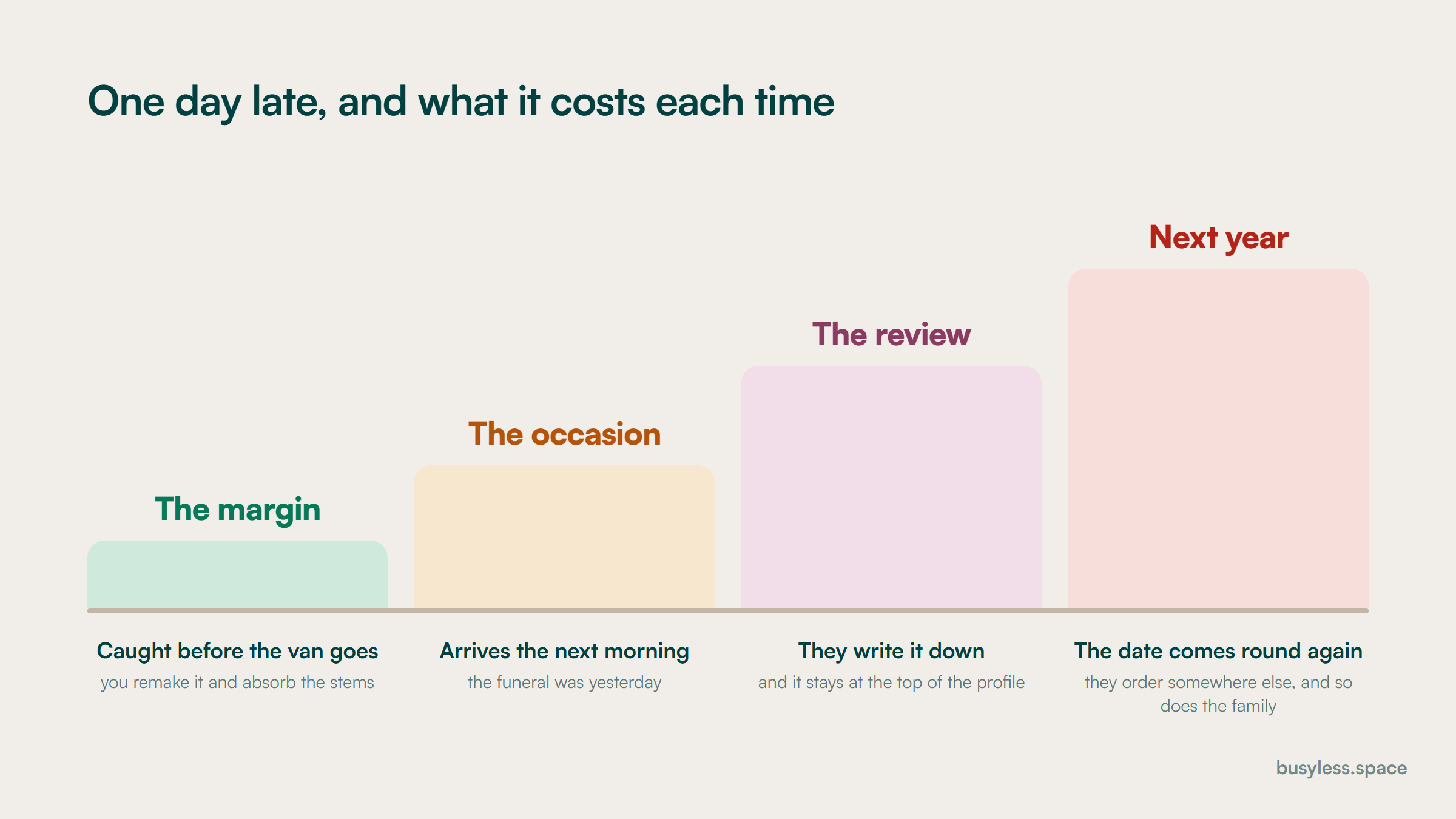
Rising steps showing the same missed delivery date costing progressively more as it moves from a refund through a review to a lost occasion
The first step is the only one you can pay your way out of. Everything after it is bought with the next customer's decision.

Proving expertise

Credibility in this business is mostly evidence that you are a real shop with real hands, because the market is full of websites that are neither. Nearly all of it is already happening on the bench and photographed by nobody.

  • Photographs of arrangements you actually made, in your own shop
  • Named florists and designers, with how long they have been doing it
  • Real delivery areas listed as places rather than hidden in a postcode field
  • The cutoff time stated plainly, including what happens after it
  • The substitution policy written specifically rather than boilerplate
  • Where the flowers come from, by farm or by region and season
  • Reviews from customers who received deliveries, not only ones who visited
  • A physical address with the shop front visible, and a phone somebody answers

How to build a florist SEO strategy

Sequencing matters more here than in almost any other category on this site, because a florist SEO strategy that starts in late January has already missed the work that decides February. Build the calendar first and let it dictate the order of everything else.

  1. 1

    Weeks 1-2

    Fix the facts

    • Publish the real cutoff time on every delivery and product page
    • Correct hours, special hours and delivery attributes on every profile
    • List the delivery areas as readable place names, not a postcode dropdown
    • Write the substitution policy properly and put it on product pages
    • Set special hours for every peak date in the next twelve months

    You end up with
    A site and a profile that describe what the shop actually does

  2. 2

    Weeks 3-8

    Get off the shared catalogue

    • Photograph your twenty best-selling arrangements yourself
    • Rewrite those product descriptions in your own words
    • Add Product and Offer markup with the delivery cutoff in it
    • Build the funeral home pages for every home you deliver to
    • Write the corporate and subscription page with a real starting price

    You end up with
    Product pages that exist nowhere else, and two pages nobody local has written

  3. 3

    Weeks 9-16

    Build the calendar ahead of itself

    • Create an occasion page for each of the next four peak dates
    • Publish each one at least six weeks before the date
    • Keep last year's occasion URLs live rather than recreating them
    • Build venue pages for the wedding venues you work at most
    • Load test the site at the traffic a peak date actually brings

    You end up with
    Occasion pages indexed and ranking before the demand arrives

  4. 4

    Weeks 17-24

    Make it repeat without you

    • Set a standing task to publish each occasion page six weeks out
    • Fold the review request into the delivery confirmation message
    • Track the local pack position by the postcodes you actually deliver to
    • Report peak dates separately from the rest of the year
    • Review which funeral home and venue pages produced orders

    You end up with
    A calendar that runs itself and a report that separates the spikes from the year

Technical fixes with the best payoff

Two suppliers cause most of what breaks here. The wire services hand every member the same product catalogue, and the shop websites are built on a small number of florist-specific platforms with the same defects baked into all of them.

  • Your product pages are the trade catalogue, verbatim

    A fortnight, then permanent

    Wire service membership includes product images, names and descriptions, so several hundred shops publish identical money pages. A reverse image search on your bestseller finds the same photograph on sites in forty states.

    Photograph and rewrite your top twenty sellers. That is a fortnight of work that makes your highest-intent pages the only ones of their kind in the country.

  • The cutoff time is not in the HTML anywhere

    A day

    It lives in the checkout logic, because that is where it functions. The page a customer lands on from search therefore answers every question except the only one that decides whether they can order.

    Print it on the delivery page, on every product page and in the Offer markup as a shipping cutoff. It is the highest-converting sentence on the site.

  • The delivery area is a dropdown of postcodes

    Half a day

    The platform models the delivery zone as data for the checkout to validate against, so the towns and villages you serve exist only inside a select element that no crawler reads and no searcher sees.

    Render the areas as readable text on a delivery page, grouped by town, with the fee and cutoff for each. The dropdown can stay; it just cannot be the only version.

  • The product grid arrives by script

    A sprint

    Category pages are built by the ecommerce widget after the page loads, so an occasion collection page ships with a heading, a spinner and nothing else in the source.

    Render the first screen of products server side. The rest can load as the shopper scrolls, but the page has to contain products when it is fetched.

  • The site falls over on the two days it exists for

    A day of testing, then a bill

    Hosting is sized for an ordinary week, and the two dates that carry a disproportionate share of the year's revenue bring traffic and checkout load that no other week comes close to.

    Load test in January against last year's peak, then buy the capacity for a fortnight rather than a year. This is the cheapest insurance in the business.

  • Every occasion is a new URL every year

    An hour of restructuring

    A page gets built for this year's date, indexed slowly, then replaced by next year's page on a different address, so the authority never compounds and every February starts from zero.

    One durable URL per occasion, updated in place each year. The page keeps whatever it earned last time instead of handing it back.

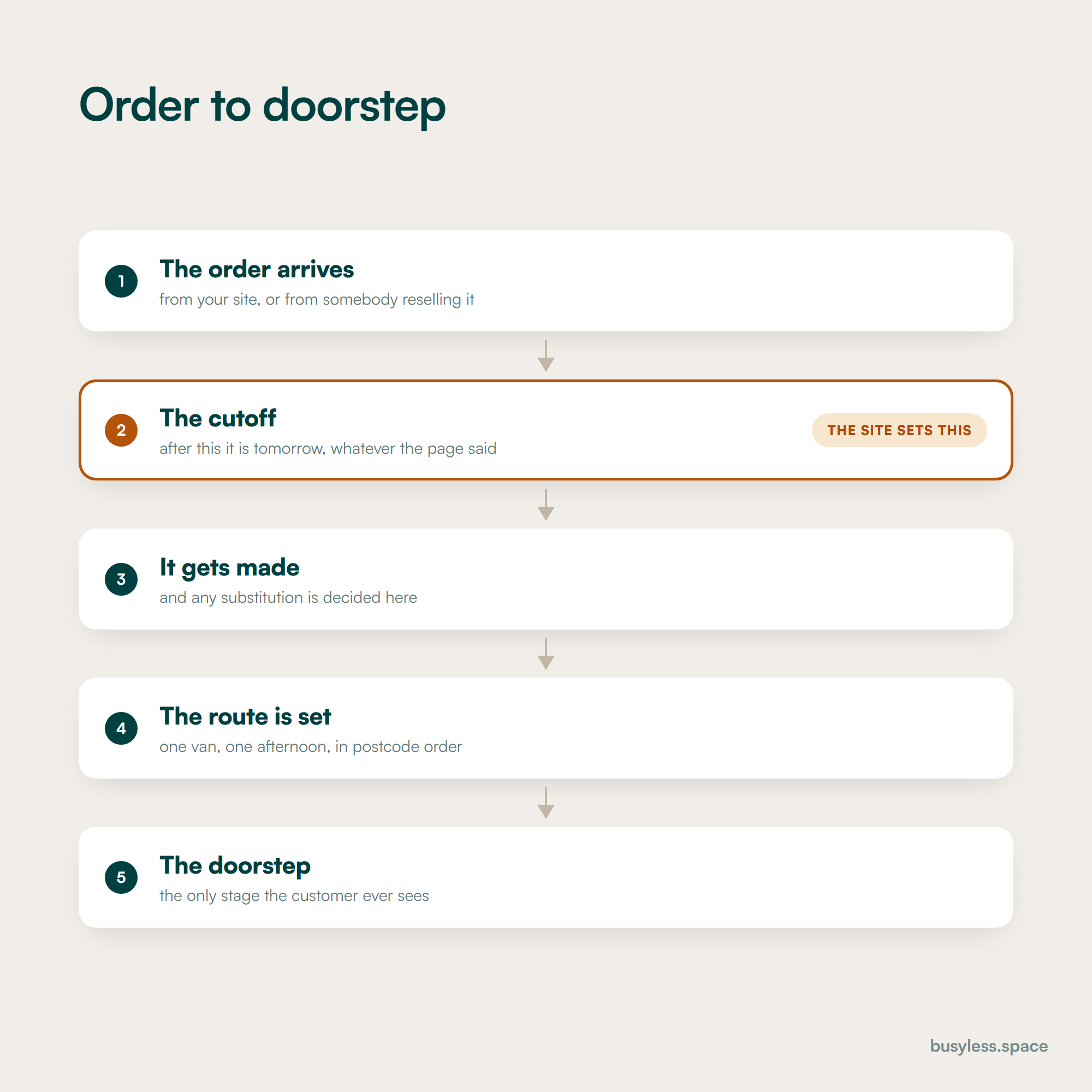
An ordered sequence from order through design and route to doorstep, with the cutoff stage flagged as the bottleneck the website never mentions
Only one stage in this sequence is set by the website, and it is the one the website usually leaves out.

Structured data that applies here

The types below fit this industry specifically. Most of them earn no rich result on their own, which is worth knowing before anyone sells the work on that basis. What they do is describe the entity precisely, which matters for how search engines and answer engines resolve who you are.

  • Florist

    The home page and any shop location page

    Schema.org has a type for exactly this business, sitting under Store, and hardly any florist uses it. It carries the address, the hours and the delivery area, which are the three facts the local pack is deciding on anyway.

    Florist.jsonld
    {
      "@context": "https://schema.org",
      "@type": "Florist",
      "name": "[SHOP NAME]",
      "url": "https://[YOUR-DOMAIN]/",
      "image": "https://[YOUR-DOMAIN]/[SHOP-FRONT].jpg",
      "telephone": "[+00 000 000 0000]",
      "priceRange": "[$$]",
      "address": {
        "@type": "PostalAddress",
        "streetAddress": "[STREET]",
        "addressLocality": "[TOWN]",
        "addressRegion": "[REGION]",
        "postalCode": "[POSTCODE]",
        "addressCountry": "[ISO COUNTRY CODE]"
      },
      "geo": {
        "@type": "GeoCoordinates",
        "latitude": "[LAT]",
        "longitude": "[LON]"
      },
      "openingHoursSpecification": [
        {
          "@type": "OpeningHoursSpecification",
          "dayOfWeek": ["Monday", "Tuesday", "Wednesday", "Thursday", "Friday"],
          "opens": "[09:00]",
          "closes": "[17:30]"
        }
      ],
      "areaServed": [
        { "@type": "City", "name": "[TOWN]" },
        { "@type": "City", "name": "[NEIGHBOURING TOWN]" }
      ]
    }
  • Product with a delivery cutoff

    Every arrangement and bouquet page

    The block that matters most on this site, because it is the only place the cutoff time becomes machine readable. Most florists mark up the price and stop, which describes everything except the thing being bought.

    Product with a delivery cutoff.jsonld
    {
      "@context": "https://schema.org",
      "@type": "Product",
      "name": "[ARRANGEMENT NAME]",
      "url": "https://[YOUR-DOMAIN]/flowers/[SLUG]",
      "image": "https://[YOUR-DOMAIN]/[YOUR-OWN-PHOTOGRAPH].jpg",
      "description": "[WHAT IS IN IT, IN YOUR WORDS, WITH THE SEASON STATED]",
      "brand": { "@type": "Brand", "name": "[SHOP NAME]" },
      "offers": {
        "@type": "Offer",
        "price": "[PRICE]",
        "priceCurrency": "[CURRENCY CODE]",
        "availability": "https://schema.org/InStock",
        "shippingDetails": {
          "@type": "OfferShippingDetails",
          "shippingRate": {
            "@type": "MonetaryAmount",
            "value": "[DELIVERY FEE]",
            "currency": "[CURRENCY CODE]"
          },
          "shippingDestination": {
            "@type": "DefinedRegion",
            "addressCountry": "[ISO COUNTRY CODE]",
            "postalCodePrefix": ["[PREFIX]", "[PREFIX]"]
          },
          "deliveryTime": {
            "@type": "ShippingDeliveryTime",
            "cutoffTime": "[14:00:00Z]",
            "handlingTime": {
              "@type": "QuantitativeValue",
              "minValue": 0, "maxValue": 0, "unitCode": "DAY"
            },
            "transitTime": {
              "@type": "QuantitativeValue",
              "minValue": 0, "maxValue": 1, "unitCode": "DAY"
            }
          }
        }
      }
    }
  • ItemList for an occasion collection

    Occasion pages such as Valentine's Day or Mother's Day

    An occasion page is a curated set rather than a category, and saying so machine readably is what stops it being read as a thin duplicate of the main shop. Keep the list to what the page actually shows.

    ItemList for an occasion collection.jsonld
    {
      "@context": "https://schema.org",
      "@type": "ItemList",
      "name": "[OCCASION] flowers in [TOWN]",
      "url": "https://[YOUR-DOMAIN]/occasions/[SLUG]",
      "numberOfItems": "[COUNT SHOWN ON THE PAGE]",
      "itemListElement": [
        {
          "@type": "ListItem",
          "position": 1,
          "url": "https://[YOUR-DOMAIN]/flowers/[SLUG]",
          "name": "[ARRANGEMENT NAME]"
        },
        {
          "@type": "ListItem",
          "position": 2,
          "url": "https://[YOUR-DOMAIN]/flowers/[SLUG]",
          "name": "[ARRANGEMENT NAME]"
        }
      ]
    }
  • Service for wedding and event work

    The wedding portfolio page

    Wedding florals are a consultative service rather than a product with a price, and marking it as one keeps it out of the shopping results where it does not belong. The honest version states a starting budget rather than a price.

    Service for wedding and event work.jsonld
    {
      "@context": "https://schema.org",
      "@type": "Service",
      "serviceType": "Wedding floristry",
      "name": "Wedding flowers in [TOWN]",
      "url": "https://[YOUR-DOMAIN]/weddings",
      "provider": {
        "@type": "Florist",
        "name": "[SHOP NAME]",
        "url": "https://[YOUR-DOMAIN]/"
      },
      "areaServed": [
        { "@type": "City", "name": "[TOWN]" },
        { "@type": "Place", "name": "[VENUE NAME]" }
      ],
      "offers": {
        "@type": "Offer",
        "priceSpecification": {
          "@type": "PriceSpecification",
          "minPrice": "[TYPICAL STARTING BUDGET]",
          "priceCurrency": "[CURRENCY CODE]"
        },
        "description": "[Consultation, design, delivery and set-up. Budgets start at MIN.]"
      }
    }
  • FAQPage

    Delivery, substitution and care pages

    Only for questions visible on the page. The three that earn their place here are the cutoff, the substitution policy and what happens if nobody is home, because those are the objections that stop an order at the last step.

    FAQPage.jsonld
    {
      "@context": "https://schema.org",
      "@type": "FAQPage",
      "mainEntity": [
        {
          "@type": "Question",
          "name": "[What time do you stop taking same-day orders?]",
          "acceptedAnswer": {
            "@type": "Answer",
            "text": "[The real time, and what happens to orders placed after it.]"
          }
        },
        {
          "@type": "Question",
          "name": "[Will my flowers look exactly like the photograph?]",
          "acceptedAnswer": {
            "@type": "Answer",
            "text": "[What you substitute, what you never substitute, and how you decide.]"
          }
        },
        {
          "@type": "Question",
          "name": "[What happens if nobody is home?]",
          "acceptedAnswer": {
            "@type": "Answer",
            "text": "[Exactly what the driver does, and how the customer is told.]"
          }
        }
      ]
    }
  • AggregateRating on the shop

    The home page, only if reviews are genuinely shown there

    Worth including only when the reviews are on the page and were collected without incentive. Marking up a number nobody can see, or one bought in bulk, is the fastest route to a manual action in a category where it is common.

    AggregateRating on the shop.jsonld
    {
      "@context": "https://schema.org",
      "@type": "Florist",
      "name": "[SHOP NAME]",
      "url": "https://[YOUR-DOMAIN]/",
      "aggregateRating": {
        "@type": "AggregateRating",
        "ratingValue": "[YOUR REAL AVERAGE]",
        "reviewCount": "[HOW MANY ARE SHOWN ON THE PAGE]",
        "bestRating": "5",
        "worstRating": "1"
      },
      "review": [
        {
          "@type": "Review",
          "author": { "@type": "Person", "name": "[REVIEWER FIRST NAME]" },
          "datePublished": "[YYYY-MM-DD]",
          "reviewRating": {
            "@type": "Rating", "ratingValue": "[N]", "bestRating": "5"
          },
          "reviewBody": "[THEIR WORDS, UNEDITED]"
        }
      ]
    }

What it costs

The bands below are editorial estimates for the work described here rather than quoted prices. What moves a shop up a tier is usually wedding and corporate ambition rather than delivery volume, because those two lines need content and photography that everyday orders do not.

Do it yourself

$0 to $300
  • Cutoff times, hours and delivery areas published correctly
  • Twenty product pages photographed and written by you
  • Funeral home pages for every home you deliver to
  • Occasion pages built six weeks ahead on durable URLs
  • A review request in the delivery confirmation

Who it suits

A single shop where the owner or a designer has a few hours a month and knows the town better than any agency could. Most of the value in this playbook lives here.

Where it stops

Photography is the bottleneck. Twenty products is a fortnight of evenings, and a shop with two hundred lines will not finish the catalogue this way.

Lean

$700 to $2,000
  • Product photography and copy across the full range
  • Venue pages for the wedding venues you work at
  • The corporate and subscription line built out properly
  • Local pack tracking by delivery postcode rather than one position

Who it suits

An established shop with a delivery fleet and real wedding ambition, where the catalogue is too large to photograph in evenings.

Where it stops

Rankings do not add drivers. Once the peak dates are at capacity, more search traffic moves the ordinary weeks and nothing else.

Funded

$2,000 to $4,000
  • Multi-location or multi-town coverage with distinct pages
  • A wedding portfolio built and maintained as its own property
  • Peak-date load testing and capacity planning as a routine
  • Reporting that separates peak dates, weddings and corporate

Who it suits

A multi-shop group, or a single shop where weddings and corporate contracts are the growth plan rather than a sideline.

Where it stops

Two dates a year still carry the revenue, and no amount of search work changes the shape of the calendar. It can only make sure you are ready for it.

How to do it with no budget

Almost everything decisive in this playbook is free, and most of it is information the shop already has and has never written down. The two things that cost money, photography and capacity, can both wait.

  1. 1

    Publish your cutoff time everywhere

    An hour

    Your website editor

    Delivery page, product pages, home page, profile. It is the single fact that decides whether somebody can buy from you today, and it currently appears for the first time in your checkout.

  2. 2

    Set special hours for every peak date this year

    Half an hour

    Google Business Profile

    Do the whole year in one sitting. Wrong hours on Valentine's Day produce the review that costs you the following Valentine's Day, and the fix takes ninety seconds per date.

  3. 3

    List your delivery areas as readable text

    An hour

    Your website editor

    Towns and villages by name, with the fee and cutoff for each. They currently exist only inside a checkout dropdown, which means neither a searcher nor a crawler has ever seen them.

  4. 4

    Write a page for each funeral home you deliver to

    20 minutes each

    Your website editor

    Name the building, the delivery window, what is appropriate and what the home prefers. It answers a search made by somebody grieving and in a hurry, and almost no shop has written it.

  5. 5

    Rephotograph your ten bestsellers

    An afternoon

    A phone and the shop window light

    Your ten highest-intent pages currently carry the same catalogue image as several hundred other shops. Ten photographs taken on your own bench make them unique in the country.

  6. 6

    Rewrite the substitution policy properly

    An hour

    Your website editor

    What you swap, what you never swap, and how you decide. Written specifically it reads as craft, and it removes the objection that stops an order at the last step.

  7. 7

    Ask for a review on every delivery confirmation

    20 minutes to set up

    Your order system's confirmation message

    No incentive, no scheme, just the ask, every time. In a business with this many transactions, consistency produces more reviews than anything clever, and it is the one thing the local pack rewards most.

The tool stack

Very little is needed, and one entry exists for a reason specific to this trade: a florist's rankings differ from one delivery postcode to the next, and a single position number averages that difference away.

  • Track the local pack by delivery area rather than as one number

    Advanced Web RankingSEO APIRead the review

    You rank differently in every town you deliver to, and the towns furthest from the shop are the ones worth winning. One pooled position tells you nothing about any of them.

    Free routeSearch from two or three postcodes by hand each month

  • Run a product catalogue that is genuinely yours

    Zesty.ioHeadless CMSRead the review

    An arrangement, a season, a delivery zone and an occasion are structured records. Modelling them once is what lets an occasion page rebuild itself each year rather than being written from scratch.

    Free routeYour existing platform, with the catalogue fields overwritten by hand

  • Work out what a peak date is actually worth

    Marketing Funnel CalculatorFree toolOpen the tool

    Two dates carry a disproportionate share of the year, and most shops have never modelled the funnel behind them. Doing it once tells you how much capacity to buy and how early to publish.

    Free routeFree

  • Keep the profile accurate through the calendar

    Google Business Profile

    Hours, special hours, delivery attributes and the products feed. For a single-shop florist this is a more valuable asset than the website and it takes an hour a quarter.

    Free routeFree

  • Survive the two days the year depends on

    Your hosting provider's autoscaling or a temporary plan upgrade

    Buy the capacity for a fortnight rather than a year. The test is the important half; most shops discover the ceiling on the morning it matters.

    Free routeLoad test with a free tool in January and see what breaks

  • Watch which pages produce orders rather than visits

    Analytics with the checkout instrumented

    Funeral home pages and venue pages produce few sessions and large orders, so a traffic report makes them look like failures. Measure them on revenue or they get cut.

    Free routeFree

Take it from here

Everything below is meant to be filled in and used rather than read. Bodies are plain text, so what lands on your clipboard is exactly what you see, brackets and all.

Checklist

Puts the cutoff, the areas and the fees in one place, and finds where the site currently contradicts itself.

DELIVERY PROMISE AUDIT
Shop: [NAME]     Audited by: [NAME]     Date: [DATE]

THE ONE FACT
Same-day cutoff time: [ ......... ]
Where does it currently appear?
  [ ] Home page
  [ ] Delivery page
  [ ] Every product page
  [ ] Checkout only
  [ ] Nowhere on the site

If the last two are ticked, this audit has already paid for itself.

CUTOFFS BY DAY
Day            Orders close    Last van leaves   Notes
Monday         [ ......... ]   [ ........... ]   [ ............. ]
Tuesday        [ ......... ]   [ ........... ]   [ ............. ]
Wednesday      [ ......... ]   [ ........... ]   [ ............. ]
Thursday       [ ......... ]   [ ........... ]   [ ............. ]
Friday         [ ......... ]   [ ........... ]   [ ............. ]
Saturday       [ ......... ]   [ ........... ]   [ ............. ]
Sunday         [ ......... ]   [ ........... ]   [ ............. ]

DELIVERY AREAS AS PEOPLE SAY THEM
Town or area              Fee          Cutoff        Same day?
[ ..................... ] [ ....... ]  [ ......... ] [ ] Y [ ] N
[ ..................... ] [ ....... ]  [ ......... ] [ ] Y [ ] N
[ ..................... ] [ ....... ]  [ ......... ] [ ] Y [ ] N
[ ..................... ] [ ....... ]  [ ......... ] [ ] Y [ ] N

  - these must exist as readable text on the delivery page
  - a postcode dropdown is not a published delivery area

EDGE CASES THE PAGE MUST ANSWER
  [ ] What happens if nobody is home
  [ ] What happens on a bank holiday
  [ ] What happens if the address is a hospital or a workplace
  [ ] What happens if the recipient refuses the delivery
  [ ] Whether you deliver on Sundays, and at what price

CONTRADICTION CHECK
Compare these four and record any that disagree:
  Website cutoff:                [ ......... ]
  Business profile hours:        [ ......... ]
  Checkout logic:                [ ......... ]
  What the shop actually does:   [ ......... ]

Every mismatch is a customer promised something you will not do.

SIGN OFF
Fixed by: [NAME]     Date: [DATE]     Next review: [DATE]

What to publish

The assets below share one property: each of them removes a specific doubt about whether the delivery will go right. That is the job of content in this category, and it is why product photography outranks blogging here.

  • Occasion pages on durable URLs

    One per occasion, updated six weeks before each date

    The demand arrives in a seventy-two hour window and the page has to have been indexed for weeks before it. A permanent URL updated each year keeps everything it earned last time.

  • Funeral home pages

    One per home, written once

    A search made under time pressure by somebody unfamiliar with the conventions. Naming the building, the window and the etiquette answers three anxieties in one page.

  • Venue pages for weddings

    One per venue you have genuinely worked at

    The directories own the wedding florist query, but nobody optimises for the venue name, which is what a couple who has already booked will search.

  • Your own product photography

    Ten to twenty products, then as the range changes

    The highest-intent pages on the site currently carry an image several hundred competitors also use. Your own photographs are the cheapest uniqueness available anywhere in this playbook.

  • The delivery page

    Once, reviewed each quarter

    Areas, fees, cutoff, what happens if nobody is home, what happens on a bank holiday. It is the page that converts and most shops treat it as an afterthought.

  • Care and seasonality guides

    One a month until the common questions are covered

    They bring the customer back and they are the natural home for the substitution explanation, where it reads as knowledge rather than as small print.

And what not to

  • Product pages left on the wire service catalogue text and photography
  • Occasion pages created fresh each year on a new URL
  • Flower meaning and symbolism posts, which publishers own and which sell nothing
  • Same-day badges on category pages where the cutoff makes them untrue
  • Locally grown and eco-friendly claims with no farm, county or season behind them

The expensive mistakes

Hiding the cutoff time until the checkout

Costs you The one fact that decides whether somebody can order today is invisible on the page they landed on, so they leave and buy from a page that told them.

Print it above the fold on every delivery and product page, and put it in the Offer markup as a shipping cutoff.

Building the occasion page during the occasion week

Costs you A brand new URL competing in a seventy-two hour window against pages that have been indexed for a month. It never ranks, every year.

One durable URL per occasion, updated in place, live six weeks before the date.

Publishing the trade catalogue as your product range

Costs you Your highest-intent pages are identical to several hundred competitors', so nothing distinguishes them except which brand the shopper already knew.

Photograph and describe your top sellers yourself. A fortnight of work, and it does not need repeating.

Treating the wire service as only a competitor or only a partner

Costs you Shops either leave and lose the order flow, or stay and never notice that their own town's query belongs to the brand sending them discounted work.

Decide the two questions separately. Distribution is a commercial call; your own town's query is a page you can win either way.

Promising a photograph you cannot reproduce

Costs you The substitution arrives unannounced, and a customer who was shown one thing and received another leaves the review that costs the next twenty orders.

Say what you substitute and why, on the product page. Customers accept a living crop; they do not accept a surprise.

Sizing the website for an ordinary week

Costs you The site slows or falls over on the two dates that carry the year, during the exact hours the orders would have been placed.

Load test in January against last year's peak, then buy capacity for a fortnight. It is the cheapest insurance available.

What to measure

The reporting problem in this business is that averages destroy the signal. A monthly figure that blends a peak date with three ordinary weeks describes neither, and a shop that reports that way cannot tell whether the work is landing.

Leading indicators

Move first. They predict, they do not prove.

  • Local pack position by delivery area

    A rank tracker with postcode-level locations

    Read as a set rather than an average. The towns at the edge of your radius are where the growth is, and they are exactly what a pooled number hides.

  • Impressions on occasion pages, six weeks out

    Search Console

    The early warning that tells you whether February will work, in January. If the page is not collecting impressions a month before the date, it will not rank during it.

  • Product pages with your own photography

    Your own count

    A production metric reported as a fraction of the range. It is the clearest measure of how far you have escaped the shared catalogue.

  • Profile actions: calls, directions and website clicks

    Google Business Profile insights

    For a single-shop florist this moves before anything on the website does, because the profile is where the local pack sends people. Watch calls in particular on peak weeks.

  • Review volume and recency

    Your profiles

    Volume matters in the pack and recency matters to shoppers. A steady trickle from delivery confirmations beats a burst, and a burst looks exactly like the thing that gets filtered.

Business indicators

The ones a manager acts on.

  • Orders and revenue on peak dates

    Your order system

    Reported separately from the rest of the year, always, and compared to the same date last year rather than to last month. Everything else in the calendar is a different business.

  • Wedding and event enquiries

    The wedding enquiry form

    Low volume, long lead and the largest orders you take. Count enquiries and track them to booking, because a quarter with three enquiries and two bookings is a good quarter.

  • Corporate and subscription contracts

    Your order system, by account

    The revenue that fills the weeks between spikes. Worth reporting as recurring value rather than as orders, since one account can be worth a month of retail.

The verdict

Most florist SEO services sell blog posts about flower meanings and a monthly ranking report. Both are beside the point in a business where the customer is choosing whether to trust that a van will reach an address before a service starts.

The work that pays is unglamorous and mostly free. Publish the cutoff, fix the hours, list the towns, photograph your own arrangements, and build the occasion page before anybody is searching for it.

Two structural facts sit under all of it. Your product pages belong to the trade catalogue until you replace them, and your biggest search competitor may be sending you discounted orders at the same time.

Honest SEO services for florists therefore start with the calendar and the delivery promise rather than with keywords. Get those right and the shop is findable at the moment it matters, which in this trade is a moment that does not come back.

FAQ

Florists SEO questions

  • Why do order gatherers outrank my shop for my own town?
    They are large national domains running a city page for every town, and they spend on it continuously. You will rarely outrank them on the broad delivery query, but you can beat them on your neighbourhoods, your funeral homes and your venues, which is where the better orders are anyway.
  • Should I leave my wire service?
    That is a commercial decision about order flow rather than an SEO one, and the two get confused. Whatever you decide, replace the shared product catalogue on your own site, because that part costs you nothing to fix and is hurting you either way.
  • Where should the cutoff time go?
    Above the fold on the delivery page, on every product page, in your business profile attributes and in the Offer markup as a shipping cutoff. It is the fact that decides whether somebody can buy from you today.
  • When should I publish the Valentine's Day page?
    By early January at the latest, and on the same URL you used last year. A page created during the week of the date is competing against pages that have been indexed for a month, and it loses every time.
  • How do I handle substitutions without losing the sale?
    State the policy on the product page, specifically. What you swap, what you never swap, and how you choose. Customers accept that flowers are a crop; what they do not accept is finding out afterwards.
  • Are funeral home pages really worth writing?
    Yes, and they are among the highest-value pages on the site. The search is made under time pressure by somebody who does not know the conventions, and naming the home, the delivery window and what is appropriate answers all of it at once.
  • Do I need a separate wedding site?
    Not usually. A strong portfolio section with real weddings, named venues and honest budget bands does the job. The winnable queries are venue names rather than the wedding florist head term, which the directories hold.
  • What should I do about the traffic spike on peak dates?
    Load test in January against last year's peak and buy capacity for a fortnight rather than a year. Discovering the ceiling on the morning of the busiest day of your year is the most expensive way to learn it.

Run it yourself, or have someone own it

Everything above is written to be run without us, and the free path is genuinely most of the value for a single-location business. Where these plans stall is almost never the plan. It is that nobody owns it after the first month. That is the job we do, with search as one distribution layer inside a wider system rather than the whole engagement.