
Apify review
Best for scraping anything without a dataset
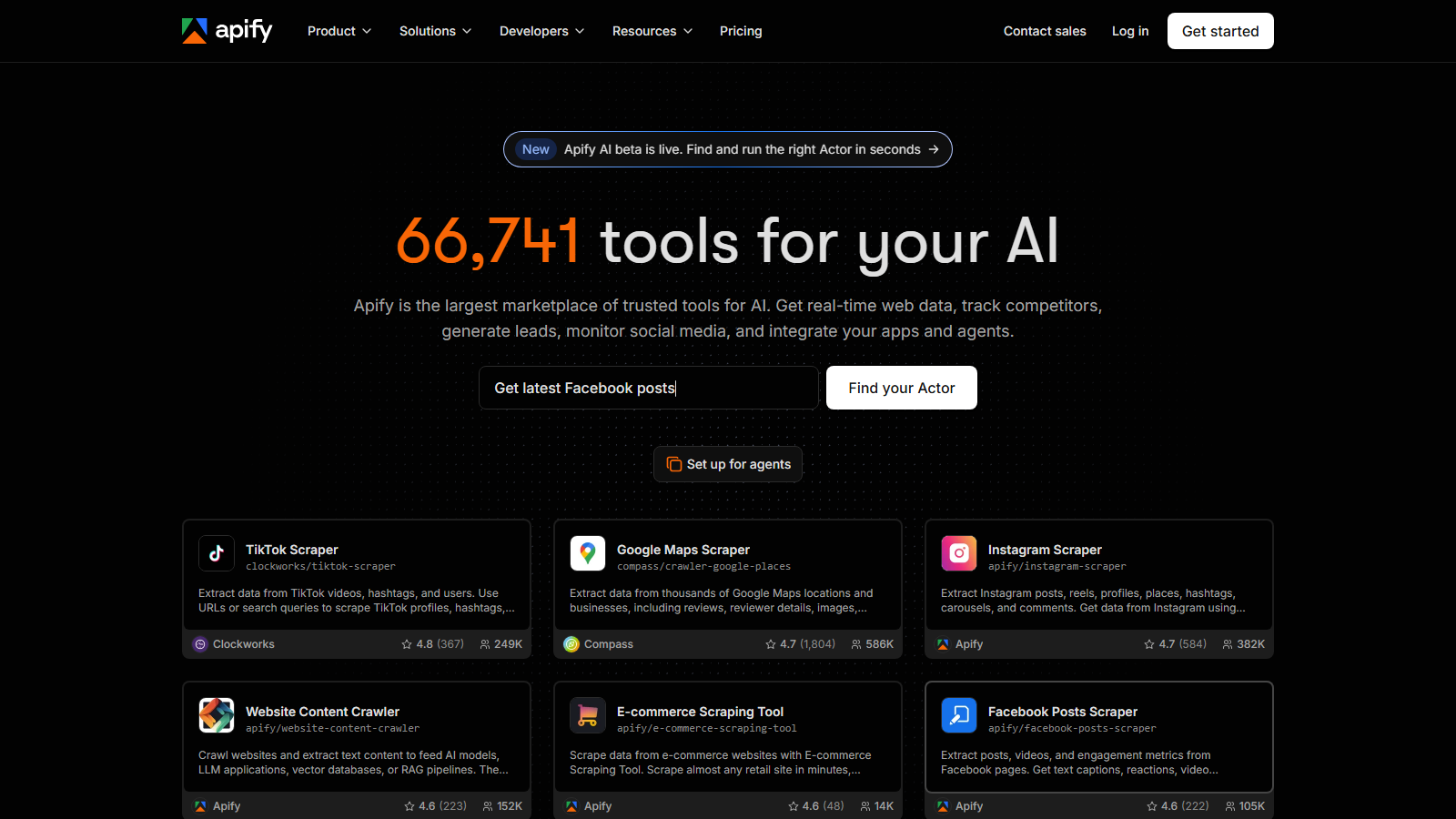
Apify is the odd one out in this directory and the difference is structural. Everything else here sells access to a dataset the vendor built. Apify sells a place to run scrapers, plus a store of more than 66,000 Actors, most written by third-party developers, that already scrape the sites you were going to write a scraper for. If the data you need has no API anywhere, this is usually where you end up.
The billing has two layers and people trip on both. The plan gives you an equal amount of platform credit to spend: $19 on Starter buys $19 of usage, $199 on Scale buys $199. Underneath that, everything meters. Compute units run from $0.2 down to $0.13 depending on tier, and proxies, data transfer and storage operations bill separately. Unused credit does not roll over.
On top of the platform cost sits the Actor's own price. Some Actors charge nothing beyond the platform usage they consume, others charge a rental or a per-result fee set by their developer. That is where the marketplace shows: Apify takes a commission, and practitioners report buying the same Actor from its developer directly for meaningfully less.
Our scorecard
Our editorial read across six dimensions, scored 1 to 5. This is our own assessment, not an aggregate of user reviews, and it is deliberately kept out of the page's structured data.
- Data coverage5/5
66,000+ Actors. If a site can be scraped, something in the store already does it. Nothing here is broader.
- Pricing3/5
Transparent per unit and genuinely confusing in aggregate: plan, compute, proxy, storage and Actor fees all stack.
- Documentation4/5
Thorough API reference and SDKs. Reviewers find it overwhelming when the goal is one simple scraper.
- Ease of integration5/5
Bearer token, clean REST, and synchronous run-and-return-dataset endpoints that skip the polling entirely.
- Reliability4/5
Strong at long-running jobs and persistence. Actor availability is outside Apify's control and does change.
- Support4/5
Good platform support. An abandoned third-party Actor is the developer's problem, not a support ticket.
An editorial read, not an aggregate of user reviews, and deliberately kept out of this page's structured data.
What you can pull
Run Actor
400 requests per second
Starts an Actor run and returns the run object, or with the synchronous variants, the dataset items or key-value record directly
Actor tasks
400 requests per second
Saved Actor configurations you can run without resending input, including synchronous run-and-get-items
Datasets
400 rps for pushes, 60 for reads
Create, list and read scraped results, with item-level access, headers and statistics. The usual place output lands
Key-value stores
200 requests per second
Arbitrary records keyed by name: screenshots, files, run state and anything not row-shaped
Request queues
400 requests per second
The crawl frontier, so a distributed crawl can share one queue across many runs
Schedules and webhooks
60 requests per second
Cron-style scheduling and event callbacks on run states, so pipelines react rather than poll
Actor builds and versions
60 requests per second
Build, version and validate your own Actors, which is how you ship private scrapers on the platform
Proxy
Metered per GB
Datacenter and residential proxy access used by runs, billed separately from compute
Who Apify is for
Teams that need data from somewhere with no API at all, and teams building a product where scraping is the input rather than the point. The store means a competitor-monitoring or lead-research pipeline can be running in an afternoon instead of a fortnight, and the platform handles the parts that actually hurt: retries, persistence, scheduling and proxies.
It is the wrong tool for standard SEO data. If you want SERPs, keyword volume or backlinks, a dataset provider will be cheaper, faster and more stable than running someone else's Actor against a search engine.
Strengths and limits
What it does well
- More than 66,000 prebuilt Actors, so most scraping jobs start from working code rather than a blank file.
- The synchronous run-and-get-dataset-items endpoints return results in a single request, which removes the polling most job-based APIs force on you.
- Managed datasets, key-value stores and request queues mean a crawl survives restarts without you building persistence.
- Generous rate limits where it matters: 400 requests a second for running Actors and pushing items, against 60 for general resources.
- Free usage is genuine. $5 of it a month with no card is enough to prove a pipeline works before anyone approves a budget.
- An official MCP server and x402 support, so an AI agent can run Actors and pay per run without a subscription.
- You can publish your own Actors, which turns an internal scraper into either a private tool or a revenue line.
Where it falls short
- The cost model stacks: plan fee, compute units, proxy traffic, data transfer, storage operations and the Actor's own charge. Reviewers consistently call the pricing confusing, and they are right.
- Apify takes a commission on store Actors. Practitioners report paying 30 to 40% less by buying the same Actor directly from its developer.
- Unused credit expires at the end of the billing cycle rather than rolling over.
- You are depending on third-party code. An Actor can be abandoned, or blocked by its target: users report Apollo scraping stopping, which is not something Apify can fix for you.
- That $5 goes quickly. A scheduled job checking a site every 30 minutes will exhaust it well before the month ends.
- It returns whatever the site says, so there is no normalisation, no dataset guarantees and no consistency between two Actors scraping the same thing.
- Scraping law and platform terms are your problem, and personal data pulled from social profiles carries obligations the platform does not handle for you.
Apify pricing
The plan fee and the credit are the same number, which is the part people misread. Starter at $19 a month gives you $19 to spend, Scale at $199 gives you $199, Business at $999 gives you $999. What the tiers actually buy is a lower compute rate, $0.2 down to $0.16 and then $0.13 per unit, plus better store discounts and support. Annual billing takes 10% off.
Underneath that, everything meters independently: compute units, proxy traffic, data transfer and storage operations. Then the Actor itself may charge on top. Apify Store Actors use one of two models and each Actor's page states which: some charge nothing beyond the platform usage the run consumes, others charge a rental or per-result fee set by their developer.
That last layer is where the marketplace economics show. Apify takes a commission on Actor revenue, and practitioners in r/n8n report finding the same Actor's developer selling access directly at 30 to 40% less. If one Actor is central to your pipeline, it is worth an email before you scale it.
Budget for the free tier being small. $5 a month sounds generous until a job runs every 30 minutes, which is exactly the complaint that starts most of the threads about Apify alternatives.
Free
$0
$5 of usage a month, $0.2 per compute unit
- Genuinely usable for evaluation and small jobs
- No card required, community support
- No Apify Store discount
- Practitioners report burning the $5 quickly at any real volume
Starter / Scale
$19 / $199 / mo
Equal credit, then $0.2 and $0.16 per CU
- The plan fee IS the credit: $19 buys $19 of usage
- Scale drops the compute rate 20% and adds priority support
- Bronze and Silver Apify Store discounts respectively
- Unused credit expires at the end of the cycle
Business / Enterprise
$999 / mo or custom
$0.13 per compute unit
- Account manager and Gold Store discount
- Enterprise adds SLAs with guaranteed data and a dedicated team
- Annual billing takes 10% off
- Where a product built on scraped data should sit
Request example
A minimal call against the live endpoint, with credentials read from the environment rather than pasted inline.
curl -s -X POST \
  "https://api.apify.com/v2/acts/apify~website-content-crawler/run-sync-get-dataset-items" \
  -H "Authorization: Bearer $APIFY_TOKEN" \
  -H "Content-Type: application/json" \
  -d '{
        "startUrls": [{ "url": "https://example.com" }],
        "maxCrawlPages": 25
      }'

# run-sync-get-dataset-items does the whole job in one request:
# no polling the run id, no separate dataset fetch. Cost is compute
# units plus whatever the Actor's own developer charges on top.
Rate limits and quotas
- Global rate limit of 250,000 requests per minute per user or IP address.
- 60 requests per second per resource as the standard limit.
- 200 requests per second for key-value store record operations.
- 400 requests per second for running Actors and tasks, metamorph, pushing dataset items and request queue operations.
- Exceeding a limit returns HTTP 429 with an explicit rate-limit error.
- Compute units cost $0.2 on Free and Starter, $0.16 on Scale and $0.13 on Business.
- Unused monthly credit does not roll over and expires at the end of the cycle.
- Proxies, data transfer and storage operations are billed separately from compute.
Third-party reviews
Scores read from each source on 3 September 2026. We report them as-is and publish no rating of our own.
These scores rate the Apify platform, which in this case is the product being reviewed here, though they cover the interface and the store as well as the API.
What practitioners say on Reddit
Practitioners rate the platform highly and question the economics, and the split is unusually clean. Where Apify is praised it is for the things a platform should be good at: long-running jobs, persistence and reliability at scale. Almost nobody criticises it for falling over.
The criticism is about cost and about the marketplace. The recurring advice in r/n8n is to check whether the target has its own API before reaching for an Actor, because several do and are cheaper. The sharper observation is that Apify's commission is visible enough that buying direct from an Actor's developer can cost 30 to 40% less.
The risk nobody mentions until it happens is Actor availability. One thread starts from Apollo scraping no longer working, which is a supply problem rather than a platform problem, and is the trade you make when the catalogue is written by other people.
“Apify is great but you can find cheaper solutions if you go directly to actors developers, because Apify takes big comissions. I used to use APify as well but then found my actors devs official site and pay 30-40% cheaper now”
r/n8n on Reddit“Apify in particular shines with long-running jobs, persistence, and reliability at scale.”
r/n8n on Reddit“Reddit's own search endpoint is free and works great if you just need keyword monitoring. Feed it the right JSON params through an HTTP Request node in n8n and you're golden. I set up a workflow that checks every 30 minutes and stores the last seen post ID to avoid duplicates, saves me from burning through Apify credits.”
r/n8n on Reddit“Came here to say what others have said! Save Apify for other social platforms. With Reddit and Google (YouTube) you can get away with a lot on the free tier”
r/n8n on Reddit“once the pipeline starts collecting LinkedIn profiles or emails, you're technically handling personal data. Depending on where it's used, that can bring some data protection considerations (like retention or opt-out handling).”
r/n8n on Reddit
Verdict
Reach for Apify when the data has no API anywhere, and not before. The store is the product: 66,000 Actors means most jobs start from something that already works, and the platform handles retries, persistence, scheduling and proxies so you do not have to. For that job nothing else in this directory competes.
For standard SEO data it is the expensive answer to a solved problem. DataForSEO will return a SERP for a fraction of what an Actor run costs, with a stable schema and no third-party dependency.
Two things to do before you scale. Check whether your target publishes its own API, because the most common regret in the practitioner threads is paying to scrape something that was free. And if one Actor becomes load-bearing, contact its developer directly: the commission is real, and so is the 30 to 40% some teams have saved by going around it.
Apify FAQ
How much does Apify cost?
The plan fee is also your credit: Free gives $5 of usage a month, Starter $19, Scale $199 and Business $999. What the tiers really buy is a cheaper compute rate, from $0.2 per unit down to $0.13, plus store discounts and support. Annual billing takes 10% off and unused credit does not roll over.What is a compute unit?
The metering unit for running an Actor, priced from $0.2 down to $0.13 depending on plan. It measures the memory and time a run consumes, so a heavier crawl costs more than a light one. Proxies, data transfer and storage operations are billed on top of it rather than included.Do Actors cost extra on top of the platform usage?
It depends on the Actor, and each Actor's page states which model applies. Some charge nothing beyond the platform usage their runs consume. Others charge a rental or per-result fee set by their developer, and Apify takes a commission on that.Can I buy an Actor more cheaply elsewhere?
Sometimes, and practitioners do. Because Apify takes a commission on store revenue, some Actor developers sell access directly from their own sites for less, with one r/n8n user reporting 30 to 40% savings. If a single Actor is central to your pipeline, it is worth asking its developer before you scale.What are the Apify API rate limits?
250,000 requests a minute globally per user or IP, and 60 requests a second per resource as standard. Running Actors, running tasks, pushing dataset items and request queue operations get 400 a second, and key-value store record operations get 200. Exceeding any of them returns HTTP 429.Is the Apify free tier enough to test with?
For evaluation, yes. $5 of usage a month with no card is enough to prove a pipeline works. For anything scheduled it goes quickly: a job running every 30 minutes will exhaust it well before month end, which is what starts most of the alternatives threads on Reddit.What happens if an Actor stops working?
That is the risk of a marketplace. Most Actors are third-party code, so one can be abandoned or blocked by the site it targets, as users found when Apollo scraping stopped working. Apify keeps the platform running but cannot make somebody else's Actor work against a target that has locked it out.Apify or DataForSEO for SEO data?
DataForSEO, almost always. It returns SERPs, keywords and backlinks from a stable schema at a per-request price an Actor run cannot match. Use Apify for what it is uniquely good at: data from sites that publish no API at all, where somebody has already written and maintained the scraper.
Other providers worth a look
This is an independent review. We have no affiliate relationship with Apify, earn nothing if you sign up, and no provider pays for placement in the directory. Prices were read from the vendor's own pages in September 2026 and change without notice.