
Amplience review
Best for retailers with heavy campaign calendars
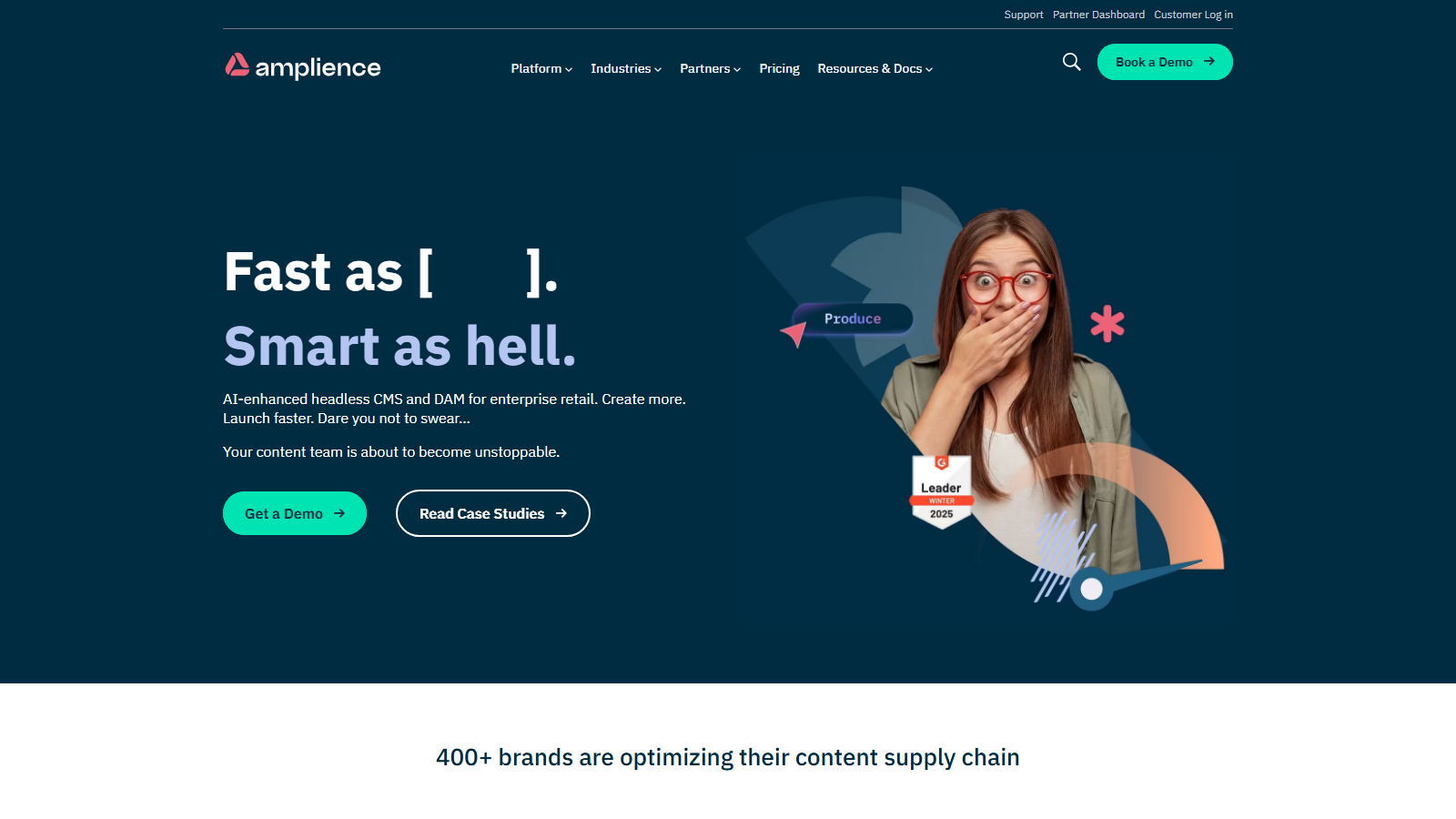
Amplience is a content platform for retail and commerce teams, founded in 2008. The Amplience CMS is Dynamic Content, a headless CMS. It is sold beside Content Hub (a DAM), Dynamic Media (image and video delivery) and Workforce (AI content production). Each can be licensed on its own or together, and none of the four has a published price.
The headline commercial promise is unlimited API calls, with fees based on visits instead and a 99.99% SLA on every success plan. It holds up because the delivery API is deliberately narrow. Amplience's documentation says it offers no general query engine, so a list can only filter on paths declared in advance in the content type schema, five per type.
The meters that do exist sit where builds and editors work. The uncached Fresh API for static builds allows 100 requests a second, publishing is capped at 100 requests a minute and bulk publishing at 10, while virtual staging allows 7 requests a second. Content Delivery v2 itself has to be provisioned on each hub by a Customer Success Manager.
Our scorecard
Our editorial read across six dimensions, scored 1 to 5. This is our own assessment, not an aggregate of user reviews, and it is deliberately kept out of the page's structured data.
- Content modelling4/5
JSON Schema content types, hierarchies, slots and editions. Every list filter has to be designed in up front.
- Developer experience3/5
Limits are documented in detail, but delivery v2 and Fresh are provisioned by a CSM, and linked lists page at 12.
- Editor experience4/5
Calendar scheduling, editions and real-time visualisation suit merchandisers. Preview, not in-place page editing.
- Pricing2/5
Unmetered delivery is valuable, but there is no public number for any of the four products.
- Governance4/5
Hubs and repositories per brand, workflow statuses, a 99.99% SLA on every success plan and SOC 2.
- Ecosystem3/5
Real commerce connectors and a partner programme, a small public developer community, and no MCP server.
An editorial read, not an aggregate of user reviews, and deliberately kept out of this page's structured data.
Amplience in their own words
From Amplience's own YouTube channel. Vendor marketing rather than an independent review, included because it is the quickest way to see the product before you sign up.
What you can query
HTTP Content Delivery v2
No published rate limit; public, 5-minute CDN cache
Published content by delivery key or ID from {hub}.cdn.content.amplience.net, with depth, format and locale parameters
Filter API
5 filterBy paths per type; 12 per page with depth
Lists of content by schema, hierarchy parent or declared filterable paths, sorted by declared sort keys, paged by cursor
GraphQL Content Delivery
8KB request, 1MB response, complexity 1,000
A graph generated and published per hub from your content types, queried at the hub's /graphql endpoint
Fresh API
X-API-Key required; 100 req/s, burst 200
The same requests uncached from {hub}.fresh.content.amplience.net, for static site builds rather than browsers
Dynamic Content Management API
5,000 req/min; publish 100/min; bulk 10/min
Back-office create, update, localise and publish operations, with a JavaScript SDK and a CLI for copying and cloning hubs
Dynamic Media and Asset Management
Images to 8,000 x 8,000 px; asset API 60 req/min
On-the-fly image and video transformations by URL, plus a GraphQL API for Content Hub assets and background removal
Who Amplience is for
Retail and commerce teams with a real content calendar: campaigns scheduled weeks ahead, many locales, several brands, and a commerce engine such as Salesforce Commerce Cloud, commercetools or Shopify already chosen. Hubs, editions, slots and the commerce connectors are built for that shape of work, and unmetered delivery suits storefront traffic that spikes.
It makes little sense for a content team with no commerce engine, or for anyone who has to price a CMS before a sales call. The query model also favours known pages over ad hoc lists, so a front end that relies on search-like content queries should be prototyped against the filter limits first.
Strengths and limits
What it does well
- Delivery API calls are not metered and carry no published rate limit, so a storefront traffic spike does not become an overage invoice.
- The delivery design protects performance by construction. Filters and sort keys are declared in the schema, which the docs say makes a bad query impossible to write by accident.
- Amplience commerce connectors are documented for Salesforce Commerce Cloud, commercetools, Shopify, BigCommerce and SCAYLE, plus a SAP Commerce Cloud integration for Dynamic Media.
- Dynamic Media transforms images from URL parameters at up to 8,000 by 8,000 pixels and encodes video up to 4096 by 4096.
- Scheduling is central rather than bolted on: editions and slots, a calendar view, and virtual staging environments that preview unpublished content without a separate deployment.
- A 99.99% SLA on every success plan rather than an upgrade you negotiate for.
- Hubs and repositories separate brands and regions inside one account, up to 100 hubs and 500 repositories.
- The limits page is thorough, covering delivery, management, webhooks, search, snapshots, sync, Dynamic Media and Workforce in one place.
Where it falls short
- NOTHING IS PRICED IN PUBLIC. None of Dynamic Content, Content Hub, Dynamic Media or Workforce has a published rate, so no budget can be set before a sales conversation.
- List queries must be anticipated in the schema: five filterBy paths per content type, five entries per path, three sort paths.
- Once linked content is requested a list returns at most 12 items per page, and a request touching more than 500 content items fails with a 524.
- Content Delivery v2 and the Fresh API are provisioned per hub by a Customer Success Manager, not switched on from a settings screen.
- Published content is public by design: the CDN and GraphQL delivery endpoints need no credentials, so anything published is readable without a token.
- Publishing is capped at 100 requests a minute, and bulk publishing at 10 a minute per account, shared between the API and the Dynamic Content app.
- Leadership has changed twice since January 2023. The founders stepped back that quarter, Anthony Lye was announced as CEO in July 2023, and the About page now lists co-CEOs John Williams and Jeremy Straker.
- Amplience's AI investment goes into Workforce and credit-metered AI services, and it publishes no MCP server.
Amplience pricing
Amplience publishes no rate card. The pricing page says fees are based on visits across your digital properties, that API calls are unlimited, and that a 99.99% SLA comes with every success plan. It lists what a quote is aligned to: organisational scope, content volume and throughput, media storage and delivery, and automation depth.
That model is a real difference from the metered platforms in this directory. Our Contentful page, read on 3 September 2026, records Lite at $300 a month with extra API calls at $5 per additional million. Amplience removes the meter from delivery, and the trade is a narrower query model plus a price you only learn from sales.
The four products are licensed separately or together, so the quote depends on the mix. Workforce and the AI services run on Amplience credits: each organisation receives an annual allocation, AI extension actions and background removal use one credit each, and Workforce Flows is switched on separately by an Account Manager.
Evaluation does not need a contract. The trial page offers a Developer Edition as a two-month evaluation licence with no credit card, and its form lists developers alongside partners and customers. The pricing page describes the same trial as for solution integrators and consultants, so expect to be asked which you are.
Developer Edition
Free evaluation
2-month evaluation licence
- No credit card, according to the trial page
- Pricing page offers it to integrators and consultants
- Includes access to the AI Playground
- An evaluation licence, not a production plan
Platform licence
Quote only
Fees based on visits
- Unlimited API calls, no penalty for consumption
- 99.99% SLA on every success plan
- Also shaped by content volume, media and automation depth
- CMS, DAM, Dynamic Media and Workforce licensed separately or together
AI credits
Annual allocation
Top-ups bought as needed
- A bundle of credits allocated to each organisation every year
- One credit per AI extension action or background removal
- Workforce Flows enabled separately by your Account Manager
- Flows keep running without credits; AI extension features stop
Query example
A minimal fetch against the live API, with credentials read from the environment rather than pasted inline.
# The ten newest posts in one category, uncached, for a build step.
# /category must be listed in the content type's trait:filterable,
# and "date" must be a sort key declared in trait:sortable.
curl -s -X POST "https://${AMPLIENCE_HUB}.fresh.content.amplience.net/content/filter" \
  -H "Content-Type: application/json" \
  -H "X-API-Key: ${AMPLIENCE_FRESH_API_KEY}" \
  -d '{
    "filterBy": [
      { "path": "/_meta/schema", "value": "https://example.com/blog-post.json" },
      { "path": "/category", "value": "sustainability" }
    ],
    "sortBy": { "key": "date", "order": "DESC" },
    "parameters": { "depth": "all", "format": "inlined", "locale": "en-GB" },
    "page": { "size": 10 }
  }'

# Swap "fresh" for "cdn" and drop the X-API-Key header for the cached,
# public endpoint a storefront should use. With depth set to all, the
# maximum page size is 12; pass page.nextCursor back as page.cursor.
Limits and quotas
- Content Delivery v2: no published rate limit; responses cached on the CDN with a 5-minute TTL.
- Get multiple items: 12 per request. Content item body: 200KB. Nested content: 22 levels. Request timeout: 10 seconds.
- Filter API: page size 50 at depth 0, 12 at depth 1 to 22; complexity limit 500 content items per request.
- Filterable trait: 5 filterBy paths, 5 entries per path. Sortable trait: 3 sortBy paths, 5 entries per path.
- GraphQL delivery: 8KB request, 1MB response, complexity score 1,000.
- Fresh API: 100 requests a second with a burst of 200, tracked per hub API key.
- Management API: 5,000 requests a minute; publish and unpublish 100 a minute; bulk publish 10 a minute per account.
- Virtual staging: 7 requests a second with a burst of 350 a minute, per staging environment. GraphQL Asset Management: 60 requests a minute.
- Account: 100 hubs, 500 repositories, 100 locales per hub, 2,300 versions per content item, 200 slots per edition.
- Content sync: 1 active job per organisation and 1,000 items synced per calendar month unless your Account Manager raises it.
What developers say on Reddit
Amplience is named on Reddit far more often than it is discussed. It turns up in lists of enterprise headless CMSes beside Contentful, Contentstack and Sitecore, and in threads where a team on SAP Commerce Cloud is shortlisting a replacement CMS, but very few commenters describe using it.
The first-hand accounts we found are old. In 2020 a developer described marketing assembling pages in Amplience for a Next.js front end on Salesforce Commerce Cloud, and in 2022 an ecommerce commenter rated its CMS above what the big commerce suites bundle. Neither speaks to Content Delivery v2 limits, Workforce or pricing as they stand in 2026.
That is consistent with a product sold through enterprise sales and implementation partners rather than self-serve sign-ups. Our coverage was also incomplete, because full-text searches of the largest subreddits timed out. Treat this as an absence of evidence, not a verdict in either direction.
Verdict
For a retailer on Salesforce Commerce Cloud, commercetools or Shopify with a heavy campaign calendar, Amplience belongs on the shortlist, and unmetered delivery is the reason. Storefront traffic does not turn into an API bill, the SLA is in every plan, and editions, slots and virtual staging match how merchandising teams already schedule work.
The cost of unmetered delivery is paid in the content model. Every list the front end needs has to be anticipated in the schema, five filter paths at most, with pages of 12 once linked content is inlined. Map the queries your storefront actually makes against those limits before the demo, not after the contract.
Expect to negotiate without reference points. No product has a public price, delivery v2 is enabled per hub by a Customer Success Manager, and no review base is large enough to lean on. With leadership changing twice since 2023, reference customers on your own commerce stack and SLA terms in the contract will tell you more than the marketing.
Amplience FAQ
How much does Amplience cost?
Amplience does not say. No public price exists for Dynamic Content, Content Hub, Dynamic Media or Workforce. The pricing page says fees are based on visits, with unlimited API calls and a 99.99% SLA on every success plan, and that quotes reflect organisational scope, content volume, media storage and automation depth. Plan for a sales process before you can plan a number.Is Amplience a CMS or a commerce platform?
A content platform, not a commerce engine. Dynamic Content is the headless CMS, and it sits beside a commerce platform rather than replacing one: the documented connectors bring categories, products or segments from Salesforce Commerce Cloud, commercetools, Shopify, BigCommerce and SCAYLE into content forms. Checkout, pricing and orders stay in the commerce system.Where do I find an Amplience agency or implementation partner?
Amplience runs a Partner Program for ecommerce system integrators and interactive agencies, with Platinum, Certified and Partner tiers on its partners page and a deal registration route. Most implementations go through one of them, and the pricing page offers the developer trial to integrators and consultants. Ask a shortlisted partner which commerce connector they have shipped, not only which tier they hold.How do reviewers rate Amplience Dynamic Content?
We could not find a review base worth reporting. On 13 September 2026 Capterra listed Amplience with a single review scored 4.0, which is one person's view. G2 and Gartner Peer Insights refused automated reading, so we report no score from either. Content Hub, the DAM, is in the same position. Ask for reference customers on your own commerce stack instead.What are the Amplience API rate limits?
Content Delivery v2 has no published rate limit and is cached for five minutes. The limits sit elsewhere: the Fresh API allows 100 requests a second with a burst of 200, and the Management API 5,000 a minute. Publishing is capped at 100 a minute, bulk publishing at 10 a minute per account, and virtual staging at 7 a second. Amplience reserves the right to add limits to protect availability.Is Amplience an alternative to Salesforce Commerce Cloud content tools?
For content, yes; for commerce, no. The documented integration maps Dynamic Content slots to SFCC content slots and can create SFCC content assets from Dynamic Content items, so merchandisers plan, preview and schedule in Amplience while SFCC keeps running the storefront. Amplience announced a Composable Storefront starter kit for SFCC on 3 November 2022.Can I trial Amplience without a sales call?
Partly. The trial page offers a Developer Edition as a two-month evaluation licence with no credit card, through a form that lists developers, partners and customers. The pricing page frames the trial as for solution integrators and consultants. Content Delivery v2 and the Fresh API have to be provisioned per hub by a Customer Success Manager, so confirm they are enabled before testing delivery.What are the main Amplience Dynamic Content alternatives?
Amplience's own comparison pages name Contentstack, Contentful, Bloomreach and Adobe Experience Manager. Of those, Contentful publishes prices, with a free tier and Lite at $300 a month that meters API calls. Contentstack and Bloomreach Content are quote-only in this directory, on entries not yet re-verified. The real choice is between paying per API call and accepting declared filters plus a quote.
Other platforms worth a look
This is an independent review. We have no affiliate relationship with Amplience, earn nothing if you sign up, and no vendor pays for placement in the directory. Prices were read from the vendor's own pages in September 2026 and change without notice.