
Contentful review
Best for enterprise governance
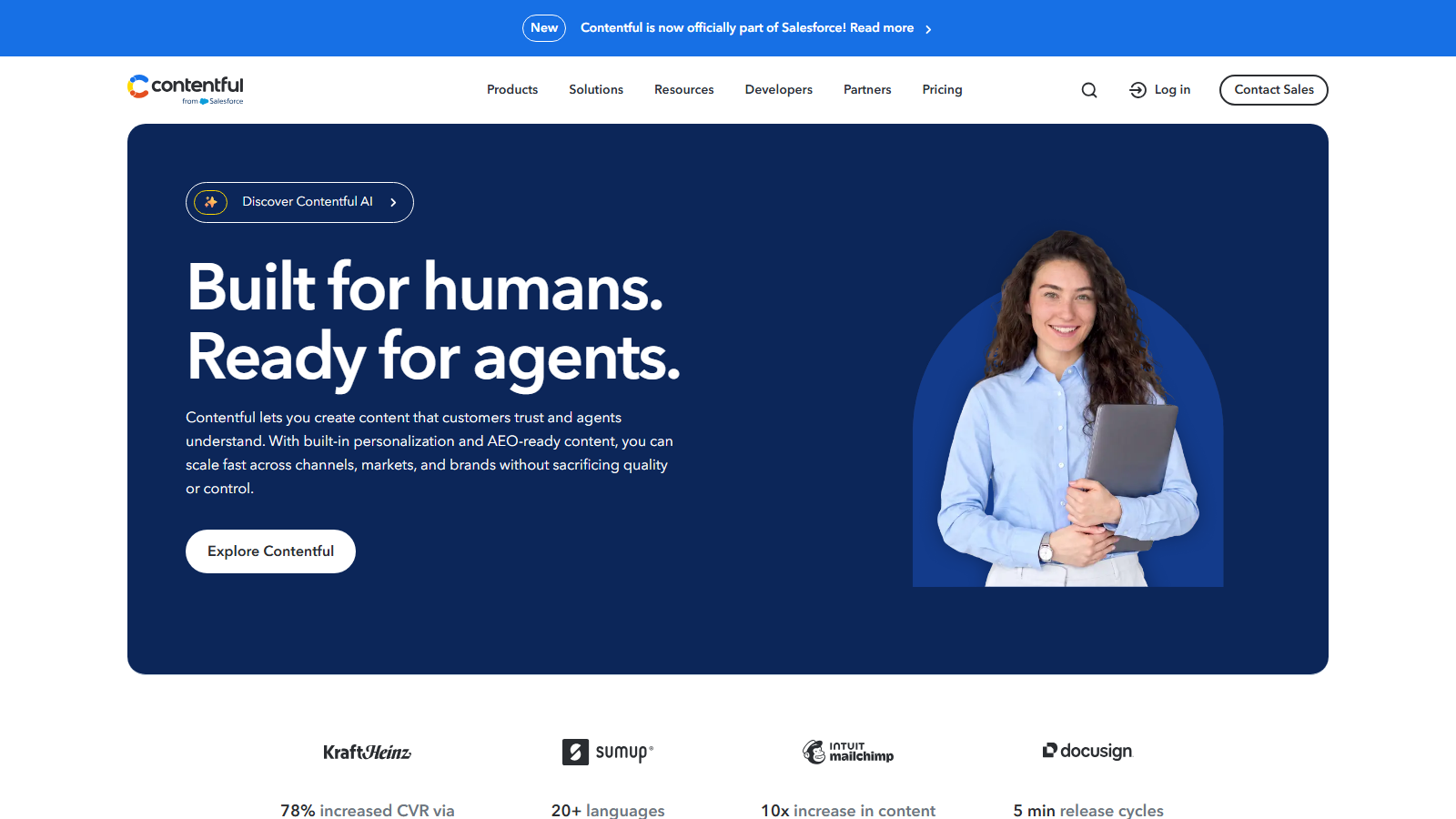
Contentful is the platform most large organisations end up on, and the reasons are institutional rather than technical. It has the compliance paperwork, the SLAs, the governance model, EU data residency on every API, and the professional-services network a procurement process asks for.
The APIs are mature and well documented, and environment aliases let you change a content model on a branch and cut over atomically, which is still the most underrated feature in this category.
Salesforce completed its acquisition of Contentful on 1 September 2026, having announced it on 1 June. The wordmark now reads "Contentful from Salesforce".
Salesforce's own announcement commits to "preserving the composability that developers and digital teams expect from a modern headless platform" and to making Contentful's structured content accessible to Agentforce. It does not commit to Contentful continuing as a standalone product, nor to current pricing, nor to the existing support model. We looked for those commitments specifically and they are not there.
That is a real difference from the other acquisition in this market. When Adobe bought Semrush, Semrush published a customer FAQ saying services, agreements, billing and product access would not change immediately. Contentful buyers have the strategic rationale and the composability line, and nothing addressed to them. Two days in, that is not evidence of anything bad. It is a reason to ask for contractual answers rather than to infer them from a press release.
Our scorecard
Our editorial read across six dimensions, scored 1 to 5. This is our own assessment, not an aggregate of user reviews, and it is deliberately kept out of the page's structured data.
- Content modelling4/5
Mature, well-governed, and localisation is first-class rather than bolted on. Modelled in a UI rather than in your repository.
- Developer experience4/5
Five well-documented APIs, published rate limits, real client libraries and both a remote and a self-hosted MCP server.
- Editor experience3/5
Capable and complete, and carrying a decade of accumulated features. New editors need training in a way they do not with Storyblok.
- Pricing2/5
Free to $300 with nothing between, an $850 space add-on, and enterprise behind a quote. Predictable, not friendly.
- Governance5/5
Roles, workflows, environment aliases, EU data residency and an audit trail somebody will actually read. Best here.
- Ecosystem5/5
A deep app marketplace for a hosted headless platform, and one most agencies have already staffed for.
An editorial read, not an aggregate of user reviews, and deliberately kept out of this page's structured data.
Contentful in their own words
From Contentful's own YouTube channel. Vendor marketing rather than an independent review, included because it is the quickest way to see the product before you sign up.
What you can query
Content Delivery API (CDA)
cdn.contentful.com, or cdn.eu.contentful.com for EU residency
Published content as JSON from a global CDN. The read path for production traffic, and the one your page-render budget is spent against.
GraphQL Content API
graphql.contentful.com. Counts against the CDA rate limit
A generated schema per environment, so a page can request exactly the fields and linked entries it needs in one round trip.
Content Preview API (CPA)
preview.contentful.com. Separate, lower rate limit
The same shape as the CDA, but including drafts. What live preview and editorial review run against.
Content Management API (CMA)
api.contentful.com. 10 requests a second on paid plans
Read-write access to entries, assets, content types, roles and environments. Migrations, imports and the web app all run on it.
Images API
images.ctfassets.net. 100MB and 300 megapixels per image
Resizing, cropping, background colour and format conversion applied through URL parameters, served from the asset CDN.
MCP servers
Remote at mcp.contentful.com/mcp, plus a self-hosted build
Model Context Protocol access so an AI client can read and write content, manage the model and invoke AI Actions without a bespoke integration.
Who Contentful is for
Large content teams with real governance requirements: many locales, many contributors, formal approval chains, EU data residency obligations and an audit trail somebody will actually read. It is also the right answer when the buying decision runs through procurement rather than engineering, because Contentful is the one platform here that has already been through everyone's vendor review.
It is overkill and overpriced for a marketing site with three editors, and the pricing structure makes that decision for you rather than leaving it to taste.
Strengths and limits
What it does well
- Environments and environment aliases let you change a content model on a branch and cut over atomically, which most competitors still do not match.
- Localisation is part of the model rather than a plugin, and it handles field-level translation across many locales without contortions.
- Every API has an EU data residency equivalent host, which turns a procurement blocker into a configuration line.
- Rate limits are published per API and per plan tier, so you can design a caching strategy against real numbers instead of guessing.
- The free tier is genuinely usable for evaluation at 10 users, 100,000 calls and 10,000 records, and it caps rather than bills.
- Both a vendor-run remote MCP server and a self-hosted open-source one, which is more than most of this directory offers.
- A deep app and integration marketplace, and the platform agencies are most likely to already be staffed for.
Where it falls short
- Salesforce has made no public commitment about standalone continuation, pricing or the support model. The composability line in the announcement is about architecture, not about your contract.
- The pricing cliff is still brutal. Free is $0, the next tier is $300, and there is nothing in between.
- Records, content types, locales and spaces are capped per tier, so growth is an upgrade conversation rather than a metered overage.
- SSO sits on Enterprise, which has repeatedly pushed teams onto a quote-only tier for one checkbox they need for compliance.
- A second space on Lite is an $850 monthly add-on, which is nearly three times the plan it attaches to.
- No self-host option at any price, so data residency is configurable and infrastructure control is not.
- The interface carries a decade of features and new editors need training in a way they do not with Storyblok or Sanity.
Contentful pricing
Free is $0 forever: 10 users, 2 roles, 2 locales, 100,000 API calls a month, 50GB of CDN bandwidth and one Starter Space carrying 25 content types, 2 environments and 10,000 records. There are no overages. Usage stops at the cap, which means the free tier cannot generate a surprise invoice and also cannot absorb a traffic spike.
Lite is $300 a month and raises that to 20 users, 3 roles, 3 locales, 1,000,000 API calls and 100GB of bandwidth. Unlike Free it meters: extra API calls are $5 per additional million a month and extra bandwidth is $0.15 per GB. Contentful writes both rates as "USD / EUR", the same figure in either currency, so a euro quote is not a conversion.
The add-on is the part people miss. A second space on Lite is a Lite Space at $850 a month, which buys 50 content types, 4 environments, 50,000 records, up to 5 workflows, 2,000,000 more API calls and 750GB more bandwidth. A team that needs two projects on Lite is therefore looking at $1,150 a month, not $600.
Enterprise is quote-only and shaped by use-case count and space architecture. It is where unlimited API calls, up to 750 spaces, SSO, embargoed assets, localised workflows, uptime SLAs, a customer success manager and dedicated infrastructure live.
Practitioners circulate third-party benchmark data for it, and one r/cms comment puts the median at $86,240 a year for 100 users on Premium Plus, citing vendr. Treat that as a negotiating anchor from a broker's dataset rather than as a Contentful figure, because Contentful publishes none.
Free
$0
Forever, with hard caps rather than overages
- 10 users, 2 roles, 2 locales, 1 space
- 100,000 API calls and 50GB of CDN bandwidth a month
- One Starter Space: 25 content types, 2 environments, 10,000 records
- Usage stops at the cap, so it cannot produce a surprise invoice
Lite
$300 / mo
Overages metered on top
- 20 users, 3 roles, 3 locales, 2 spaces
- 1,000,000 API calls and 100GB of bandwidth a month
- Extra usage at $5 per million calls and $0.15 per GB
- An optional Lite Space is a further $850 a month
Enterprise
Quote only
Shaped by use cases and space architecture
- Custom users, roles and locales, unlimited API calls
- Up to 750 spaces, SLAs, CSM and infosec review
- Dedicated infrastructure can raise the API rate limits
- Where SSO, embargoed assets and localised workflows live
Query example
A minimal fetch against the live API, with credentials read from the environment rather than pasted inline.
curl -s "https://graphql.contentful.com/content/v1/spaces/$SPACE_ID/environments/master" \
  -H "Authorization: Bearer $CDA_TOKEN" \
  -H "Content-Type: application/json" \
  -d '{"query":"{
        blogPostCollection(limit: 3, order: publishedDate_DESC) {
          items { title slug publishedDate
                  author { name }
                  heroImage { url(transform: {width: 1200, format: WEBP}) } }
        }
      }"}'

# One round trip returns the entry, the linked author and a
# transformed image URL. Keep the query body under 8KB and the
# reference chain under 10 levels: both are hard limits.
Limits and quotas
- CDA, including GraphQL, is 55 requests a second on Free and 78 on paid plans.
- CMA is 7 requests a second on Free and 10 on paid plans, which is the real constraint on bulk imports.
- CPA is 14 requests a second on Free and 20 on paid plans.
- Request size is 1MB, GraphQL request size is 8KB, and response size is 7MB.
- Entry size is 2MB and a long text field is capped at 50,000 characters.
- Reference chains resolve 10 levels deep, and a request URI is capped at 7,600 characters.
- Images are capped at 100MB and 300 megapixels, or 9 megapixels for AVIF conversion.
- Spaces per organisation: 1 on Free, 2 on Lite, 750 on other paid plans.
- Environment aliases are limited to master unless the plan includes custom aliases, which allows master plus two.
- Dedicated infrastructure on Enterprise is the only route to customised API rate limits.
Third-party reviews
Scores read from each source on 3 September 2026. We report them as-is and publish no rating of our own.
Read from the source page rather than a search snippet, which reported a different score and count for the same product on the same day.
What developers say on Reddit
Almost every practitioner thread about Contentful is a thread about its price, and the criticism is unusually specific rather than general grumbling. The recurring pattern is not that the platform is bad, it is that a single requirement pushes a team onto a tier priced for a much larger organisation. SSO is named repeatedly as the trigger.
The capability is rarely disputed. Where people defend it, they defend it as a pure content platform and point out that the surrounding marketing tooling has to come from somewhere else, which is a total-cost argument rather than a quality one.
One comment from 2025 has aged into unintentional comedy given who owns the company now, and it is quoted below for that reason as much as any other.
“One client literally told me, "it feels like we're paying Salesforce prices for a CMS." Curious if that's just them venting or if others are feeling the same squeeze”
r/cms on Reddit“I worked for a company that required SSO and it meant going to an enterprise tier even though we didn't need any of the other features it came with. Because of that they priced themselves out of the equation entirely. We went with DatoCMS in the end who were much more accommodating.”
r/cms on Reddit“Contentful feels nice for editors, but the free tier limits can creep up fast.”
r/webdev on Reddit“It's strong as a pure CMS, but since it doesn't include much on the marketing side, you often need extra tools. Sitecore/Adobe are way up in enterprise-budget land. WordPress looks cheap upfront but plugins, security, and upkeep add hidden costs.”
r/cms on Reddit“Here's some of the pricing insights from vendr.com's data ... There's $23,380 spread between the 25th and 75th percentile, that's meaningful savings territory. The fact that some buyers land 23% below the median shows Contentful is definitely negotiable.”
r/cms on Reddit
Verdict
Still the right call when the organisation is big enough that governance, localisation, EU data residency and a signed SLA are the actual requirements, and when $300 a month is not the deciding number. In that context nothing here is obviously better, and the ecosystem advantage is real.
For everyone else the pricing structure decides it. A five-person team that outgrows the free tier is choosing between $300 a month at Contentful and roughly $75 at Sanity or €99 at Storyblok for a comparable job, and a team that needs two spaces on Lite is at $1,150 before anyone mentions Enterprise.
On the Salesforce question, hold your judgement and get it in writing. Two days after close there is nothing to report and no promise to hold anyone to, which is itself the useful fact: if you are signing a multi-year deal this quarter, ask for the continuity terms explicitly rather than reading them into a press release that does not contain them.
Contentful FAQ
How much does Contentful cost?
Free is $0 with 10 users, 100,000 API calls and 10,000 records. The next tier, Lite, is $300 a month. Enterprise is quote-only. There is nothing between free and $300, which is still the single most important fact about Contentful's pricing, though it is no longer the only one.Does Contentful charge for overages?
On paid plans, yes. Lite meters extra usage at $5 per additional million API calls a month and $0.15 per additional GB of asset bandwidth. The Free plan works differently: it uses hard caps, so usage stops instead of billing.What does a second space cost on Lite?
A Lite Space is $850 a month on top of the $300 plan, so two projects on Lite is $1,150 rather than $600. It buys 50 content types, 4 environments, 50,000 records, up to five workflows, two million more API calls and 750GB more bandwidth.What are the Contentful API rate limits?
The Content Delivery API, including GraphQL, allows 55 requests a second on Free and 78 on paid plans. The Content Management API allows 7 and 10, which is the real constraint on bulk imports. The Content Preview API allows 14 and 20. Only Enterprise plans on dedicated infrastructure can raise these.What changed when Salesforce bought Contentful?
Ownership, so far. The deal was announced on 1 June 2026 and completed on 1 September 2026, and the wordmark now reads "Contentful from Salesforce". Salesforce committed to preserving composability and to making the content accessible to Agentforce, but published no commitment about standalone continuation, pricing or support. Ask for continuity terms in your contract rather than inferring them.Does Contentful support EU data residency?
Yes, and it is a genuine differentiator here. Every API has an EU host: cdn.eu.contentful.com, api.eu.contentful.com, graphql.eu.contentful.com and images.eu.ctfassets.net. For a European organisation that turns a procurement blocker into a configuration line.Does Contentful have an MCP server?
Two, both from the vendor. A remote hosted server at mcp.contentful.com/mcp is generally available, and there is an open-source local server you can run yourself. They expose the same core toolset and differ in how clients authenticate, and either way an assistant gets read and write access to content with no custom connector.Contentful or Sanity?
Contentful for governance, localisation at scale, EU residency and procurement. Sanity for developer control, a version-controlled content model and much cheaper entry at small headcount. Below twenty seats Sanity is cheaper. At twenty the two meet at $300 a month, and Lite is capped there, so above twenty users it is Sanity Growth against a Contentful Enterprise quote.
Other platforms worth a look
This is an independent review. We have no affiliate relationship with Contentful, earn nothing if you sign up, and no vendor pays for placement in the directory. Prices were read from the vendor's own pages in September 2026 and change without notice.