
Tavily API review
Best for crawl and extract pipelines
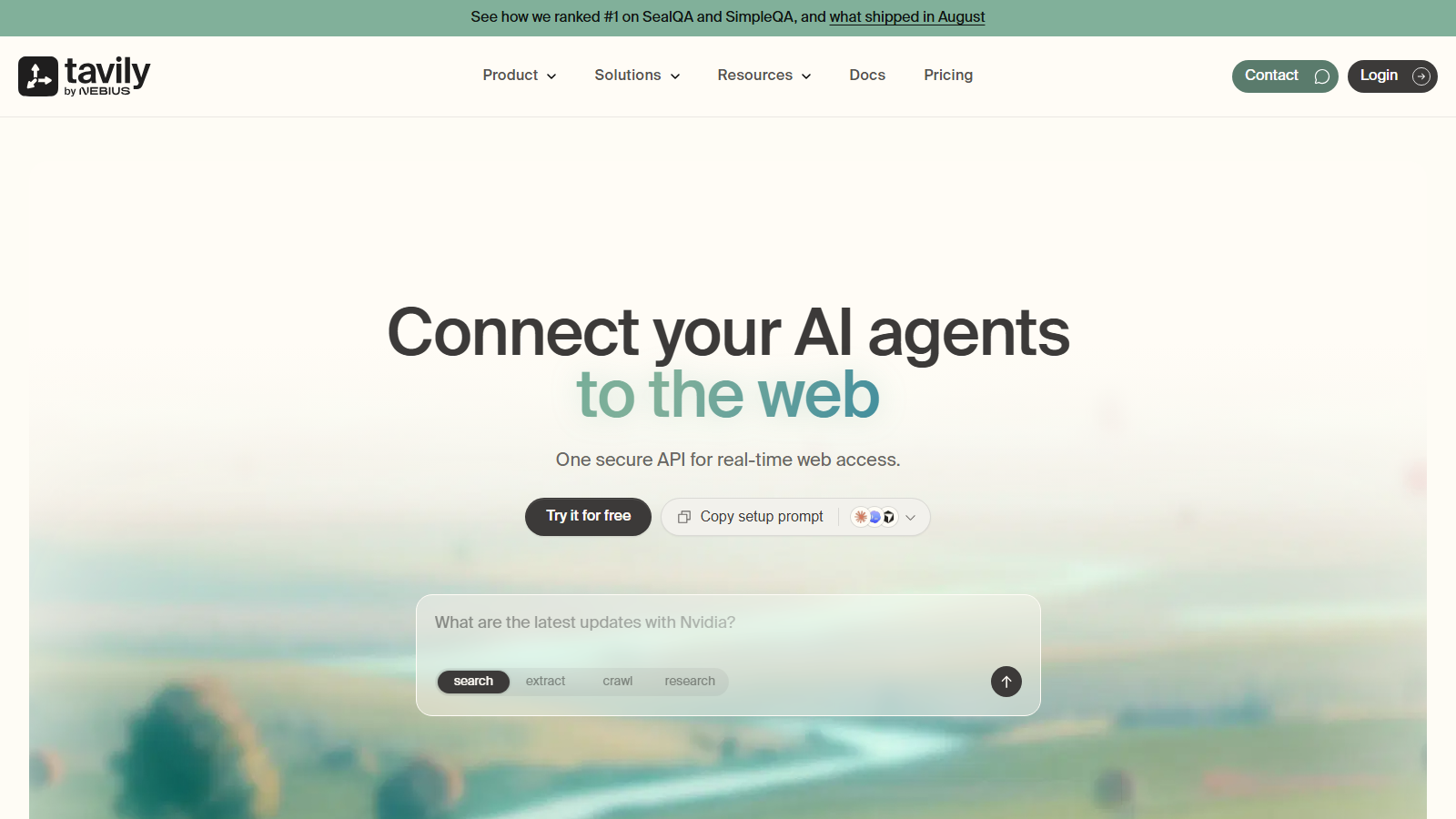
Tavily is a web access API built for AI agents. Five endpoints cover the whole retrieval job: search the web, extract known pages, map a site's URLs, crawl a site, and run multi-step research that returns a cited report. Page content comes back as cleaned text or markdown a model can read directly, which removes the fetch-and-strip stage that a plain search API leaves to you.
What it does not return is a search engine's results page. Tavily's documentation describes aggregating up to 20 sources per call and ranking them with its own relevance score, and its country parameter boosts results from that country rather than simulating a searcher's location. It cannot tell you where a page ranks on Google, which is the job of Serper or SerpApi. It can read the pages that do rank.
Tavily pricing is where buyers go wrong, because it sells credits and a credit is not a request. One credit buys a basic search, five extracted pages or ten mapped URLs, while a single pro Research request can consume 250. The $0.008 pay-as-you-go rate therefore says little until you know which endpoints your workload calls, which is why each one is priced separately below.
Our scorecard
Our editorial read across six dimensions, scored 1 to 5. This is our own assessment, not an aggregate of user reviews, and it is deliberately kept out of the page's structured data.
- Data coverage3/5
Open-web search plus extraction, mapping and crawling. No ranking positions, no keyword or link data, and no public statement of which index sits underneath.
- Pricing3/5
Per-endpoint credit rules are published in full, but $8 per 1,000 basic searches on pay as you go is a premium for anyone who only needed links.
- Documentation5/5
Credit rules for every endpoint and depth, an OpenAPI spec, a dated changelog and a Markdown copy of every page.
- Ease of integration5/5
Keyless calls for Search and Extract, Python and JavaScript SDKs, a CLI and a remote MCP server with OAuth.
- Reliability4/5
Documented 429 handling with a retry-after header, and failed extractions cost nothing. Uptime SLAs are an Enterprise feature.
- Support3/5
Email on self-serve plans. A Slack channel, account manager and SLAs are reserved for Enterprise.
An editorial read, not an aggregate of user reviews, and deliberately kept out of this page's structured data.
Tavily API in their own words
From Tavily API's own YouTube channel. Vendor marketing rather than an independent review, included because it is the quickest way to see the product before you sign up.
What you can pull
Search
1 credit (basic, fast, ultra-fast), 2 credits (advanced)
Up to 20 relevance-scored results with chunked page text, and optionally raw content, images and an LLM-written answer. Topics are general, news or finance
Extract
1 credit per 5 successful URLs, 2 at advanced depth
Clean markdown or text from up to 20 URLs a call, with advanced depth pulling tables and embedded content
Map
1 credit per 10 pages, 2 with instructions
A site's URL list, discovered by following links out from a root URL and filterable by path and domain patterns
Crawl
Mapping cost plus extraction cost
Map and Extract in one job: traverses a site up to five levels deep and returns the content of every page it keeps
Research
4 to 110 credits (mini), 15 to 250 (pro)
An asynchronous cited report, or JSON matching a schema you supply, from mini or pro models with optional streaming
Usage and Logs
No credit cost documented
Credit consumption per key and per-request logs filterable by endpoint. Logs are a paid-plan feature
Keyless access
Free
Search and Extract with no account or API key, using the same response schema as a keyed call, under a rate limit
x402 advanced search
$0.01 per request
Advanced-depth search paid per request in USDC on the Base network, with no API key or account
Who Tavily API is for
Teams building agents or content pipelines that need the text of web pages rather than a list of links. A research assistant grounding answers in current sources, a brief generator that reads the articles already ranking, or a job that maps a competitor's blog and extracts every post are squarely what the five endpoints were designed for. The MCP server puts the same tools inside Claude or Cursor.
For an SEO team it is the reading half of a workflow, never the measuring half. Positions, search volumes, SERP features and backlinks belong with a SERP or SEO data provider, and pairing the two is common. Agent fleets running many parallel jobs should test the limits early: 1,000 requests a minute on a production key is generous, while Crawl stays at 100.
Strengths and limits
What it does well
- Every endpoint returns cleaned, chunked content, so there is no scraping or HTML-stripping stage to build and maintain.
- Map and Crawl turn a domain into a URL list or a content dump in one call, which is directly useful for content audits and competitor sweeps.
- Failed URL extractions and failed map requests are not charged, according to the credit documentation.
- Search and Extract work keyless with the same response schema as a keyed call, so an agent can be wired up before anyone creates an account.
- Tavily maintains its own remote MCP server with OAuth, plus a CLI that installs agent skills into coding tools.
- Credit costs are published for every endpoint and depth, and include_usage returns what each individual call consumed.
- Plan unit rates fall to $0.005 a credit on Growth, and x402 sells advanced search at $0.01 a request with no account at all.
Where it falls short
- A credit is not a request. Research can take up to 250 credits in one call, so monthly spend is hard to forecast without logging usage per endpoint.
- No ranking positions, SERP features, search volumes or backlinks, and the country setting only boosts results from that country.
- The documentation we read does not say which index or engines supply the results, which matters if you must explain provenance.
- Free keys are development keys at 100 requests a minute. Production limits need a paid plan or pay as you go.
- At $8 per 1,000 basic searches on pay as you go, each query costs several times a Google SERP API call, before counting the page content it adds.
- Plan allowances reset on the first of each calendar month, and without pay as you go enabled, requests stop when credits run out.
- Crawl is held to 100 requests a minute and Research task creation to 20, whatever the plan.
Tavily API pricing
Tavily bills in credits, bought three ways. The free Researcher plan includes 1,000 a month. Pay as you go charges $0.008 per credit. Monthly plans sell bigger allowances at lower unit rates: Project is $30 for 4,000 credits, Bootstrap $100 for 15,000, Startup $220 for 38,000 and Growth $500 for 100,000, running from $0.0075 down to $0.005 a credit. Enterprise is quoted.
The rate card is the easy half. A basic, fast or ultra-fast search takes 1 credit and advanced takes 2. Extraction takes 1 credit per 5 successful URLs, or 2 at advanced depth. Mapping takes 1 credit per 10 pages, doubling when you add natural-language instructions. A crawl pays for both, and a Research request takes anywhere from 4 to 250 credits.
Translated at pay-as-you-go rates, 1,000 basic searches cost $8 and 1,000 advanced searches $16, while 1,000 extracted pages cost $1.60 and 1,000 mapped URLs $0.80. On Growth the same 1,000 basic searches cost $5. A pro Research request lands between $0.12 and $2.00, which makes it the line most worth capping in application code.
Two billing mechanics matter as much as the unit price. Allowances reset on the first of each calendar month whatever your billing date, and once credits run out, requests stop unless pay as you go is switched on. Production keys, with ten times the development rate limit, are only issued to accounts with a paid plan or pay as you go enabled.
Researcher
$0
1,000 credits a month, no card
- Development key, capped at 100 requests a minute
- Every endpoint, including Crawl and Research
- Allowance resets on the 1st of each month
- Enough for 1,000 basic searches or 10,000 mapped URLs
Pay as you go
$0.008 / credit
Charged on usage, cancel anytime
- Unlocks production keys at 1,000 requests a minute
- $8 per 1,000 basic searches, $16 per 1,000 advanced
- Also bills usage beyond a plan's allowance
- A dashboard spend limit returns error 433 when reached
Project to Growth
$30 to $500 / mo
4,000 to 100,000 credits a month
- Bootstrap $100 for 15,000, Startup $220 for 38,000
- Unit rate falls from $0.0075 to $0.005 a credit
- Upgrades prorated, downgrades at the next cycle
- Enterprise quoted separately, with SLAs
Request example
A minimal call against the live endpoint, with credentials read from the environment rather than pasted inline.
# 1. An advanced search. include_usage makes the response report
#    what the call consumed: 2 credits at this depth.
curl -s -X POST "https://api.tavily.com/search" \
  -H "Authorization: Bearer $TAVILY_API_KEY" \
  -H "Content-Type: application/json" \
  -d '{
        "query": "best crm for small business",
        "search_depth": "advanced",
        "chunks_per_source": 3,
        "max_results": 10,
        "country": "united states",
        "include_usage": true
      }'

# 2. Map a competitor's blog. 1 credit per 10 URLs returned, so a
#    200-URL map costs up to 20 credits. Add "instructions" and the
#    same map costs double.
curl -s -X POST "https://api.tavily.com/map" \
  -H "Authorization: Bearer $TAVILY_API_KEY" \
  -H "Content-Type: application/json" \
  -d '{
        "url": "https://www.example.com",
        "max_depth": 2,
        "limit": 200,
        "select_paths": ["/blog/.*"],
        "include_usage": true
      }'
Rate limits and quotas
- Development keys: 100 requests a minute. Production keys: 1,000 a minute, available only with a paid plan or pay as you go.
- Crawl: 100 requests a minute on both key types. Research task creation: 20 a minute. Usage endpoint: 10 requests per 10 minutes.
- Exceeding a rate limit returns HTTP 429 with a retry-after header.
- Search returns at most 20 results per call; Extract accepts at most 20 URLs per call.
- Map and Crawl: depth 1 to 5, up to 500 links followed per page, a default limit of 50 URLs, and a timeout of 10 to 150 seconds.
- Search costs 1 credit at basic, fast or ultra-fast depth and 2 at advanced; auto_parameters may choose advanced for you.
- Extract costs 1 credit per 5 successful URLs (2 advanced); Map costs 1 per 10 pages (2 with instructions); Crawl costs both.
- Research costs 4 to 110 credits a request with the mini model and 15 to 250 with pro.
- Monthly credits reset on the first day of each month, regardless of billing date.
- A plan limit breach returns error 432; a pay-as-you-go spend limit breach returns 433.
What practitioners say on Reddit
Tavily's reputation lives in AI developer communities rather than SEO ones. In r/Rag and r/AI_Agents it comes up as an easy first search API for LangChain and RAG builds, and the favourable comments are about exactly that experience: quick to implement, sensible sources, and output a model can use without further cleaning.
The complaints cluster around control and scale. Developers report date filters letting old articles through, results that vary by query type, and friction once many agents search in parallel. The Search reference now documents a filter_by_published_date setting that drops out-of-window and undated results; we could not date when it arrived, so test it against your own queries rather than trusting either side.
Discount the loudest threads. Recent discussions titled as searches for Tavily alternatives are crowded with founders of competing search APIs pitching their own products, and none of those comments is quoted here.
“I like Tavily, easy to implement and super accurate retrieval. Others are ok but Tavily is just stronger imo”
r/Rag on Reddit“The issue i see with Tavily is that it doesn't respect the time range filter that i apply”
r/Rag on Reddit“Tavily works fine in isolation but once you're doing multi-step agent workflows the lack of async-friendly batching becomes heck noticeable.”
r/Agent_AI on Reddit“I've found Tavily to underperform and decided to go with Google Search (GCP)”
r/Rag on Reddit
Verdict
A strong reading layer for agents and no use as a measuring one. Tavily's five endpoints cover search, page extraction and whole-site crawling with cleaned output. Add keyless trial calls and Tavily's own MCP server, and handing a model current web content takes an afternoon rather than a scraping project.
Budget it by endpoint, never by the headline rate. Map and Extract are cheap per page, basic search runs $5 to $8 per thousand depending on plan, and Research is the line that surprises people at up to 250 credits a call. Switch on include_usage in development, multiply by your real call mix, and only then choose between pay as you go and a plan.
Keep ranking questions elsewhere. Tavily does not reproduce Google's results or return positions, so pair it with a SERP API when a workflow needs both the ranking and the page. On vendor risk, Nebius announced the acquisition in February 2026 and described it as done by May, with Tavily keeping its brand and its founder.
Tavily API FAQ
How is Tavily priced?
Through credits. The free Researcher plan includes 1,000 a month, pay as you go costs $0.008 a credit, and monthly plans run from Project at $30 for 4,000 credits to Growth at $500 for 100,000, or $0.005 each. Every endpoint consumes credits at its own rate, so the right plan depends on which endpoints you call as much as on how often.What comes with a free Tavily key?
1,000 credits a month with no card, access to every endpoint, and a development key limited to 100 requests a minute. Production keys, at 1,000 a minute, require a paid plan or pay as you go switched on. Search and Extract can also be called keyless, with no account at all, under a rate limit the documentation does not quantify.What does a single Tavily search cost?
One credit at basic, fast or ultra-fast depth and two at advanced. In money that is $0.008 or $0.016 per search on pay as you go, $0.0075 or $0.015 on Project, and $0.005 or $0.01 on Growth. Watch auto_parameters: it can switch a query to advanced depth by itself, doubling the cost unless you set the depth explicitly.How many credits do Tavily Extract, Map and Crawl use?
Extract charges 1 credit per 5 successful URLs, or 2 at advanced depth. Map charges 1 credit per 10 pages returned, or 2 once you add natural-language instructions. Crawl charges both, so 10 pages at basic depth cost 3 credits and at advanced depth 5. Failed extractions and failed maps are not charged at all.Why can one Tavily Research call use 250 credits?
Research is an agent rather than a lookup: it plans searches, reads sources and writes a cited report, so its cost scales with the work done. Tavily bounds each request at 4 to 110 credits on the mini model and 15 to 250 on pro. At pay-as-you-go rates that is up to $0.88 and $2.00 a call, so budget for the ceiling before exposing it to users.Can Tavily replace a Google SERP API for SEO?
For measurement, no. Tavily returns its own relevance-ranked selection of sources rather than Google's results page, so there are no positions, ads, local packs or People Also Ask boxes to track. It earns a place in SEO work as a reader: mapping a competitor's site, extracting the articles that rank, or grounding a content brief in current sources.Who owns Tavily?
Nebius, the Amsterdam-based AI cloud company listed on Nasdaq. It announced an agreement to acquire Tavily on 10 February 2026, and its own blog stated on 20 May 2026 that the acquisition had happened. Nebius said Tavily would keep its brand and its founder and CEO, Rotem Weiss, and its announcement did not disclose the price.Tavily or Exa for an SEO content team?
Tavily when the work starts from sites you already know: a 100-page crawl at basic depth takes 30 credits, about $0.24 on pay as you go. Exa when the work is discovery, since it searches its own index and charges $7 per 1,000 searches with content for ten results included. Both return page text, and neither returns Google rankings.
Other providers worth a look
This is an independent review. We have no affiliate relationship with Tavily API, earn nothing if you sign up, and no provider pays for placement in the directory. Prices were read from the vendor's own pages in September 2026 and change without notice.