
Oxylabs SERP Scraper API review
Best structured SERP parsing
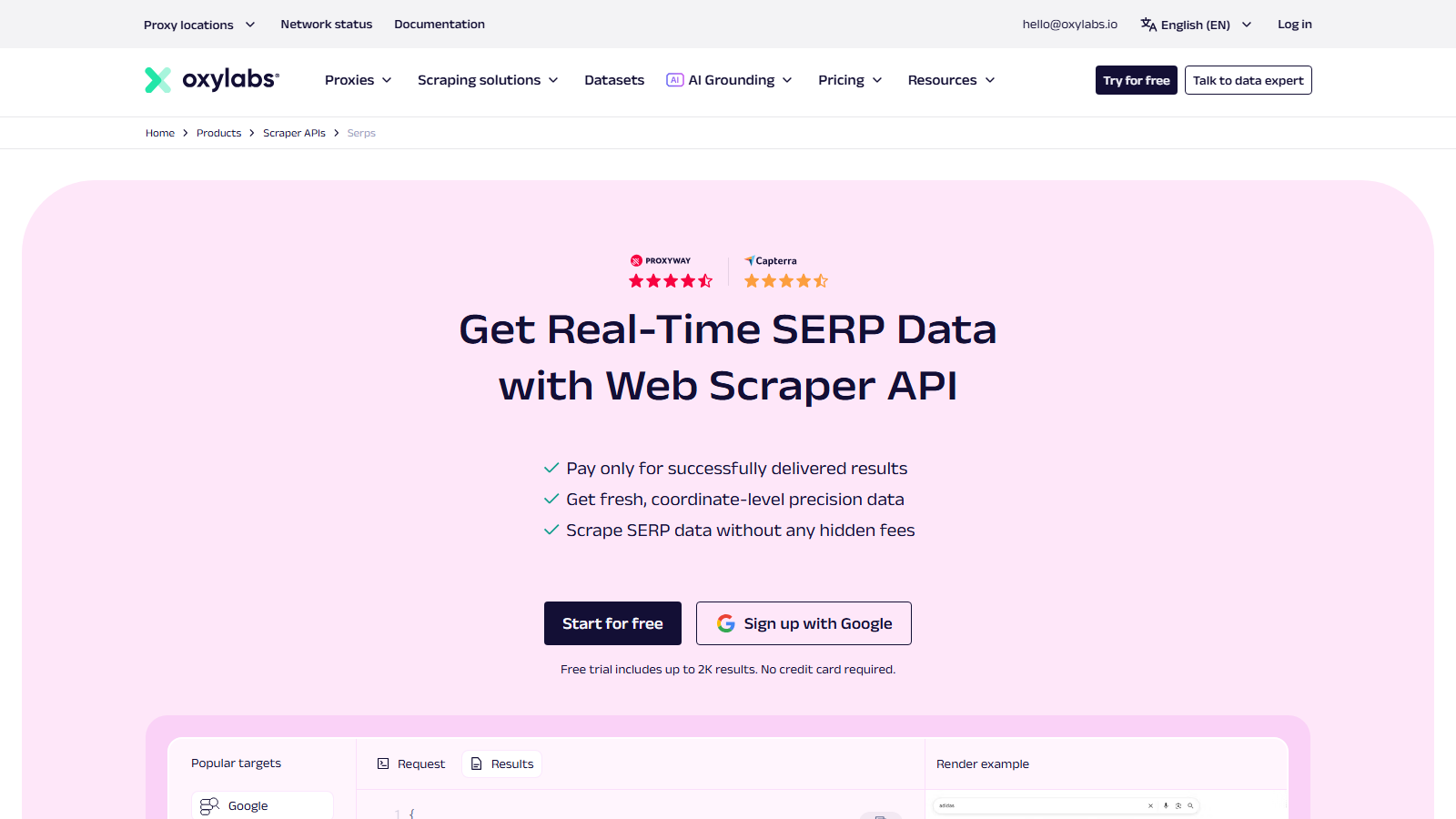
Oxylabs sells structured scraping on a monthly plan, and the SERP product now sits inside its broader Web Scraper API rather than standing alone. You send a target, it handles the proxies, the retries and the parsing, and you get structured results back. The engineering is solid and unremarkable, which is the right thing for infrastructure.
What makes it worth its own page is the pricing model, which is unique in this directory. Oxylabs charges a different rate depending on which site you are scraping. On the entry plan, Amazon results cost $0.50 per thousand, Google costs $1.00, and anything else costs $1.15. Add JavaScript rendering and the rate becomes $1.35 regardless of target.
That structure rewards knowing your own workload precisely, and it punishes reading the headline. "From $0.50 per 1,000" is a real number and it is the Amazon rate. If you are here for search results, your rate is double that, and if your target is not one of the named sites it is higher again. Nothing about that is hidden, but nothing about it is on the marketing page either.
Our scorecard
Our editorial read across six dimensions, scored 1 to 5. This is our own assessment, not an aggregate of user reviews, and it is deliberately kept out of the page's structured data.
- Data coverage4/5
Search plus a broad set of e-commerce and general targets, with structured parsing rather than raw HTML.
- Pricing3/5
Transparent per target and genuinely fiddly to model. The headline rate is not the SERP rate.
- Documentation4/5
Thorough developer docs with per-target parameter reference. Less playful than SerpApi's, equally complete.
- Ease of integration4/5
Basic auth and a JSON payload. Nothing surprising, which is what you want here.
- Reliability4/5
Rate limits rise with tier, from 10 to 50 requests a second and beyond. Enterprise-grade retry handling.
- Support5/5
24/7 support and a dedicated account manager on every paid tier, including the $49 entry plan.
An editorial read, not an aggregate of user reviews, and deliberately kept out of this page's structured data.
What you can pull
Google SERP
$1.00 per 1,000 results on Micro
Organic results, ads, local packs and SERP features as structured JSON, with locale and device parameters
Amazon
$0.50 per 1,000 results on Micro
Product listings, pricing, reviews and search results, priced at half the Google rate and clearly the volume target
Other targets
$1.15 per 1,000 results on Micro
Any other supported site through the same interface, parsed where a dedicated parser exists and raw where it does not
JavaScript rendering
$1.35 per 1,000 results on Micro
Full browser rendering for targets that will not yield to a plain request, applied as a rate rather than a toggle
Media download
$3 per GB on Micro, $2.50 on Starter
Images and other binary assets retrieved through the same pipeline, billed by volume rather than by result
AI-oriented search
Priced separately from Web Scraper API
A separate, faster product returning the top ten organic results in milliseconds, aimed at agent workflows rather than reporting
Who Oxylabs SERP Scraper API is for
Teams with a mixed scraping workload where search is one target among several, particularly if e-commerce is in the mix. The per-target pricing is a genuine advantage if a large share of your volume is Amazon, and the structured parsers mean you are not maintaining extraction logic for each site yourself.
It is a poor fit for pure Google SERP work at volume. At $1.00 per thousand you are paying roughly what Bright Data charges without the unlimited concurrency, and many times what a metered SERP specialist charges. The model rewards breadth of target, not depth on one.
Strengths and limits
What it does well
- Prices by target site, which genuinely saves money if your volume skews to the cheaper sites.
- Structured parsers per target, so you get JSON rather than HTML and do not maintain extraction logic yourself.
- 24/7 support and a dedicated account manager on every paid tier, including the $49 entry plan, which is unusual at that price.
- Rate limits scale sensibly, from 10 requests a second on the trial to 50 on Micro and upward.
- A free trial of 2,000 results with no card, which is enough to test parse quality against your actual targets.
- Rates fall across every dimension as tiers rise, including media download, rather than only the headline number improving.
- A separate low-latency search product aimed at AI agent workflows, returning top-ten organic results in milliseconds.
- Top-up capacity on the entry plan, so exceeding an allowance does not immediately force a tier change.
Where it falls short
- THE HEADLINE RATE IS THE AMAZON RATE. "From $0.50 per 1,000" is not what a SERP costs. Google is $1.00 on the entry plan and other targets are $1.15.
- JavaScript rendering is a different, higher rate rather than an option, so a target that needs it costs $1.35 per thousand at entry.
- It is a monthly subscription with a results allowance, so irregular volume either wastes the allowance or needs a top-up.
- For plain Google SERPs it is expensive: many times a metered specialist's rate for the same rows.
- No unlimited concurrency, unlike Bright Data at a comparable price, so large batches are bounded by the tier's rate limit.
- The SERP product has been folded into the broader Web Scraper API, so the pricing page you reach from the SERP URL is titled for the wider product and takes a moment to read correctly.
- No legal indemnity, unlike SerpApi's higher tiers.
- Public practitioner discussion is very thin, since r/webscraping deletes threads about paid scraping vendors.
Oxylabs SERP Scraper API pricing
A monthly subscription with a results allowance, and a per-result rate that depends on what you scrape. Micro is $49 a month for up to 98,000 results. Starter is $99 for up to 220,000. A free trial gives 2,000 results with no card.
The rate card is the part to read twice. On Micro, Amazon results cost $0.50 per thousand, Google costs $1.00, and any other target costs $1.15. Add JavaScript rendering and everything becomes $1.35. On Starter each of those falls slightly, to $0.45, $0.90, $1.10 and $1.30, and media download drops from $3 to $2.50 per GB.
So the honest way to quote Oxylabs for SEO work is $1.00 per thousand at entry, not $0.50. The cheaper number is the Amazon rate, and it exists because e-commerce scraping is the higher-volume business. If your workload is genuinely mixed, the per-target model saves real money; if it is Google only, you are on the higher of the two rates and comparing badly against a metered specialist.
One useful feature at the entry tier: top-ups of up to $249 mean exceeding your allowance does not force an immediate upgrade. And VAT may be added to the monthly figure depending on where you are, which the page notes but the plan cards do not include.
Free trial
$0
Up to 2,000 results
- No credit card required
- Rate limited to 10 requests per second
- Enough to test parsing quality on your real targets
- 24/7 support and an account manager even here
Micro
$49 / mo
Up to 98,000 results
- Google $1.00, Amazon $0.50, other $1.15 per 1,000
- With JavaScript rendering: $1.35 per 1,000
- 50 requests per second, top up to $249
- Media download $3 per GB
Starter
$99 / mo
Up to 220,000 results
- Google $0.90, Amazon $0.45, other $1.10 per 1,000
- With JavaScript rendering: $1.30 per 1,000
- Media download drops to $2.50 per GB
- Higher tiers and Enterprise continue the same curve
Request example
A minimal call against the live endpoint, with credentials read from the environment rather than pasted inline.
curl -s -X POST "https://realtime.oxylabs.io/v1/queries" \
  -u "$OXYLABS_USER:$OXYLABS_PASS" \
  -H "Content-Type: application/json" \
  -d '{
        "source": "google_search",
        "query": "best crm for small business",
        "geo_location": "Austin,Texas,United States",
        "parse": true
      }'

# "source" is the thing that decides your price, not just your
# schema: google_search bills at the Google rate, amazon_search at
# half of it, and an unlisted target at the "other" rate.
#
# "parse": true returns structured JSON. Adding render for a
# JavaScript target moves you to the higher rate again.
Rate limits and quotas
- Free trial: up to 2,000 results, 10 requests per second, no card.
- Micro at $49/mo: up to 98,000 results, 50 requests per second, top up to $249.
- Starter at $99/mo: up to 220,000 results.
- Micro rates per 1,000 results: Amazon $0.50, Google $1.00, other $1.15, with JavaScript $1.35.
- Starter rates per 1,000 results: Amazon $0.45, Google $0.90, other $1.10, with JavaScript $1.30.
- Media download: $3 per GB on Micro, $2.50 per GB on Starter.
- Rates quoted are for SUCCESSFUL results.
- VAT may apply on top of the listed monthly price.
What practitioners say on Reddit
A targeted sweep across the SEO and scraping subreddits returned no usable practitioner discussion of Oxylabs, and the explanation is structural rather than a research failure. r/webscraping, where this conversation would naturally happen, deletes posts about paid scraping products so the subreddit does not fill with proxy vendors' marketing. The single Oxylabs-versus-Bright-Data comparison thread we located had been deleted by moderators on exactly that ground.
That moderation note is quoted below because it is genuinely informative about this whole product category: the moderators point out that the best provider depends so heavily on your task and your target that a general comparison cannot produce a meaningful answer. That is also good buying advice.
The removed thread did contain an unsourced claim about Oxylabs' stability. We have not repeated it. One anonymous impression in a deleted post is not evidence, and presenting it as sentiment would be worse than reporting nothing.
“We're sorry to let you know that discussing paid vendor tooling or services is generally discouraged, and as such your post has been removed. This includes tools with a free trial or those operating on a freemium model.”
r/webscraping on Reddit“the best proxy provider is dependant on your task & the site you are scraping, so it varies too wildly between use cases for this poll to provide any meaningful outcome”
r/webscraping on Reddit“Well the big question is what are you trying to scrape? [...] For more complicated scrapes with sites that REALLY don't want you to grab their data, you would potentially need to upgrade”
r/webscraping on Reddit
Verdict
Oxylabs is the right answer for a mixed scraping workload with good support expectations, and the wrong answer for Google-only volume. If a meaningful share of your requests hit e-commerce targets, the per-target rate card genuinely reduces the bill, and the structured parsers save you maintaining extraction logic per site.
Price it against your own target mix rather than the headline. "From $0.50 per 1,000" is the Amazon rate; SERP work is $1.00 at entry and $1.15 for anything unlisted, and JavaScript rendering moves everything to $1.35. Work out the weighted average across your actual targets before comparing anything.
The unusual strength at this price is the human one. 24/7 support and a named account manager on a $49 plan is not something Bright Data, Serper or DataForSEO offer at that level, and for a team without deep scraping expertise that is worth more than a slightly better rate. For pure SERP volume at scale, a metered specialist remains several times cheaper.
Oxylabs SERP Scraper API FAQ
How much does Oxylabs cost for SERP data?
$1.00 per 1,000 Google results on the $49 Micro plan, falling to $0.90 on the $99 Starter plan. The advertised "from $0.50" is the Amazon rate, not the search rate, so budget from $1.00 if search is what you came for.Why does the price depend on the site?
Oxylabs prices by target site in dollars, where ScraperAPI does something similar through credit multipliers. On Micro, Amazon is $0.50 per 1,000 results, Google $1.00 and any other target $1.15. Different sites cost different amounts to collect reliably, and Oxylabs passes that through rather than averaging it into one rate.Does JavaScript rendering cost extra?
Yes, and it is a rate rather than a toggle. Any result requiring rendering is billed at $1.35 per 1,000 on Micro and $1.30 on Starter, regardless of target. If your targets are JavaScript-heavy, that is your real rate and it should be the number you compare.What is the free trial?
Up to 2,000 results with no credit card, rate limited to 10 requests a second. That is enough to test parse quality against your actual targets, which matters more here than raw volume because the value is in the structured parsers rather than in the raw fetch.What are the Oxylabs rate limits?
10 requests a second on the free trial and 50 on the Micro plan, rising with tier. There is no unlimited-concurrency option, which is a real difference from Bright Data at a comparable per-result price if your workload is large batches rather than steady throughput.Is support really included at $49?
Yes, 24/7 support and a dedicated account manager appear on the entry plan and even on the free trial. At that price it is genuinely unusual, and for a team without in-house scraping expertise it can be worth more than a slightly cheaper per-result rate elsewhere.What happens if I exceed my allowance?
The Micro plan allows top-ups of up to $249, so going over does not immediately force a tier change. That is a more forgiving shape than a hard cap, though it still means a subscription with an allowance rather than genuine pay as you go.Oxylabs or Bright Data?
Bright Data for unlimited concurrency, city-level residential geotargeting and billing only for successes. Oxylabs for per-target pricing that rewards a mixed workload, structured parsers, and 24/7 support with an account manager from $49. On plain Google SERPs the two are comparably priced, and both are far above a metered specialist.
Other providers worth a look
This is an independent review. We have no affiliate relationship with Oxylabs SERP Scraper API, earn nothing if you sign up, and no provider pays for placement in the directory. Prices were read from the vendor's own pages in September 2026 and change without notice.