
ScraperAPI review
Best for page-heavy scraping
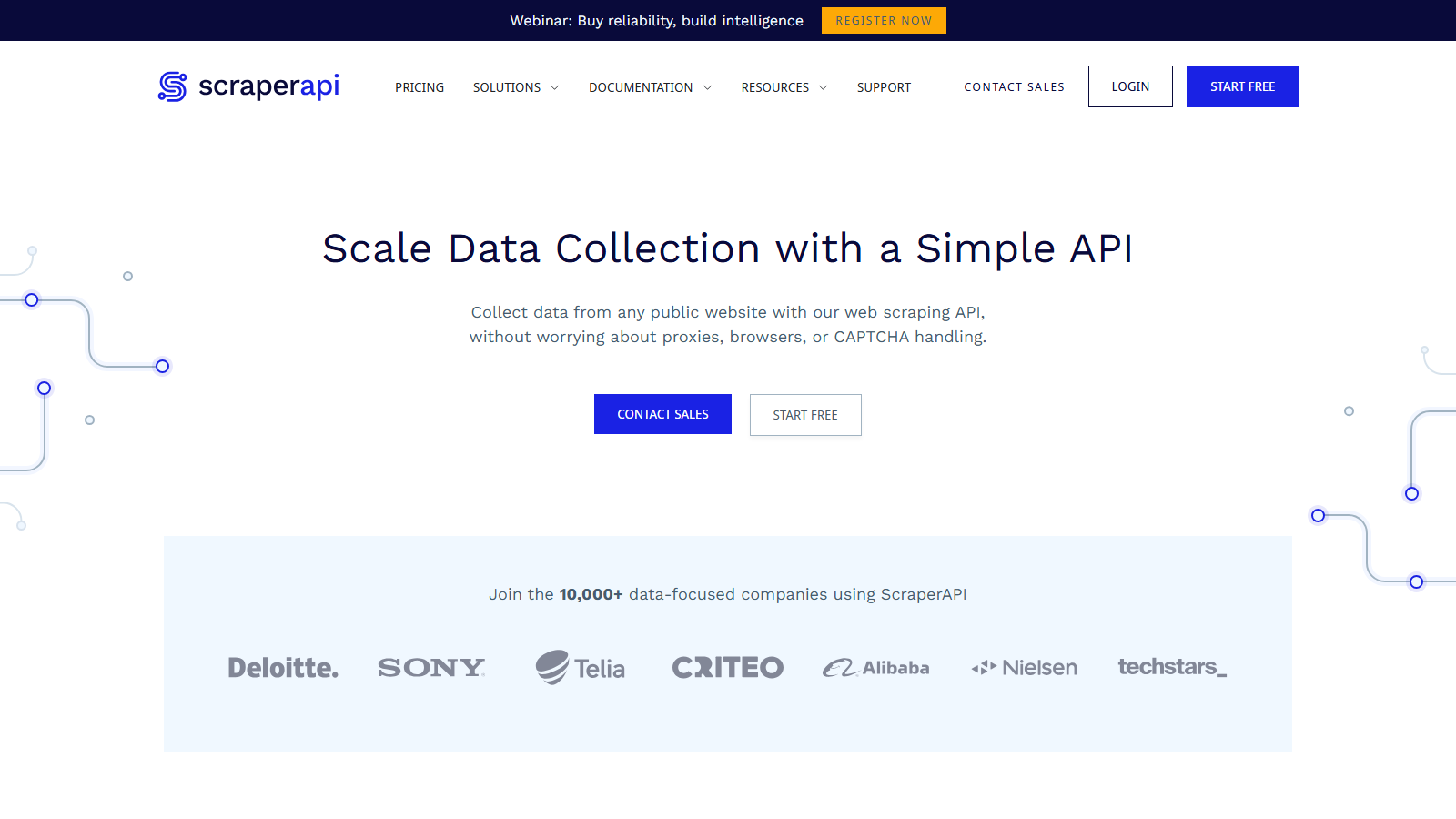
ScraperAPI is an unblocking and scraping API, owned since August 2020 by the software portfolio company saas.group. Send it a URL or a query for a structured endpoint, and it rotates proxies, handles blocks and retries for up to a minute before returning HTML or parsed JSON. The structured side covers Google Search, News, Jobs, Shopping and Maps, several marketplaces and, since July 2026, AI answer engines.
What a request costs depends on where it goes. An ordinary page is 1 credit. Amazon, Walmart and eBay are 5. Every request to Google or Bing, on any of their subdomains, is 25, and a site behind Cloudflare, DataDome or PerimeterX adds 10 for the bypass. Rendering and premium proxies stack on top of that. A plan's credit allowance is a page count, not a search count.
Do that division before reading the ScraperAPI pricing table. The $49 Hobby plan holds 100,000 credits, which buys 4,000 Google searches at $12.25 per thousand. The rate falls fast with volume, to $3.73 on the $149 Startup plan and about $2.30 on the $1,975 Advanced plan. Ordinary pages on Hobby cost 49 cents per thousand, and that is the work this meter is really priced for.
Our scorecard
Our editorial read across six dimensions, scored 1 to 5. This is our own assessment, not an aggregate of user reviews, and it is deliberately kept out of the page's structured data.
- Data coverage4/5
Any page, structured Google, marketplace and real-estate endpoints, and four AI answer engines. No keyword, link or ranking-history data.
- Pricing2/5
Transparent, but Google at 25 credits makes the entry plan $12.25 per thousand searches, and overage needs a $475 plan.
- Documentation4/5
Every domain and parameter cost is published and can be priced before sending. A couple of pages disagree on how parameters combine.
- Ease of integration4/5
One GET with a key, five SDKs, a proxy mode and MCP. Picking between sync, async, DataPipeline and the crawler takes some reading.
- Reliability3/5
Retries for 60 seconds and bills only successes, yet practitioners report errors and very slow requests on protected targets.
- Support3/5
Priority support starts at $975 a month. A dedicated team and a Slack channel are Enterprise only.
An editorial read, not an aggregate of user reviews, and deliberately kept out of this page's structured data.
What you can pull
Scraping API
1 credit a page, 10 rendered
Any URL fetched through rotating proxy pools with retries and block handling, returned as HTML, or as parsed JSON on supported domains
Google SERP API
Google rate, 25 credits
Organic results, related questions, related searches, shopping items and pagination as JSON or CSV, with tld, country_code, hl, gl, uule and tbs
Google News, Jobs, Shopping and Maps
Google rate
Separate structured endpoints for each Google vertical, each with a synchronous and an asynchronous variant
AI Results
25 credits; ChatGPT with sources 75
Answers from ChatGPT, Perplexity, Gemini and Google AI Mode with their cited sources, structured as JSON
Async API
Standard credit schedule
Batches of up to 50,000 URLs retried for up to 24 hours, delivered to a webhook or a status URL and held for up to 72 hours
DataPipeline and Crawler
Standard rates since July 2026
Scheduled low-code projects of up to 100,000 inputs, and a crawler that follows links until a credit budget or depth limit stops it
Cost tooling
No charge
An sa-credit-cost header on every response, an account/urlcost endpoint that prices a URL in advance, and max_cost to refuse dearer requests
MCP server
Normal request costs
Hosted at mcp.scraperapi.com or installed locally, exposing scraping, the structured endpoints and the crawler to an AI client
Who ScraperAPI is for
Built for scraping that is mostly ordinary pages with some search on the side: auditing client sites, collecting competitor pages and prices, pulling marketplace product data, and checking a few hundred Google results or AI answers as well. At 1 credit a page the allowances go a long way for that shape of work, and a single key covers all of it.
The meter works against SERP volume. A rank tracker spends 25 credits a search, which on the entry plan is over twelve times the $1.00 per thousand that Oxylabs charges for Google and that Serper charges at entry, both on their pages in this directory. The gap narrows on the bigger plans but never closes.
Strengths and limits
What it does well
- Costs are published per domain and per parameter, and every response carries an sa-credit-cost header, so an invoice can be reconciled request by request.
- An account/urlcost endpoint prices any URL with any parameters before a credit is spent on it.
- Structured endpoints for Google Search, News, Jobs, Shopping and Maps, plus Amazon, Walmart, eBay and Redfin, returning JSON or CSV.
- AI answers from ChatGPT, Perplexity, Gemini and Google AI Mode with their cited sources, at 25 credits, or 75 for ChatGPT with sources.
- The $49 plan gets rendering, premium proxies, structured endpoints, DataPipeline and the crawler; higher tiers mostly add volume, concurrency, geotargeting and support.
- Billing counts only 200 and 404 responses, and the service keeps retrying for up to 60 seconds before it gives up.
- MCP support comes from ScraperAPI itself, as a hosted server or a local package, alongside maintained n8n, Zapier, LangChain and LlamaIndex integrations.
Where it falls short
- Every Google or Bing request costs 25 credits, so the $49 plan is 4,000 searches, or $12.25 per thousand before any rendering.
- Bot-protected sites add 10 credits for the bypass, and one practitioner on Reddit spent a 100,000-credit allowance in a day on a single Cloudflare site.
- Overage only exists from the $475 Scaling plan upward; below that, running out means upgrading or waiting for renewal.
- Credits reset at each renewal with no rollover, so a quiet month is still paid in full.
- Hobby and Startup geotarget the US and EU only; country-level targeting needs the $299 Business plan.
- Concurrency is capped at 20 to 500 threads by plan, and a request over the cap gets a 429 rather than a place in a queue.
- No SEO metrics at all: no search volumes, difficulty, backlinks or stored ranking history.
ScraperAPI pricing
Six self-serve plans: Hobby at $49 for 100,000 credits, Startup at $149 for a million, Business at $299 for three million, Scaling at $475 for five million, Professional at $975 for 10.5 million and Advanced at $1,975 for 21.5 million. Yearly billing takes 10% off each. Enterprise starts above 22 million credits. A free plan adds 1,000 credits a month, and new accounts get a 7-day trial of 5,000.
Convert credits into your actual requests before comparing anything. At 25 credits, a Google search costs $12.25 per thousand on Hobby, $3.73 on Startup, $2.49 on Business, $2.38 on Scaling, $2.32 on Professional and $2.30 on Advanced. Billed yearly, Advanced comes down to about $2.07. Ordinary pages at 1 credit cost a twenty-fifth of each figure.
Parameters stack on the Google rate. ScraperAPI's DataPipeline cost table, which it says now mirrors the standard API, lists a Google request at 35 credits with rendering or premium proxies, 45 with both and 75 with ultra premium and rendering. Its documentation is not fully consistent on combined parameters, so read the sa-credit-cost header on a real request before sizing a plan.
Overage exists only from Scaling upward, as pay as you go under a monthly spending cap, and the per-credit rate is not on the pricing page. Below Scaling, running dry mid-cycle means upgrading. Priority support begins on Professional, while a dedicated support team and a Slack channel come only with Enterprise. A 7-day refund applies to paid plans.
Free / Hobby
$0 / $49 per mo
1,000 and 100,000 credits
- Free plan: 5 concurrent, about 40 Google searches a month
- Hobby: 20 concurrent threads, US and EU geotargeting only
- Hobby buys 4,000 Google requests at $12.25 per 1,000
- 7-day trial with 5,000 credits and no card
Startup / Business
$149 / $299 per mo
1,000,000 and 3,000,000 credits
- 50 and 100 concurrent threads
- 40,000 and 120,000 Google requests
- Country-level geotargeting starts on Business
- No overage: running out means upgrading
Scaling to Advanced
$475 to $1,975 per mo
5M to 21.5M credits, 10% off yearly
- 200, 300 and 500 concurrent threads
- Pay-as-you-go overage with a spending cap
- Priority support from Professional at $975
- Google requests near $2.30 per 1,000 at the top
Request example
A minimal call against the live endpoint, with credentials read from the environment rather than pasted inline.
# 1. Ask what a request will cost before spending anything.
curl -s -G "https://api.scraperapi.com/account/urlcost" \
  --data-urlencode "api_key=$SCRAPERAPI_KEY" \
  --data-urlencode "url=https://www.google.com/search?q=best+crm"

# 2. Run the structured Google SERP endpoint and print only the
#    credit charge from the response headers.
curl -s -G "https://api.scraperapi.com/structured/google/search" \
  --data-urlencode "api_key=$SCRAPERAPI_KEY" \
  --data-urlencode "query=best crm for small business" \
  --data-urlencode "country_code=us" \
  --data-urlencode "tld=com" \
  --data-urlencode "hl=en" \
  -D - -o serp.json | grep -i "sa-credit-cost"

# Expect 25: Google is priced per domain, not per result.
# Hobby and Startup only geotarget the US and EU.
Rate limits and quotas
- Credits per request: 1 for an ordinary page, 5 for Amazon, Walmart or eBay, 25 for Google or Bing including subdomains, 30 for LinkedIn.
- Anti-bot bypass for Cloudflare, Cloudflare Turnstile, DataDome or PerimeterX: 10 credits.
- On an ordinary page render=true and premium=true are 10 credits each; ultra_premium=true is 30, or 75 with rendering, on paid plans only.
- Concurrent threads: 5 on Free, 20 Hobby, 50 Startup, 100 Business, 200 Scaling, 300 Professional, 500 Advanced.
- Rendered requests have a default burst limit of 10 new requests a second.
- Only 200 and 404 responses are charged, plus requests the client cancels before 70 seconds.
- Async batches take up to 50,000 URLs, retry for up to 24 hours and keep results up to 72 hours, 24 guaranteed.
- DataPipeline projects take up to 100,000 inputs and keep results for 30 days.
- Unused credits do not roll over; the balance resets at each renewal.
- Free plan: 1,000 credits a month. Trial: 5,000 credits for 7 days, no card required.
Third-party reviews
Scores read from each source on 2026-09-13. We report them as-is and publish no rating of our own.
Capterra rates ScraperAPI as a whole service, most of it general page scraping. No review site scores its Google endpoints on their own.
What practitioners say on Reddit
Mixed, and the complaints are more specific than the praise. ScraperAPI appears in beginner threads as a default pick beside ScrapingBee, usually in a single line and sometimes from accounts promoting another tool. Experience reports are fewer and more critical: 500 errors on a legacy plan where a rival succeeded, and a whole credit allowance spent in a day on one Cloudflare-protected directory.
The most instructive comment is a misreading. A practitioner's 2026 cost table in r/SEO, built to price first-page Google results, listed ScraperAPI's $149 plan as a million keywords. That figure is the credit count. At 25 credits a Google request the plan buys 40,000 searches, which is the exact division this page asks a buyer to do.
Some evidence was set aside. A 2021 critic was recommending a competitor in the same breath, and a 2022 recommendation came from an account matching ScraperAPI's own CTO, so neither is quoted. r/webscraping also removes posts about paid vendors, which helps explain why most surviving discussion is either years old or sits in r/webdev and r/SEO.
“ScraperAPI. Have a legacy cheaper plan so have kept it, but often it will return a 500 error when scapfly works every time.”
r/webscraping on Reddit“Found Scraper API and paid $49 for their premium plan with 100k credits. Seemed perfect until I burned through ALL the credits in one day lol. The site had Cloudflare protection so each request took 40-50 seconds, and the automation kept stopping randomly.”
r/webdev on Reddit“So your third party solutions had to pass Cloudflare validation like turnstile but your local puppeteer version didn't? Normally when you see this your local / stealth puppeteer is getting lucky. IE your IP is not suspicious and the automation service is.”
r/webdev on Reddit“I was basing the cost calculations on cost to scrape 1st page of Google for at least 500k keywords/searches. ... |scraperapi|No|Monthly|$149 (1 mil keywords)||”
r/SEO on Reddit
Verdict
Buy ScraperAPI for pages, not for positions. One key fetches ordinary pages at 1 credit, marketplaces at 5 and AI answers at 25, returns structured JSON for most of what an SEO or pricing team collects, and publishes the cost of every request before and after you send it. For a crawl-heavy workload with some search alongside, that is a well-built meter.
The Google rate decides the rest. At 25 credits a search the $49 plan buys 4,000 SERPs, and even the $1,975 plan lands near $2.30 per thousand, more than double the $1.00 entry rates that Oxylabs and Serper publish. A rank tracker running tens of thousands of keywords a day belongs with one of those instead.
Use the trial with the response headers visible. Send your real mix, including the protected sites and any rendering, and record sa-credit-cost for each response rather than trusting the domain table, because bypasses and parameters add up. Then size the plan on credits spent per useful result, never on the headline allowance.
ScraperAPI FAQ
What do ScraperAPI plans cost?
Hobby is $49 a month for 100,000 credits, Startup $149 for a million, Business $299 for three million, Scaling $475 for five million, Professional $975 for 10.5 million and Advanced $1,975 for 21.5 million. Paying yearly takes 10% off, Enterprise is quoted, and a free plan gives 1,000 credits a month.Why does a Google search use 25 ScraperAPI credits?
Because the price follows the destination. ScraperAPI's documentation puts Google and Bing at 25 credits a request, including all of their subdomains, against 1 credit for an ordinary page. Its DataPipeline table, said to match standard rates, puts a rendered or premium-proxy Google request at 35 and both together at 45, so check the sa-credit-cost header on the configuration you actually use.What does a Google SERP really cost on each ScraperAPI plan?
Divide the plan's credits by 25. Hobby buys 4,000 searches at $12.25 per thousand, Startup 40,000 at $3.73, Business 120,000 at $2.49, Scaling 200,000 at $2.38, Professional 420,000 at $2.32 and Advanced 860,000 at $2.30. Those are unrendered requests on monthly billing; yearly billing is 10% cheaper.Is there a ScraperAPI free trial?
New accounts get 7 days with 5,000 credits and no card, and a free plan then continues at 1,000 credits a month with 5 concurrent connections. At the Google rate the trial covers 200 searches, so spend it on a sample of your real targets rather than on search volume.What happens when ScraperAPI credits run out mid-month?
That depends on the plan. Hobby, Startup and Business customers upgrade or ask for a custom plan. Scaling, Professional, Advanced and Enterprise can continue on pay-as-you-go overage under a monthly spending cap, at a rate the pricing page does not publish. Either way, unused credits never carry over to the next cycle.Does ScraperAPI charge for failed or blocked requests?
Only 200 and 404 responses are billed, plus any request you cancel before 70 seconds. The service retries for up to 60 seconds before returning an error, and its own FAQ expects 1 to 3% of requests to fail. A successful bypass of Cloudflare, DataDome or PerimeterX is billed, at 10 extra credits.Can ScraperAPI collect Google AI Mode and ChatGPT answers?
It can, through AI Results endpoints added in July 2026 for ChatGPT, Perplexity, Gemini and Google AI Mode, each returning the answer and its cited sources as JSON. AI Mode costs 25 credits whatever the parameters; ChatGPT costs 25, or 75 with sources. The documented Google SERP response itself shows no AI Overview field.Is ScraperAPI worth it for rank tracking?
Rarely on price. Rank tracking spends nearly every credit on Google at 25 each, which puts even the largest self-serve plan near $2.30 per thousand searches against $1.00 entry rates from Oxylabs and Serper in this directory. ScraperAPI makes more sense when rankings are a small slice of a workload dominated by ordinary pages.
Other providers worth a look
This is an independent review. We have no affiliate relationship with ScraperAPI, earn nothing if you sign up, and no provider pays for placement in the directory. Prices were read from the vendor's own pages in September 2026 and change without notice.