
Magnolia review
Open source, self-hosted
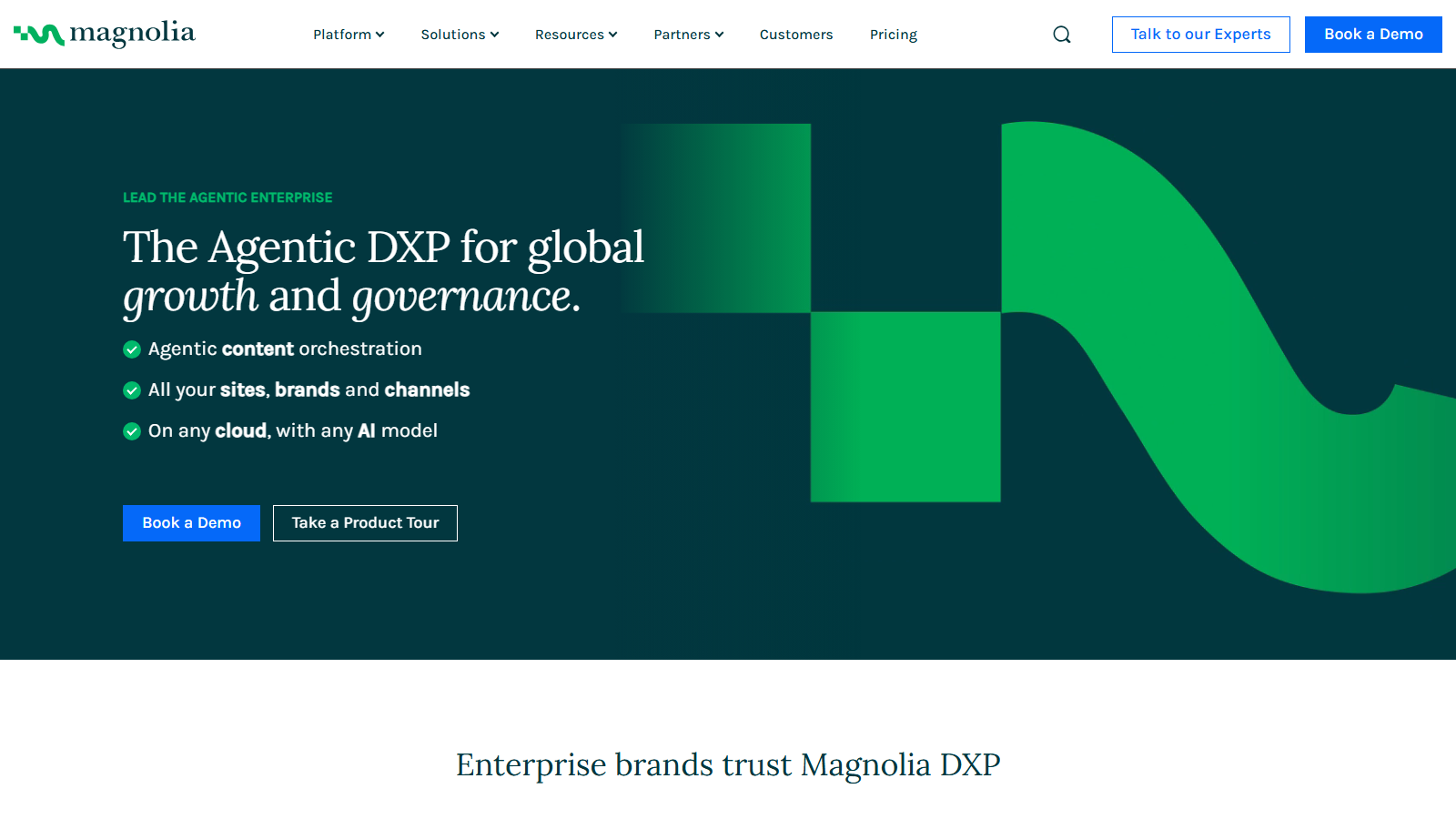
Magnolia, long known as Magnolia CMS and now branded Magnolia DXP, is a Java digital experience platform from Basel, sold as DX Core, which you host, or DX Cloud, which Magnolia runs. It is hybrid in the useful sense. Authors compose pages visually, including single-page apps built in React, Vue or Angular, while the same content leaves through REST delivery endpoints for any other channel.
What the marketing site does not say is that a free edition still exists. The Community Edition is licensed under GPLv3, downloadable from Magnolia's public Nexus repository, and its 6.4.9 bundle is dated 14 August 2026. Magnolia's own Hello Headless tutorial starts from the community webapp. The homepage, pricing page and developer hub mention only a 30-day DX Core trial.
The free edition stops where enterprise requirements begin. It runs one site, publishes to one public instance and has no GraphQL, which ships with DX Core. The paid floors are published: $3,500 a month for DX Core and $6,000 for DX Cloud on the English pricing page, or €3,000 and €5,000 on the German one, each still subject to a quote.
Our scorecard
Our editorial read across six dimensions, scored 1 to 5. This is our own assessment, not an aggregate of user reviews, and it is deliberately kept out of the page's structured data.
- Content modelling4/5
Content types and delivery endpoints defined in YAML light modules over a JCR tree. Powerful, with a Java learning curve underneath.
- Developer experience3/5
Light development and a CLI help, but it is still a Tomcat and JCR platform, and practitioners have called the redeploy loop slow.
- Editor experience4/5
The Visual SPA Editor keeps in-context page editing on headless React, Vue and Angular projects.
- Pricing3/5
A genuinely usable GPL edition and published floors, but those floors are $3,500 and $6,000 a month and still end in a quote.
- Governance4/5
Roles, workflows, SSO, ISO 27001 and SOC 2 Type 2 in both paid editions. The free edition carries no SLA.
- Ecosystem3/5
Documented connectors for SAP, commercetools and Salesforce Commerce Cloud, but a small public developer community.
An editorial read, not an aggregate of user reviews, and deliberately kept out of this page's structured data.
Magnolia in their own words
From Magnolia's own YouTube channel. Vendor marketing rather than an independent review, included because it is the quickest way to see the product before you sign up.
What you can query
REST Delivery API
In the Community Edition; endpoints defined in YAML
JSON for any workspace: read a node by path, list children with @nodes, or query with q, orderBy, offset, limit and lang, with references resolved.
GraphQL API
DX Core only; GraphQL module 3.1.1
JCR and Solr-indexed content through an endpoint at /.graphql, over GET or POST, with introspection.
REST nodes and commands
REST module; authenticated
Create, read, update and delete content nodes in named workspaces, and run commands to publish, export and import.
Front-end SDK
npm, for example @magnolia/react-editor
React, Vue and Angular editor libraries that render an SPA inside the Pages app so authors can edit it in context.
MCP server and client
Incubator 1.0.0-beta2; requires a special licence
Exposes Magnolia's tool registry to external AI assistants and connects Magnolia agents to outside MCP servers.
Magnolia CLI
npm package @magnolia/cli
Jumpstarts a Magnolia instance and scaffolds light modules for headless or FreeMarker projects.
Who Magnolia is for
Java organisations choosing between enterprise DXPs, including teams leaving Adobe Experience Manager, which is where practitioners on Reddit most often suggest it. It suits multi-brand, multi-language estates where marketers need to compose pages visually while developers deliver the same content headlessly, on infrastructure the organisation chooses.
The Community Edition suits a single-site Java team that can manage without GraphQL or a vendor SLA. Teams without Java operations experience should look elsewhere, as should anyone who needs several sites or public instances but cannot justify a monthly floor in the thousands.
Strengths and limits
What it does well
- The GPLv3 Community Edition is still maintained: its 6.4.9 bundle on Magnolia's public Nexus is dated 14 August 2026, the same day as the DX Core release.
- The free edition can be used headlessly, because the REST module and its delivery endpoints are bundled with the Community Edition.
- Delivery endpoints are YAML files in a light module, with full-text query, ordering, paging, language variants and reference resolution, and no Java required.
- The Visual SPA Editor lets authors edit React, Vue or Angular single-page apps in context, which answers the usual complaint that headless loses visual editing.
- Published floors of $3,500 a month for DX Core and $6,000 for DX Cloud answer the first procurement question without a demo request.
- DX Cloud deploys to AWS, Azure, GCP, Hetzner, Mironet or Aliyun, across multiple regions, which gives real control over data residency.
- Both paid editions list ISO 27001 and SOC 2 Type 2 certification, SSO, role-based access and a binding SLA.
- Magnolia's pricing FAQ says a subscription is not tied to a release and carries no hidden upgrade costs, so new versions are included.
Where it falls short
- THE MARKETING SITE HIDES THE FREE EDITION. Only the documentation and a Nexus link mention the Community Edition, while the pricing page and developer hub offer a 30-day DX Core trial.
- The Community Edition runs one site and publishes to one public instance. You can configure more receivers, but only the first one receives content.
- GraphQL is bundled with DX Core, so the only API in the free edition is REST.
- Community Edition updates cover the current major version only. Fixes for earlier major versions go to DX Core subscribers.
- Magnolia 6.2 and 6.3 leave active support in September 2026 and reach end of life in September 2027, so older estates face an upgrade now.
- The paid floors are enterprise floors. Both lead to a quote, and traffic, sites, extra instances, cloud provider and SLA package all move the number.
- The MCP integration is an incubator module at 1.0.0-beta2 that requires a special licence, so treat it as a preview rather than part of the standard product.
- The source repository is not public. Code reaches the public as jars and bundles on Nexus, and the GitLab project named in the POM asks for a sign-in.
Magnolia pricing
The Community Edition costs nothing and is licensed under GPLv3. It does not appear on the pricing page; the installation docs link a Tomcat bundle on Magnolia's Nexus instead. It includes the REST delivery endpoints, so a single-site headless project can run on it with no licence fee at all.
DX Core, which you host yourself, is listed from $3,500 a month on the English pricing page and from €3,000 a month on the German page. Magnolia says the price moves with the number of sites, extra author or public instances, and the SLA package. It adds GraphQL, multisite, SSO, AI agents, a binding SLA and a customer success manager.
DX Cloud, the managed option, is listed from $6,000 a month in English and €5,000 in German, and moves with traffic, regions, cloud provider and SLA. It adds dedicated infrastructure, an embedded CDN, CI/CD pipelines, unlimited development and test environments and up to 99.9% uptime. Frontend hosting, design system hosting and Solr hosting are add-ons.
Read both floors as the start of a quote. The two languages quote different numbers, neither states whether the monthly figure is billed monthly or annually, and A/B testing, behavioural analytics and AI search visibility are partner add-ons on top. Implementation by a partner is a separate cost again.
Community Edition
Free
GPLv3, self-hosted, not on the pricing page
- REST delivery endpoints and the Hello Headless tutorials
- One site and one public instance (receiver)
- NO GraphQL, NO multisite, NO vendor SLA
- Updates for the current major version only
DX Core
From $3,500 / mo
Self-hosted, on quote; €3,000 on the German page
- GraphQL, multisite, SSO and customisable workflows
- Extra author and public instances, licence key required
- Binding SLA, onboarding and a customer success manager
- Price moves with sites, instances and SLA package
DX Cloud
From $6,000 / mo
Managed PaaS, on quote; €5,000 on the German page
- DX Core features on dedicated managed infrastructure
- AWS, Azure, GCP, Hetzner, Mironet or Aliyun, multi-region
- Embedded CDN, CI/CD pipelines, up to 99.9% uptime
- Frontend, design system and Solr hosting are add-ons
Query example
A minimal fetch against the live API, with credentials read from the environment rather than pasted inline.
# 1. Define the endpoint in a light module. No Java and no DX Core
#    licence needed. File: site-api/restEndpoints/delivery/pages.yaml
#
#      $type: jcrDeliveryEndpoint_v2
#      workspace: website
#      bypassWorkspaceAcls: true
#      depth: 2
#      nodeTypes:
#        - mgnl:page
#
# 2. Query it. The file location makes the path /.rest/delivery/pages,
#    and the built-in rest-anonymous role already allows GET there.
curl -s -G "$MAGNOLIA_PUBLIC_URL/.rest/delivery/pages" \
  --data-urlencode "q=pricing" \
  --data-urlencode "orderBy=mgnl:lastModified desc" \
  --data-urlencode "offset=0" \
  --data-urlencode "limit=10" \
  --data-urlencode "lang=de"

# Omit q to list every page. Add @nodes to a path to get its children.
# GraphQL (/.graphql) is not in the Community Edition.
Limits and quotas
- Community Edition: one site.
- Community Edition: one receiver (public instance); additional configured receivers get no content.
- GraphQL module 3.1.1 is bundled with DX Core only.
- REST payloads: string values are capped at 20 million characters from Magnolia 6.4.0.
- DX Core cannot start without a licence key; the DX Core trial lasts 30 days.
- Magnolia 6.4 was released on 12 November 2025; active support runs until at least two years after the next major.
- Magnolia 6.2 and 6.3: active support until September 2026, end of life September 2027.
- Security fixes continue for one year after a release's active support ends.
- DX Cloud uptime: up to 99.9% with multi-region deployment.
- Magnolia 6.4 needs Java 17, 21 or 25 and Tomcat 10.1 or later.
What developers say on Reddit
Magnolia's Reddit presence is small and comes almost entirely from enterprise replatforming threads. When a team asks what could replace Adobe Experience Manager, Magnolia is the name practitioners keep offering, usually described as a lighter, cheaper platform with a familiar author and public instance model.
The criticism is thinner but real. In a 2024 r/webdev thread asking which CMS people hated using most, a one-line answer naming Magnolia was upvoted without any explanation, and a 2019 r/java comparison found development slow because every change meant a redeploy.
The most revealing comment is a question. Replying to a recommendation in February 2026, a buyer asked whether Magnolia could be tried through a community edition or had to be paid for up front like AEM. That confusion is the marketing site's doing, since nothing on the pricing page mentions the free edition. None of the quoted accounts showed an obvious vendor affiliation in the comment history we checked.
“You should probably look closer at Magnolia, which in many ways is AEM-lite and transitioning there to would basically mean far less training for your admins and editors and a lot of your existing content and components could be migrated over to with little to no changes.”
r/cms on Reddit“they are a traditional CMS with an open source core but can also be used headless while giving the users the ability to preview the pages - which can be a problem with some headless approaches where they have to jump through hoops.”
r/cms on Reddit“do you know if its easy to test it with a community edition or similiar? or its like AEM payupfront only”
r/cms on Reddit“I definitely recommend Magnolia. They are also java-based so the migration is SUPER EASY. Way better price point than Adobe also.”
r/cms on Reddit“The development experience was much worse then AEM cause when you develop you do a lot of change code / deploy / test and because of the nature of underlying tech of the Magnolia it takes a lot of the time.”
r/java on Reddit
Verdict
Magnolia belongs on the shortlist of any Java organisation replacing an enterprise DXP, and its published floors make that shortlist honest early. At $3,500 a month self-hosted, or $6,000 managed, a buyer can decide before the first call whether the conversation is worth having.
The free edition deserves more attention than Magnolia gives it. A single-site Java project can run the GPLv3 Community Edition headlessly today, with YAML-defined REST endpoints and the same authoring model as the paid product. Plan the exit before you need it, because a second site, a second public instance or GraphQL all mean DX Core.
Before signing, settle the upgrade and the licence. If your estate runs 6.2 or 6.3, active support ends in September 2026 and the upgrade belongs in the budget. And read the licence you are actually buying: the core source is GPLv3 or Magnolia's commercial agreement, one or the other, and only the commercial side unlocks the enterprise modules.
Magnolia FAQ
Is the Magnolia Community Edition still available?
Yes. It is free under GPLv3, and the installation docs link a Tomcat bundle on Magnolia's public Nexus repository; the 6.4.9 bundle is dated 14 August 2026. It is simply not marketed. The homepage, pricing page and developer hub mention only a 30-day DX Core trial, so buyers regularly assume no free edition exists.What does Magnolia cost in dollars and euros?
The Community Edition is free. DX Core, self-hosted, is listed from $3,500 a month on the English pricing page and from €3,000 a month on the German page. DX Cloud, managed by Magnolia, starts at $6,000 or €5,000 a month. Both paid editions are quoted individually, and Magnolia publishes no billing term behind those monthly figures.Can Magnolia's free edition be used as a headless CMS?
Yes, over REST. The REST module is bundled with the Community Edition, and Magnolia's own Hello Headless tutorial starts from the community demo webapp. You define delivery endpoints in YAML and call them under /.rest/delivery/. What you do not get is GraphQL, which is bundled with DX Core, or more than one site and one public instance.What does Magnolia DX Core add over the free edition?
The documented differences are GraphQL, multisite, publishing to more than one public instance, fixes for earlier major versions, and a binding SLA with onboarding and a customer success manager. The Community Edition is limited to one site and one receiver. DX Core also needs a licence key to start, and its extra modules sit in a private repository.Which licence covers Magnolia's source code?
LICENSE.txt in magnolia-core 6.4.9 says the code is dual-licensed under the GNU General Public License version 3 and the Magnolia Network Agreement, and you elect one. Electing GPLv3 makes the Community Edition open source with copyleft obligations. The agreement link in that file now redirects to a Magnolia License Agreement page, the commercial terms behind DX Core.How does the Magnolia API deliver content to a headless front end?
Each endpoint is a YAML file of type jcrDeliveryEndpoint_v2 in a light module's restEndpoints folder, naming a workspace and node types. It answers GET requests to read a node by path, list children with @nodes, or query with q, orderBy, offset, limit and lang. The built-in rest-anonymous role already allows GET under /.rest/delivery/.Who owns Magnolia?
Investment company GENUI acquired a majority stake on 27 July 2022, buying it from Elvaston Capital, according to Magnolia's own press release, and the price was not disclosed. Magnolia is headquartered in Basel and appointed Dave Wilby as chief executive on 18 February 2026. Its company timeline lists no ownership change since the GENUI deal.How long does Magnolia support each release?
Magnolia 6.4 was released on 12 November 2025 and stays in active support until at least two years after the next major release. Versions 6.2 and 6.3 lose active support in September 2026 and reach end of life in September 2027, with security fixes in between. Community Edition users receive updates for the current major version only.
Other platforms worth a look
This is an independent review. We have no affiliate relationship with Magnolia, earn nothing if you sign up, and no vendor pays for placement in the directory. Prices were read from the vendor's own pages in September 2026 and change without notice.