
Perplexity Search API review
Best for high-volume agent search loops
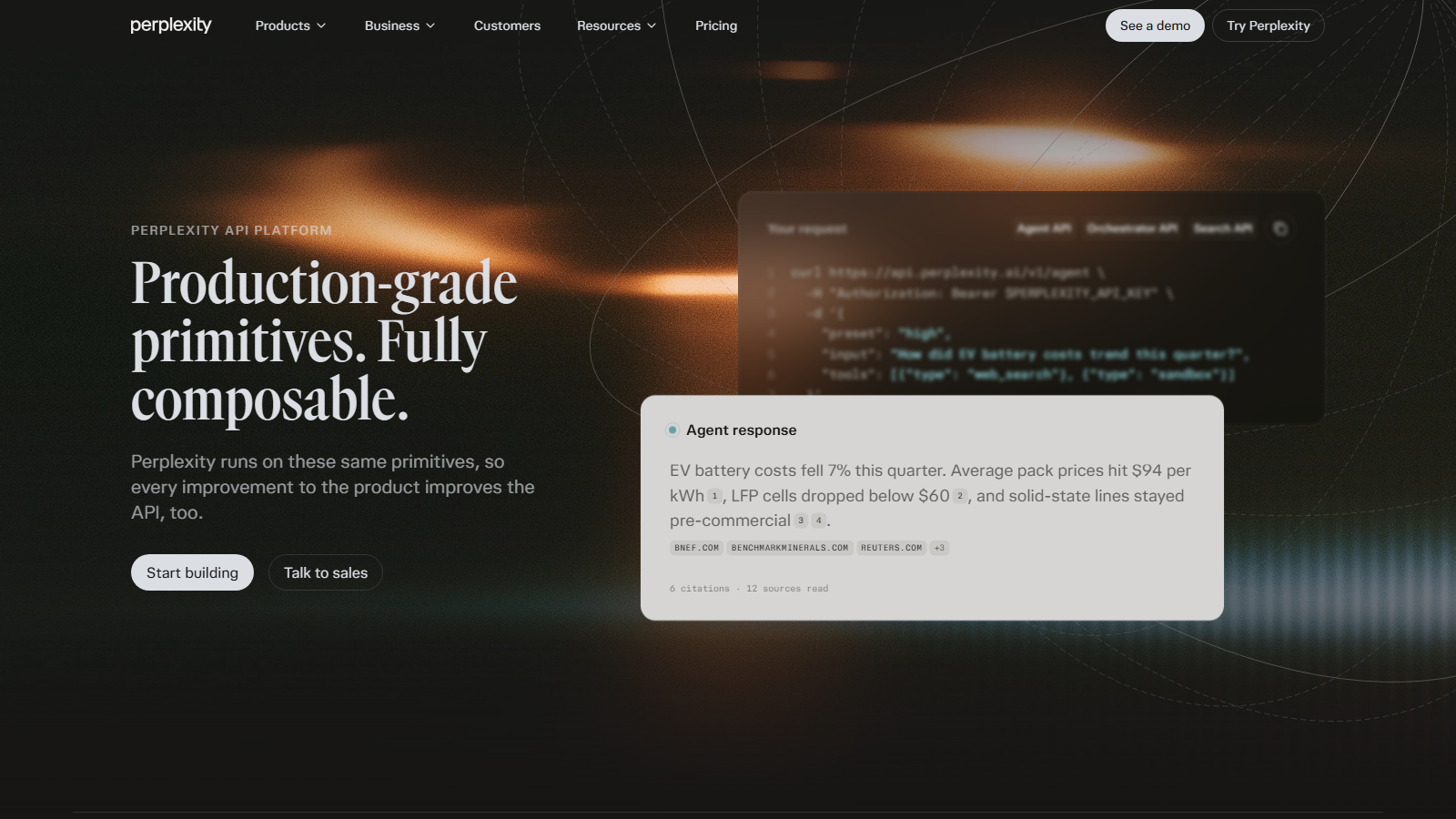
The Perplexity Search API returns ranked web results as JSON and stops there. Each result has a title, a URL, dates where known, and a snippet that is text extracted from the page for your query, often several paragraphs long. No model runs and no answer is written, so your code decides what reaches your own model. The docs describe the source as Perplexity's web index and give no size figure.
Billing and rate limits count different things. Perplexity charges $5 per 1,000 successful requests, or $1 per 1,000 on Fast Search, and a request can carry an array of up to five queries for the price of one. The rate limit counts queries instead, at 50 a second on every account. Failed, invalid and rate-limited requests are free; a successful request that finds nothing is still billed.
Perplexity launched it in September 2025 as a search-only API beside Sonar, its answer-writing models. Sonar Chat Completions has since become the Agent API, and support for it ended on 27 September 2026. The Search API stands apart from both in its terms too: a separate Search Addendum lets Perplexity retain and use the queries you send and the results it returns, and disapplies the zero data retention and service-level commitments made for its other APIs.
Our scorecard
Our editorial read across six dimensions, scored 1 to 5. This is our own assessment, not an aggregate of user reviews, and it is deliberately kept out of the page's structured data.
- Data coverage3/5
Web, Fast and People search with domain, language, date and country filters. No news, image or local endpoints in the Search API, and no figures on the index.
- Pricing4/5
Flat per-request prices with no token charges, and five queries per request. No published free allowance beyond an unstated sign-up credit.
- Documentation5/5
Recorded responses, every limit in a table, Markdown copies of each page and a dated changelog.
- Ease of integration5/5
Python and TypeScript SDKs, a CLI, agent-SDK guides for OpenAI, Anthropic and Gemini, and a hosted MCP server with OAuth.
- Reliability3/5
Unbilled failures and documented 429 handling, but the Search Addendum disclaims uptime guarantees and service levels for the Search Services.
- Support3/5
Self-serve docs, community and email. Custom limits by request form; enterprise terms through sales.
An editorial read, not an aggregate of user reviews, and deliberately kept out of this page's structured data.
What you can pull
Search (web)
$5 per 1,000 requests
Up to 20 ranked results across up to five queries, each with title, URL, query-relevant extracted text, publication date and last-updated date
Search (Fast Search)
$1 per 1,000 requests
The same response format on a lower-latency path, for agent loops and high-volume retrieval
Search (People Search)
Not listed separately on the pricing page
Professional profiles by name, role, company and location, up to 50 results a request
Context API
$1 per 1,000 fetched URLs
Markdown, HTML, links, query highlights and metadata from URLs you already have, for full page text
Agent API web_search tool
$2.50 per 1,000 calls ($1 on Fast Search), plus model tokens
Search inside a hosted model run that writes a cited answer, the successor to Sonar
Monitor API (Search monitors)
$1 per 1,000 succeeded runs
Scheduled searches that report new findings
Remote MCP server
Billed at the underlying API rates
A perplexity_search tool plus ask, reason and research tools for Claude Code, Cursor, VS Code and other MCP clients
Who Perplexity Search API is for
Teams running agents or retrieval pipelines that call search constantly and want to pay per request with no token arithmetic. Fast Search at $1 per 1,000 requests suits tool calls inside agent loops, and the five-queries-per-request rule lets a fan-out search cost one call. Because every result carries extracted page text, many agents can answer from the response without fetching anything else.
It suits two groups less well. Anything sensitive should not go in a query until legal has read the Search Addendum, which lets Perplexity retain and use search inputs and outputs, bars personal data without written permission, and switches off the zero data retention available elsewhere on the platform. And SEO teams measuring rankings need Google's results page, which this is not.
Strengths and limits
What it does well
- Every result carries text extracted from the page for your query, so a model can often answer without a separate fetch.
- Up to five queries in one request are billed once, which makes fan-out searches cheap.
- Fast Search costs $1 per 1,000 requests, with the same response format as standard search.
- No token charges on the Search API, and invalid, rate-limited and failed requests are not billed.
- Domain filters of up to 200 entries, language filters, publication and last-updated date windows, and a country bias.
- An official remote MCP server at api.perplexity.ai/mcp with OAuth sign-in, plus an open-source local server from Perplexity's own GitHub organization.
- The 50 queries a second limit applies at every usage tier, so a new account gets the full search throughput from the start.
Where it falls short
- The Search Addendum lets Perplexity retain, copy, distribute and use your search inputs and outputs, and states that ZDR obligations for its other products do not apply.
- The same Addendum disclaims service levels and uptime guarantees for the Search Services, and you do not own the Search API's output.
- Personal data may not be sent to the Search Services without Perplexity's written authorization.
- No published free allowance: some new accounts get a one-time credit of unstated size that expires after 60 days.
- Snippets are query-relevant extracts, not full pages, and there is no parameter to fetch a page live or control cache age.
- max_results caps the combined list across all queries in a request, so a five-query request can leave some queries with no results.
- No news, image, video or local endpoints in the Search API itself; image, finance and people search live in the Agent API's tools.
Perplexity Search API pricing
Perplexity Search API pricing is one flat rate per successful request, drawn from prepaid credits. Standard web search costs $5 per 1,000 requests and Fast Search $1 per 1,000. There are no token charges. Invalid requests, rate-limited requests and upstream failures are not billed, while a successful request that returns no results is.
The unit that matters is the request, not the query. A request can carry up to five queries and is billed once, so 1,000 five-query requests cost $5 on standard search, or $1 per 1,000 queries. The catch is that max_results caps the combined result list, so a fan-out request shares at most 20 results among its queries.
Snippets are extracts rather than whole pages. When an agent needs the full text of a page it found, the Context API returns Markdown, HTML, links and highlights at $1 per 1,000 URLs, so searching and then reading ten pages costs $0.005 plus $0.01 on standard search.
Credits are bought in advance in the API Console, with a card, through AWS Marketplace, or through sales, and auto reload keeps keys from being blocked at zero. Some new accounts receive a one-time sign-up credit that expires after 60 days; the docs do not state its amount. Cumulative purchases move an account through usage tiers at $50, $250, $500, $1,000 and $5,000, which raise Agent and Context API limits but leave the Search API limit where it is.
Pay as you go
$5 / 1,000 requests
Prepaid credits, card on file
- Up to five queries per request, billed once
- No token charges on the Search API
- Invalid and rate-limited requests are free
- Auto reload; keys block at a zero balance
Fast Search
$1 / 1,000 requests
Set search_type to fast
- Same response format as standard search
- For agent loops and high-volume retrieval
- Standard search kept for rare or ambiguous questions
- Same 50 queries a second limit
Enterprise
Quote only
Sales or AWS Marketplace
- Custom pricing and dedicated support
- Zero Data Retention by written agreement on other APIs
- Credits purchasable through AWS Marketplace
- Custom rate limits by request
Request example
A minimal call against the live endpoint, with credentials read from the environment rather than pasted inline.
# One POST /search with three queries: billed as ONE request
# ($0.001 on Fast Search, $0.005 standard), but it uses THREE of
# your 50 rate-limit units per second. max_results caps the
# combined list, so raise it and dedupe by url.
curl -s -X POST "https://api.perplexity.ai/search" \
  -H "Authorization: Bearer $PERPLEXITY_API_KEY" \
  -H "Content-Type: application/json" \
  -d '{
        "query": [
          "crm software for small business reviews",
          "crm software pricing comparison",
          "crm software migration problems"
        ],
        "search_type": "fast",
        "max_results": 15,
        "country": "US",
        "search_recency_filter": "year"
      }'

# Each result: title, url, snippet (query-relevant text extracted
# from the page, not the full page), date and last_updated.
# Need the whole page? The Context API charges $1 per 1,000 URLs.
Rate limits and quotas
- Search rate limit: 50 query units a second with a burst of 50, the same at every usage tier; each query in an array uses one unit.
- Up to five queries per request, each 1 to 8,192 bytes of UTF-8.
- max_results: 1 to 20 for web and Fast Search (default 10), 1 to 50 for People Search, counted across all queries.
- search_domain_filter: up to 200 entries; search_language_filter: up to 20 ISO 639-1 codes.
- search_recency_filter cannot be combined with the publication date window filters.
- Billing: each successful request is one unit whatever its query count; empty results are billed, failures are not.
- Over the limit returns HTTP 429 with x-ratelimit headers; the SDKs retry twice by default.
- Credits are prepaid; at a zero balance API keys are blocked until credits are added.
- Context API at usage tier 0: 1 request a second and 10 URLs a request, rising to 5 and 25 at tiers 4 and 5.
- Search Addendum: no personal data without written authorization; Perplexity may retain and use Search Data.
Verdict
Perplexity Search API is a good fit for agents that search constantly. Fast Search at $1 per 1,000 requests, five queries per billed request and extracted page text in every result keep both the bill and the number of follow-up fetches low, and the documentation is precise about every limit.
Read the Search Addendum before anything sensitive goes into a query. It lets Perplexity retain, copy, distribute and use the queries you send and the results it returns, rules out personal data without written permission, and switches off the zero data retention and service levels offered on its other APIs. The docs' privacy page leads with no training by default, but for the Search Services the Addendum takes priority.
Keep it in its lane. It is retrieval, not answers, which is the Agent API's job now that Sonar has been folded into it, and it is not Google's results page, so SEO measurement belongs with a SERP API.
Perplexity Search API FAQ
How much does the Perplexity Search API cost?
$5 per 1,000 successful requests for standard web search and $1 per 1,000 for Fast Search, drawn from prepaid credits with no token charges. A request can carry up to five queries and is still billed once. Failed, invalid and rate-limited requests are free; a successful request with no results is billed.Is there a free tier on the Perplexity Search API?
Not a published one. Perplexity's billing docs say some new accounts receive a one-time sign-up credit that expires 60 days after it is added, without stating the amount. Setting up billing needs a credit card, though adding one does not charge it, and API credits are separate from Perplexity Pro and Max subscriptions.What does a Perplexity Search API result contain?
A title, a URL, a snippet, and dates where known. The snippet is text extracted from the page that is relevant to your query, often several paragraphs, but not the full page, and the same page can return different text for different queries. For full page content, Perplexity's Context API returns it at $1 per 1,000 URLs.What is the Perplexity Search API rate limit?
50 query units a second, with a burst of 50, at every usage tier. Each query in a request uses one unit, so a five-query request uses five units while being billed as one request. Over the limit, the API returns HTTP 429, which is not billed, and the official SDKs retry twice by default.Does Perplexity use data sent to its Search API?
The Perplexity Search Addendum, which overrides the general API terms for the Search Services, says Perplexity may retain, copy, distribute and otherwise use Search Data, meaning your inputs and the outputs, for its lawful business purposes. It also says ZDR obligations for other products do not apply, and bars personal data without written authorization.How does the Perplexity Search API relate to Sonar?
They are separate products. Sonar models searched and wrote an answer; the Search API, launched in September 2025, returns ranked results with no model. Sonar Chat Completions has since become the Agent API, and Perplexity says Sonar support ended on 27 September 2026, with synchronous requests now reformulated as Agent API requests.Does Perplexity have an official MCP server?
Yes, two forms of one. Perplexity hosts a remote server at api.perplexity.ai/mcp, with OAuth sign-in or an API key, and publishes an open-source local server in its perplexityai GitHub organization. Both expose perplexity_search, which calls the Search API, plus ask, reason and research tools that now run on Agent API effort levels.Perplexity Search API or Brave Search API for an AI agent?
Both list $5 per 1,000 standard requests and 50 a second. Perplexity adds Fast Search at $1 per 1,000 and five queries per billed request, but its Search Addendum lets it reuse your queries and results. Brave includes token-budgeted LLM Context at $5 and keeps logs up to 90 days, but its self-serve terms forbid storing results.How do you authenticate with the Perplexity Search API?
Bearer token (API key). Keep the credential in an environment variable or a secrets manager, never in code that runs in the browser.
Other providers worth a look


Automations built with Perplexity Search API
5 content automations in the busyless directory run on Perplexity.
- Trending topics turned into postsSocial media
- Brand visibility across AI assistantsAEO
- Fact-check what AI assistants say about youAEO
- Curated newsletter from trusted sourcesPublishing
- Facts, quotes and links verifiedContent
This is an independent review. We have no affiliate relationship with Perplexity Search API, earn nothing if you sign up, and no provider pays for placement in the directory. Prices were read from the vendor's own pages in November 2026 and change without notice.