
Plasmic review
Best for design-led React landing pages
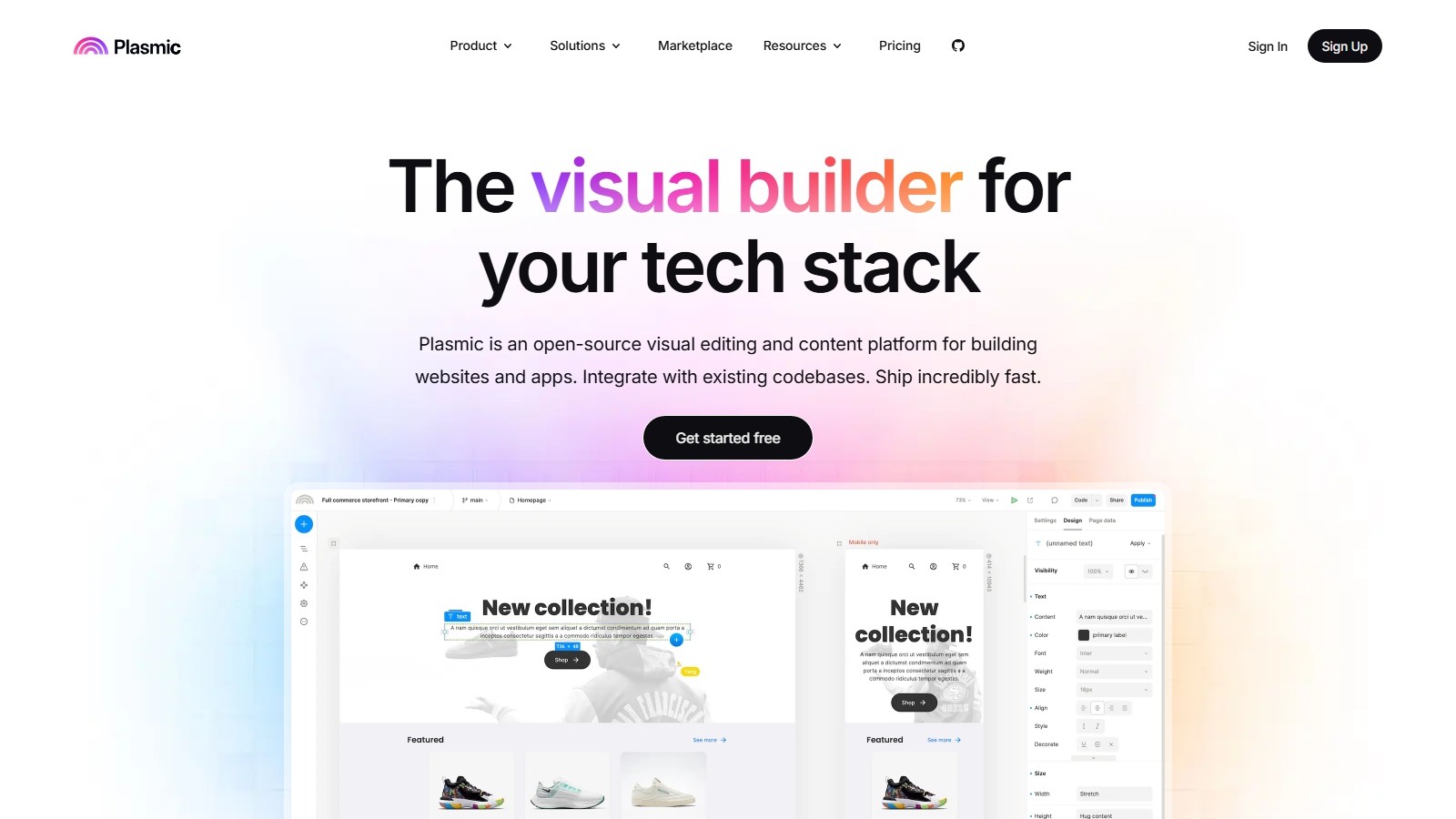
Plasmic is a visual builder for React: designers and marketers compose pages on a canvas, and developers pull the result into a codebase they already run. Beside the builder sits a headless CMS of its own, with models, fields, drafts, localised fields, publish webhooks and a REST API split into read and write tokens. That CMS comes with unlimited models and entries on every plan, Free included.
What the plans charge for is people and control. Free and Starter stop at three collaborators, and viewers count as collaborators. Content creator mode, the role that hides free-form styling so a marketer can only assemble approved components, arrives on Scale at $399 a month billed yearly. So do scheduled content, A/B testing, pre-set roles and localisation, which the table describes as integration with frameworks such as react-i18next.
Read the repository before the pricing page, because it changes the calculation. Everything outside its platform folder is MIT, and the Studio and server inside it are AGPL-3.0, public since late 2023. Running your own Studio is permitted, though the published setup guide describes a development environment. And a dated change is coming: legacy data queries and app auth stop working on 1 November 2026.
Our scorecard
Our editorial read across six dimensions, scored 1 to 5. This is our own assessment, not an aggregate of user reviews, and it is deliberately kept out of the page's structured data.
- Content modelling2/5
Models, enumerations, rich text, uploads and localised fields cover page content. No field-type reference is published, so test relational needs first.
- Developer experience4/5
Headless loaders, codegen, an HTML Render API and code components give real choice. The data-query migration is churn you must schedule.
- Editor experience3/5
A strong canvas for designers. The simplified role that makes it safe for marketers costs $399 a month.
- Pricing3/5
Content is free and unlimited; collaborators are capped per plan, and viewers count against the cap.
- Governance2/5
Team roles start on Scale. SSO, custom roles, branching and the availability SLA are Enterprise.
- Ecosystem3/5
MIT packages, Figma import and connectors for Contentful, Sanity, Strapi and Hygraph, with a quiet public community.
An editorial read, not an aggregate of user reviews, and deliberately kept out of this page's structured data.
Plasmic in their own words
From Plasmic's own YouTube channel. Vendor marketing rather than an independent review, included because it is the quickest way to see the product before you sign up.
What you can query
Headless API (loaders)
The recommended mode, per the docs
Published pages and components fetched at build time or on the server through @plasmicapp/loader-nextjs, loader-react or loader-gatsby, using a public project token.
Codegen and build-time codegen
Code generation is on every plan
React source written into your repository by plasmic sync, versioned in Git. The build-time variant suits runtimes without dynamic code evaluation, such as Cloudflare Workers.
HTML Render API
Works from PHP or any stack
Plain HTML for a page or component from codegen.plasmic.app, optionally hydrated, from preview, published or versioned routes, with prepass for server-side data.
Plasmic CMS API
Public token reads; secret token writes and drafts
Query, count, create, update, publish and delete rows at data.plasmic.app, with JSON filters using $and, $or, $not, $in and $gt, and a locale parameter.
Data queries ($q) and code components
Legacy $queries end 1 November 2026
Functions from your own app, server-rendered through React Server Components, plus registered React components that editors drop onto the canvas.
Agent access to Studio
Not a Plasmic MCP server; edits designs, not CMS rows
An AI client drives Studio through Google's chrome-devtools-mcp and Plasmic's plasmic-designer skill, editing designs via a browser-side API.
Who Plasmic is for
Design-led marketing teams on React who want pages built on a canvas and then served from their own front end, with a small amount of structured content alongside. Agencies suit it too: projects are unlimited on every plan, ownership can be transferred, and codegen plus the open licence give a client an exit if the subscription ends.
Look elsewhere if the content model is the product, such as a large catalogue or a newsroom, or if editors outnumber the budget. Every viewer takes a collaborator slot, and the locked-down editor role needs Scale, so a wide editorial team gets expensive before the CMS does.
Strengths and limits
What it does well
- The CMS and the headless integration cost nothing: unlimited models and entries, code generation and deploy-anywhere are on the Free plan.
- Open source in both halves: MIT for the loaders and components you ship, AGPL-3.0 for the Studio and server in platform/.
- Three ways into a codebase: runtime loaders, generated React committed to Git, or plain HTML from the Render API for non-React stacks.
- Code components register React components from your codebase or from npm as building blocks inside Studio.
- Once you reach Scale, content creator mode hides free-form styling and raw elements so editors can only assemble approved components.
- CMS rows support draft and publish, localised fields, preview links per model and webhooks that fire on publish.
- Data queries now run inside your own app rather than through Plasmic servers, which keeps secrets and user data off the vendor's infrastructure.
- Project ownership transfers on every plan, which fits agencies handing work to clients.
Where it falls short
- Viewers count as collaborators, and Free and Starter cap a workspace at three people in total.
- Content creator mode, team roles, localisation, scheduling and A/B testing all start on Scale at $399 a month billed yearly.
- Legacy data queries and app auth stop on 1 November 2026, when their APIs start returning 404, so older projects have migration work.
- Self-hosting is permitted, but the published guide is a development setup needing at least 8GB of RAM, and supported self-hosting goes through Enterprise sales.
- Agent access rides on Google's chrome-devtools-mcp plus a Plasmic skill rather than a Plasmic-run server, and it edits Studio designs, not CMS content.
- The CMS API documents no rate limits and the docs list no field-type reference, so load and schema questions need testing.
- The Vue and Svelte loaders are deprecated on npm, so component-level integration now means React.
- SSO, custom roles, branching and the 99.5% availability SLA are Enterprise only.
Plasmic pricing
Free costs nothing and is not a trial. It carries unlimited projects, unlimited CMS models and entries, image optimisation, code generation, backup export and deployment to any host, plus Plasmic hosting with a badge. The ceiling is three collaborators, and a viewer occupies a seat the same as an editor.
Starter is $39 a month billed yearly or $49 monthly, and mostly buys the removal of the badge and a custom favicon; it keeps the three-person cap. Pro is $103 yearly or $129 monthly with four collaborators, extendable to ten at $20 each, priority support and Plasmic AI in beta.
Scale is $399 a month yearly or $499 monthly with eight collaborators, extendable to thirty at $40 each. This is where content creator mode, pre-set roles, localisation, scheduled content, custom targeting and A/B testing appear. Enterprise is quoted and adds SSO, custom roles, branching, white labelling, embedding and SLAs.
So the cost driver is headcount plus governance, never content volume. A team of three designers publishing structured content pays nothing. A team of eleven lands on Scale whatever features it wants, because Pro stops at ten collaborators.
Free
$0
Free forever, 3 collaborators
- Unlimited projects, CMS models and CMS entries
- Deploy to your own servers, or Plasmic hosting with a badge
- Code generation, backup export and 14 days of version history
- A collaborator is any editor or viewer
Pro
$103 / mo
Billed yearly; $129 monthly
- 4 collaborators included, up to 10 at $20 each
- Priority support, answered in 1 to 2 business days
- Plasmic AI, in beta, and 90 days of version history
- Still no content creator mode, roles or localisation
Scale
$399 / mo
Billed yearly; $499 monthly
- 8 collaborators included, up to 30 at $40 each
- Content creator mode and pre-set team roles
- Localisation, A/B testing, scheduled content, targeting
- 180 days of version history; Enterprise quoted above this
Query example
A minimal fetch against the live API, with credentials read from the environment rather than pasted inline.
curl -s -G "https://data.plasmic.app/api/v1/cms/databases/$PLASMIC_CMS_ID/tables/blogPosts/query" \
  -H "x-plasmic-api-cms-tokens: $PLASMIC_CMS_ID:$PLASMIC_CMS_PUBLIC_TOKEN" \
  --data-urlencode 'q={"where":{"slug":"spring-launch"},"limit":1,"offset":0}'

# blogPosts is the model's unique identifier from its schema page.
# The PUBLIC token only reads published rows. Adding draft=1, and
# every write (POST .../rows, PUT or DELETE /cms/rows/ROW_ID), needs
# the SECRET token, which the docs say must stay on a server.
# No rate limit is documented for this API, so cache on your side.
Limits and quotas
- Free: 3 collaborators, unlimited projects, CMS models and CMS entries, 14 days of version history.
- Starter: $39 a month billed yearly or $49 monthly, still capped at 3 collaborators, removes the Plasmic badge.
- Pro: $103 a month yearly or $129 monthly, 4 collaborators included, up to 10, $20 per extra collaborator.
- Scale: $399 a month yearly or $499 monthly, 8 collaborators included, up to 30, $40 per extra collaborator.
- A collaborator is any editor or viewer of your projects.
- Version history: 14, 30, 90 and 180 days from Free to Scale; custom on Enterprise.
- CMS writes and draft reads require the secret token; published reads use the public token.
- Legacy $queries data queries and app auth stop working on 1 November 2026.
- Loader V2 requires React 18+, Next.js 14+ for loader-nextjs, and Node 18.17+.
- Enterprise availability SLA: 99.5% for the API and Plasmic hosting, with a 24-hour response SLA.
What developers say on Reddit
Most Plasmic discussion lives in no-code and React communities rather than CMS ones, and it treats Plasmic as a builder first. Regular users are warm about the canvas, the Figma importer and the fact that output lives in their own Git repository. Comments from Plasmic employees, several over the years, were excluded from this read.
The complaints repeat across years. Users describe documentation that leaves logic and data binding hard to learn, and one builder with three paid apps on Plasmic reports pages that work in the editor failing in production when data comes back undefined. A 2024 thread asked whether the product was still developed at all, and regulars answered that the forum and Slack were active.
Two newer notes matter for this page. A 2026 evaluator found the docs good but the built-in AI helper inventing components that do not exist. And self-hosting, legally open since 2023, still reads as a project: one recommender said they had not tried it because it seemed too technical.
“The main things I like about Plasmic is it's an easy editor with JavaScript mapping and all the code can be hosted in GitHub. So it's not siloed in some app that could die.”
r/nocode on Reddit“The one thing I find a little frustrating is their error handling. It will work perfectly in the editor but once you see it in production it can just error out if any data returns undefined.”
r/nocode on Reddit“Loving plasmic, Just that sometimes the support and the biggest one is the documentation. I think the documentation needs to be more clearer.”
r/nocode on Reddit“Plasmic's documentation is pretty good but its "helper agent" hallucinates big time. Talks about Supabase-specific components that do not exist.”
r/Supabase on Reddit“Try plasmic. I haven't self-hosted it because it seemed too technical for me, but I believe it is an option.”
r/selfhosted on Reddit
Verdict
Plasmic makes sense when the pages are the content: landing pages, campaign sites and marketing sections composed visually, served from your own React front end, with a modest CMS for the repeating parts. On that brief the free plan is unusually complete, because the CMS, codegen and deployment to your own host cost nothing.
Budget for the people, not the content. Every viewer takes a seat, three is the ceiling below Pro, and the controls that make a canvas safe for non-designers, content creator mode and team roles, begin at $399 a month. If editors will outnumber designers, price Scale on day one rather than discovering it at launch.
Treat the licence as insurance and the calendar as a task. Generated code, the MIT runtime and the AGPL Studio give a project a route to outlive the subscription, even if running the Studio yourself is real engineering. And any project still on legacy data queries or app auth needs migrating before 1 November 2026, when those APIs start returning 404.
Plasmic FAQ
What does Plasmic cost once a team grows past three people?
Pro, at $103 a month billed yearly or $129 monthly, includes four collaborators and allows up to ten at $20 each. Beyond ten you need Scale, at $399 yearly or $499 monthly, with eight included and up to thirty at $40 each. Free and Starter both stop at three, and viewers count toward every cap.Is the Plasmic CMS really unlimited on the free plan?
Yes on volume. The pricing table lists unlimited CMS models and unlimited entries on every plan, and the CMS API is available to all of them. What Free lacks is people and control: three collaborators and no content creator role, which arrives on Scale with the localisation integration.Is Plasmic open source?
Yes, under two licences. The README states that everything outside the platform folder is MIT, which covers the loaders and components you ship. The Studio and server inside platform are AGPL-3.0, published in late 2023. Modify and serve that Studio to others and AGPL obliges you to offer them the source.Can a team realistically run Plasmic Studio on its own servers?
Legally yes, practically with effort. The repository's setup guide is written for developing the Studio, uses a development environment and asks for at least 8GB of RAM for the Docker container. Plasmic's security page directs anyone wanting a supported self-hosted deployment to its enterprise team.Should a Plasmic project use the Headless API or codegen?
The docs recommend the Headless API for most projects, including using Plasmic as a CMS, because published changes appear on the next build without developers. Codegen writes React into your repository for teams attaching heavy logic. Build-time codegen covers runtimes such as Cloudflare Workers that cannot evaluate code dynamically.Which Plasmic plan includes content creator mode?
Scale and Enterprise. The mode limits editors to existing components and hides free-form styling, raw elements and token management, and customising what it hides is Enterprise only. The content creator docs also mention Growth plans, a tier the current pricing page does not list, so confirm in the app.What stops working in Plasmic on 1 November 2026?
Two features go: the legacy $queries data queries and the related app auth. Plasmic's July 2026 post says new projects cannot use them and that after the date their APIs return 404. Replacement $q queries run in your own app, and auth moves to a global context or Supabase auth.Plasmic or Builder.io for marketer-built pages?
Plasmic if you want the CMS and headless delivery free, an open licence, and a bill that moves with seats rather than usage. Builder.io's entry here is proprietary and hosted only, priced per user and in Agent Credits. Both let editors compose with registered React components, so the licence and the meter decide it more than the canvas.
Other platforms worth a look
This is an independent review. We have no affiliate relationship with Plasmic, earn nothing if you sign up, and no vendor pays for placement in the directory. Prices were read from the vendor's own pages in September 2026 and change without notice.