
Pimcore review
Best when product data is the project
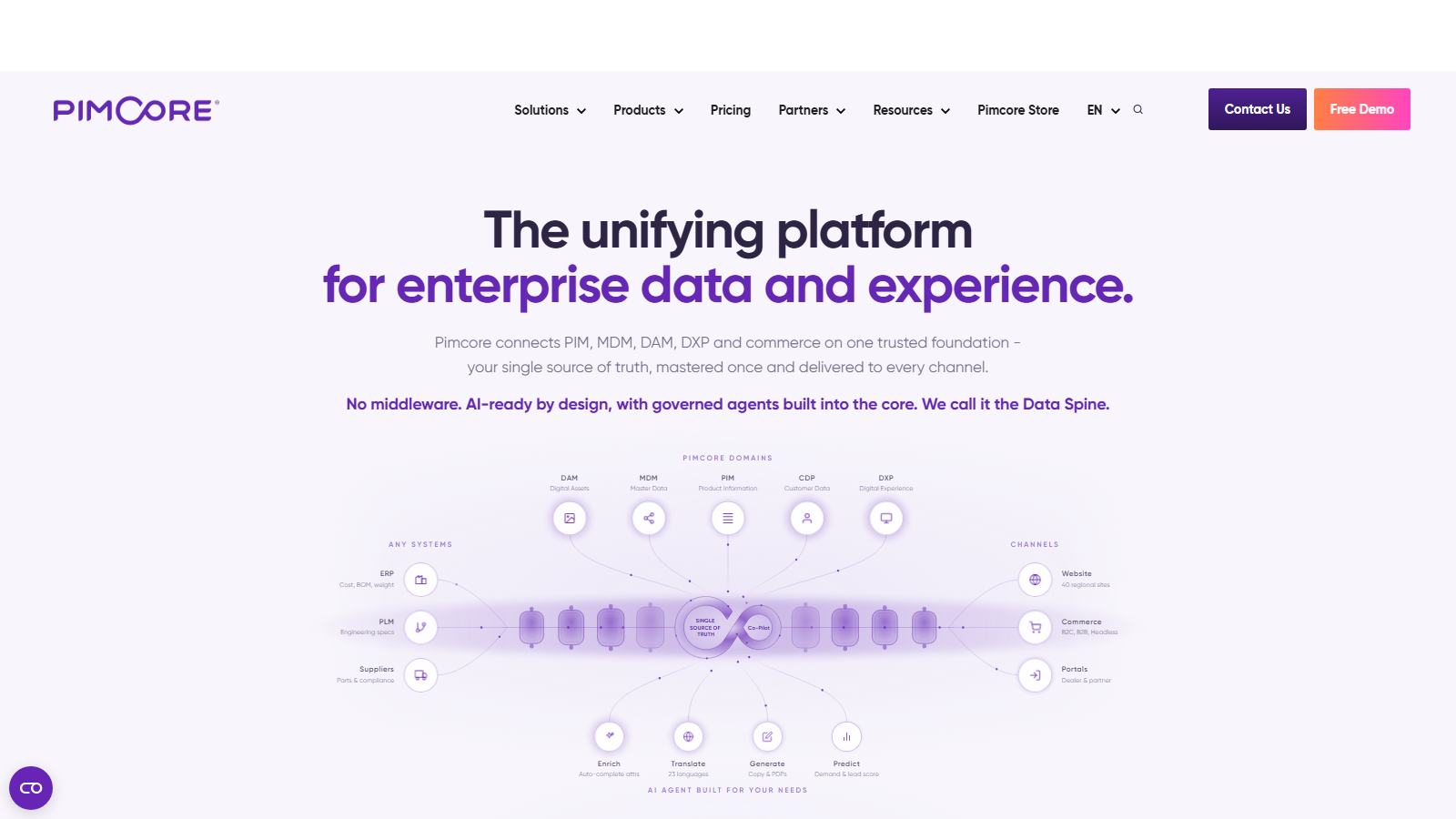
Pimcore is a PHP and Symfony platform for product data first and web content second. Product information, master data, digital assets and a CMS share one data model and one admin, Pimcore Studio. A headless buyer reaches it through Datahub, which generates a GraphQL endpoint per configuration, and that module ships in the free edition.
Free is the part that needs reading. Since Platform Version 2025.1, announced on 29 April 2025, Pimcore ships under its own Open Core License rather than GPLv3. Production use costs nothing only for organisations whose group revenue is at or under EUR 5 million, and for eligible non-profits and education. Everyone else needs a paid edition from the day development starts.
The paid ladder is published and steep. Professional is $9,900 a year and adds, beyond the licence itself, a TinyMCE editor. The modules a content team would notice, Headless Documents, webhooks, the Simple REST API and OpenID Connect sign-in, begin at Enterprise, from $29,900 a year. Meanwhile a majority stake is being sold to Tenzing, pending antitrust approval.
Our scorecard
Our editorial read across six dimensions, scored 1 to 5. This is our own assessment, not an aggregate of user reviews, and it is deliberately kept out of the page's structured data.
- Content modelling5/5
A visual class editor and more than fifty data types built for catalogue data, shared by products, assets and pages.
- Developer experience2/5
Symfony, Docker, OpenSearch, Mercure and product registration before the first query. Heavy for a CMS job.
- Editor experience3/5
Pimcore Studio is capable for data work, while one practitioner rates its website CMS below WordPress.
- Pricing2/5
Free under EUR 5 million, then $9,900 a year for little extra and $29,900 for the headless modules.
- Governance3/5
Element-level permissions and configurable workflows in core; Workflow Designer and OpenID Connect are Enterprise.
- Ecosystem3/5
A large solution-partner network and a store of extensions, with a thin public community to learn from.
An editorial read, not an aggregate of user reviews, and deliberately kept out of this page's structured data.
Pimcore in their own words
From Pimcore's own YouTube channel. Vendor marketing rather than an independent review, included because it is the quickest way to see the product before you sign up.
What you can query
Datahub GraphQL
Community and Professional; API key per configuration
Data objects, assets and documents, including page editables, through a schema generated per endpoint configuration, with queries and mutations.
Studio Backend API
Core; built for Studio, open to other clients
The OpenAPI-documented REST layer behind Pimcore Studio, covering the administrative and data operations the admin itself performs.
Datahub Simple REST
ENTERPRISE ONLY
Read-only endpoints for assets and data objects served from OpenSearch or Elasticsearch indices, with bearer tokens and an experimental MCP server.
Headless Documents
ENTERPRISE ONLY
Headless document management, with page content exposed through Datahub endpoints for front-end applications.
Datahub Webhooks and File Export
ENTERPRISE ONLY
Event notifications for assets, documents, data objects and workflow changes, plus automated CSV, XML or JSON exports.
PHP API and Twig
Core
The native Symfony path to data objects, documents and assets, and the place where document editables are defined in Twig templates.
Who Pimcore is for
Manufacturers, distributors and retailers whose hard problem is product data across channels and languages, and who want the website, portals and feeds reading from one governed model. For them the CMS is a useful extra inside a system they would buy anyway, and a partner-led implementation is the normal way in.
A team that only needs a headless CMS should look elsewhere. Above the revenue line the cheapest compliant install costs $9,900 a year before hosting, OpenSearch and Mercure are required just to run the admin, and the headless page module sits in Enterprise. A content-first CMS in this directory will do that job for less.
Strengths and limits
What it does well
- One data model for products, assets, master data and pages, so the website reads the same governed record as every feed and portal.
- Datahub GraphQL is in the free Community edition and in Professional, with queries and mutations over data objects, assets and documents.
- Genuinely free in production for organisations at or under EUR 5 million in group revenue, and for eligible non-profit and educational bodies.
- No seat, product or site metering on any edition; the pricing FAQ says users, products, assets and sites carry no extra charge.
- Catalogue modelling is the platform's core strength, with a visual class editor and more than fifty data types.
- List prices for Professional and Enterprise are published, in dollars on the English pricing page and euros on the German one.
- The same platform runs on your own infrastructure or as Pimcore's PaaS on AWS, Google Cloud or Azure.
- Vendor-built MCP endpoints exist, through the Pimcore Agent bundle and an experimental server in Datahub Simple REST, which is an Enterprise module.
Where it falls short
- THE FREE EDITION IS A REVENUE TEST. Production use is free only at or under EUR 5 million in group revenue, self-certified and auditable, with fees chargeable retroactively from the day you crossed it.
- Pimcore decides whether you exceed the threshold, and the licence states that legal recourse against that decision is excluded.
- Development intended for production counts as production use from its first day, so an agency building for a larger client needs a paid edition at kickoff.
- Professional at $9,900 a year adds a TinyMCE editor to the Community modules. Headless Documents, webhooks, Simple REST and OpenID Connect all require Enterprise.
- Self-hosting needs OpenSearch or Elasticsearch and a Mercure hub just to run Pimcore Studio, and installation stops without a product key for that instance.
- Community support for a Platform Version ends when the next one ships, and the documentation reserves three-year LTS for Enterprise and PaaS.
- Pimcore's own FAQ page still describes a free GPLv3 Community Edition, contradicting the licence file and its own edition pages. The licence file is what binds.
- The classic admin interface was removed in Platform Version 2026.1, so older projects face a move to Pimcore Studio when they upgrade.
Pimcore pricing
Community is free for non-production use by anyone. In production it is free only if your organisation, counted with any group it belongs to, has global revenue at or below EUR 5 million, or is an eligible non-profit or educational body. You self-certify when you start, Pimcore can audit, and crossing the line makes a paid licence due retroactively.
Professional is $9,900 a year on the English pricing page and EUR 8,400 on the German page and in the Pimcore Store, where it is an annual subscription that renews automatically. It is the commercial licence for organisations over the threshold, with Store access and the TinyMCE editor. It adds no vendor support and no Enterprise modules.
Enterprise starts at $29,900 a year, or EUR 25,200, and is sold through a quote. It carries every module, including Headless Documents, Simple REST, Webhooks, Workflow Designer, OpenID Connect, Copilot and the E-Commerce Framework, plus long-term support. The pricing FAQ adds that more than four independent production instances needs the Unlimited Edition.
PaaS is Enterprise on managed infrastructure, and the pricing page quotes it individually. The PaaS edition page still lists Starter at EUR 34,200, Growth at EUR 48,612 and Performance at EUR 66,612 a year, while the pricing page describes a newer usage-based base commit. Ask which model applies before comparing numbers.
Licence cost is rarely the largest line. Pimcore's own FAQ says the on-premise editions are not out-of-the-box software like WordPress or Shopify, and implementation usually runs through a solution partner.
Community
Free
At or under EUR 5m group revenue, or non-profit
- Core framework, Pimcore Studio, Datahub GraphQL, Data Importer
- PIM, MDM, DAM and CMS capabilities with the Quill editor
- No Enterprise modules and no vendor support
- Free for non-production use by anyone
Professional
$9,900 / year
EUR 8,400 in the Store, auto-renewing
- Everything in Community, plus the TinyMCE editor
- Commercial licence for organisations over the threshold
- Pimcore Store access
- NO Headless Documents, webhooks, Simple REST or SSO
Enterprise / PaaS
From $29,900 / year
From EUR 25,200; PaaS quoted separately
- Headless Documents, Simple REST and Webhooks
- Workflow Designer, OpenID Connect, Copilot, E-Commerce Framework
- Three-year support on LTS releases, optional 24/7 support
- PaaS adds managed hosting on AWS, Google Cloud or Azure
Query example
A minimal fetch against the live API, with credentials read from the environment rather than pasted inline.
curl -s "https://pim.example.com/pimcore-graphql-webservices/content" \
  -H "X-API-Key: $PIMCORE_DATAHUB_KEY" \
  -H "Content-Type: application/json" \
  -d '{"query":"{ getArticleListing(first: 10, sortBy: \"date\", sortOrder: \"DESC\") { totalCount edges { node { id title slug } } } }"}'

# "content" is the name of a Datahub configuration, and
# getArticleListing exists only because that configuration exposes a
# data object class called Article. The key can also travel as an
# apikey header or query parameter.
#
# If the configuration has no workspace selected, nothing is readable,
# and relations the endpoint may not see come back as null by default.
Limits and quotas
- Community production use: organisations at or under EUR 5 million total global revenue including their group, or recognised non-profit and educational bodies.
- Non-production use such as demos, prototypes and proofs of concept is free for anyone.
- Professional: $9,900 a year, or EUR 8,400 as an auto-renewing annual subscription in the Pimcore Store.
- Enterprise: from $29,900 a year, or from EUR 25,200. PaaS is quoted individually.
- Product registration is mandatory, and one product key may not be used for more than one instance.
- Requirements: PHP 8.5+, MySQL 8.0+ or MariaDB, OpenSearch 2.7+ or Elasticsearch 8+, and a Mercure hub.
- Datahub GraphQL authenticates with an API key per configuration, sent as a header or query parameter.
- LTS gives three years of critical fixes on designated releases; the docs say Enterprise and PaaS only, though the pricing table ticks it for Professional.
- The pricing FAQ says more than four independent production instances require the Unlimited Edition.
- The licence forbids offering Pimcore as a hosted or managed service, and forbids interfering with the usage data it transmits.
Third-party reviews
Scores read from each source on 2026-09-13. We report them as-is and publish no rating of our own.
Capterra lists Pimcore as a whole suite across PIM, DAM, MDM, CMS and ecommerce, so this is not a rating of its headless CMS, and 23 reviews is a small sample.
What developers say on Reddit
Public discussion of Pimcore is thin and skewed. r/Pimcore is mostly setup questions and posts from implementation agencies, and the most useful comments come from developers who built with it. No thread we found discusses the 2025 licence change, and a commenter in September 2026 still recommends it as open source, which the licence file no longer supports.
Where users do speak, the pattern is consistent. People who implemented it for product and asset data describe it as robust and mature. People who met it as a website CMS, or as a backend for a JavaScript front end, describe the CMS as weaker than WordPress, the documentation as thin in places, and the platform as overkill for a simple backend.
Read that as confirmation of this page rather than a verdict of its own. The praise and the complaints describe the same product from two sides: a data platform that happens to include a CMS.
“it's an extremely robust, mature, and proven platform. documentation's excellent. can accomplish anything you can dream up and handle anything thrown at it. lightning fast and scales with ease. love it to bits, completely transformed and streamlined our mdm/pim/dam.”
r/Pimcore on Reddit“Not what you asked but Pimcore it has a CMS more kinda like wordpress but way worse. But it works?”
r/symfony on Reddit“it was difficult to find information but eventually got it working by using thumbnails since the images themselves were too big. the documents could really use some rewriting or add more information in my honest opinion.”
r/Pimcore on Reddit“Pimcore is for digital projects, if you only need a backend then Pimcore is overkill.”
r/Pimcore on Reddit“If you wanna do more yourself: Pimcore (open source, PHP), not as corporate but there are big implementation partners.”
r/cms on Reddit
Verdict
Buy Pimcore when product data is the project and the website is one of its outputs. The single model for products, assets and pages is the real asset, and for a manufacturer or retailer it replaces integrations that would cost more than any licence on this page.
Do the licence arithmetic before the technical evaluation. At or under EUR 5 million in group revenue, Community with Datahub GraphQL is a legitimate free headless stack. Over it, entry is $9,900 a year for essentially the same modules, and the headless page features, webhooks and SSO are Enterprise at $29,900 or more. Development for a larger client counts as production from its first day.
Then watch two moving parts. The owner is changing: Tenzing's purchase of a majority stake was announced on 27 August 2026 and awaits antitrust approval, and Pimcore's post promises an open core but makes no commitment on prices or the threshold. The licence itself changed in April 2025, so read the current LICENSE.md rather than any forum post calling Pimcore open source.
Pimcore FAQ
How much does Pimcore cost?
Community is free if you qualify. Professional is $9,900 a year on the English pricing page, or EUR 8,400 on the German page and in the Store. Enterprise starts at $29,900 a year, or EUR 25,200. PaaS is quoted individually, although its edition page lists plans from EUR 34,200 a year. Hosting and implementation come on top of all of these.Is Pimcore still open source?
No. Platform Version 2024.4 was the last GPLv3 release. From 2025.1 the code ships under the Pimcore Open Core License, which makes it source-available: you can read and modify it, but not offer it as a hosted service, distribute a competing fork, or run it alongside GPLv3 Pimcore code. Free production use then depends on revenue.Who qualifies for the free Pimcore Community Edition?
Organisations with total global revenue at or below EUR 5 million, counted across any group they belong to, plus recognised non-profit and educational bodies, a route government bodies can use only with Pimcore's approval. Non-production use is free for anyone. Eligibility is self-certified and auditable, Pimcore decides at its discretion with legal recourse excluded, and fees can be charged retroactively.Can Pimcore CMS content be delivered headlessly without Enterprise?
Yes, within limits. Community and Professional include Datahub, which exposes data objects, assets and documents over GraphQL with an API key per configuration. Document editables are still defined in Twig templates, though, and the module built for headless document management, Headless Documents, is Enterprise, as are webhooks and the Simple REST API.What does the Pimcore framework need to self-host?
Pimcore 2026.x runs on the Symfony framework with PHP 8.5, MySQL 8.0 or MariaDB, and OpenSearch 2.7 or Elasticsearch 8 plus a Mercure hub, the last two required by Pimcore Studio. Redis and RabbitMQ are recommended. Installation uses Docker and cannot finish without a product key, which every instance must register for.Is there managed Pimcore hosting from the vendor?
Yes. Pimcore enterprise hosting comes as Enterprise Edition PaaS on AWS, Google Cloud or Azure, with 24/7 operations and the Enterprise licence included. The pricing page quotes it individually, while the PaaS page still lists fixed plans from EUR 34,200 a year. Community and Professional come with no vendor hosting, so you or a partner run them.Who owns Pimcore?
Pimcore GmbH of Salzburg, led by co-CEOs Dietmar Rietsch and Matthias Blauth. Nordwind Growth has backed it since 2022, and on 27 August 2026 agreed to sell its majority stake to Tenzing, a London investor, subject to antitrust approval. Pimcore's announcement promises an open core and unchanged deployment options, and makes no commitment on pricing.What are the best Pimcore alternatives for a headless CMS?
It depends on whether you need the PIM. If product data is not the problem, a content-first CMS in this directory such as Strapi, Directus or Payload avoids Pimcore's OpenSearch and Mercure requirements. If licence conditions worry you, note that Directus and dotCMS also set $5 million conditions, each defined differently, so compare the actual clauses.
Other platforms worth a look
This is an independent review. We have no affiliate relationship with Pimcore, earn nothing if you sign up, and no vendor pays for placement in the directory. Prices were read from the vendor's own pages in September 2026 and change without notice.